

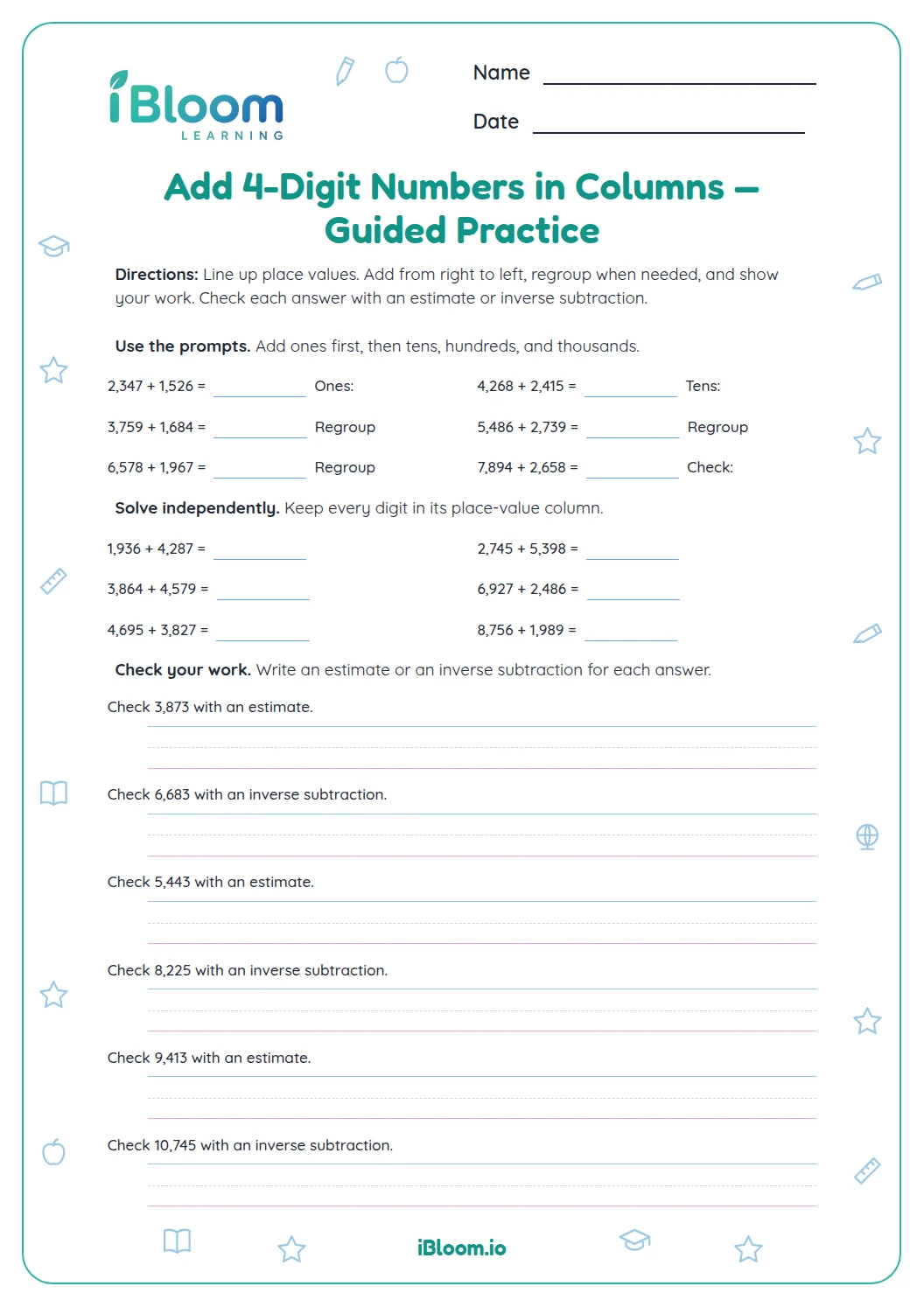
About this worksheet
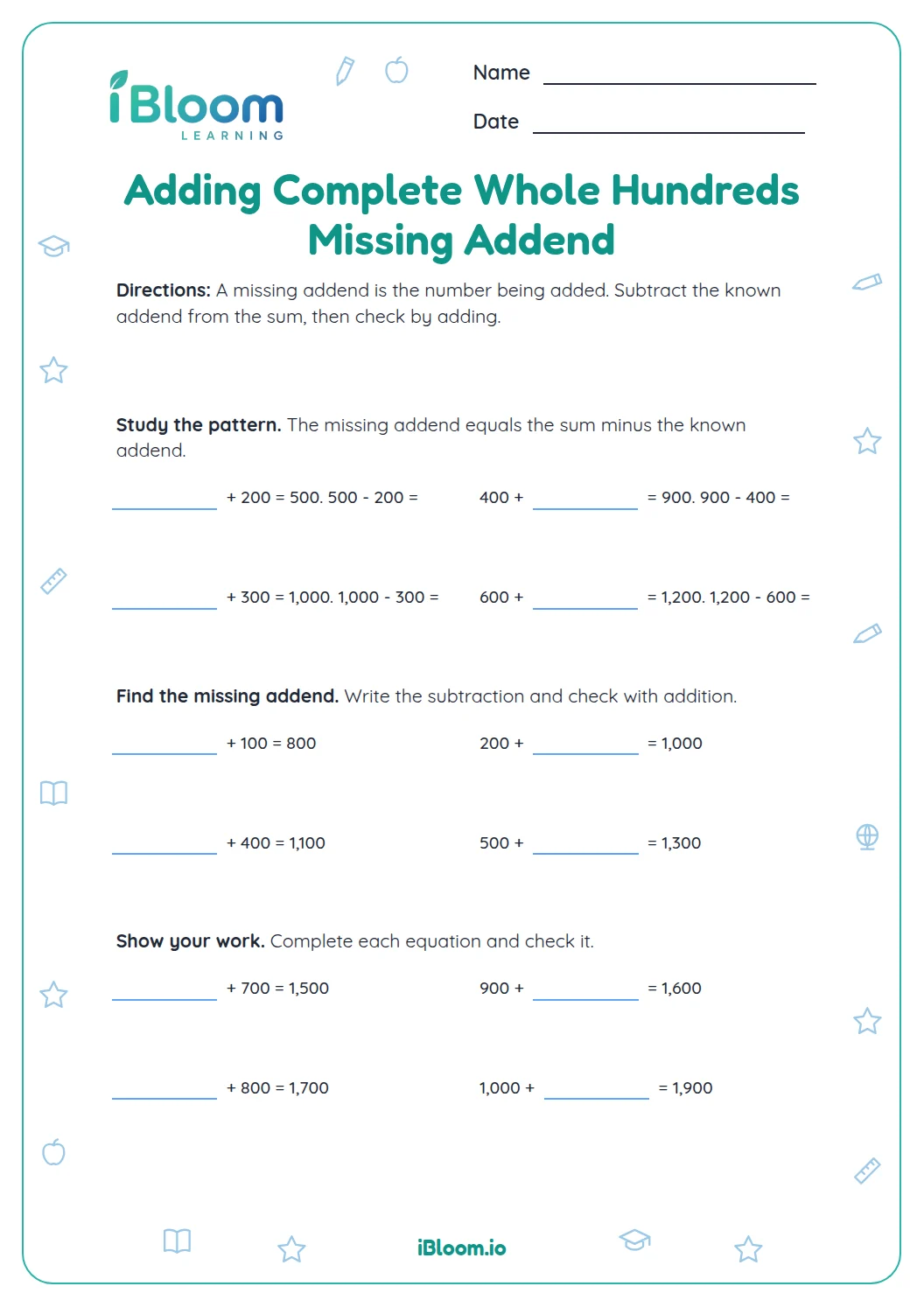
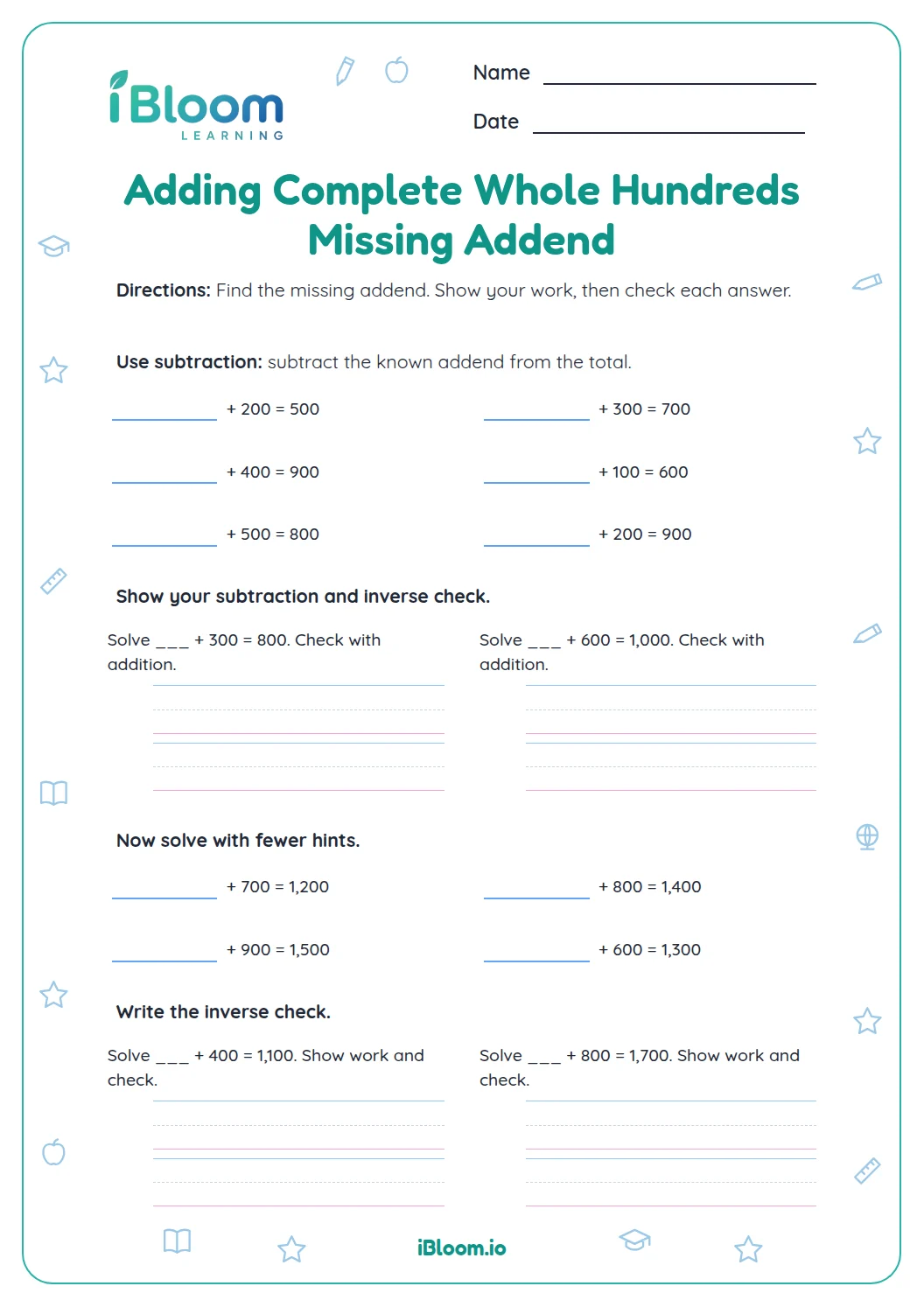
This printable Grade 4 worksheet practices missing addends when every number is a whole thousand. Students solve equations such as 14,000 + ___ = 32,000, then check claims and select valid corrections. Sixteen questions move from finding an addend in either position to checking a complete equation. A separate answer key supports review; the work practices multi-digit addition and subtraction under CCSS 4.NBT.B.4.
Aligned to 4.NBT.B.4
How can you solve missing whole-thousand addends problems carefully?
Subtract the known addend from the total; the difference is the missing addend. Add the two addends to verify.
For example: 32,000 − 14,000 = 18,000.
What will students work through?
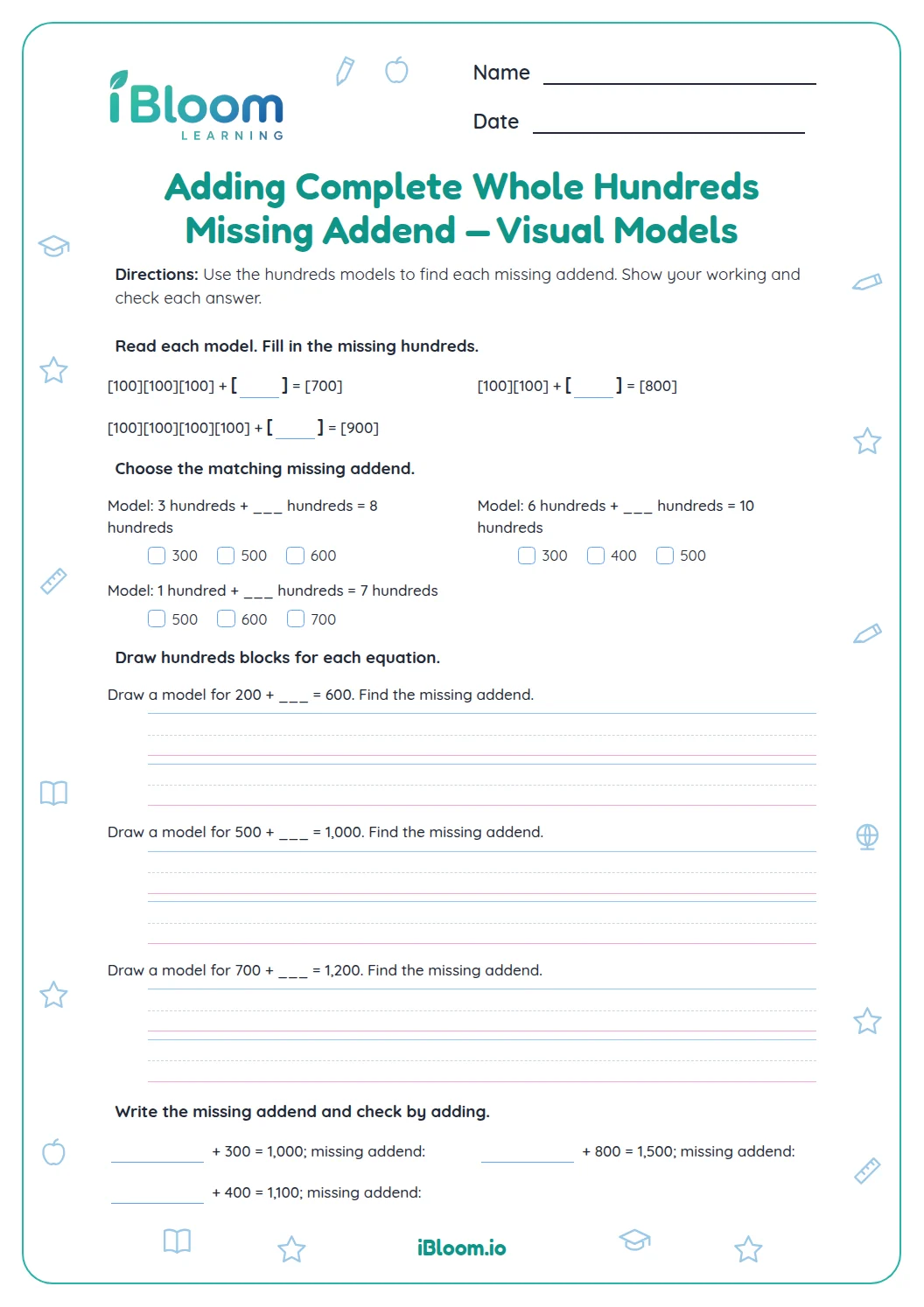
The worksheet has 16 questions in three parts, moving from direct practice to reasoning checks. Each key answer matches its printed item.
- Part A: Find the missing addend (16 questions)
- A separate answer key for all questions
How can a student check an answer?
Add a known addend to the missing value and confirm that the total matches.
How to use the worksheet
- 1Read the directions for the current part before starting.
- 2Solve each expression and record only the requested value in its blank.
- 3For a reasoning question, check the claim against the original numbers.
- 4Estimate the answer to catch place-value or computation slips.
- 5Use the key after finishing and redo any item that did not check.
Common mistakes and quick fixes
The mistake
Changing a digit or part while carrying out the operation.
The fix
Rewrite the original expression and check one place or fraction unit at a time.
The mistake
Accepting an answer that does not fit the size of the starting numbers.
The fix
Estimate first, then compare the exact result with the estimate.
The mistake
Checking a result with a different expression.
The fix
Substitute the answer into the exact equation or recompute the original sum.
Common Core alignment
This worksheet practices the computation and reasoning named in the standard below.
Subtract whole-thousand totals to find missing addends and verify sums.
On this sheet: Subtract whole-thousand totals to find missing addends and verify sums.
Show the official wordingHide the official wording
Fluently add and subtract multi-digit whole numbers using the standard algorithm.
What to practice next
Make more practice
Further reading
Questions parents and teachers ask
What is the missing addend in 14,000 + ___ = 32,000?
This sheet gives students 16 targeted questions, followed by a separate answer key. Encourage them to show a calculation or explain a choice before checking the key. That makes it easier to spot whether a mistake came from the method or a single arithmetic step.
How many pages should I print?
Print both worksheet pages for student practice. The answer key also spans two pages, so keep it aside until the student finishes. This lets students try all 16 questions independently before checking their work. The page counts are listed above for quick planning.
How should students check their work?
Have students return to the exact question and use its inverse operation, estimate, or equivalent expression to check. Then compare with the key. If answers differ, ask them to locate the first step where their work stops matching the original numbers.
Can students use scratch paper?
Yes. Scratch paper is useful for regrouping, finding equivalent fractions, and recording intermediate steps. Students should copy the final requested answer into the worksheet blank so it is easy to compare with the key. A quick estimate before checking can help catch an arithmetic slip.
What comes after this practice?
The linked sibling worksheets offer a nearby next step in the same skill sequence. Choose a page that focuses on the particular part a student wants to strengthen, then return to mixed practice to check that the strategy transfers.