

About this worksheet
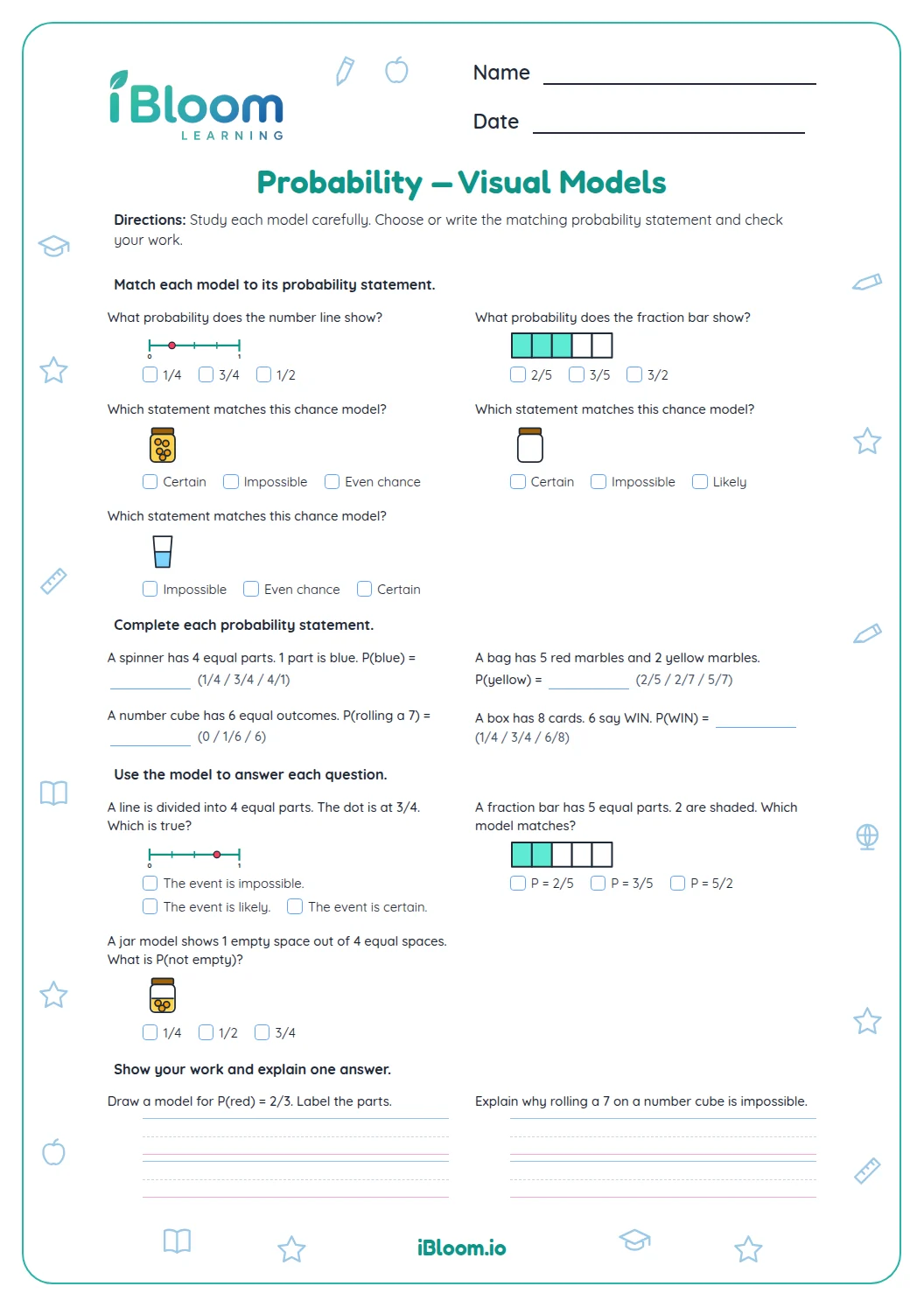
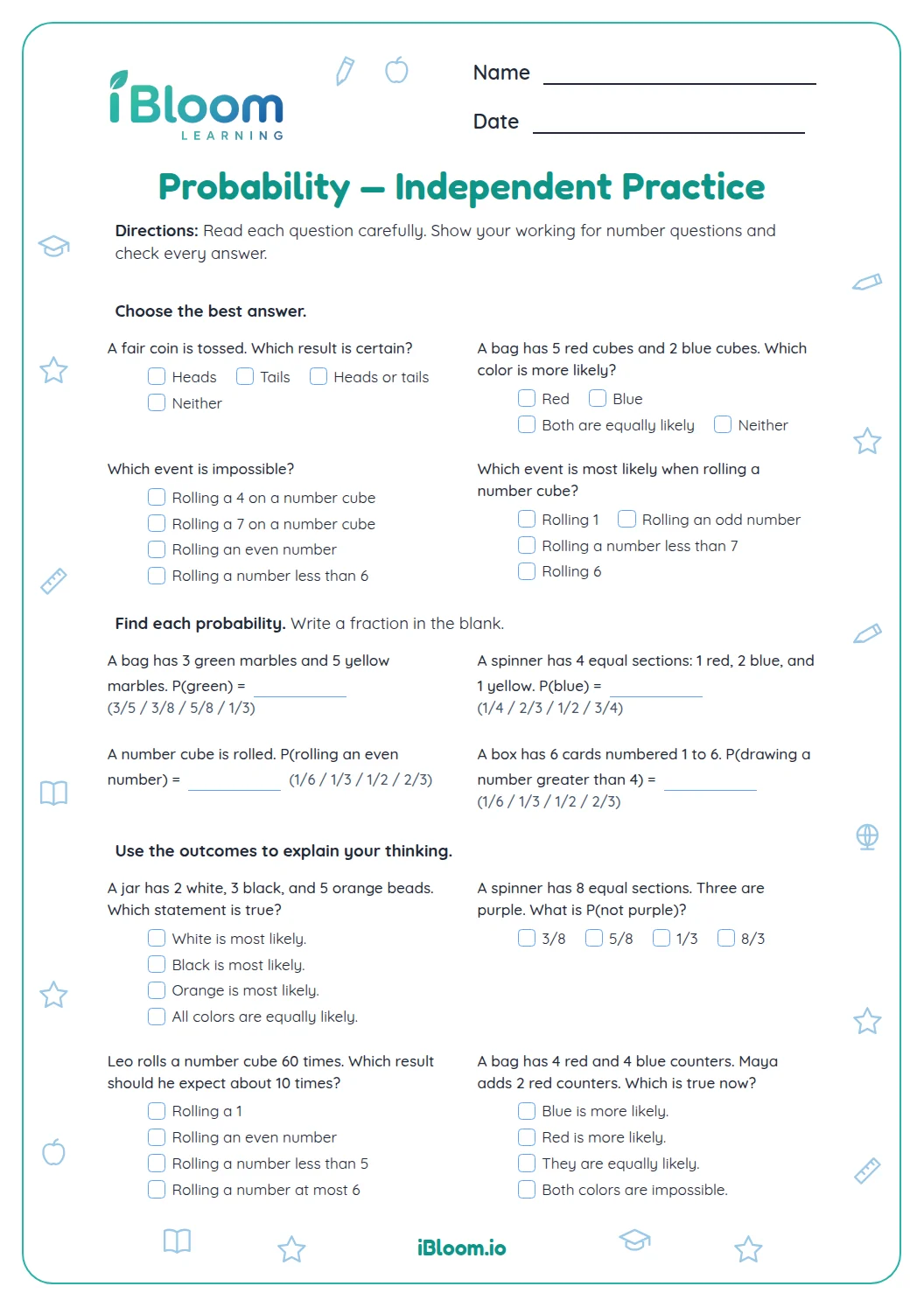
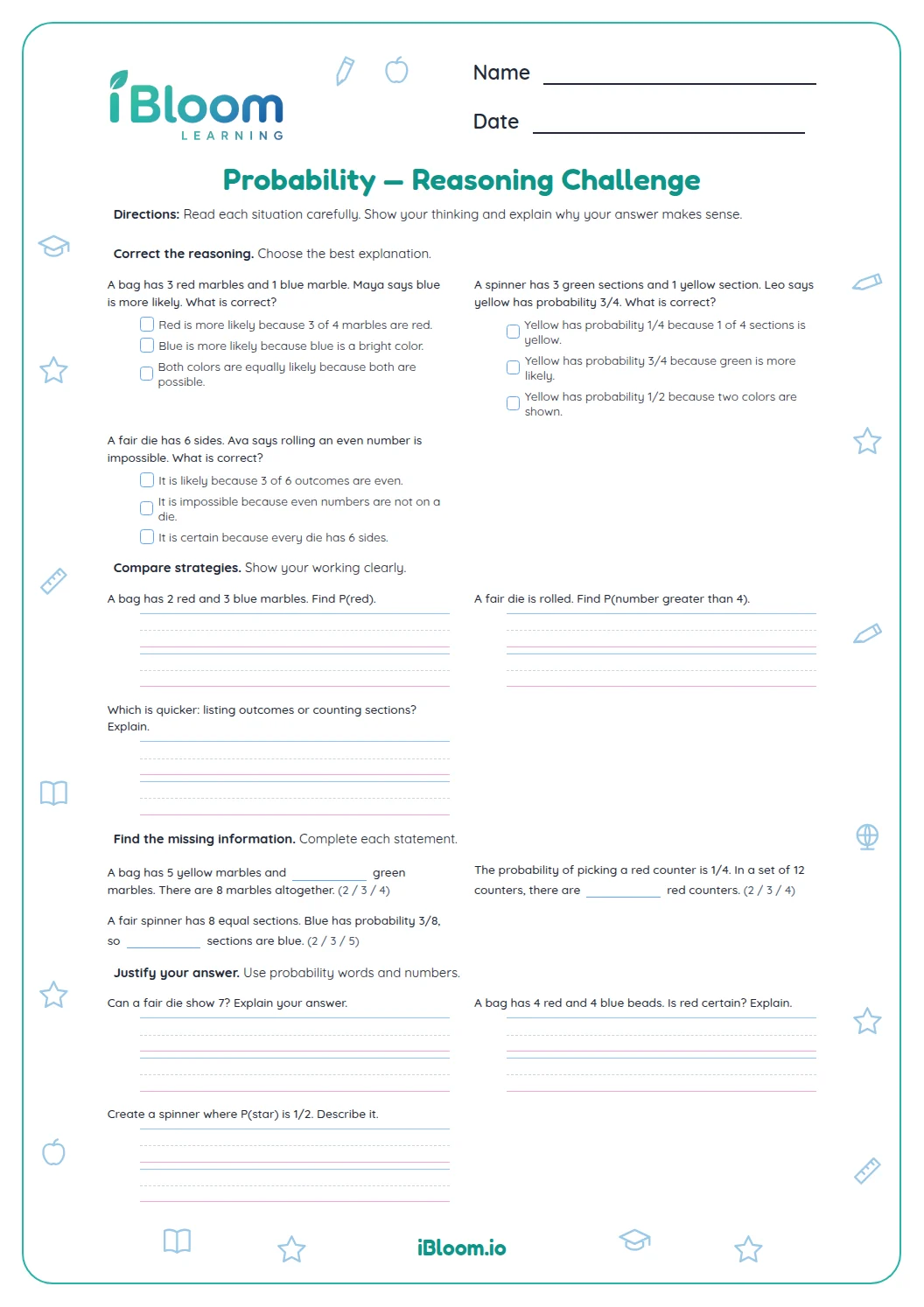
This free Grade 4 probability worksheet gives students concrete situations to classify as certain, likely, equally likely, or impossible. Students compare outcomes on a coin and number cube and objects in bags and spinners. It includes 14 multiple-choice questions and a separate answer key.
How do the chance words describe an outcome?
Certain means an event must happen in the stated situation. Impossible means it cannot happen. Likely and unlikely describe events that can happen, with one outcome having more or fewer favorable cases than its alternatives.
Question 2 uses a standard number cube labeled 1 through 6. Rolling a 7 is impossible because no face shows 7.
- 1Possible results: 1, 2, 3, 4, 5, or 6.
- 2A 7 is not among those results.
- 3So rolling 7 is impossible.
How can equal parts help compare chances?
For a spinner or bag, count the equal sections or objects that match each outcome. If two colors have the same count, they are equally likely. If one color has more matching outcomes, it is more likely.
The worksheet states the relevant counts in each situation so students can compare the outcomes directly.
What will students practice on this page?
Students begin with familiar coins and number cubes, then compare objects in bags and equal-part chance models. The final items apply the same likelihood language to new situations.
- Part A: classify events and compare groups
- Part B: read shaded equal-part models and apply likelihood language
- A separate answer key follows the student pages
How to use this worksheet
- 1Read the whole situation first; the listed objects define the possible outcomes.
- 2For a bag or spinner, count each outcome that matches the event.
- 3Use certain only when every possible result matches.
- 4Use impossible only when no possible result matches.
- 5For equal groups, explain that neither outcome has more matching objects or sections.
Common mistakes and quick fixes
The mistake
Calling an event certain because it is likely.
The fix
Check whether every object or section gives that result; if not, it is not certain.
The mistake
Calling the smaller group impossible.
The fix
A small group can still be picked, so it is unlikely rather than impossible.
The mistake
Ignoring the number of outcomes in a group.
The fix
Count each matching object or equal section before comparing colors.
What to practice next
Make more practice
Questions parents and teachers ask
Is this probability sheet suitable for Grade 4?
Yes. The worksheet uses concrete outcomes students can count, such as the faces on a number cube, colors in a bag, and equal sections on a spinner. It builds careful language for comparing chances without requiring fraction calculations. The first part applies these words to a coin toss and a standard number cube.
What is the difference between likely and certain?
A certain event happens every time in the stated situation. A likely event has more favorable outcomes than alternatives, but it still might not happen. For example, a bag with five red cubes and one blue cube makes red more likely, but not certain.
How do spinner models show probability?
Each equal section represents one possible result. Count the sections with the color named in the question and compare that count with the other colors. When two colors have the same number of equal sections, they are equally likely. Students can count the equal sections directly before deciding whether chances match.
What makes an event impossible?
An event is impossible when none of the possible outcomes can produce it. A standard number cube has faces 1 through 6, so rolling an 8 cannot happen. A color missing from a bag is also impossible to pick. The number cube question states all six possible faces for a clear check.
How many questions are on the worksheet?
There are 14 questions in two parts. Students classify events, compare object groups and equal-part models, and decide which outcomes are more, less, or equally likely. Question 14 compares the counts of apple and orange slices, with the smaller group being less likely to be selected.
Is an answer key included?
Yes. A separate answer key gives the correct choice for all 14 questions. It helps adults check each situation after the student has completed the page, or review how the stated outcomes determine whether an event is certain, possible, or impossible.