




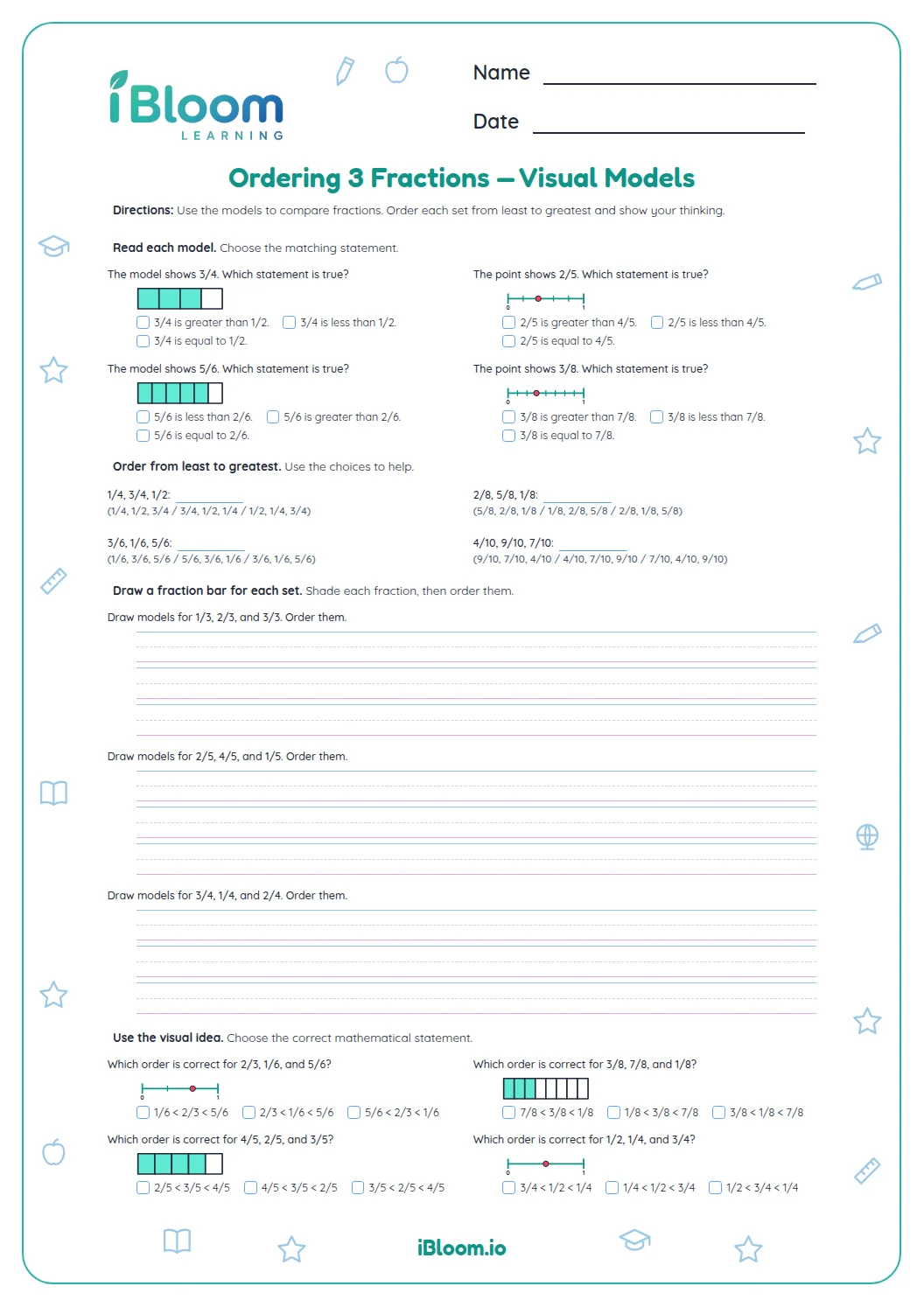
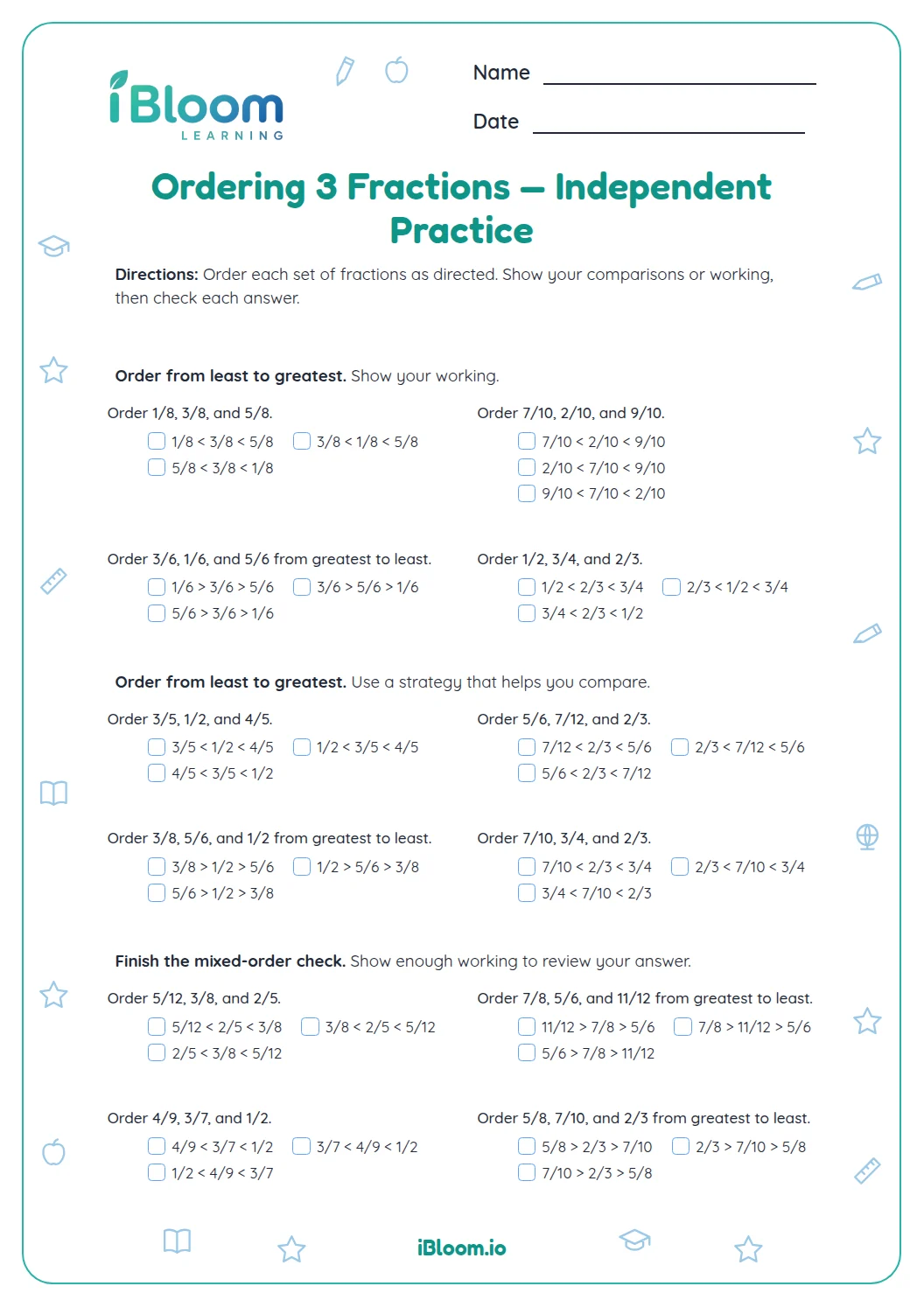
About this worksheet
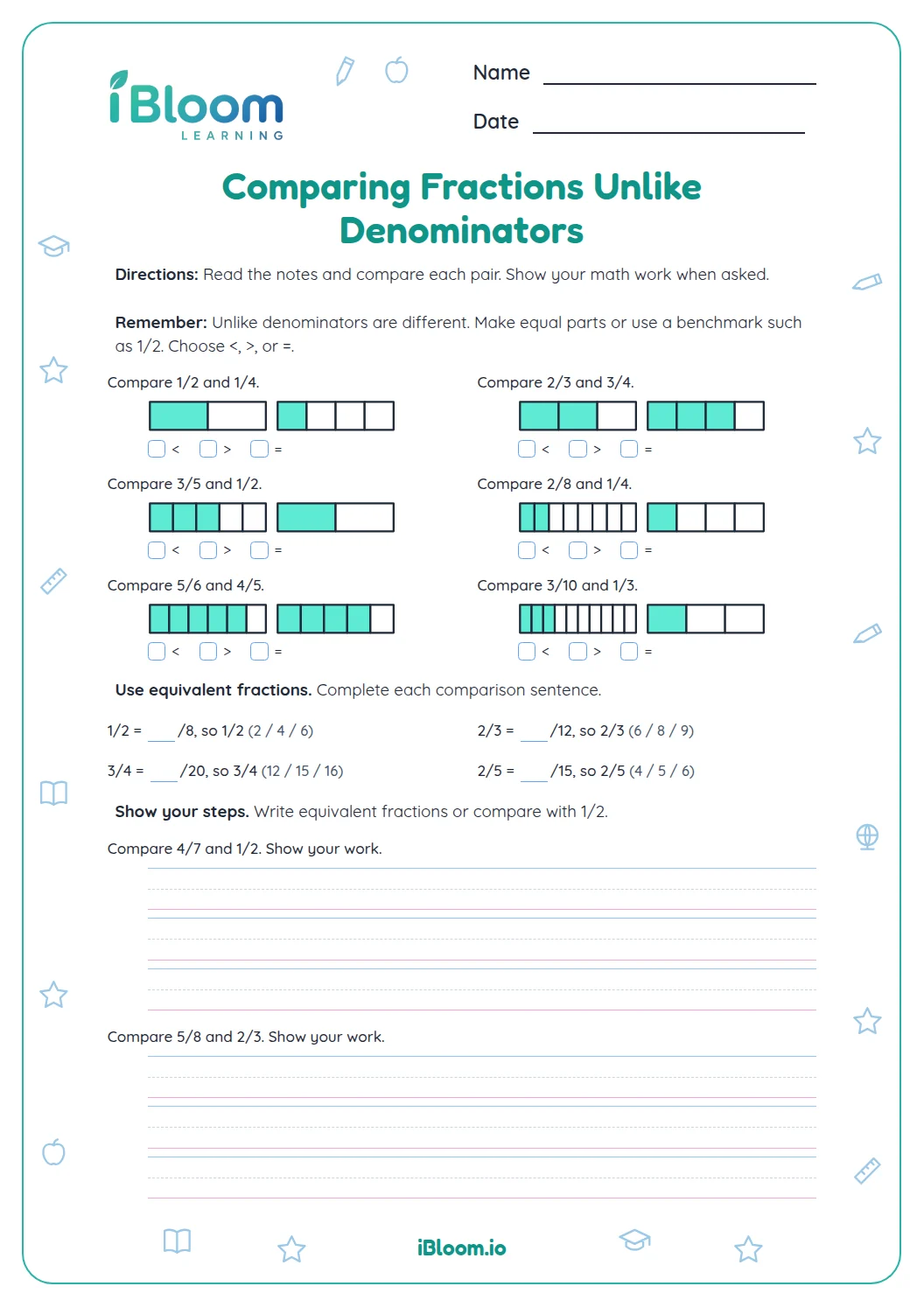
This free Grade 4 worksheet helps students compare fractions with unlike denominators using shaded fraction bars and familiar benchmarks such as one half and one whole. Students choose a true comparison, fill in >, <, or =, and explain two comparisons in writing. The 14 questions keep each pair tied to the same whole and include a separate answer key. It practices CCSS 4.NF.A.2.
Aligned to 4.NF.A.2
How do fraction bars help compare unlike fractions?
The denominator tells how many equal parts make one whole, and the numerator tells how many parts are shaded. To compare unlike fractions, line up the models mentally or use a benchmark such as one half.
Question 1 shows 1/2. Since 2/5 is less than one half, the model’s amount is greater.
- 1The bar shows 1/2.
- 22/5 is less than 1/2.
- 3So 1/2 > 2/5.
When should you use >, <, or =?
Use > when the amount on the left is greater, < when it is smaller, and = when the amounts match. In question 9, 4/6 equals 2/3 because both fractions name the same part of one whole.
Always compare fractions that refer to the same whole. The models on this page represent equal-sized wholes.
What kinds of comparisons are on the sheet?
The 14 questions are in two parts. Students compare pairs with shaded models, then use benchmarks and symbols to compare unlike fractions. Each question supplies the fractions to compare.
- Part A: choose the true comparison for each model and pair
- Part B: compare with benchmarks and choose the correct symbol or value
- The answer key marks each correct comparison
How to use this worksheet
- 1Read the two fractions as parts of one whole.
- 2Use the bar to estimate whether the modeled amount is below or above one half.
- 3Compare the second fraction with the same benchmark.
- 4Write the comparison symbol only after deciding which amount is greater.
- 5For the last two questions, explain with a benchmark or equivalent fractions.
Common mistakes and quick fixes
The mistake
Assuming the fraction with the larger denominator is greater.
The fix
Use the numerator too; a larger denominator means smaller pieces.
The mistake
Comparing only the numerators.
The fix
Check how many equal parts make a whole before comparing shaded counts.
The mistake
Reversing the symbol.
The fix
Read the wide opening as pointing toward the greater amount: 5/8 > 1/2.
Common Core alignment
This worksheet practices the fraction ideas named below.
Compare fractions with unlike denominators using models or benchmarks.
On this sheet: Every comparison uses unlike denominators and asks students to use a model or benchmark to justify order.
Show the official wordingHide the official wording
Compare two fractions with different numerators and different denominators, e.g., by creating common denominators or numerators, or by comparing to a benchmark fraction such as 1/2. Recognize that comparisons are valid only when the two fractions refer to the same whole. Record the results of comparisons with symbols >, =, or <, and justify the conclusions, e.g., by using a visual fraction model.
What to practice next
Make more practice
Further reading
Questions parents and teachers ask
What is the easiest way to compare unlike fractions?
A visual model or a benchmark such as one half can make the sizes easier to see. For example, 3/8 is less than one half and 2/5 is also less than one half, so compare how far each is from that benchmark or rename them with equal denominators.
What do the comparison symbols mean?
The symbol > means greater than, < means less than, and = means equal to. The open side faces the greater amount. For example, 5/8 > 1/2 because five eighths is more than four eighths. The bar models and benchmark fractions help verify the direction of each symbol.
Why do the fractions need to refer to the same whole?
Fraction comparisons only make sense when the wholes are the same size. The models on this page use equal-sized wholes so students can compare how much of each whole is shaded. Each drawing uses an equal-sized whole so the two amounts can be compared fairly.
How many questions are included?
There are 14 questions in two parts. Students choose comparisons from models, record comparison symbols, use benchmarks, and identify fractions that are greater than one half, less than two thirds, closest to one, or equivalent to a given fraction.
Can equivalent fractions help compare unlike denominators?
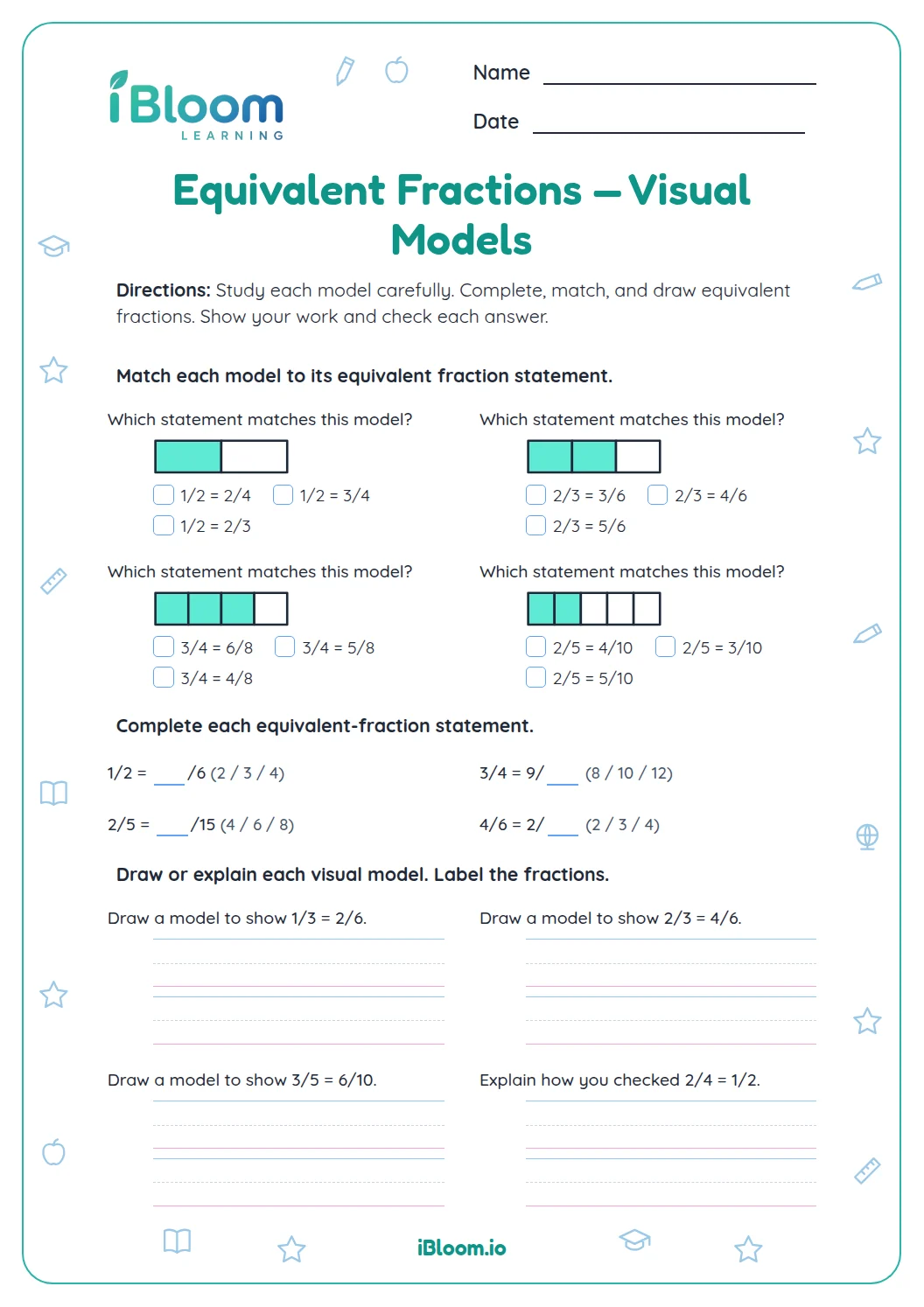
Yes. Rename both fractions with a common denominator, then compare the numerators. For 2/3 and 4/6, both names describe the same amount, so the comparison symbol is =. Equivalent fractions are one way to check whether two unlike names have equal value.
Is an answer key included?
Yes. A separate answer key gives the correct comparison or value for all 14 questions. It can be used to check work after completion or to review how models and benchmarks support a comparison. Students can revisit a shaded bar and explain which amount is larger or whether both fractions are equal.