







About this worksheet
This free Grade 4 worksheet builds equivalent fractions that are greater than one. Students read shaded fraction bars and shapes, scale numerators and denominators by the same factor, and identify equal improper fractions. It includes 14 questions in two parts and an answer key. The activities practice CCSS 4.NF.A.1 by connecting visual fraction models with equivalent fractions.
Aligned to 4.NF.A.1
How do shaded models show an improper fraction?
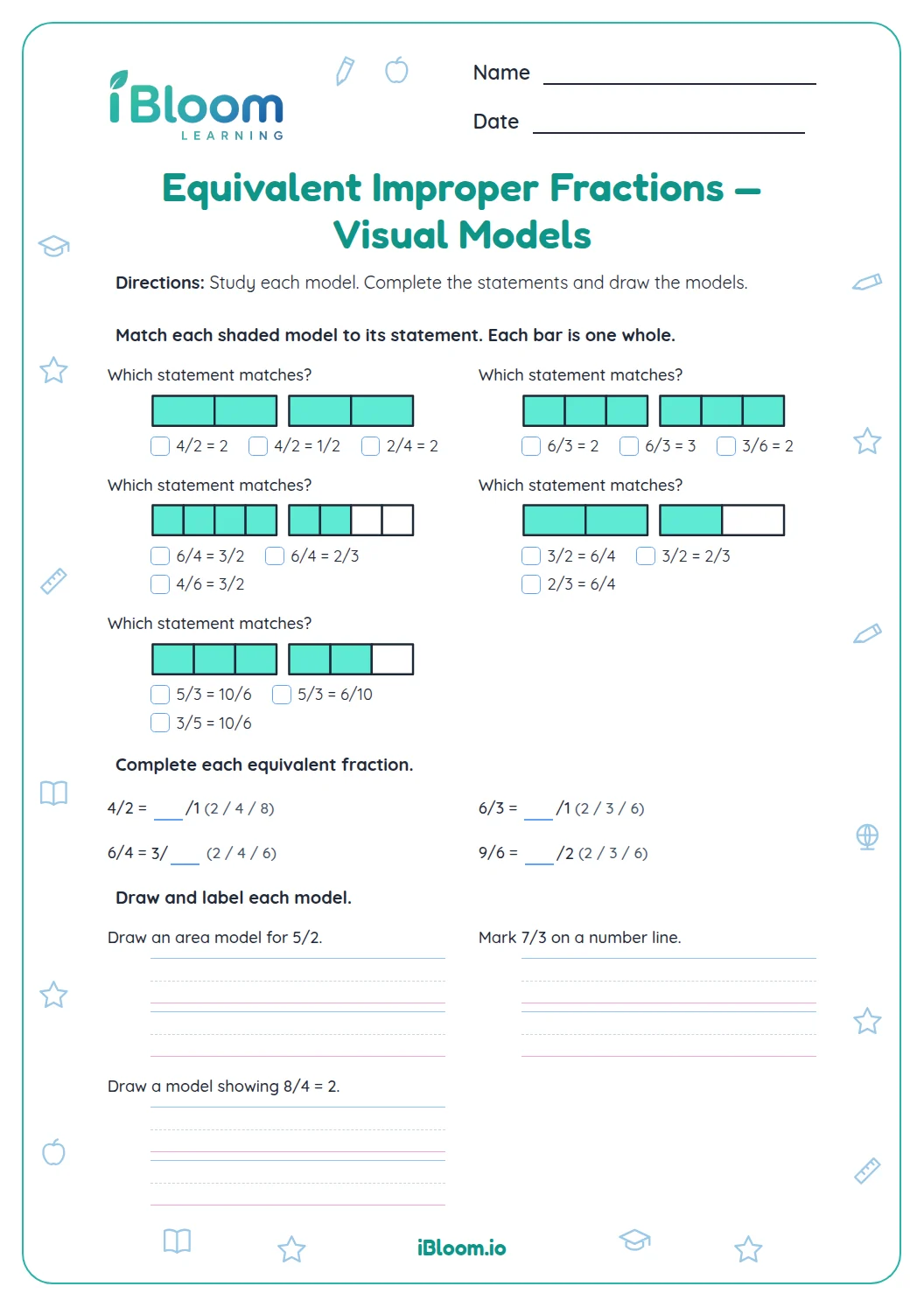
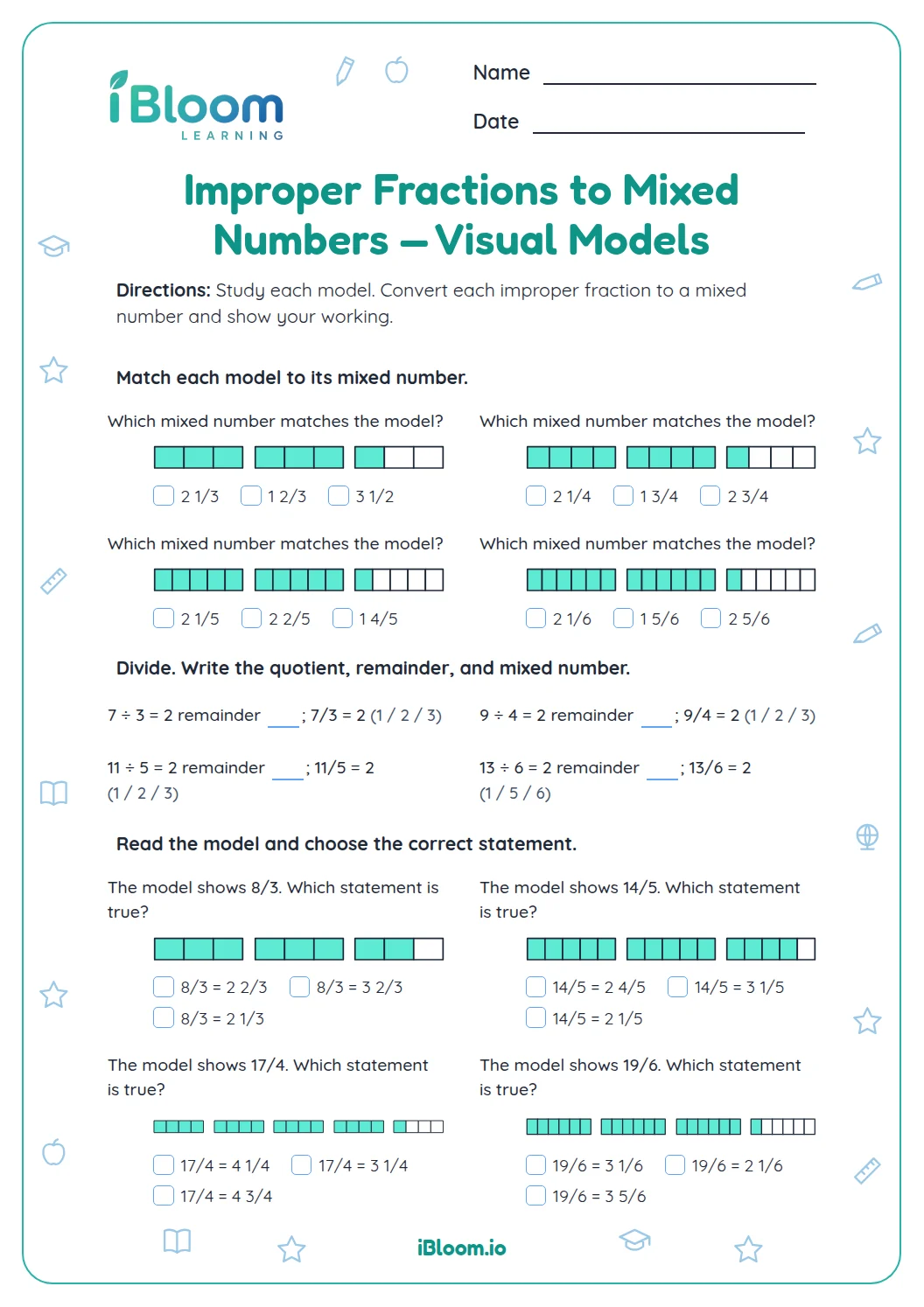
An improper fraction has at least as many equal parts shaded as make one whole. In question 1, the bar shows one whole and one half, or 3/2. Splitting each half into two smaller parts gives 6/4 without changing the amount.
Count every shaded part, including the fully shaded wholes, before writing the numerator. Keep the denominator equal to the number of equal parts in one whole.
- 13/2 is one whole and one half.
- 2Double the number of equal parts in each whole.
- 33/2 = 6/4; both fractions name 1 1/2.
What changes when you make an equivalent fraction?
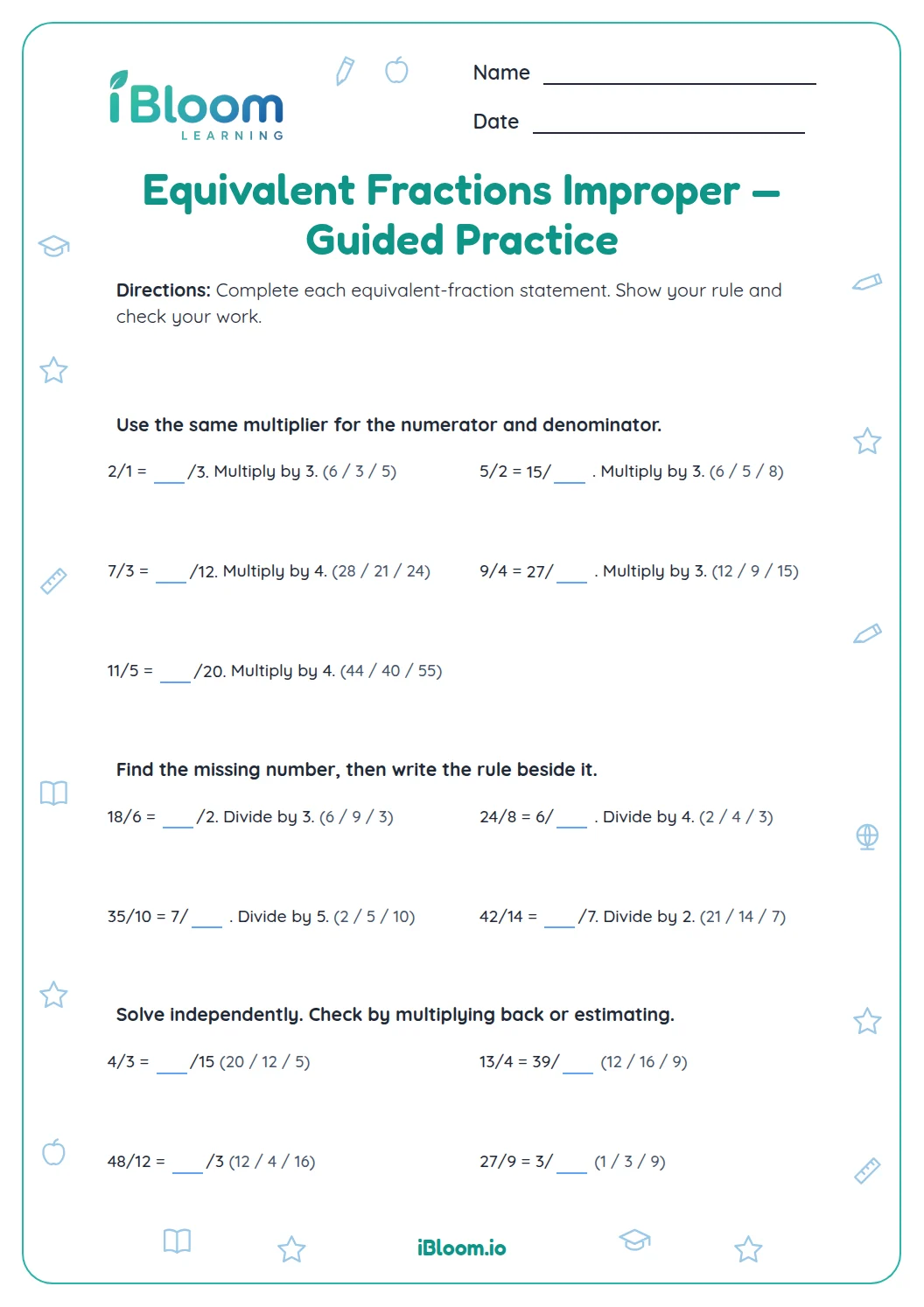
The numerator and denominator use the same scale factor. In question 5, 3/2 = ___/4: the denominator 2 becomes 4 by multiplying by 2, so multiply 3 by 2 as well. The missing numerator is 6.
The pieces become smaller as the number of parts grows, while the total shaded amount stays the same.
What will students practice on the page?
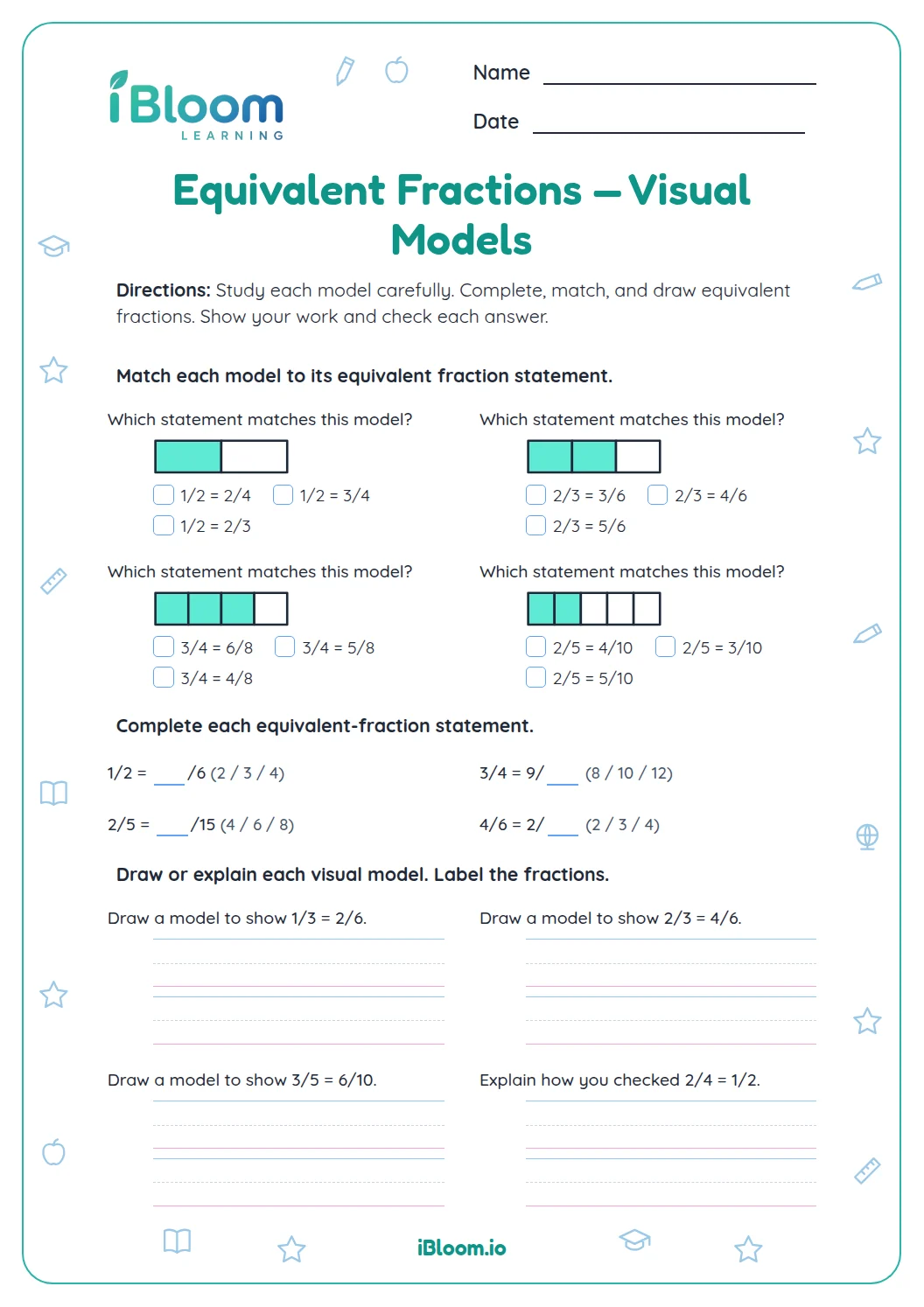
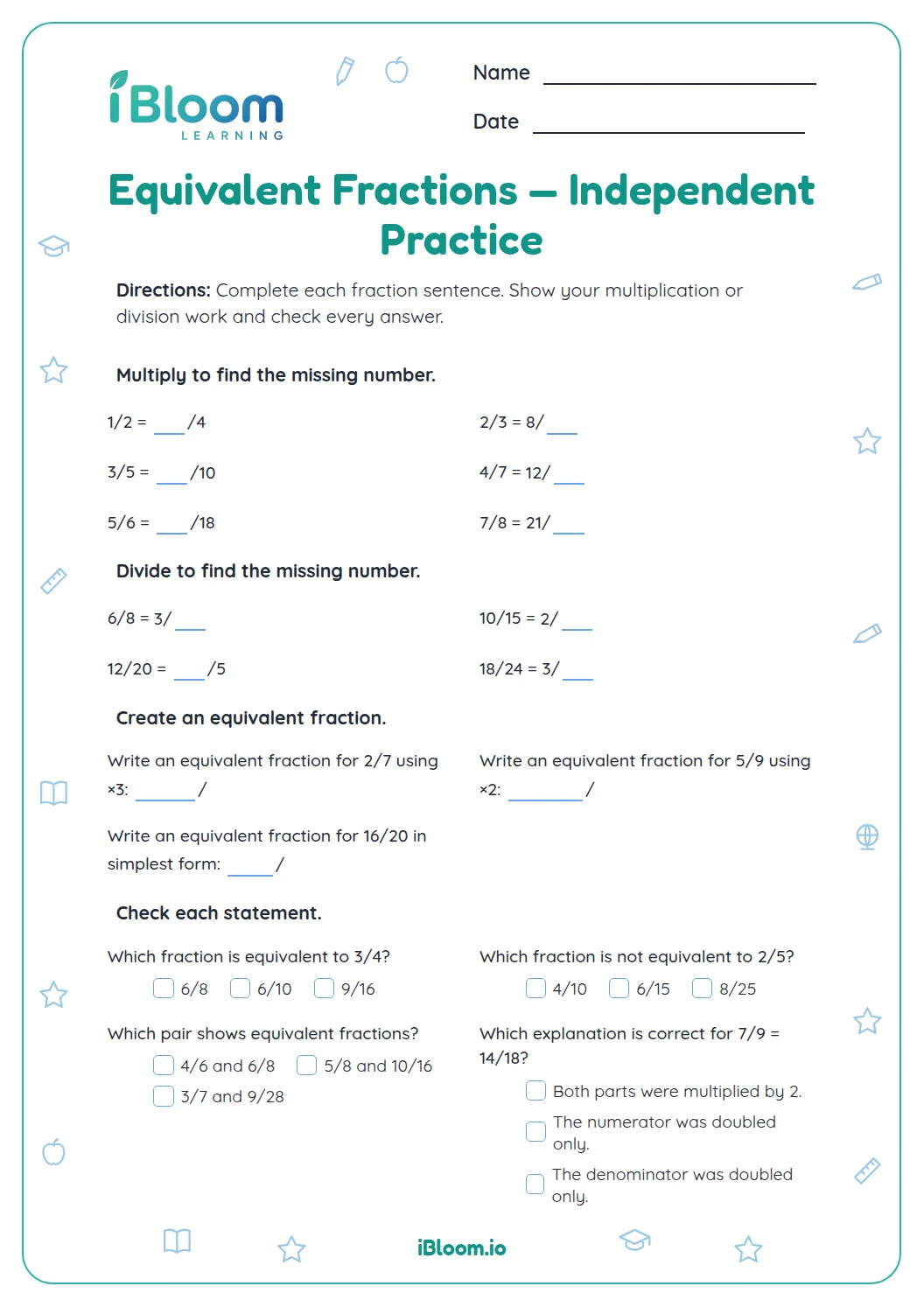
The 14 questions fit into two parts. Students match shaded improper fractions to equivalent names, then generate or recognize equivalent fractions in number sentences and additional models.
- Part A: match improper-fraction models and equivalent values
- Part B: complete equivalent-fraction statements and read more models
- A separate answer key follows the student pages
How to use this worksheet
- 1Review that one whole can be written as 2/2, 3/3, 4/4, or another unit fraction.
- 2For Part A, name the amount in the drawing before looking at the choices.
- 3In Part B, find the factor that changes the denominator, then use it on the numerator.
- 4In Part B, count fully shaded wholes and leftover parts separately.
- 5Check each generated fraction by simplifying it or comparing it with the model.
Common mistakes and quick fixes
The mistake
Multiplying only the denominator.
The fix
Write the same factor beside the numerator and denominator before calculating.
The mistake
Counting only the shaded pieces after the first whole.
The fix
Count each whole as a full set of denominator-sized parts.
The mistake
Assuming a larger denominator means a larger amount.
The fix
Compare the size and number of pieces together; equivalent fractions can use more, smaller pieces.
Common Core alignment
This worksheet practices the fraction ideas named below.
Generate equivalent fractions by multiplying both parts by the same number.
On this sheet: The drawing and number sentences show equivalent improper fractions made by scaling both parts.
Show the official wordingHide the official wording
Explain why a fraction a/b is equivalent to a fraction (n × a)/(n × b) by using visual fraction models, with attention to how the number and size of the parts differ even though the two fractions themselves are the same size. Use this principle to recognize and generate equivalent fractions.
What to practice next
Make more practice
Further reading
Questions parents and teachers ask
What is an improper fraction?
An improper fraction has a numerator that is greater than or equal to its denominator. For example, 7/5 is greater than one whole because five fifths make one whole and two fifths remain. This worksheet uses models to connect those parts with equivalent fractions.
How do you make an equivalent fraction?
Multiply or divide both the numerator and denominator by the same nonzero number. In question 5, the denominator doubles from 2 to 4, so the numerator 3 doubles to 6. The missing numerator is 6, and the value remains 3/2.
Why do equivalent fractions look different?
The numerator counts parts and the denominator tells how many equal parts make one whole. When each part is split into smaller parts, the count rises even though the total amount does not. A shaded bar makes the unchanged amount visible.
Can an improper fraction be equivalent to a mixed number?
Yes. For example, 3/2 and 1 1/2 name the same amount. This sheet focuses on equivalent improper-fraction names, while related practice can help students translate between improper fractions and mixed numbers. A related skill page practices writing either form from the other.
How many questions are included?
There are 14 questions in two parts. Students match models, fill missing numerators, count shaded improper-fraction models, and identify equivalent fractions. The final item asks which pair names the same amount, so students check both fractions rather than only one numerator.
Is an answer key included?
Yes. A separate answer key page shows the answers for all 14 questions. It is useful for checking work after the student page is complete, or for reviewing one example together before independent practice. The key places each result beside its question number so checking stays straightforward.