
About this worksheet
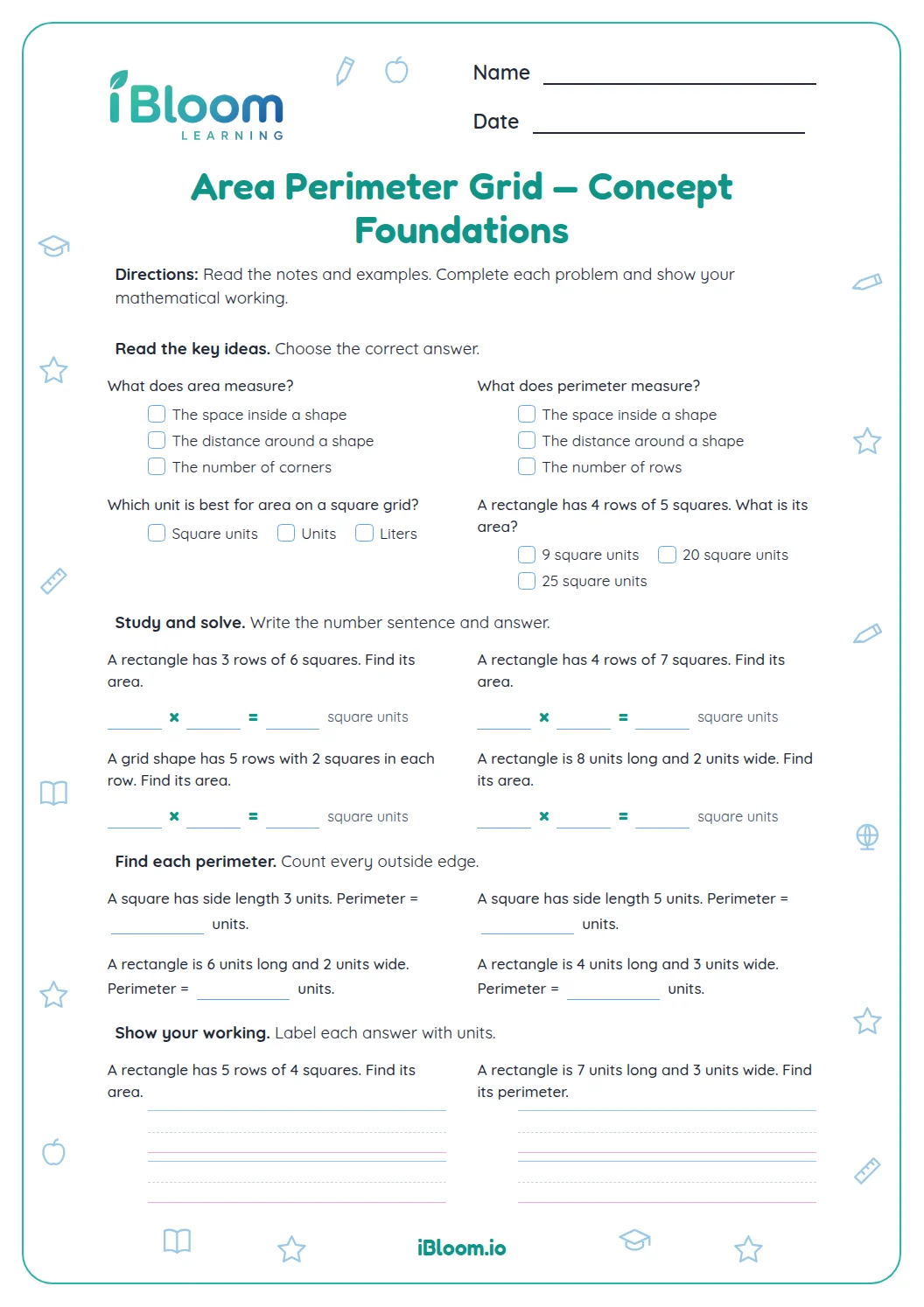
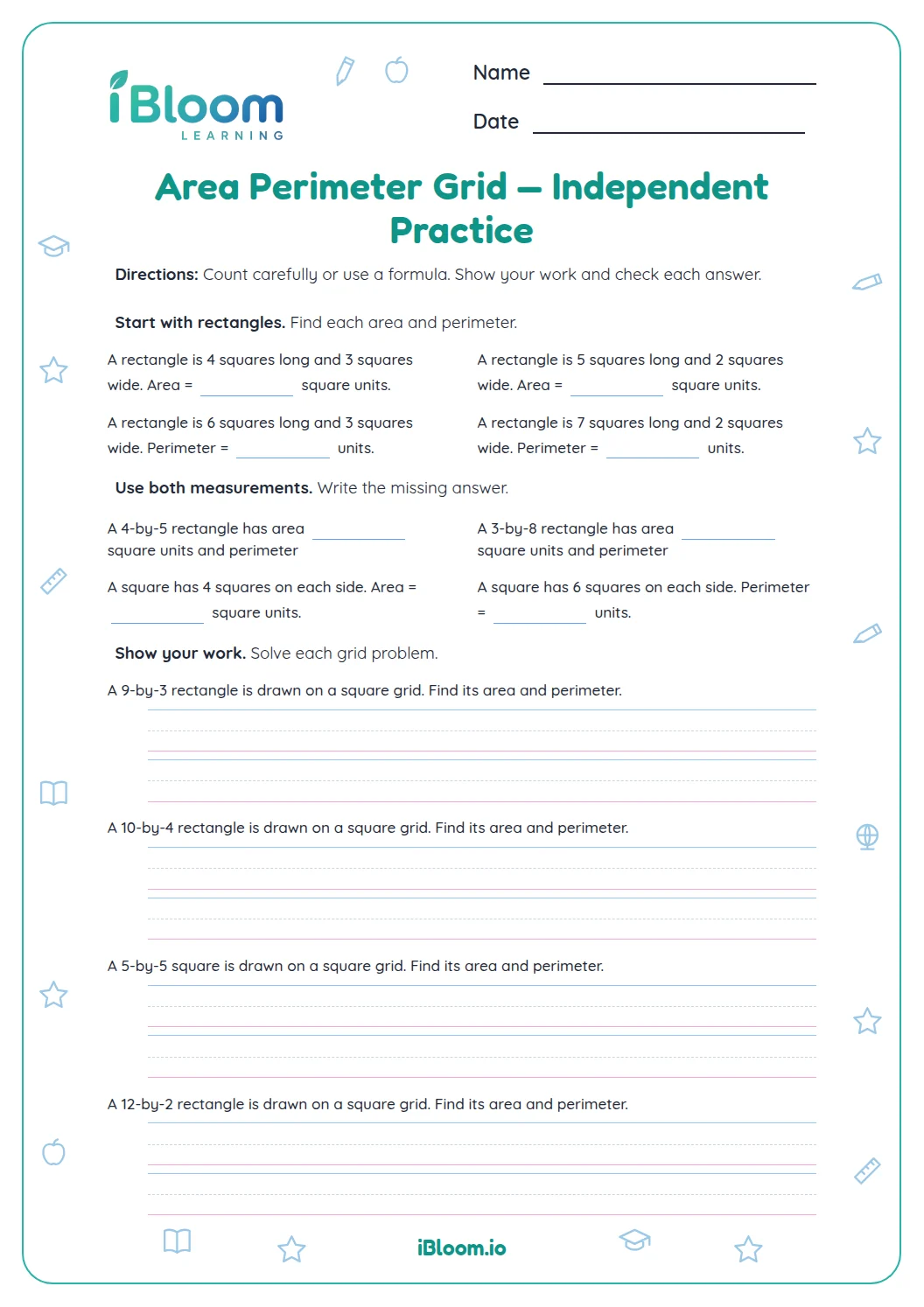
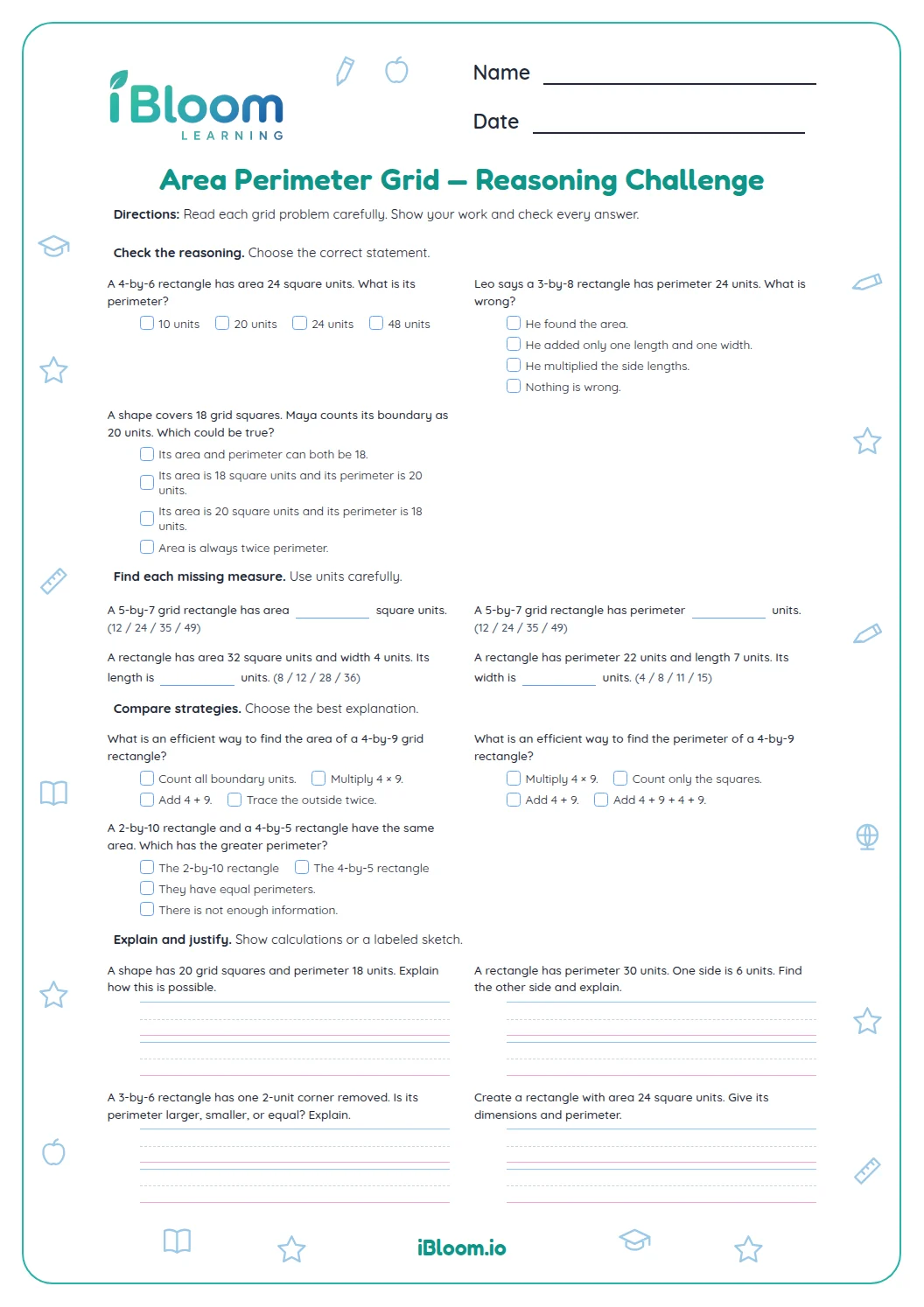
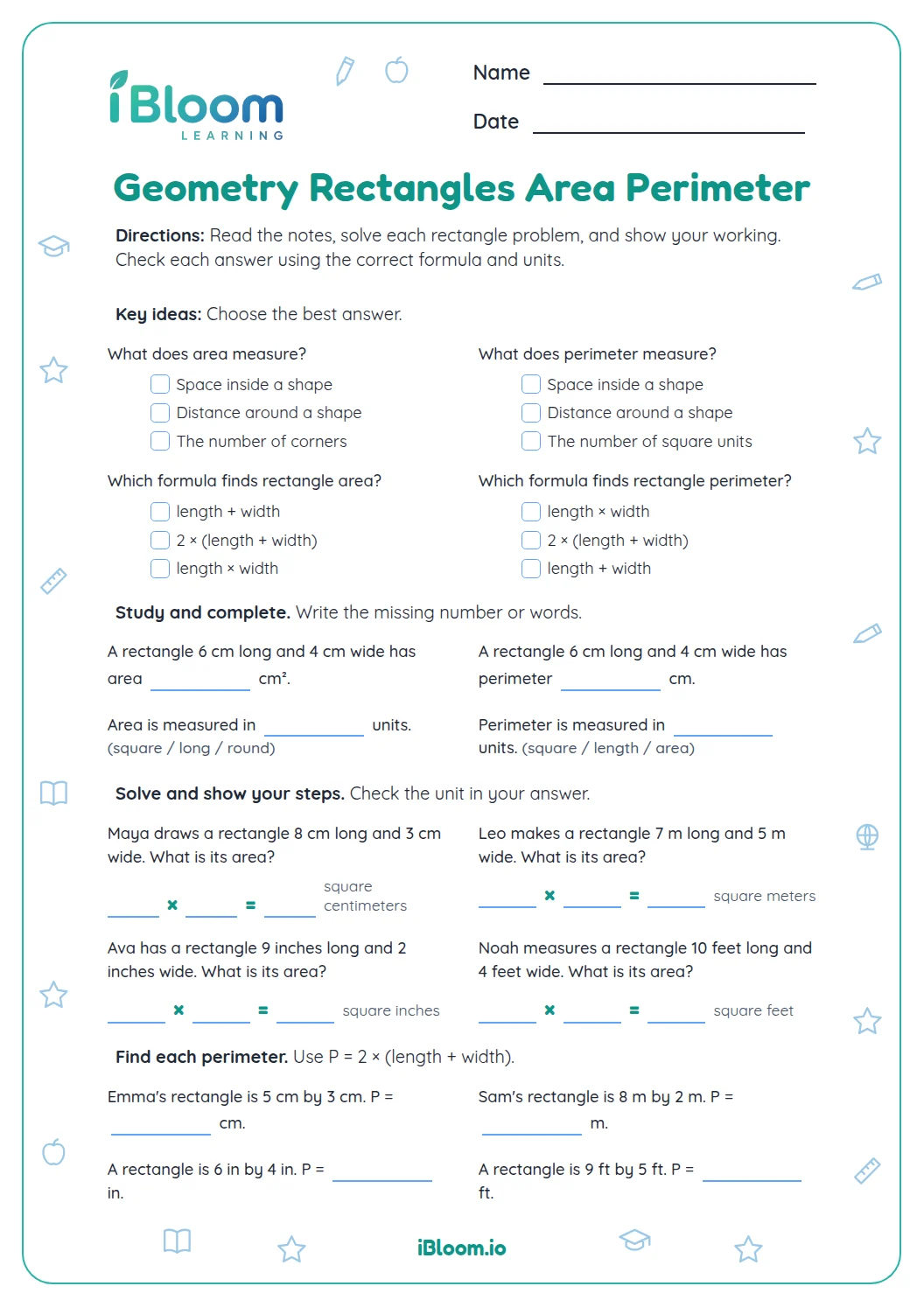
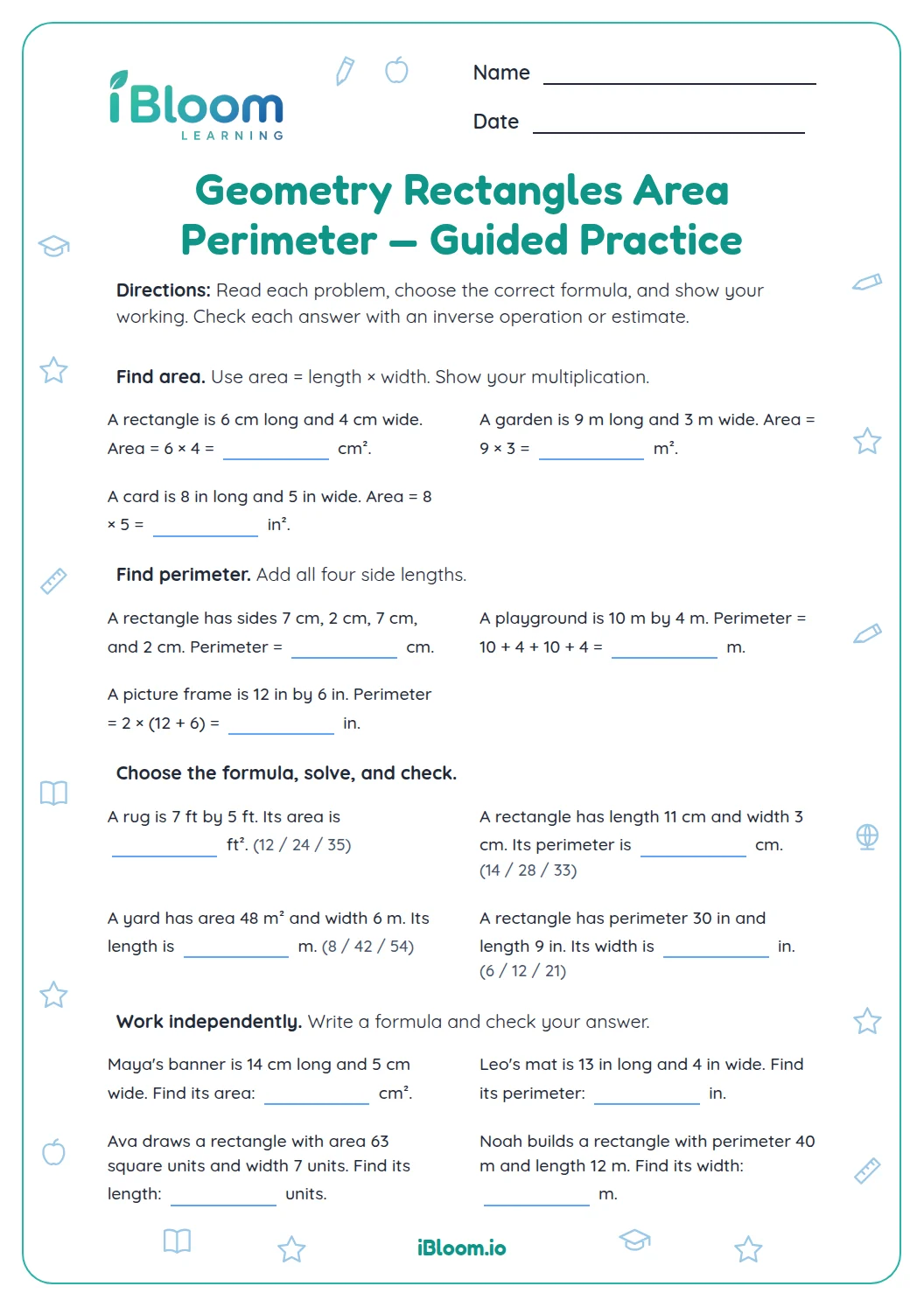
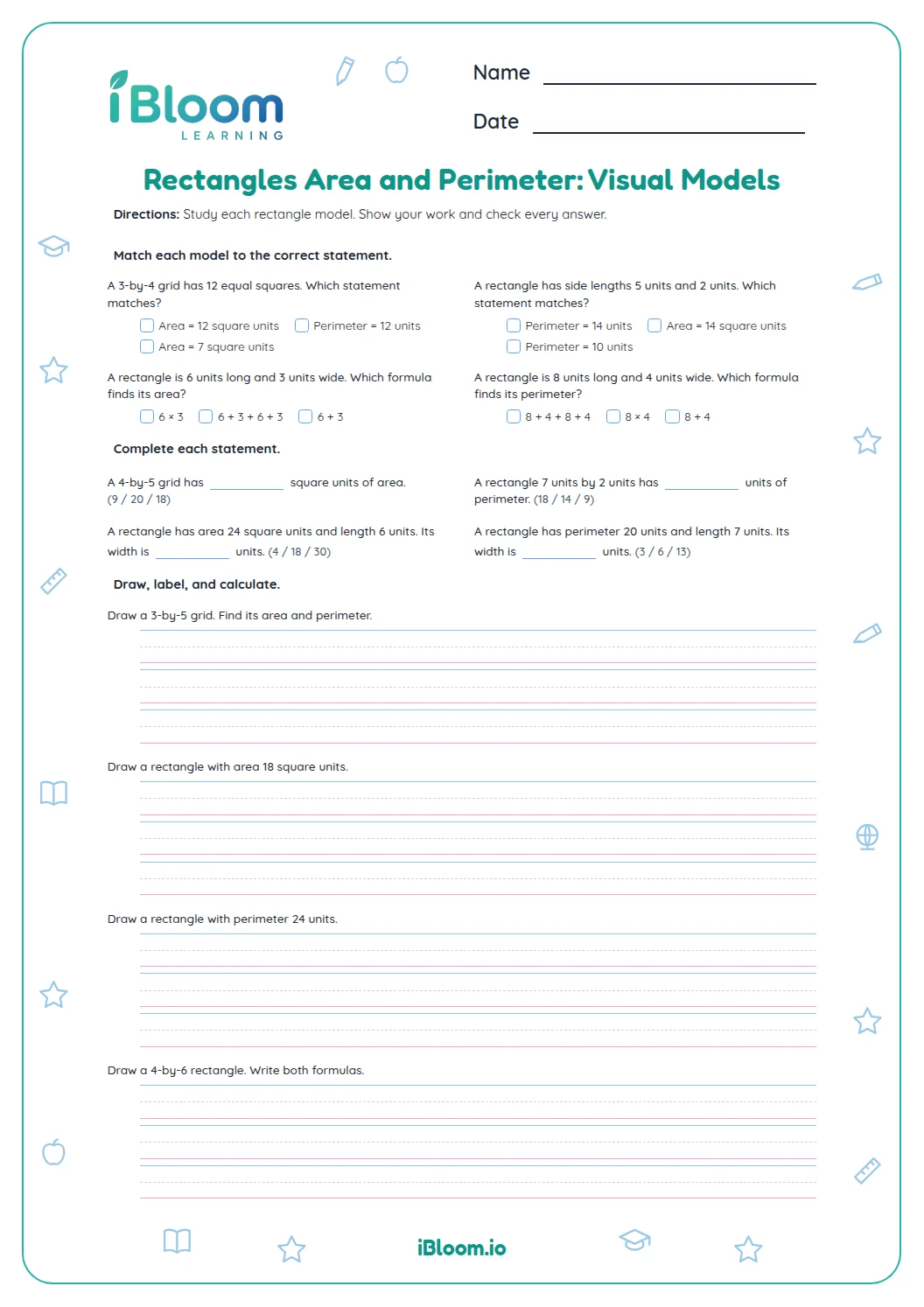
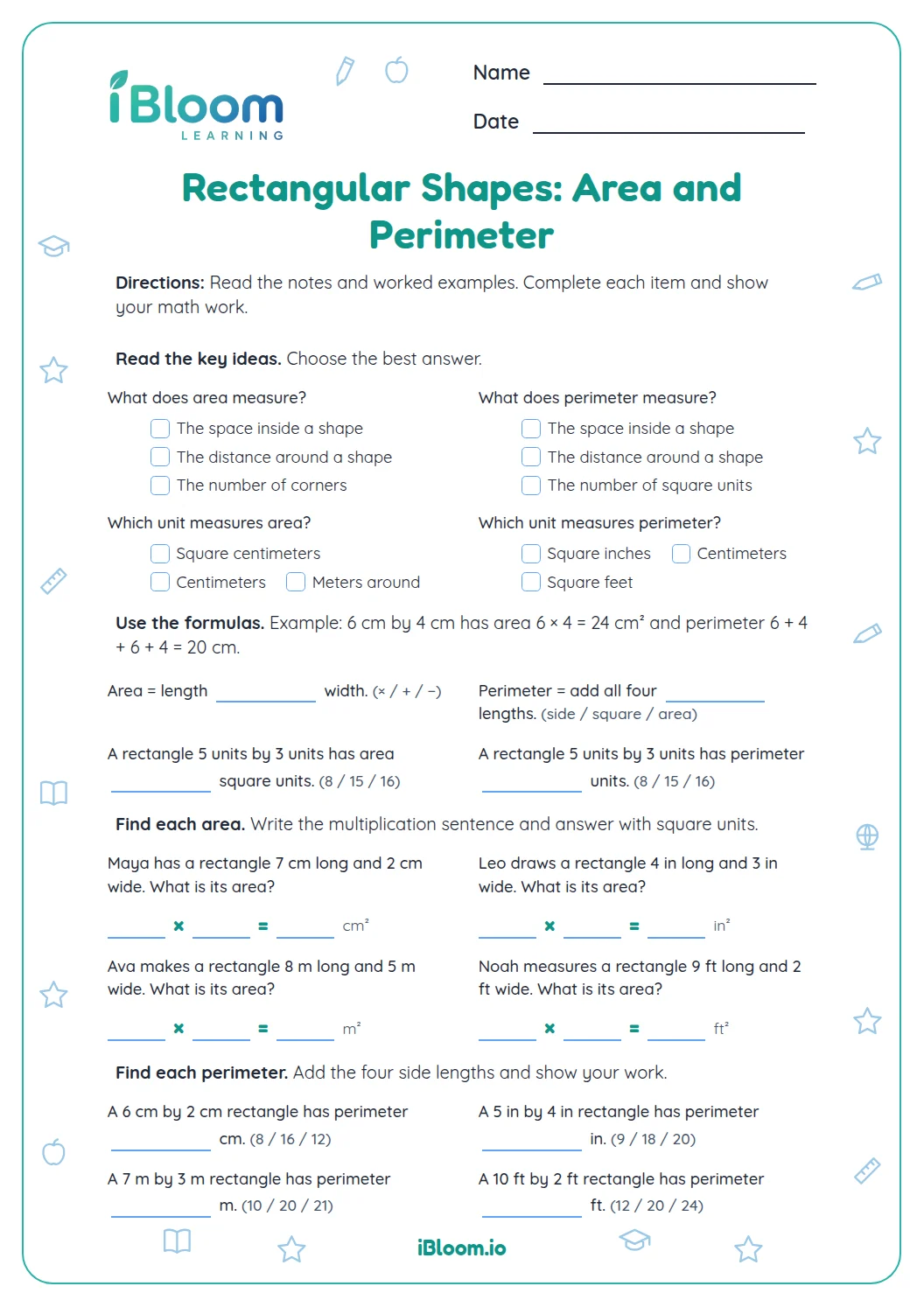
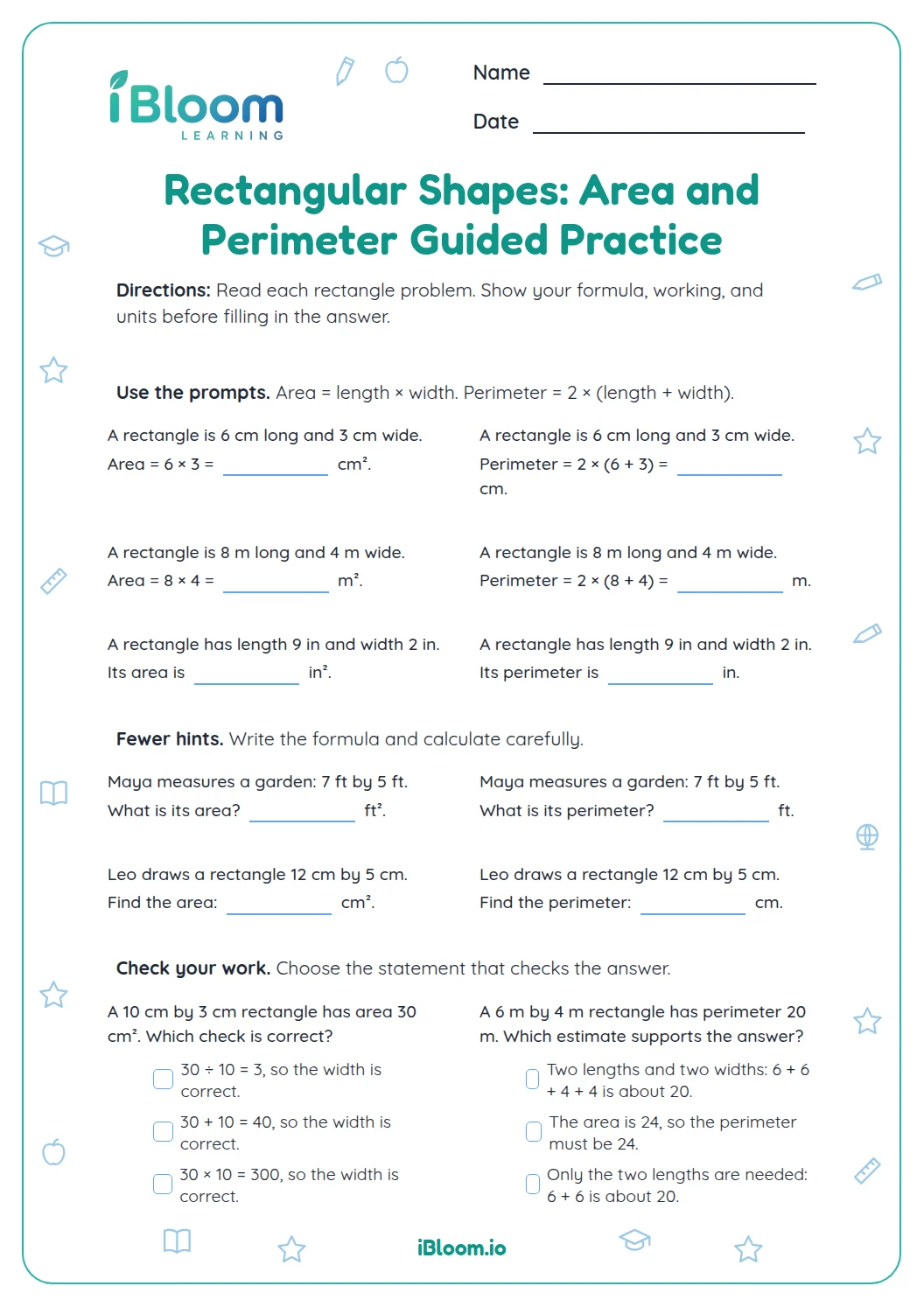
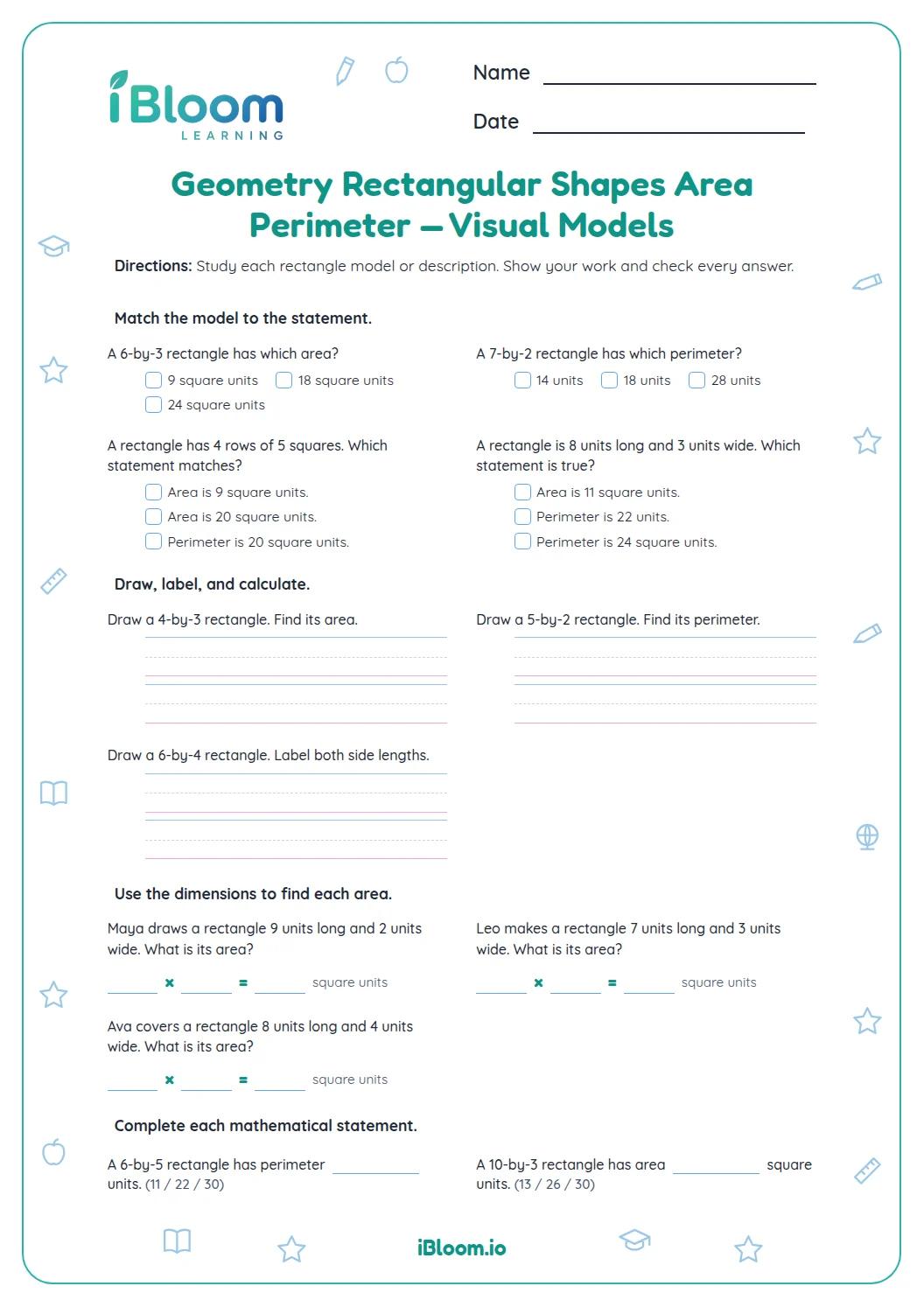
This Grade 4 worksheet practices rectangle area and perimeter. A shaded grid starts the activity; later questions use grid descriptions, side lengths, and answer choices. Students count square units inside for area and add four sides for perimeter, using the correct units for each measure.
Aligned to 4.MD.A.3
What does the shaded grid show?
The first problem shows a shaded rectangle 6 columns wide and 4 rows tall. Its area is 6 × 4 = 24 square units. Count the shaded cells inside to find area; perimeter comes from the rectangle’s outside sides.
How do you find the perimeter of a rectangle?
Add both lengths and both widths. For example, the 4 by 3 rectangle in question 6 has perimeter 4 + 3 + 4 + 3 = 14 units. Multiplying 4 × 3 would find its area, not the distance around it.
How does the worksheet compare the measures?
The questions alternate between shaded-grid area, written side lengths, area and perimeter choices, and a correction of a common perimeter error. Square units label area; plain units label perimeter.
How to use this worksheet
- 1Count rows and columns in a grid model to find area.
- 2Multiply length by width when dimensions are given.
- 3For perimeter, add two lengths and two widths.
- 4Use square units for area and ordinary units for perimeter.
- 5Check that the operation matches the measure named in the question.
Mistakes to watch for
The mistake
Calling the count of inside squares the perimeter.
The fix
Inside unit squares measure area; perimeter follows only the outer boundary.
The mistake
Adding just one length and one width for perimeter.
The fix
Include both opposite sides: L + W + L + W.
The mistake
Labeling perimeter in square units.
The fix
Use plain length units for distance around a shape.
Common Core alignment
This Grade 4 sheet practices the Common Core skill listed here.
Apply area and perimeter formulas for rectangles.
On this sheet: Students use grid models and rectangle formulas to find area and perimeter.
Show the official wordingHide the official wording
Apply the area and perimeter formulas for rectangles in real world and mathematical problems.
What to practice next
Make more practice
Further reading
Questions parents and teachers ask
What is the area of the first shaded rectangle?
The area is 24 square units. The model has 6 columns and 4 rows of shaded unit squares, so 6 × 4 = 24. The answer counts the squares inside the rectangle, not the outside edges. A quick estimate or labeled sketch helps students check that the result fits the question.
What is the perimeter of a 4 by 3 rectangle?
Its perimeter is 14 units: 4 + 3 + 4 + 3. The worksheet asks this about a rectangle traced by Leo. Adding only 4 + 3 gives 7, which counts one length and one width rather than all four sides.
How are area and perimeter different?
Area counts the square units inside a shape. Perimeter measures the total length of its boundary. A grid makes area visible as filled cells, while perimeter can be found by adding the side lengths around the rectangle. A quick estimate or labeled sketch helps students check that the result fits the question.
Why are area answers in square units?
Each unit square covers one square unit of surface. Multiplying the number of rows by columns counts those squares. Perimeter answers use plain units because they combine lengths along the outside, not squares covering the inside. A quick estimate or labeled sketch helps students check that the result fits the question.
What practice appears on this page?
The 15 questions use a shaded rectangle, grid descriptions, side lengths, and answer choices to practice both measures. They include the 6 by 3, 4 by 3, and 8 by 2 perimeter situations noted in the key, plus area items and a correction. A separate key page is included.