

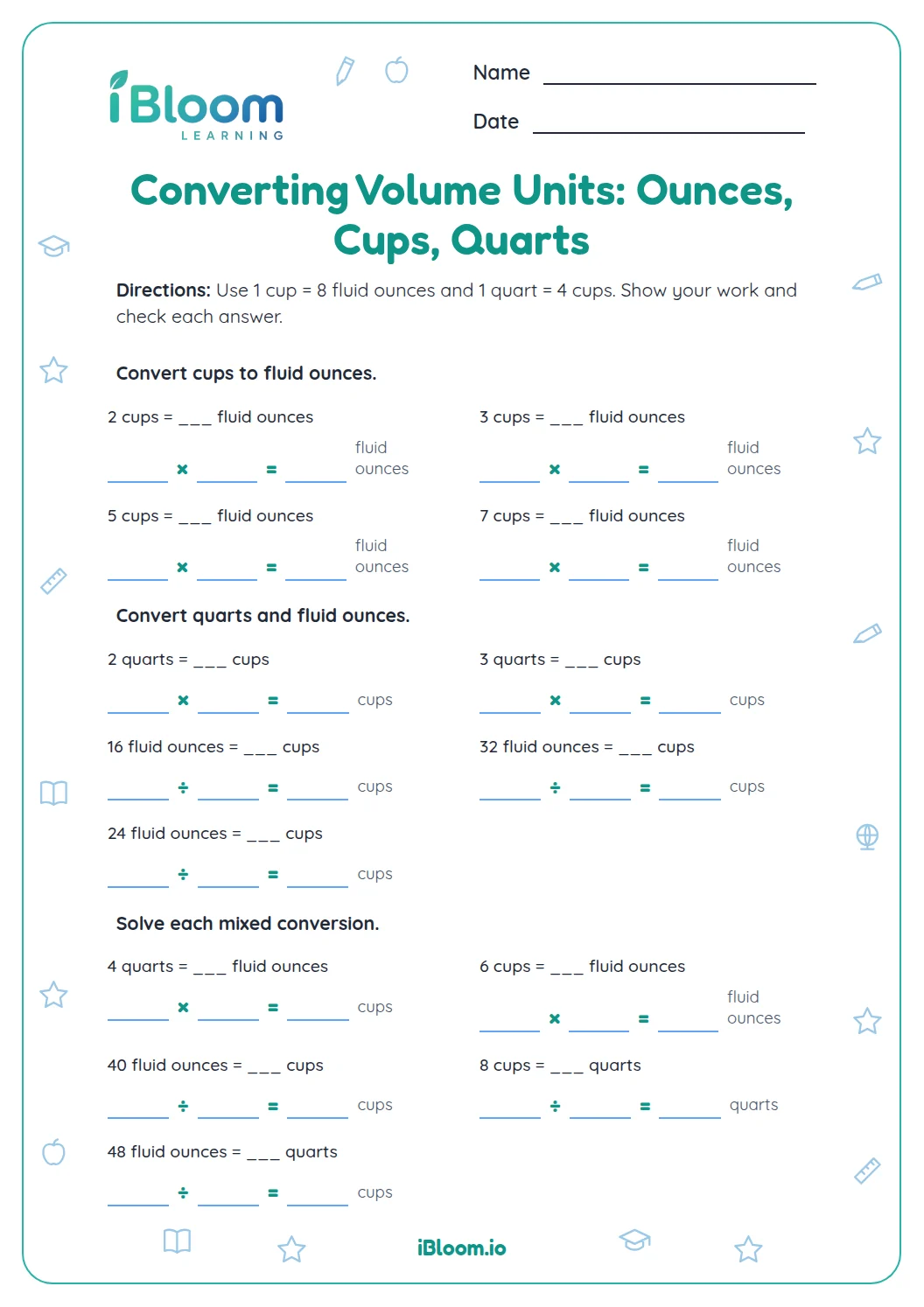
About this worksheet
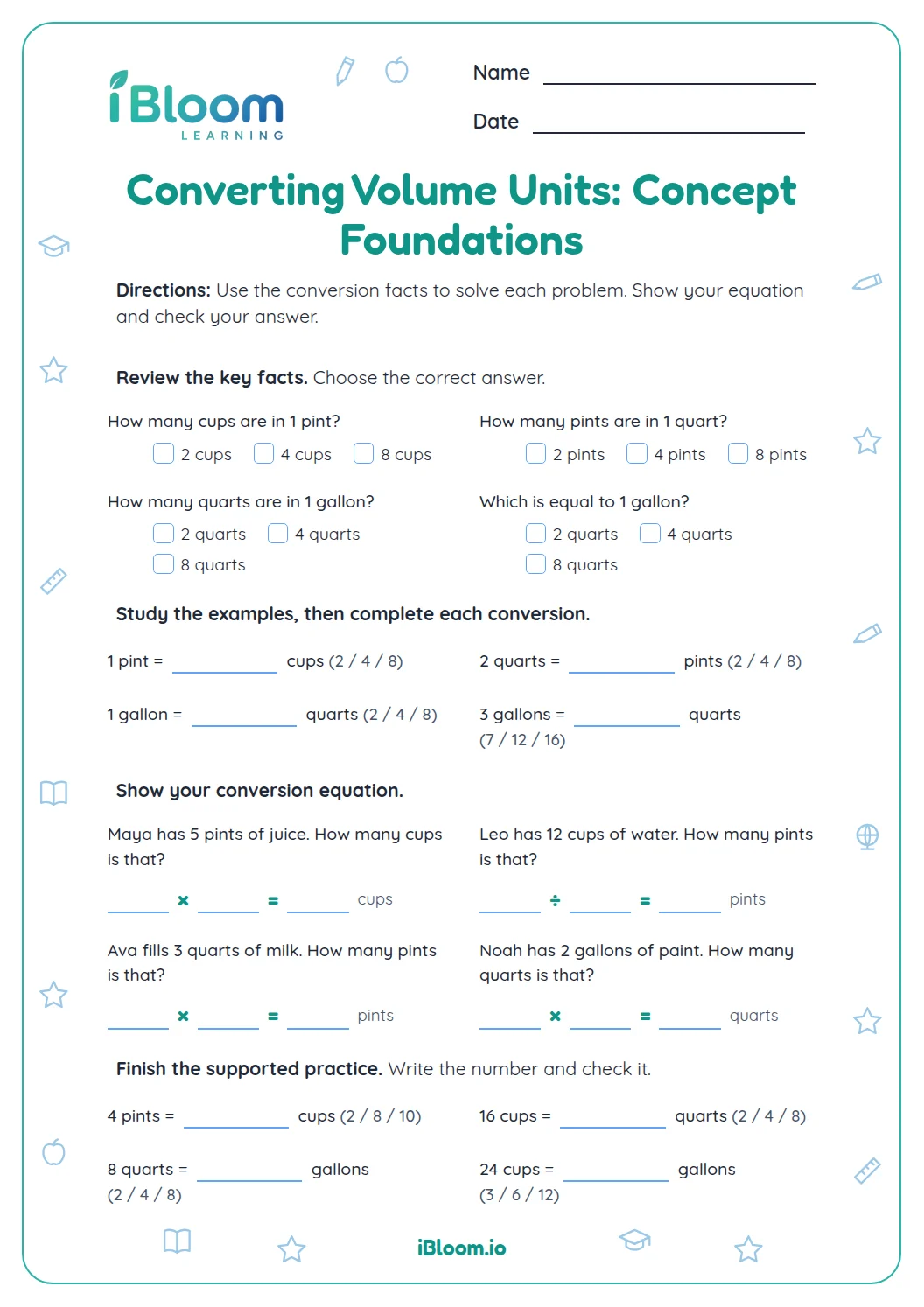
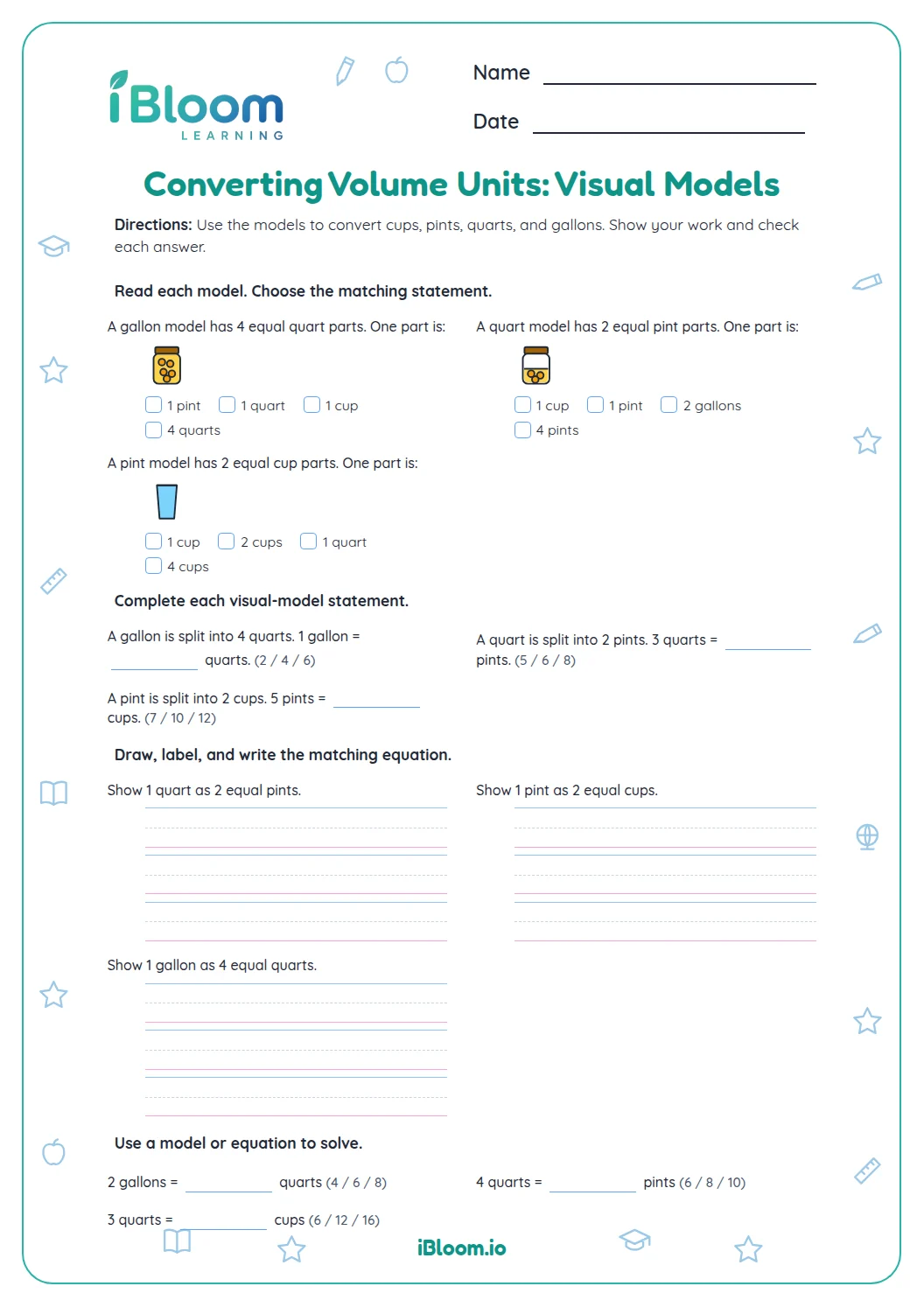
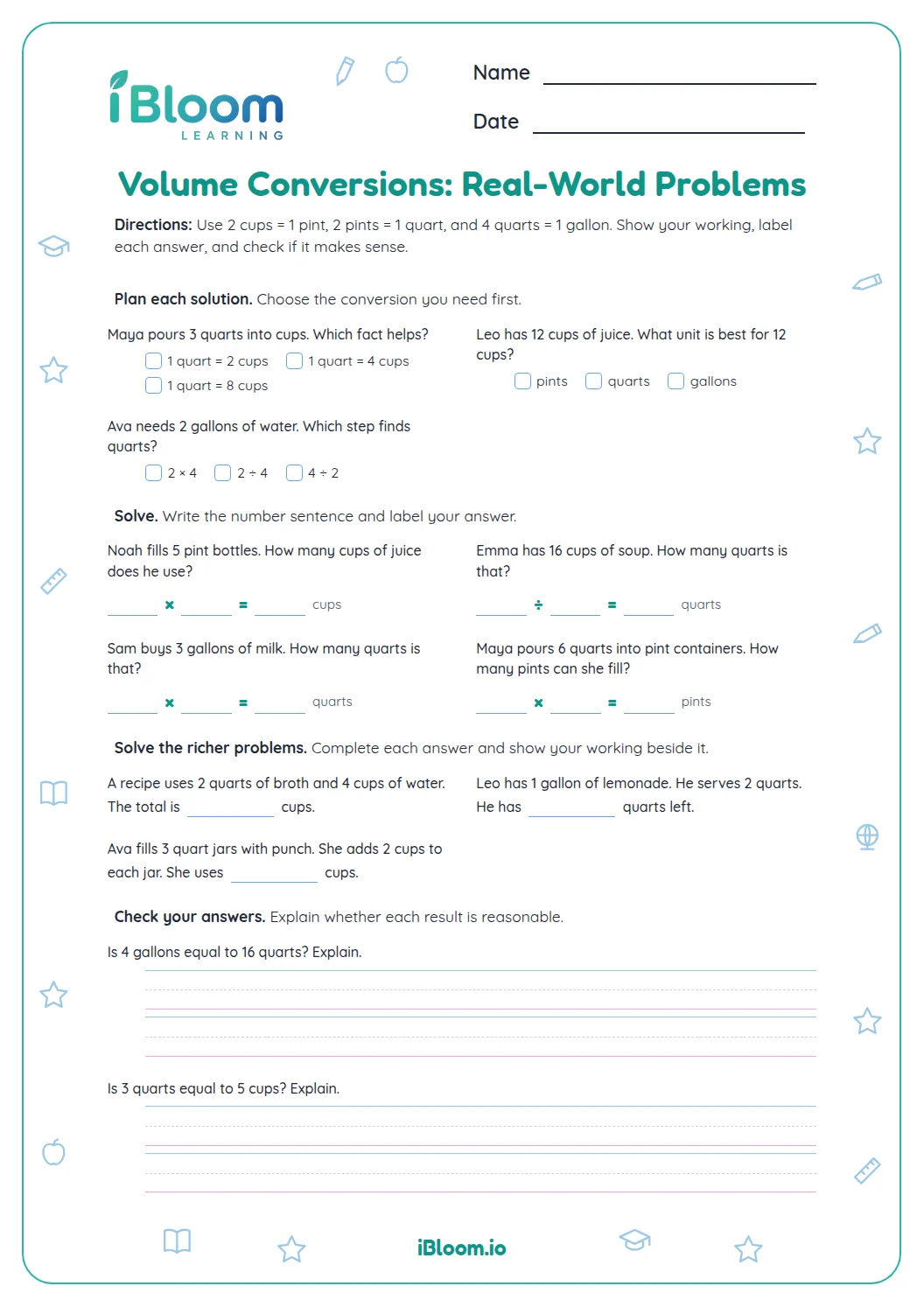
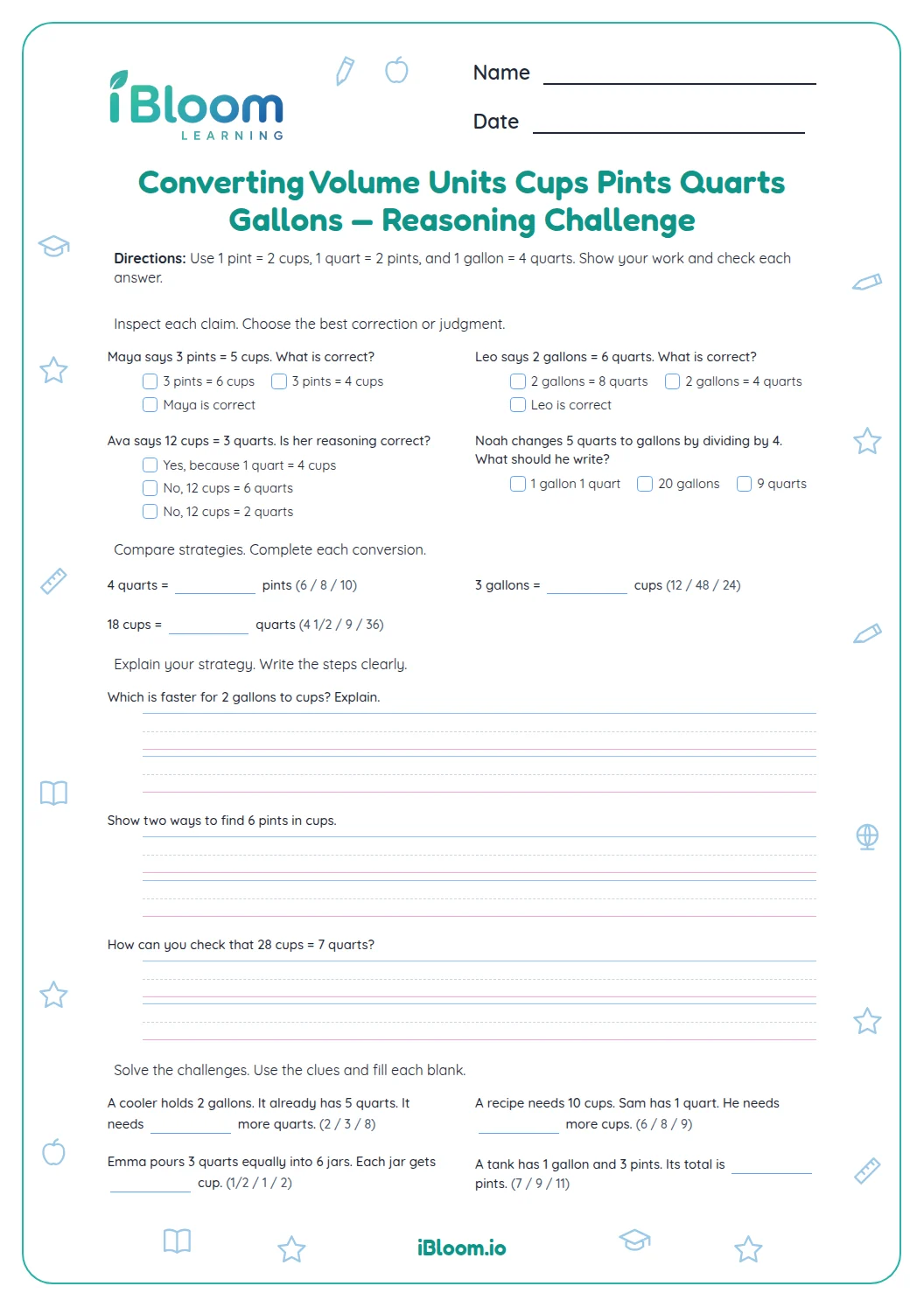
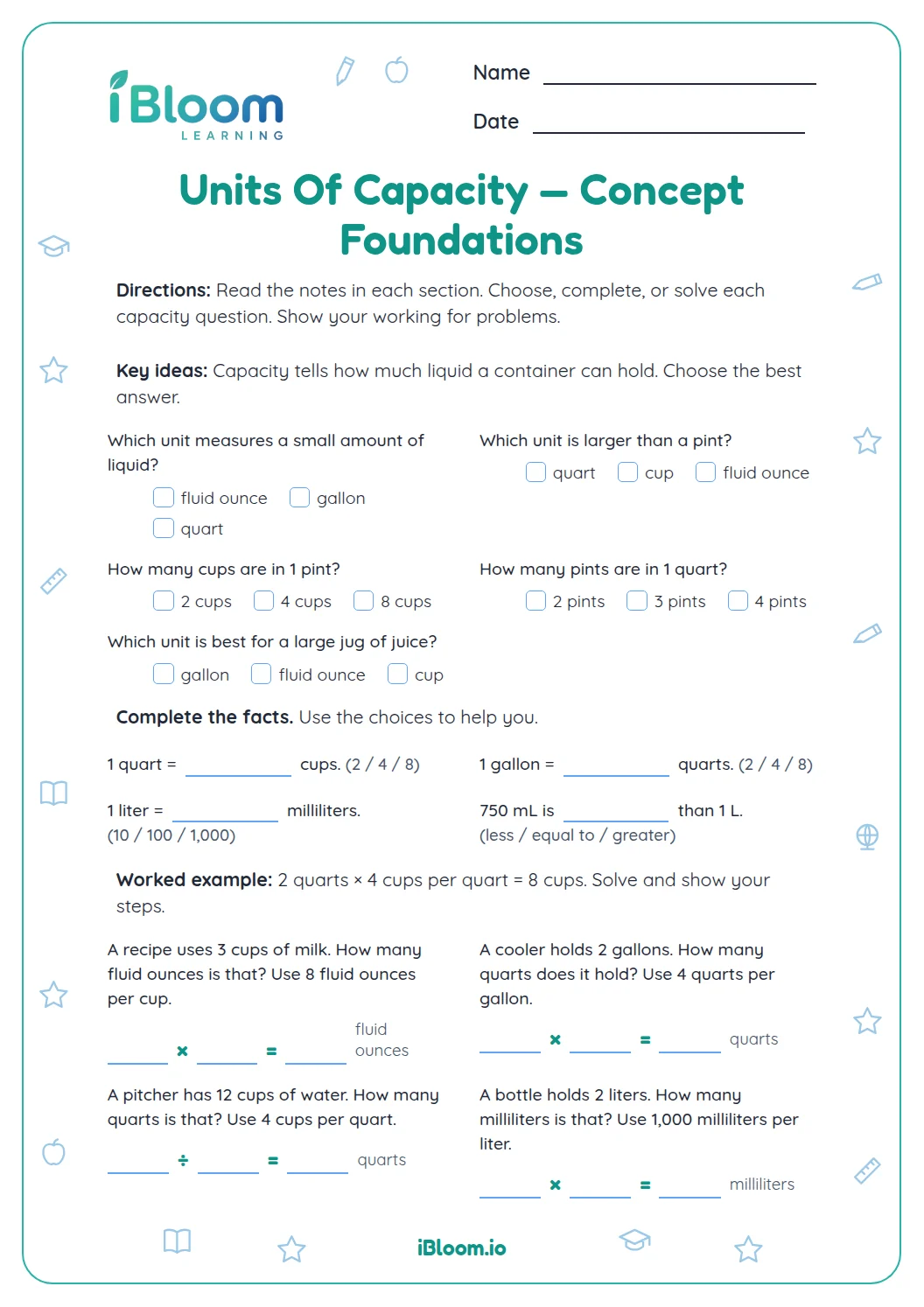
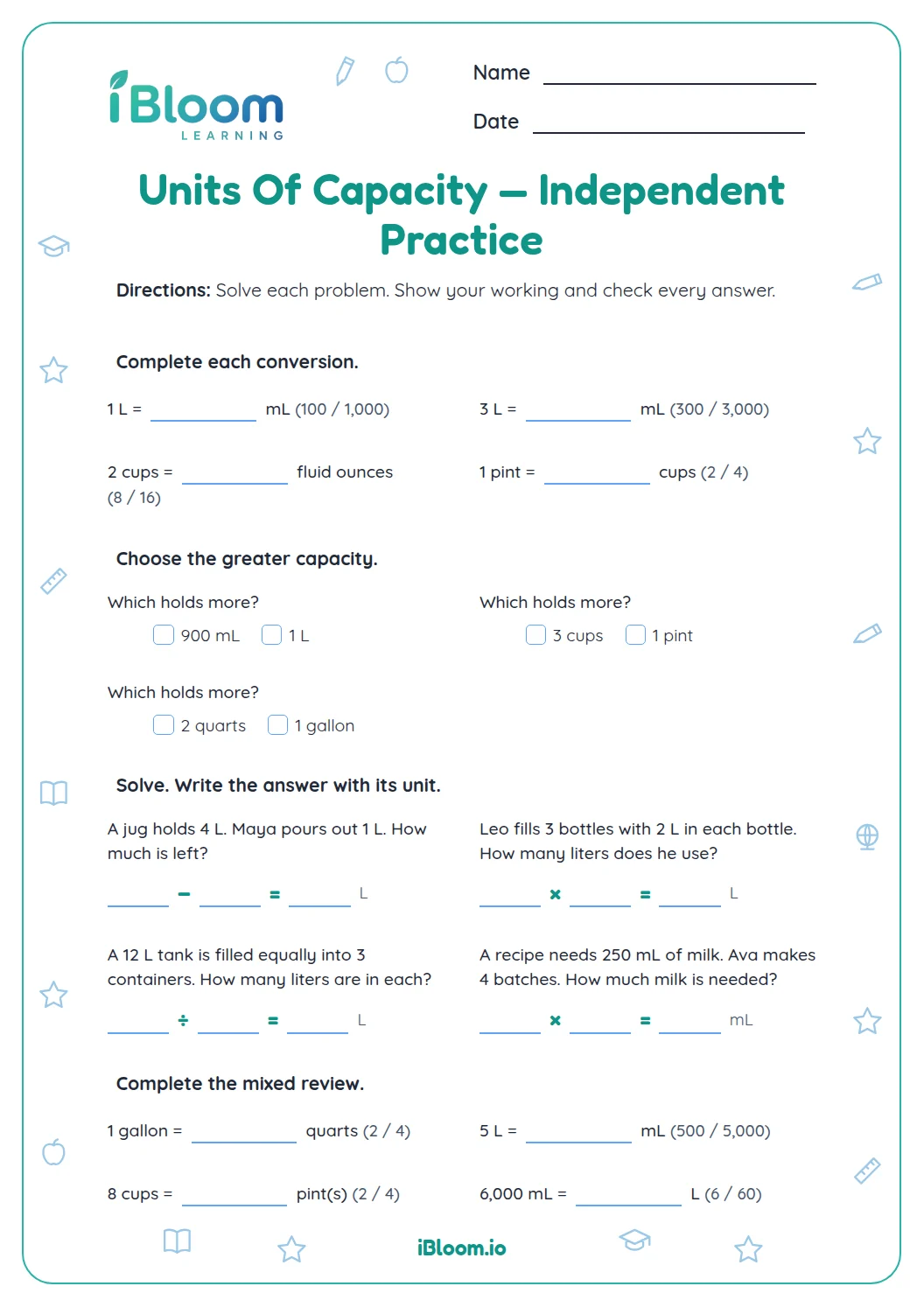
This free Grade 4 worksheet gives students 18 practice questions converting among cups, pints, quarts, and gallons. Students use the customary relationships 2 cups per pint, 2 pints per quart, and 4 quarts per gallon to fill in equivalent amounts. Some conversions produce a mixed-number answer. The answer key supplies the missing quantity without repeating the unit printed beside each blank. This conversion practice connects to CCSS 4.MD.A.1.
Aligned to 4.MD.A.1
What relationships connect the units?
A pint equals 2 cups, a quart equals 2 pints, and a gallon equals 4 quarts. Following those steps gives 16 cups in 1 gallon.
For question 2, multiply 3 pints by 2 cups per pint: 3 × 2 = 6 cups.
- 13 pints × 2 cups per pint
- 23 × 2 = 6
- 33 pints = 6 cups
Should you multiply or divide?
When converting to a smaller unit, multiply by the number of smaller units in each larger unit. When converting to a larger unit, divide by that relationship. For example, cups to pints means divide by 2; pints to cups means multiply by 2.
What practice is on this worksheet?
The 18 number sentences convert quantities in both directions across the customary units. Whole-number and mixed-number results appear. Each question prints the target unit after the blank, and the key gives only the missing number.
How to use this worksheet
- 1Write the relationship between the starting and target unit.
- 2Check whether the target is smaller or larger.
- 3Multiply when converting to smaller units.
- 4Divide when converting to larger units.
- 5Use a fraction or mixed number if the conversion is not whole.
- 6Write only the missing number; the target unit is printed.
Common mistakes and quick fixes
The mistake
Multiplying when converting to a larger unit
The fix
Divide by the number of smaller units in one larger unit.
The mistake
Skipping a unit relationship
The fix
For gallons to cups, count the steps through quarts and pints.
The mistake
Repeating the printed unit in the blank answer
The fix
Write the missing amount only because the target unit follows the blank.
Common Core alignment
This practice connects to the Common Core standard below.
Express measurements in equivalent units within the customary volume system.
On this sheet: Students apply equivalent customary capacity units and record the equivalent quantity in the requested unit.
Show the official wordingHide the official wording
Know relative sizes of measurement units within one system of units including km, m, cm; kg, g; lb, oz.; l, ml; hr, min, sec. Within a single system of measurement, express measurements in a larger unit in terms of a smaller unit. Record measurement equivalents in a two-column table. For example, know that 1 ft is 12 times as long as 1 in. Express the length of a 4 ft snake as 48 in. Generate a conversion table for feet and inches listing the number pairs (1, 12), (2, 24), (3, 36), ...
What to practice next
Make more practice
Further reading
Questions parents and teachers ask
How many cups are in one pint?
One pint equals 2 cups. To convert pints to cups, multiply by 2; to convert cups to pints, divide by 2. The worksheet uses this relationship in both directions, including 3 pints = 6 cups in question 2.
How many cups are in a gallon?
A gallon has 4 quarts, each quart has 2 pints, and each pint has 2 cups. Multiply 4 × 2 × 2 to find 16 cups in one gallon. Questions 11 and 16 use this full relationship to convert cups into gallons.
When does a conversion answer have a fraction?
A fraction or mixed number appears when the quantity does not make a whole number of target units. For example, 5 quarts equals 1 1/4 gallons: 4 quarts make 1 gallon, and the remaining quart is one fourth of a gallon.
How do I decide whether to multiply or divide?
Convert to a smaller unit by multiplying and to a larger unit by dividing. From 3 pints to cups, multiply by 2. From 6 pints to quarts, divide by 2. Check that the result is reasonable for the change in unit size.
Why does the answer key show only a number?
Every problem prints the target unit after the blank, such as “___ pints.” The key gives only the missing amount, so a response like 8 does not repeat “pints” already shown in the prompt. This formatting applies to all 18 conversion answers.
How can students check a conversion?
Reverse the conversion using the same relationship. If 3 quarts equals 12 cups, divide 12 by 4 cups per quart to return to 3 quarts. If the reverse calculation does not return to the starting amount, check the relationship used.