
About this worksheet
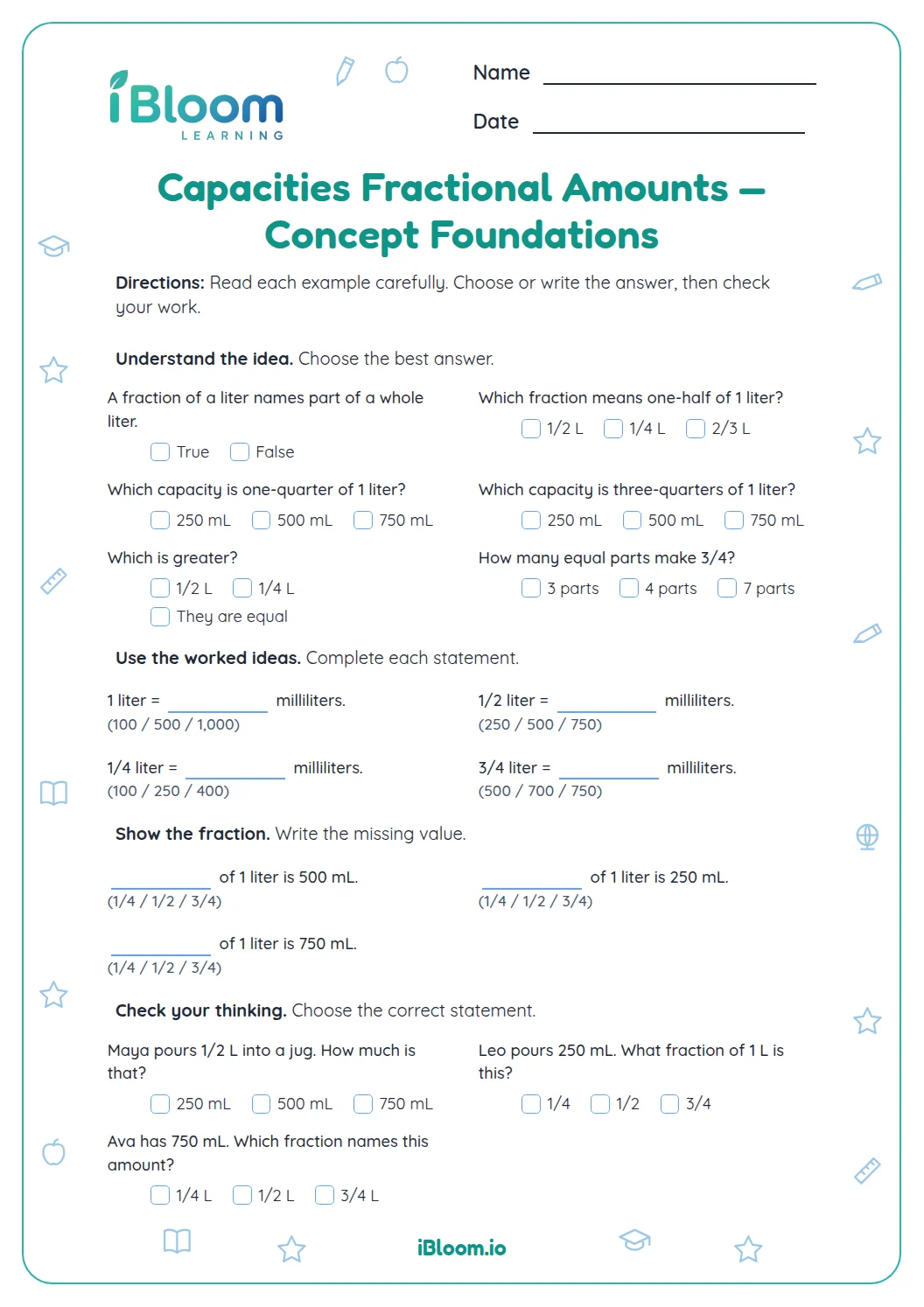
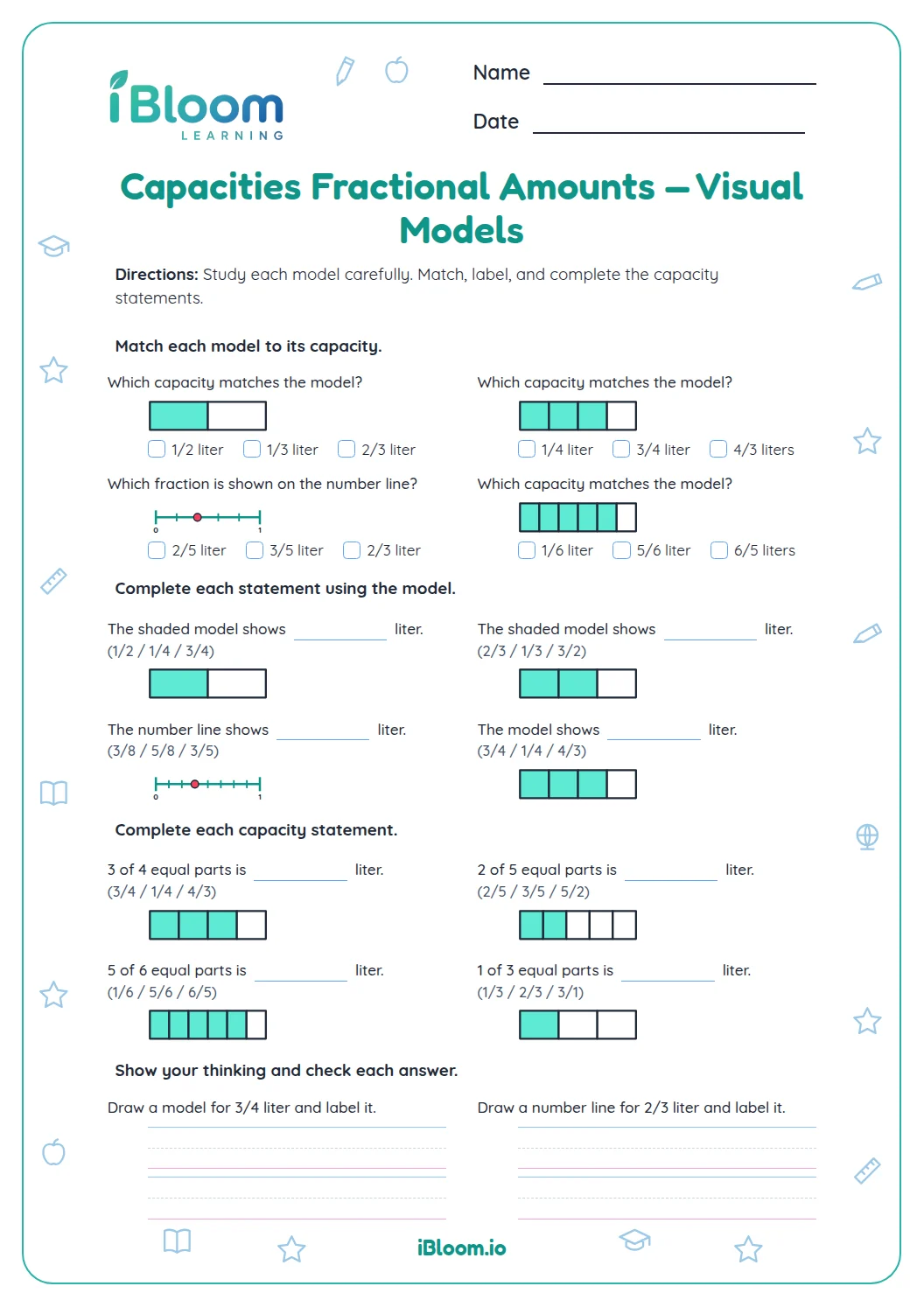
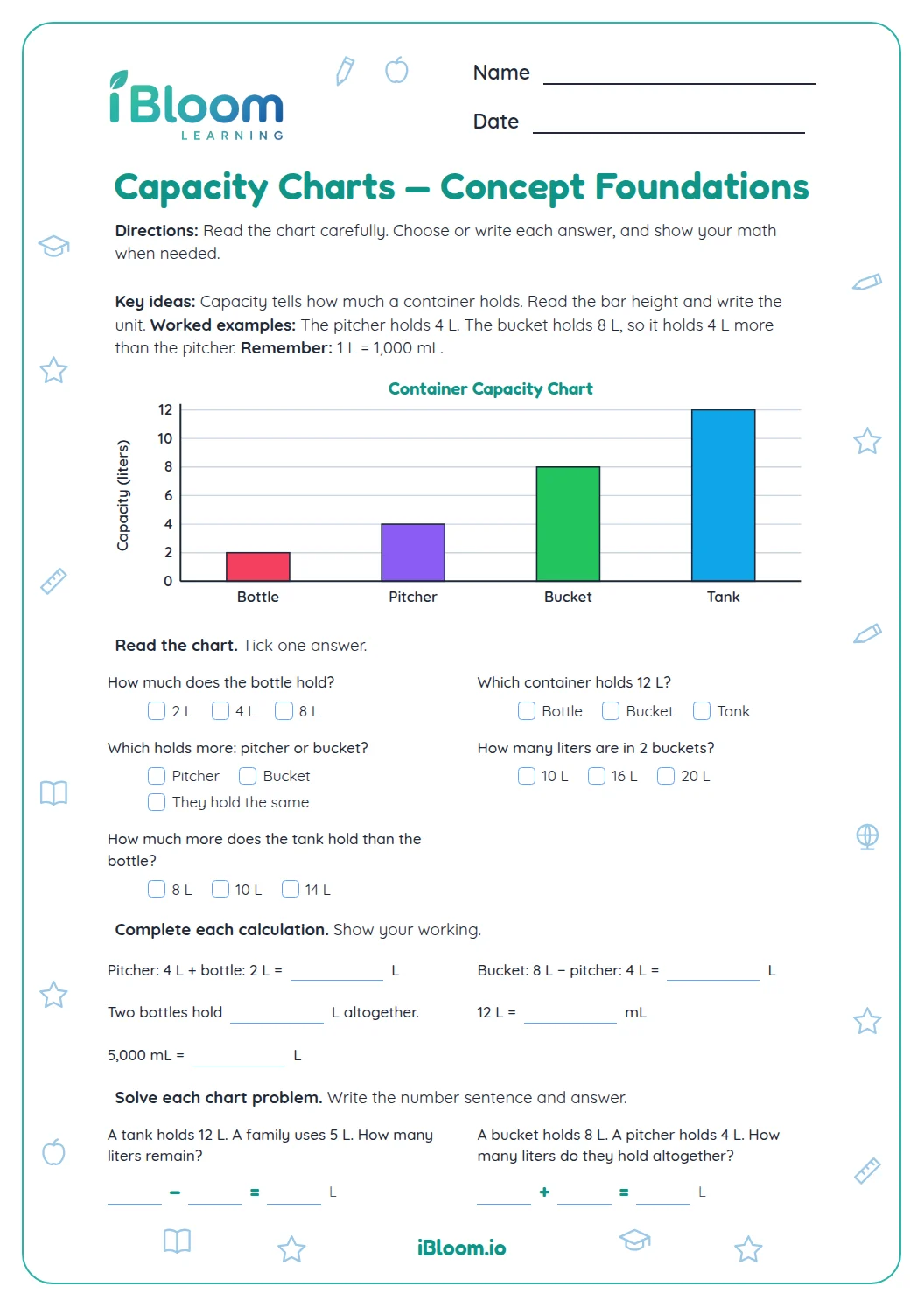
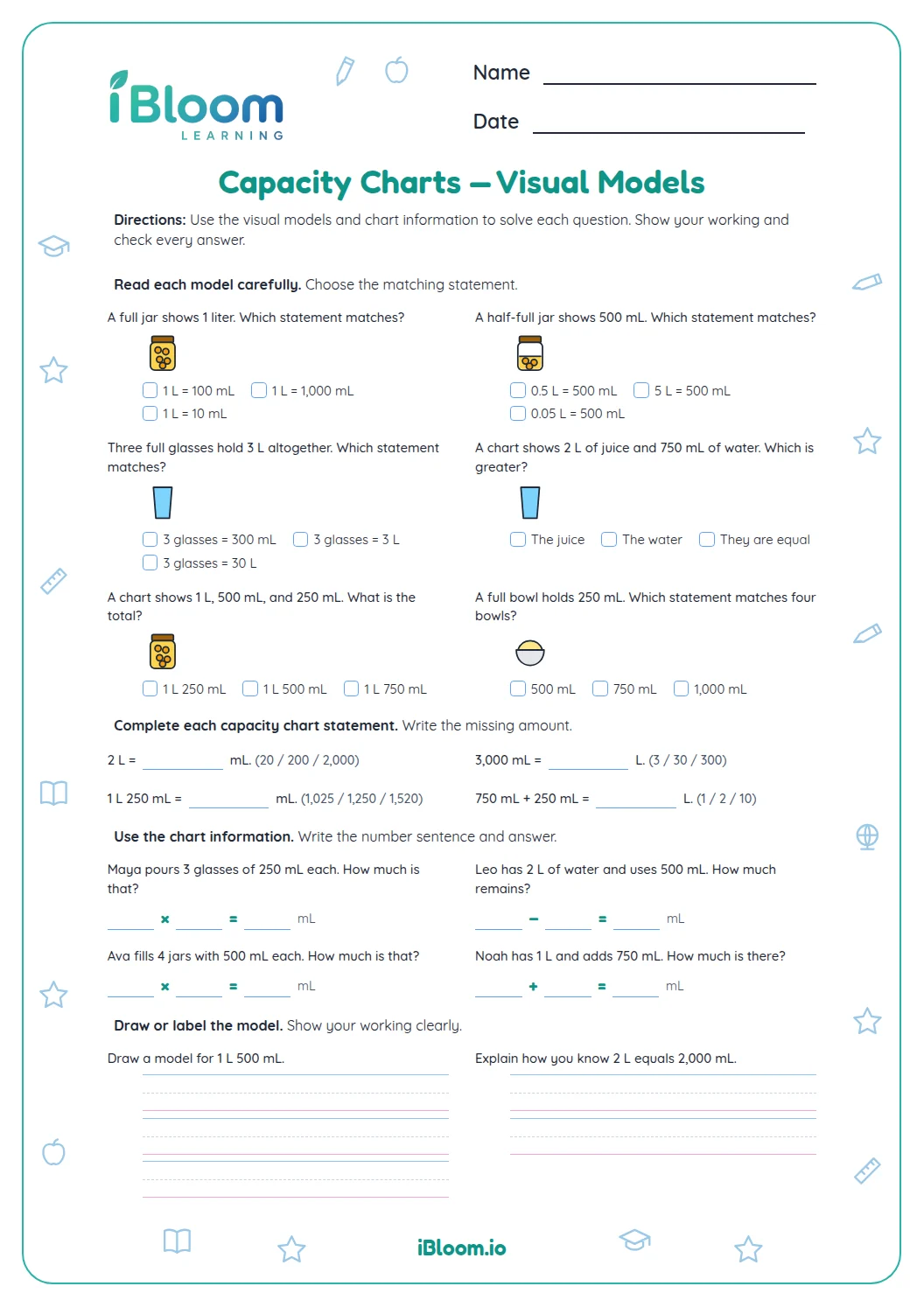
This free Grade 4 printable gives students 14 problems about metric capacity. It includes corrected conversion claims, comparisons, conversions in both directions, regrouping and short word problems. The comparison of 7,050 mL and 7 L 5 mL correctly distinguishes 7,050 from 7,005, and a separate answer key supports checking.
Aligned to 4.MD.A.2
How do liters and milliliters relate?
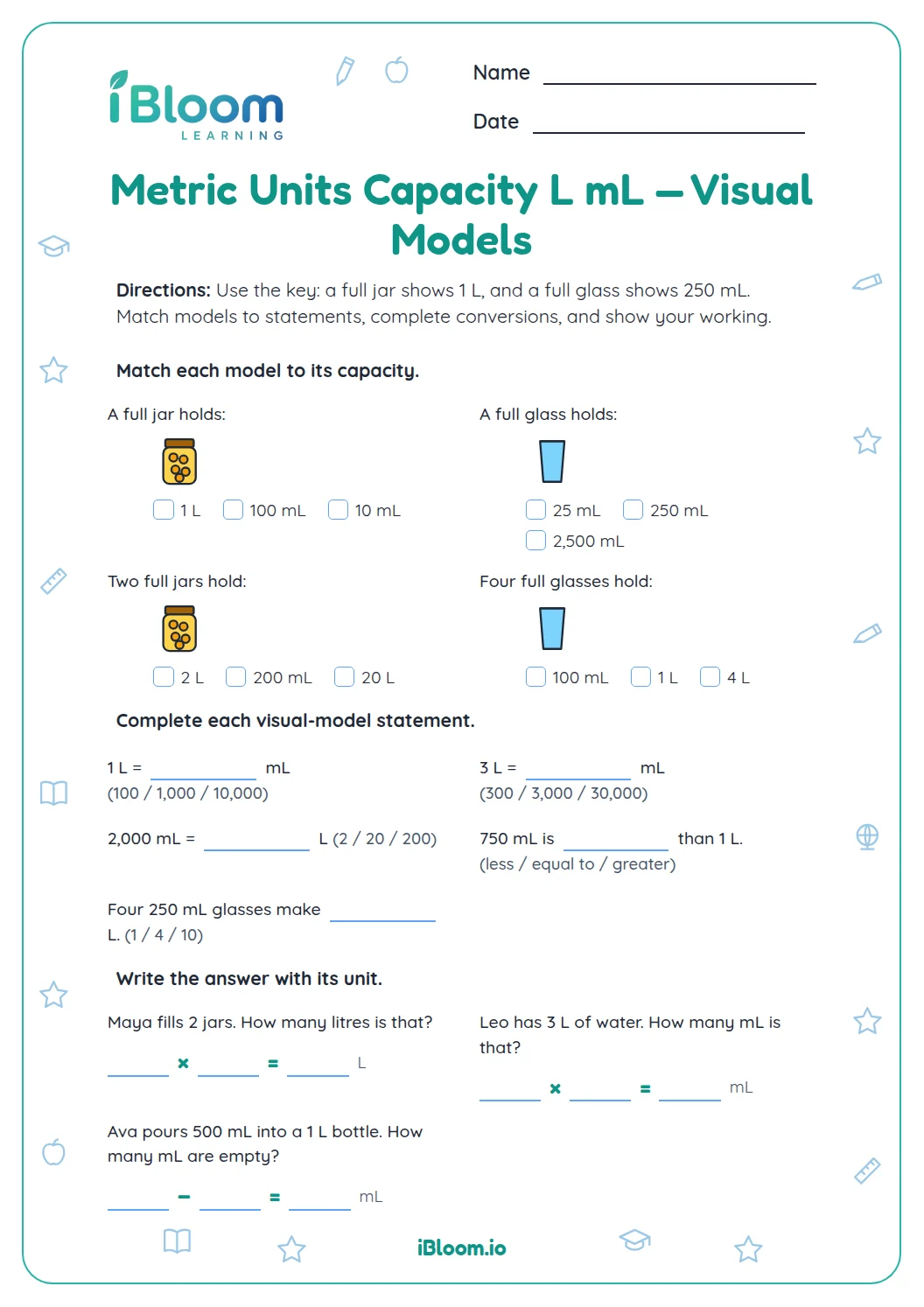
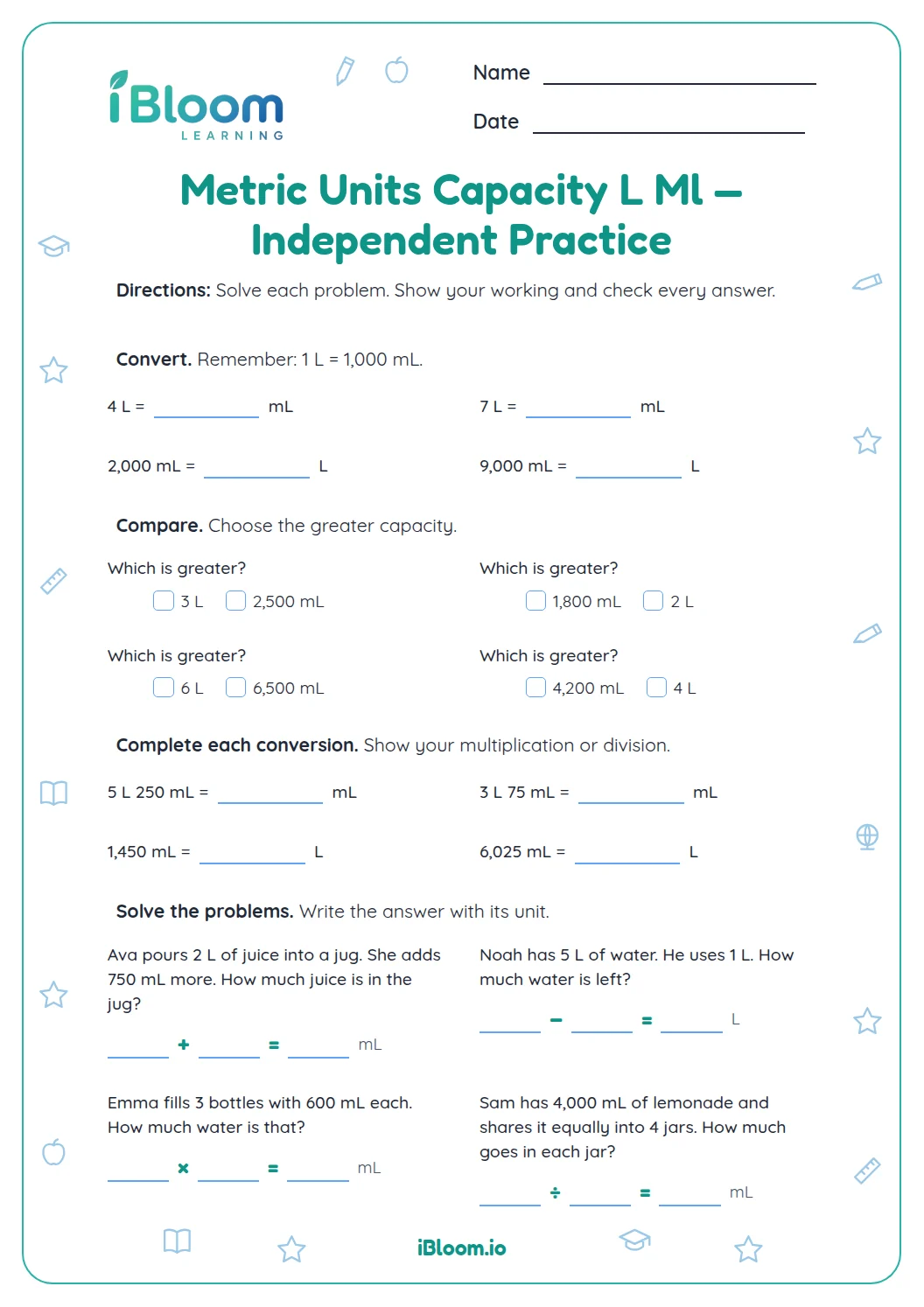
One liter is equal to 1,000 milliliters. To change liters into milliliters, multiply the number of liters by 1,000, then add any extra milliliters. For 7 L 5 mL, that gives 7,000 + 5 = 7,005 mL.
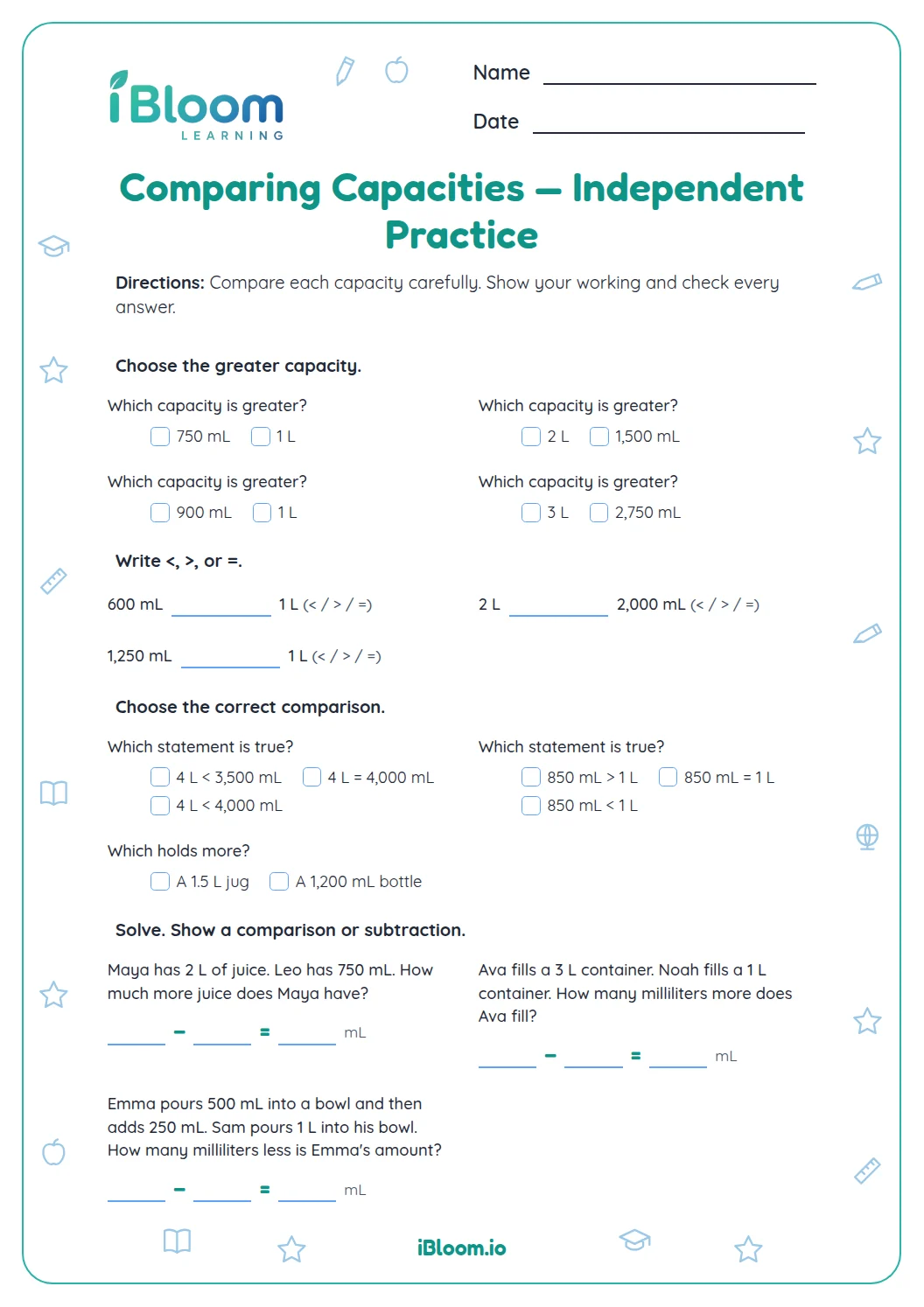
That conversion matters in question 3: 7,050 mL is greater than 7 L 5 mL because 7,050 > 7,005.
- 17 L 5 mL = 7,005 mL
- 2Compare 7,050 mL and 7,005 mL
- 37,050 mL is greater by 45 mL
When should milliliters be regrouped as a liter?
When a milliliter total reaches 1,000, trade 1,000 mL for 1 L. In 1 L 250 mL + 2 L 750 mL, the milliliters total 1,000, so the result is 4 L. Keep both units visible while adding.
What kinds of capacity problems are included?
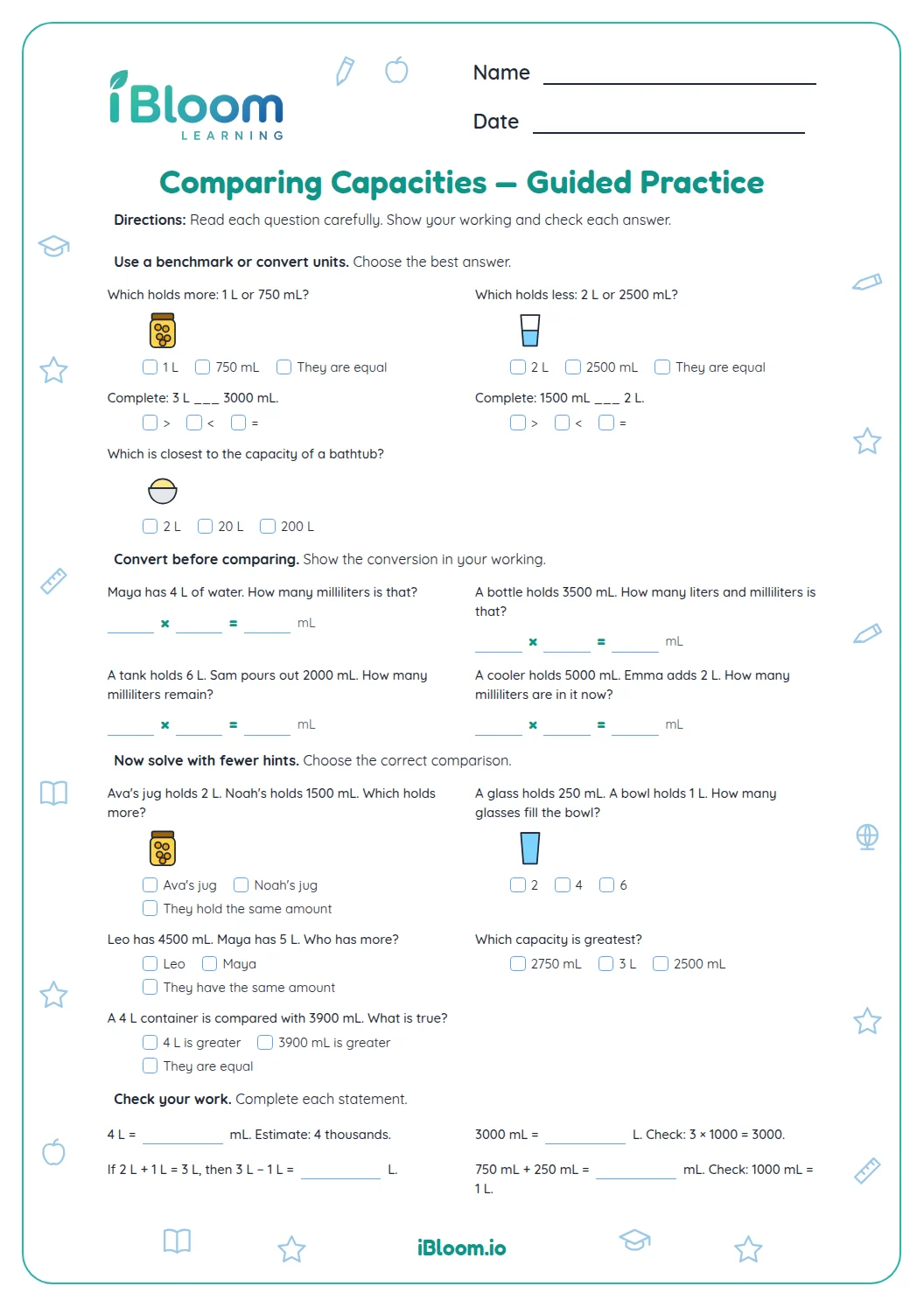
The sheet begins with five conversion and comparison decisions, then includes seven conversion equations, two story problems and two additional checks. Each prompt supplies the quantities needed for its calculation.
How to use this worksheet
- 1Write 1 L = 1,000 mL before converting.
- 2For liters to milliliters, multiply by 1,000 and add leftover milliliters.
- 3For milliliters to liters, group thousands and record what remains.
- 4Compare amounts only after expressing them in the same unit.
- 5Check whether a result is a sensible size for the situation.
Common mistakes and quick fixes
The mistake
Using 100 mL for 1 L.
The fix
Use 1,000 mL for each liter.
The mistake
Comparing the digits before converting.
The fix
Rewrite both amounts in the same unit first.
The mistake
Dropping extra milliliters after making whole liters.
The fix
Keep the remainder as the milliliter part, such as 2,500 mL = 2 L 500 mL.
Common Core alignment
This worksheet practices the Common Core skills listed below.
Solve measurement problems with liquid volume and simple fractions or decimals.
On this sheet: Students convert, compare and calculate liters and milliliters in capacity problems.
Show the official wordingHide the official wording
Use the four operations to solve word problems involving distances, intervals of time, liquid volumes, masses of objects, and money, including problems involving simple fractions or decimals, and problems that require expressing measurements given in a larger unit in terms of a smaller unit.
What to practice next
Make more practice
Further reading
Questions parents and teachers ask
How many milliliters are in 7 L 5 mL?
There are 7,005 mL in 7 L 5 mL. Convert seven liters to 7,000 milliliters, then add the extra 5 milliliters. This makes it possible to compare the amount with 7,050 mL in question 3 without mixing units. Have the student point to the related question and explain the step in their own words.
Why is 7,050 mL greater than 7 L 5 mL?
The second amount is 7,005 mL because 7 liters are 7,000 milliliters and the extra amount is 5 milliliters. Since 7,050 is 45 more than 7,005, the first amount is greater. Have the student point to the related question and explain the step in their own words.
How do students convert milliliters to liters and milliliters?
Group the milliliters into thousands. For example, 6,450 mL is 6 groups of 1,000 mL with 450 mL remaining, so it is 6 L 450 mL. Keep the remaining milliliters after making complete liters. Have the student point to the related question and explain the step in their own words.
How can two mixed capacity amounts be added?
Add liters to liters and milliliters to milliliters. If the milliliter total is at least 1,000, regroup each 1,000 mL as 1 L. For 1 L 250 mL plus 2 L 750 mL, the total is 4 L. Have the student point to the related question and explain the step in their own words.
What does the answer key show?
The key lists corrected conversions, comparison results, conversion answers and results for each capacity story problem. For written reasoning, it gives the numerical conclusion and a concise check. Have the student point to the related question and explain the step in their own words.
What standard does this sheet practice?
It practices CCSS 4.MD.A.2, using operations to solve measurement problems with liquid volume and expressing larger units in smaller units. The questions use liter and milliliter quantities throughout. Have the student point to the related question and explain the step in their own words.