




About this worksheet
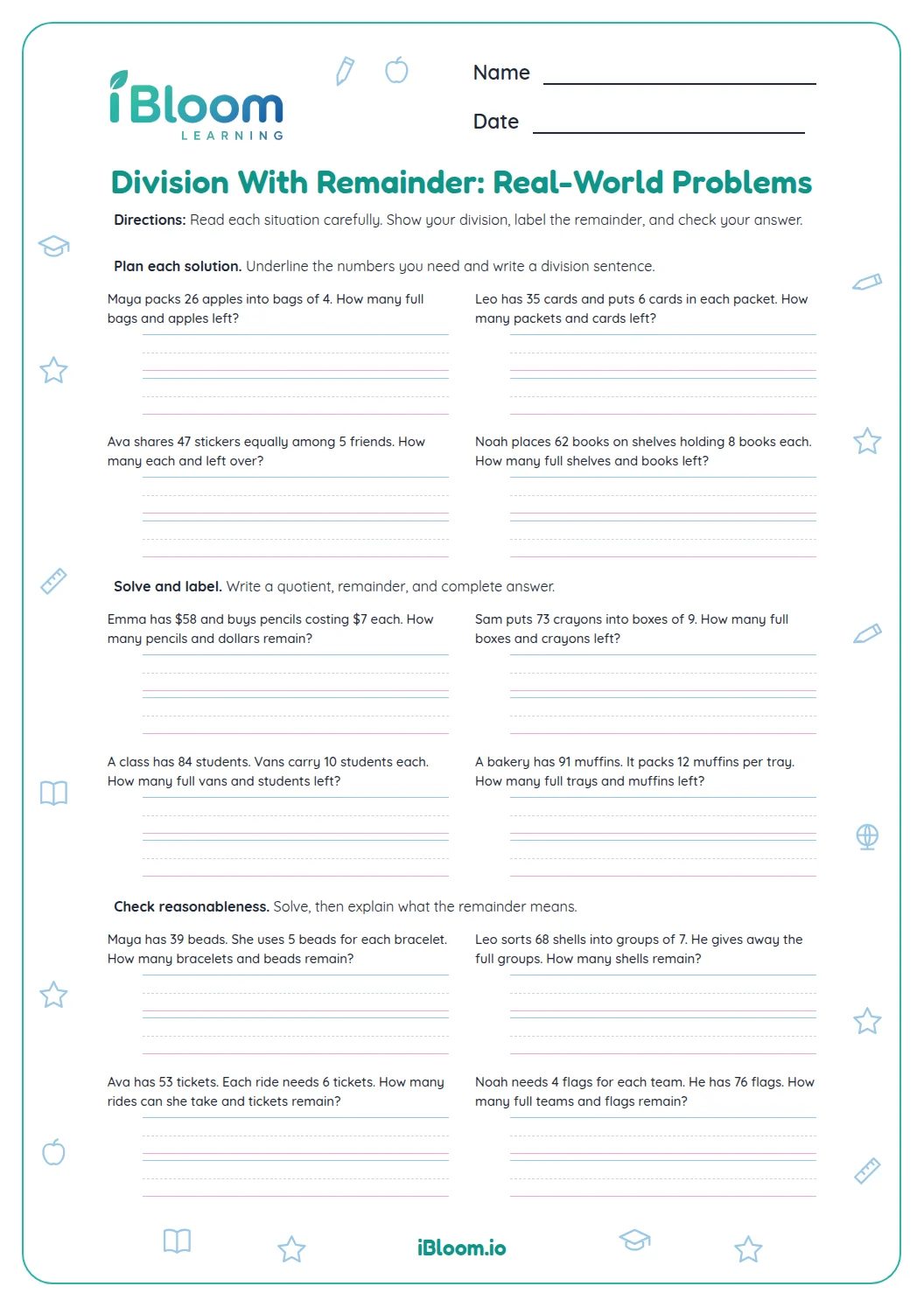
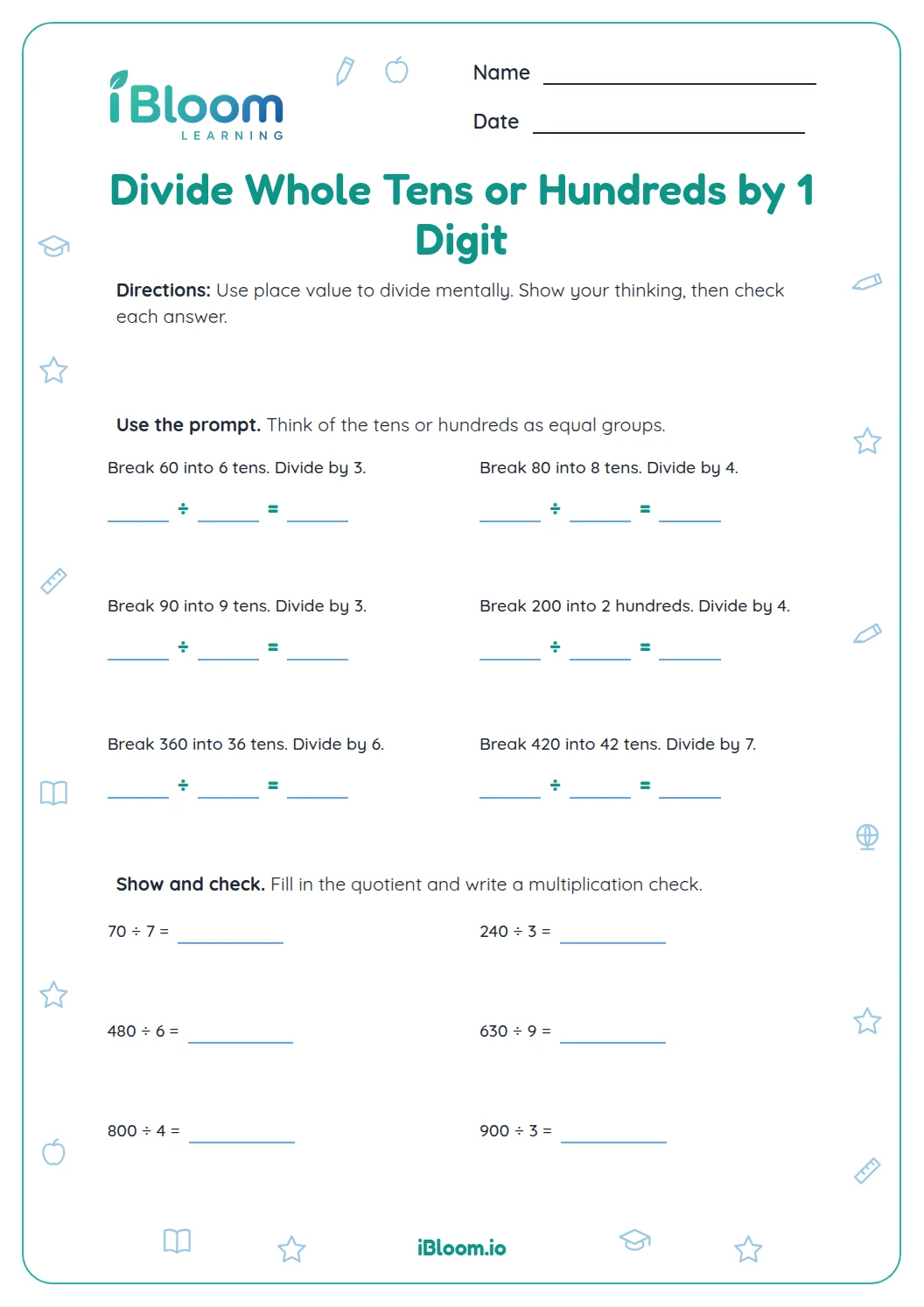
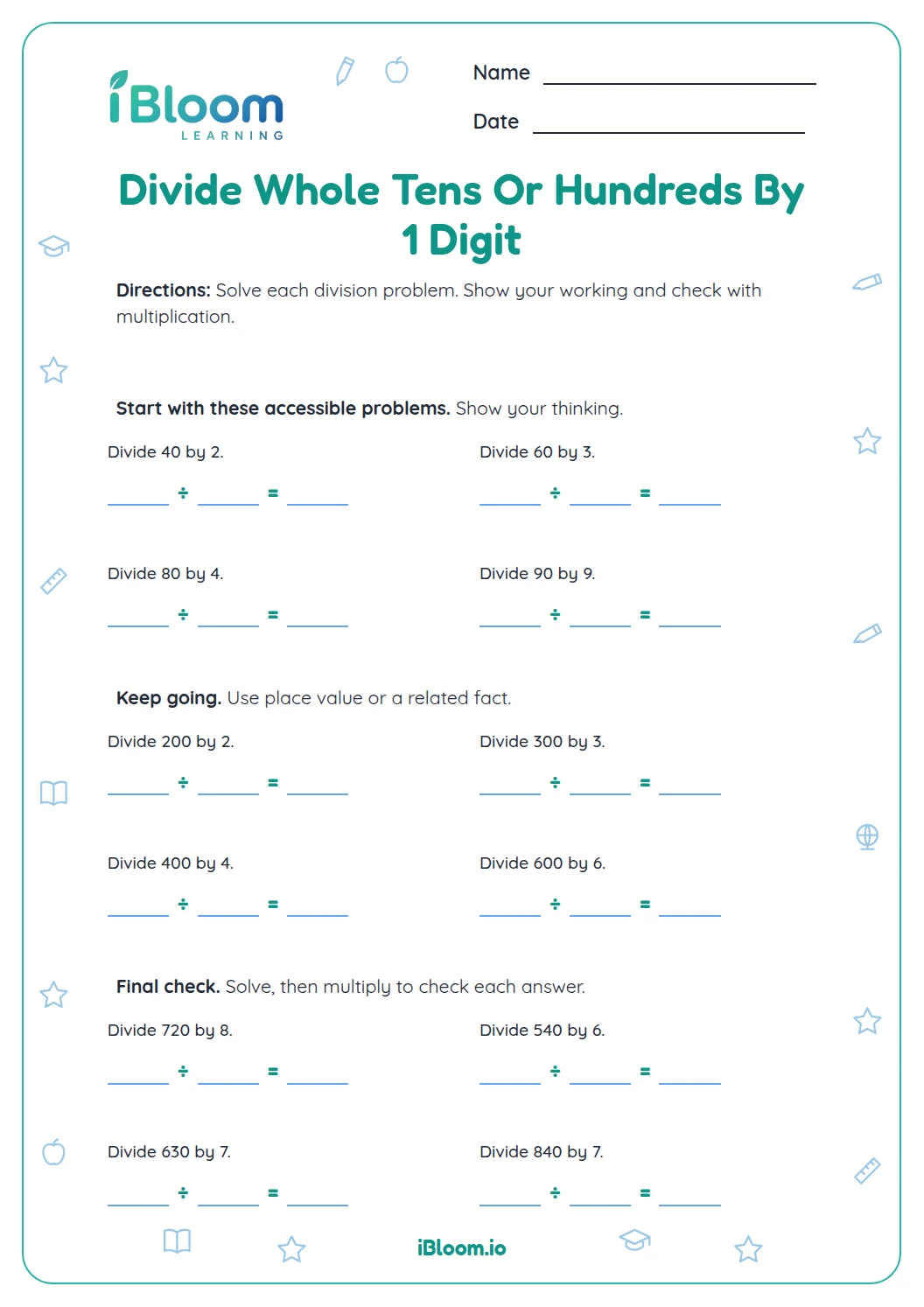
This free printable is for Grade 4 students practicing division with remainders within 1–100. It builds the idea through carefully sequenced questions, with space to calculate and check each result. The printable contains 20 items across 4 parts, followed by a separate answer key. The examples and directions name the exact step students should take, so families can use it for independent practice or work through one part together.
How does division with remainders within 1–100 work?
Division with a remainder describes equal groups and what is left. The quotient counts full groups; the remainder is less than the divisor.
Keep those two ideas in separate questions. For 46 ÷ 5, five groups of 9 use 45, so the quotient is 9 and one is left.
- 146 ÷ 5 = 9 R 1
- 25 × 9 = 45
- 345 + 1 = 46
What will students practice?
The first part asks for quotients, the second asks for remainders, and the final part switches between those targets. Each blank takes one number.
- Part A: 6 questions
- Part B: 6 questions
- Part C: 6 questions
- Part D: 2 questions
How can an adult support the practice?
Have the student estimate the number of full groups, then use multiplication and addition to check the quotient and remainder.
How to use this worksheet
- 1Read the directions for the first part and review the worked example about confusing the quotient with the remainder.
- 2Ask the student to name the operation or model before calculating.
- 3Complete one part at a time, writing each requested value in its own blank.
- 4Use the answer key to check the response and discuss any missed step.
- 5Return to a similar item and explain how the corrected method works.
Common mistakes and quick fixes
The mistake
confusing the quotient with the remainder
The fix
Pause before writing and identify exactly what the blank requests; record only that value.
The mistake
a remainder as large as the divisor
The fix
Write one intermediate step at a time, then check the result against the original expression.
The mistake
Rushing a calculation without checking whether the answer fits the question.
The fix
Substitute the result into the original problem or use the inverse operation to check it.
What to practice next
Make more practice
Questions parents and teachers ask
What skill does this page practice?
This page practices the named skill through twenty focused questions in four short parts. Students can complete a section, check the separate key, and revisit any calculation that needs another look. The first sections separate these targets, while later prompts ask students to read carefully before writing one value.
How can a student check a division answer?
Multiply the divisor by the quotient and add the remainder. The result should match the dividend, and the remainder must be smaller than the divisor for the division statement to be correct. This check confirms both the size of each group and the amount left over, so it is useful after solving mentally.
What is the difference between a quotient and a remainder?
For 23 ÷ 4, four groups of five use twenty, leaving three. The quotient is five and the remainder is three; the check is 4 × 5 + 3 = 23. Keeping the quotient and remainder distinct helps students explain what each number means in the division situation.
Can students complete this independently?
Complete one section before checking it. If an answer differs, compare the first multiplication or addition step with the key, then redo that step before changing the final answer. The drawn arrays and equations connect equal groups to multiplication, making the split visible before students use it.
How much time should we plan?
Yes. Each part has its own direction, and the questions move from focused practice to independent problems. An adult can review the first item, then let the student work at a steady pace. The first section asks for the first calculation only; later sections ask students to evaluate complete expressions using that order.
How much time should we plan?
Plan for about twenty-five minutes, adjusting for the student’s pace. The two-page worksheet can also be completed one page at a time, with the separate answer key used after each session. The separate answer key supports checking without interrupting the student’s first attempt.