Free printable practice
Multiplication Distributive Property Practice Activities
Grade 4 worksheets for using the distributive property to break apart multiplication facts and solve larger products mentally.
Practice that builds confidence
What the distributive property means
These Grade 4 math worksheets help children practise the multiplication distributive property as a mental multiplication strategy. Students learn to split one factor into friendlier parts, multiply each part, and add the partial products.
The printable activities include number sentences, missing-part problems, area-style thinking, and practice with equations such as 7 × 14 = 7 × 10 + 7 × 4. Children build flexibility while keeping multiplication accurate and organized.
The distributive property shows that a multiplication problem can be broken apart without changing the product. A child may solve 6 × 18 by thinking 6 × 10 plus 6 × 8, then adding 60 + 48. This supports mental multiplication because students use known facts and place-value parts instead of relying only on written algorithms.

How practice progresses
These worksheets move from clear split-apart models to more independent equation work. Children may identify the two parts of a factor, complete an equivalent expression, or compare two ways to decompose the same product. The focus is not memorizing a rule name; it is understanding that 8 × 23 can become 8 × 20 + 8 × 3 and still represent the same total.
A parent routine that works
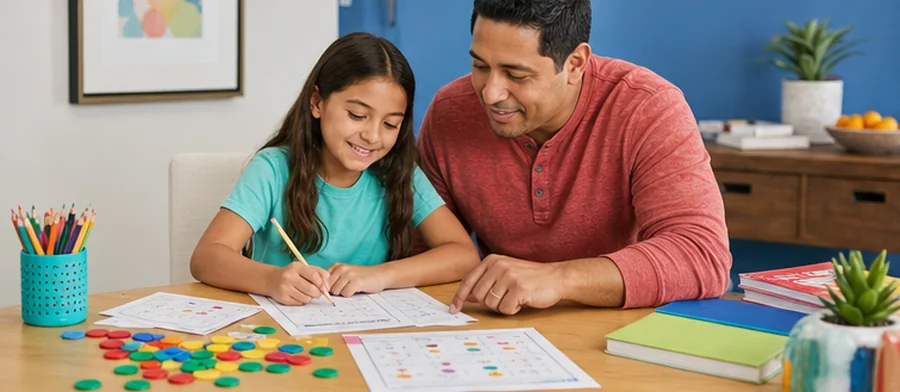
At home, choose one problem and ask your child to circle the factor that looks harder. Have them break it into tens and ones, write both smaller multiplication facts, and add the partial products aloud. For example, with 4 × 27, they can say, “4 groups of 20 is 80, 4 groups of 7 is 28, so the product is 108.” Then let them solve two similar problems independently and explain their split.
Classroom uses for teachers
Teachers can use these pages during mental math warm-ups, small-group reteaching, math centers, or as follow-up practice after an area model lesson. The problems are useful for discussing multiple valid decompositions, such as splitting 15 into 10 + 5 or 8 + 7. Students can also pair up and check whether each written expression is equivalent to the original multiplication problem.

Common errors to watch for
Some students multiply only one part, as in 5 × 16 = 5 × 10 + 6, instead of multiplying both 10 and 6 by 5. Others split a factor correctly but forget to add the partial products at the end. Watch for place-value mistakes, especially when multiplying by tens, and remind children that the equal sign means both sides have the same value.
Free printable PDF download
Use this multiplication distributive property worksheets grade 4 page to preview the activity, print it, or download it as a PDF for quick practice. It works well for homework, homeschool lessons, tutoring, morning work, revision, and classroom centers.
Answers and answer key support
After the child completes the worksheet independently, parents and teachers can use the answer support or answer key information to check the work, review mistakes, and choose the next practice step.
Why iBloom worksheets help
The activities keep the strategy visible through structured equations and repeated reasoning. A child-friendly strategy is: split, multiply both, add. Saying those three steps before solving helps students slow down, use vocabulary such as factor, product, decompose, and partial product, and build confidence with larger multiplication facts.
Helpful answers
Frequently asked questions
What does the distributive property help Grade 4 students do?
It helps students break a larger multiplication problem into smaller, easier facts. For example, 9 × 24 can be solved as 9 × 20 plus 9 × 4.
Are these worksheets only for students who already know all multiplication facts?
No. They are especially helpful for students who know many basic facts but need a strategy for larger products. The structure shows how known facts can be combined.
How is this different from the standard multiplication algorithm?
The distributive property focuses on mental reasoning and place-value decomposition. Instead of lining up digits first, students split a factor, multiply each part, and add the partial products.
What mistake should I correct first if my child is struggling?
Check whether your child is multiplying both parts after the split. In 3 × 14 = 3 × 10 + 3 × 4, both 10 and 4 must be multiplied by 3.
Can these pages support area model multiplication?
Yes. The same thinking is used in area models: one side length is split into parts, each smaller rectangle is multiplied, and the areas are added.
Is this multiplication distributive property worksheets grade 4 free?
Yes. You can preview it for free and use the printable worksheet for home or classroom practice.
Can I download this multiplication distributive property worksheets grade 4 as a PDF?
Yes. Use the worksheet download option to save a printable PDF, or print the worksheet directly from the page.
Does this multiplication distributive property worksheets grade 4 include answers or an answer key?
When the activity has fixed answers, iBloom includes answer support so parents and teachers can check the completed worksheet.