




About this worksheet
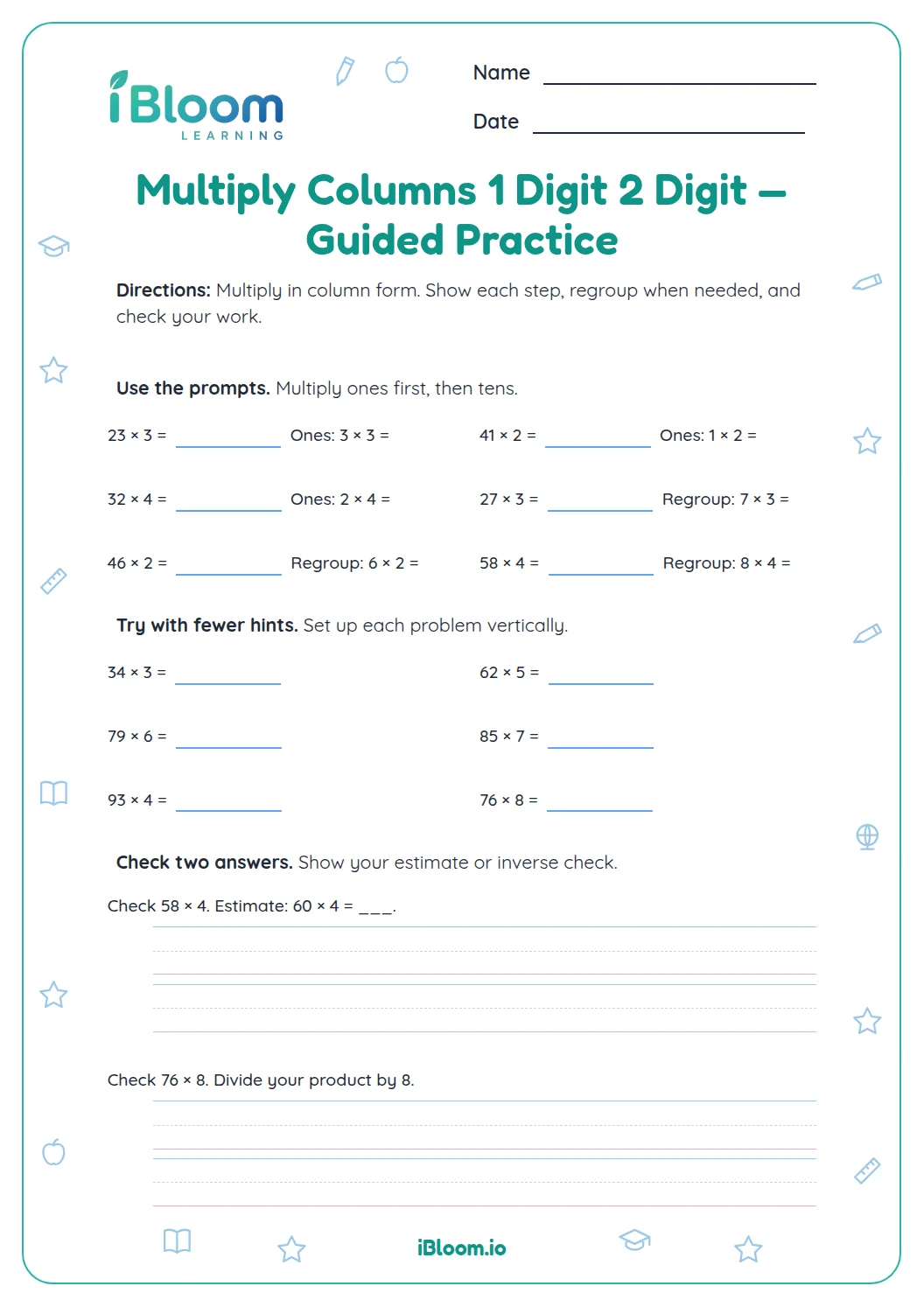
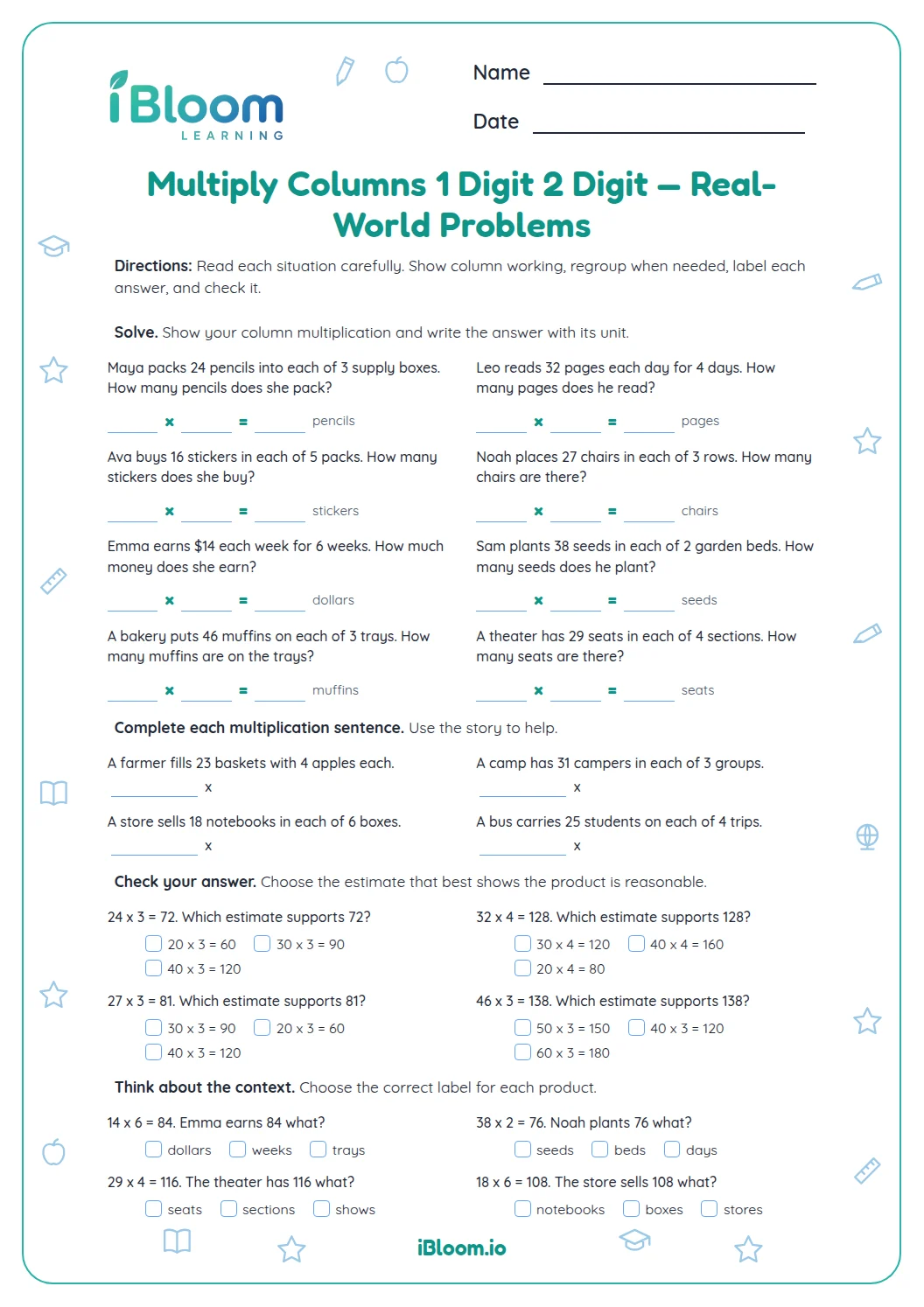
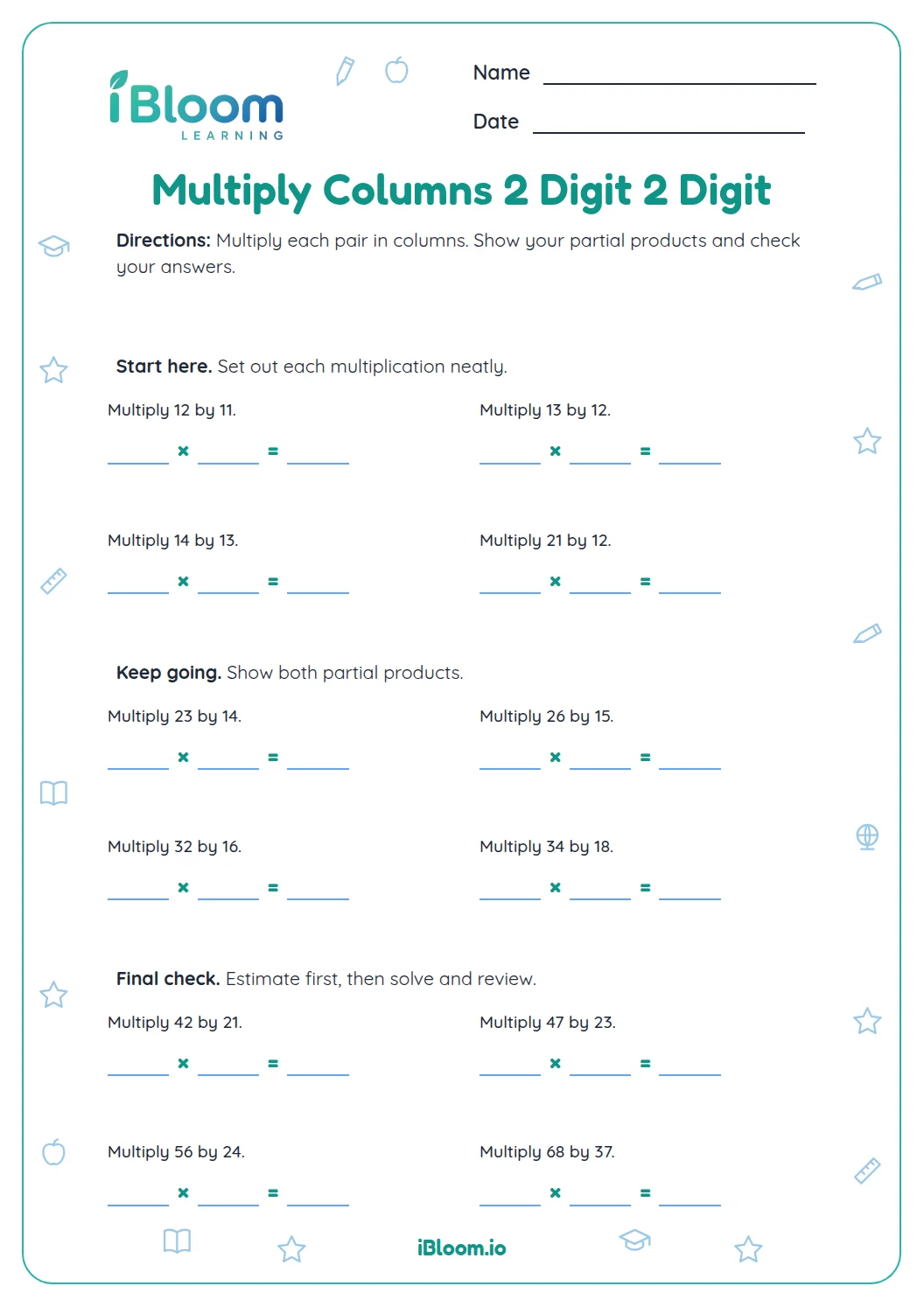
This free printable Grade 4 worksheet introduces two-digit by one-digit multiplication in columns. Students set up each printed problem, multiply the ones, regroup when needed, then multiply the tens. Sixteen problems progress from building the method to independent column practice, with a separate answer key. The work uses place-value strategies in Common Core 4.NBT.B.5.
Aligned to 4.NBT.B.5
How can place value make multiplication easier?
Write the two-digit number above the one-digit factor, lining up the ones digits. Multiply the ones first, regroup any tens, then multiply the tens and add the regrouped amount.
For 23 × 3, 3 × 3 ones = 9 ones and 3 × 2 tens = 6 tens, so the product is 69.
- 123 × 3
- 23 × 3 = 9 ones; 3 × 2 tens = 6 tens
- 323 × 3 = 69
What will students practice on these pages?
All 16 problems print both factors. The first two sections build column setup and regrouping; the final section gives six more products to solve independently.
How can students check a product?
Estimate first by rounding the larger factor to a nearby ten, hundred, or thousand. After multiplying, compare the exact product with the estimate. Students can also add the partial products again or use a related division fact when it is manageable.
How to use this worksheet
- 1Write the larger factor above the one-digit factor.
- 2Line up the ones digits.
- 3Multiply the ones and write any regrouped ten above the tens place.
- 4Multiply the tens and include the regrouped amount.
- 5Check that the product has the right place value.
Common multiplication slips
The mistake
Forgetting a place-value zero in a partial product.
The fix
Label each partial product by tens, hundreds, or thousands before adding.
The mistake
Adding the carry digit to the wrong column.
The fix
Write each carry above the next place and include it in that column’s multiplication.
The mistake
Stopping after multiplying the first digit.
The fix
Check that every digit in the larger factor has been multiplied.
Common Core alignment
This page practices Grade 4 whole-number multiplication with place-value strategies.
Multiply up to four-digit whole numbers by one-digit numbers using place value.
On this sheet: Students multiply two-digit whole numbers by one-digit numbers using place-value strategies.
Show the official wordingHide the official wording
Multiply a whole number of up to four digits by a one-digit whole number, and multiply two two-digit numbers, using strategies based on place value and the properties of operations. Illustrate and explain the calculation by using equations, rectangular arrays, and/or area models.
What to practice next
Make more practice
Further reading
Questions parents and teachers ask
Are the factors printed on the student worksheet?
Yes. Every equation includes both factors and a product blank on the student page. Students can start solving each problem right away, then use the separate key only when they are ready to check their work. Encourage students to write each step neatly so regrouping is easy to follow.
How many problems are included?
There are 16 multiplication equations grouped into three sections. Students can show their work in the space provided, keep the factors aligned by place, and use the separate answer key to check each product when finished. The sections move from a short warm-up to continued and final practice.
What strategy can students use?
Students can break the larger factor into tens, hundreds, and ones, multiply each part, and add the partial products. They may also use the standard algorithm while keeping place values aligned and recording any regrouping clearly. An estimate helps students decide whether the final answer is reasonable.
What does the answer key show?
The answer key lists the product for all 16 equations. Students can compare one result at a time and revisit their place-value work if a product does not match, checking each partial product and regrouping step carefully. Students can correct an error by finding the first step that changed the value.
Which standard does this page practice?
It aligns with Common Core 4.NBT.B.5, which includes multiplying a whole number of up to four digits by a one-digit whole number using place-value strategies and properties of operations. This page practices that whole-number multiplication in each printed equation.