



About this worksheet
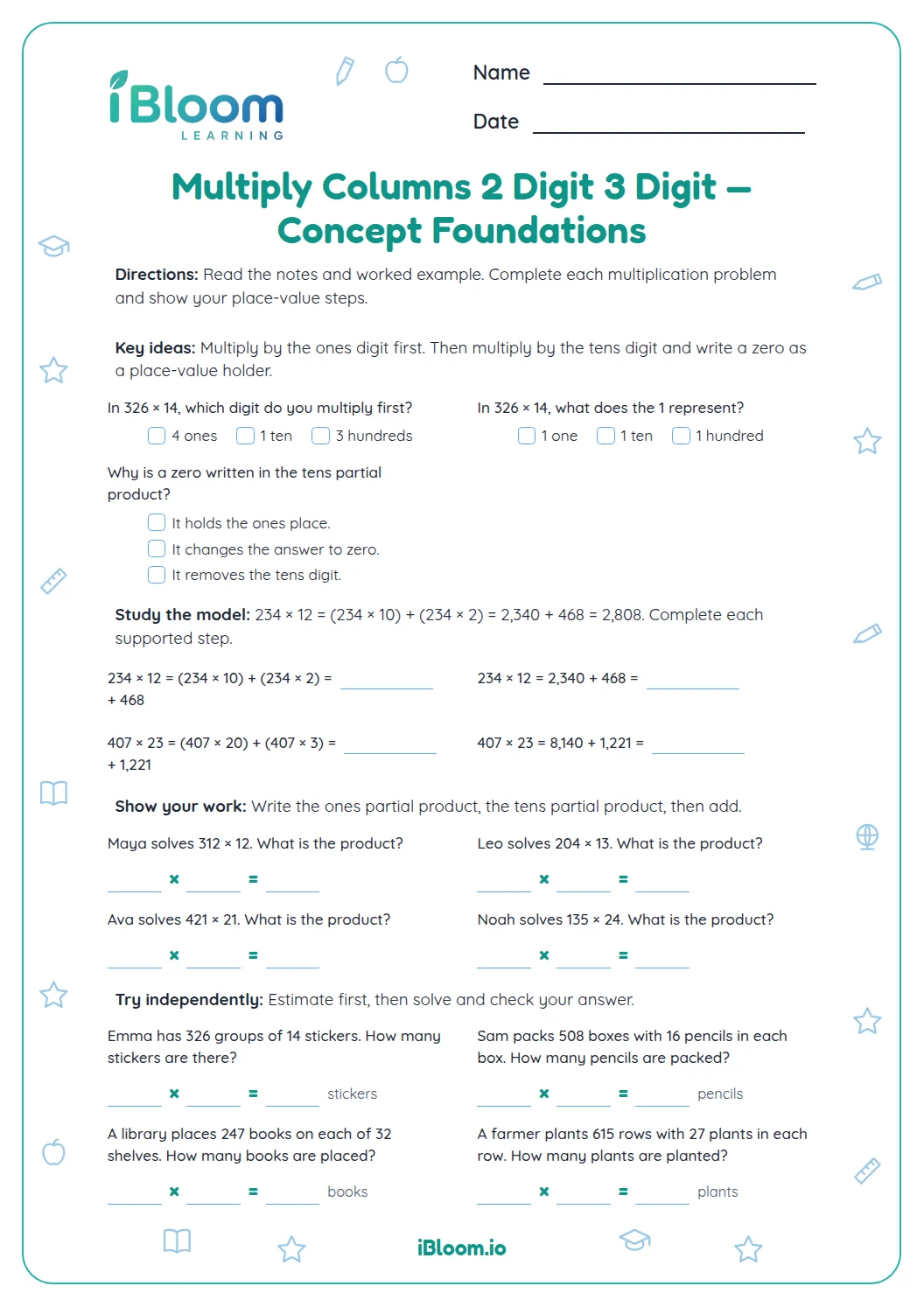
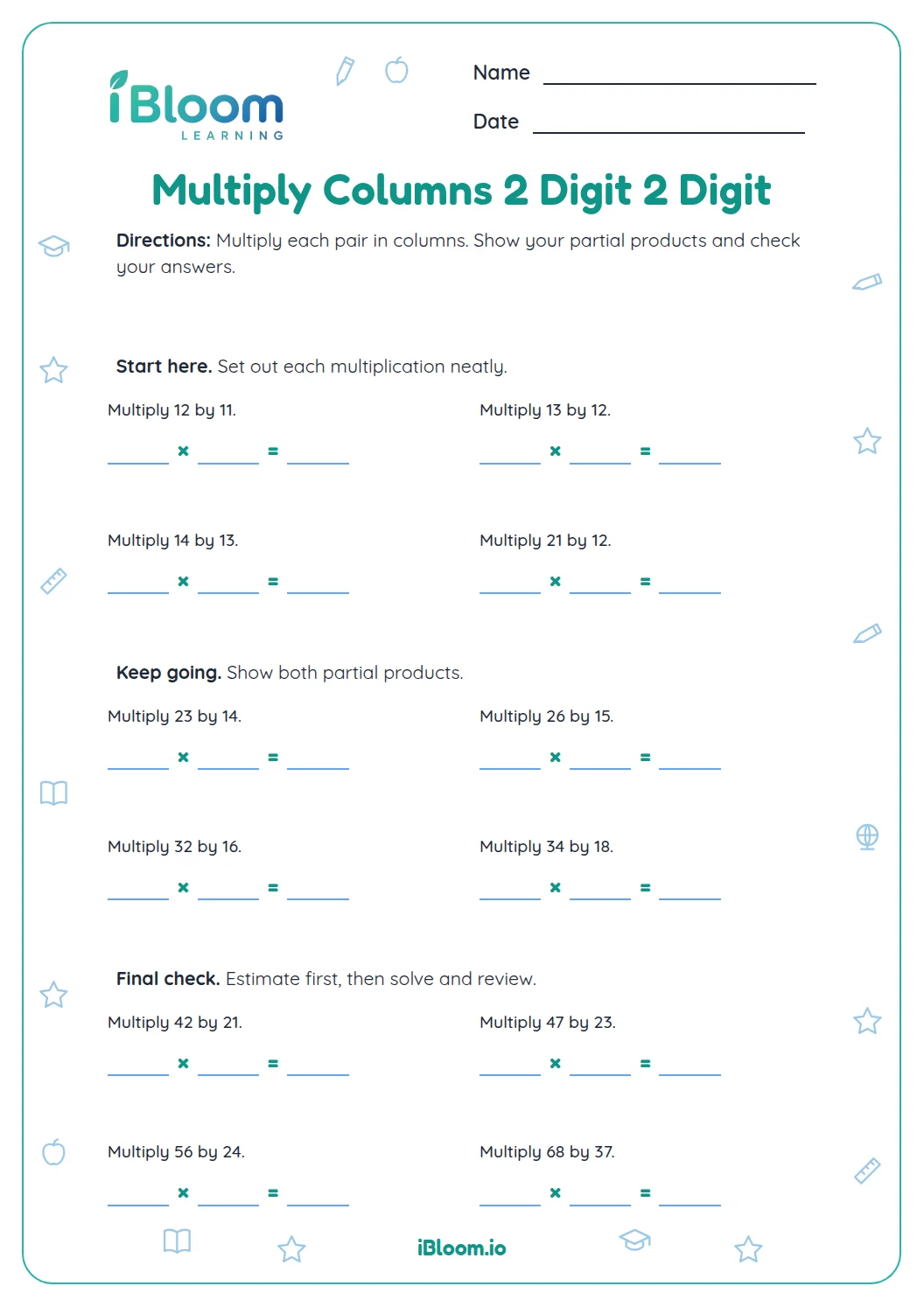
This printable gives Grade 4 students 20 two-digit by three-digit multiplication problems to solve in columns. Every prompt shows both factors. Students record the ones and tens partial products in the correct columns, then add and estimate to check. The separate answer key lists every product.
Aligned to 4.NBT.B.5
How do you multiply a three-digit number by a two-digit number?
Break the two-digit factor into tens and ones. Multiply the three-digit number by each part, then add the partial products. Keep the tens product one place to the left, or write its zero, so the place values stay aligned.
For 124 × 23, find 124 × 3 = 372 and 124 × 20 = 2,480. Add 372 + 2,480 to get 2,852. An estimate of about 2,400 confirms the product is reasonable.
- 1124 × 23
- 2124 × 3 = 372
- 3124 × 20 = 2,480
- 4372 + 2,480 = 2,852
How is the practice organized?
Part A contains ten multiplication problems with regrouping and zeroes in factors. Part B has ten more products, with estimates as a check. All 20 expressions appear on the student sheet.
- Part A: 10 products; show both partial products and their sum
- Part B: 10 products; estimate to check
- Separate answer key lists all 20 products
How to use this worksheet
- 1Set up each multiplication vertically, lining up ones, tens, and hundreds.
- 2Multiply by the ones digit and write the first partial product.
- 3Multiply by the tens digit and shift one place left before adding.
- 4Estimate each product to catch a place-value or regrouping error.
Common mistakes and quick fixes
The mistake
Adding the tens partial product without shifting it left.
The fix
Remember that the second digit is tens; 3 in 23 means 30.
The mistake
Forgetting to regroup a ten or hundred.
The fix
Add the carried value into the next column before moving on.
The mistake
Writing a product that is far from the estimate.
The fix
Round both factors and compare the rough product with your answer.
Common Core alignment
This worksheet practices Grade 4 multi-digit multiplication with whole numbers.
Multiply a whole number of up to four digits by a one-digit number and two two-digit numbers.
On this sheet: Students multiply a three-digit factor by a two-digit factor and combine partial products.
Show the official wordingHide the official wording
Multiply a whole number of up to four digits by a one-digit whole number, and multiply two two-digit numbers, using strategies based on place value and the properties of operations. Illustrate and explain the calculation by using equations, rectangular arrays, and/or area models.
What to practice next
Make more practice
Further reading
Questions parents and teachers ask
Why does the tens product shift left?
The second digit in a two-digit factor represents tens. For 23, the 2 means 20, so multiply by 20 and place that partial product one column left of the ones product. This keeps the written calculation aligned with each digit’s value.
How can a student check a product?
Round each factor to a nearby ten or hundred and estimate the product. Compare that estimate with the exact product you found. If the values seem far apart, review the tens partial product, any regrouping, and the alignment of each place-value column.
How many problems are on the sheet?
There are 20 multiplication problems in two parts: ten regrouping problems and ten place-value problems. Each shows a three-digit factor and a two-digit factor. The separate answer key follows the same order so students can check each product.
Is an answer key included?
Yes. A separate answer-key page lists all 20 products in question order. Students can finish the problems first, compare each result with its expression, and revisit any calculation that needs another look or estimate before moving on to the next problem.
What should students write while multiplying?
Set up each expression vertically. Write the product for the ones digit, then multiply by the tens digit and shift that partial product one place left. Add both partial products to find the final answer and check the place values.