


About this worksheet
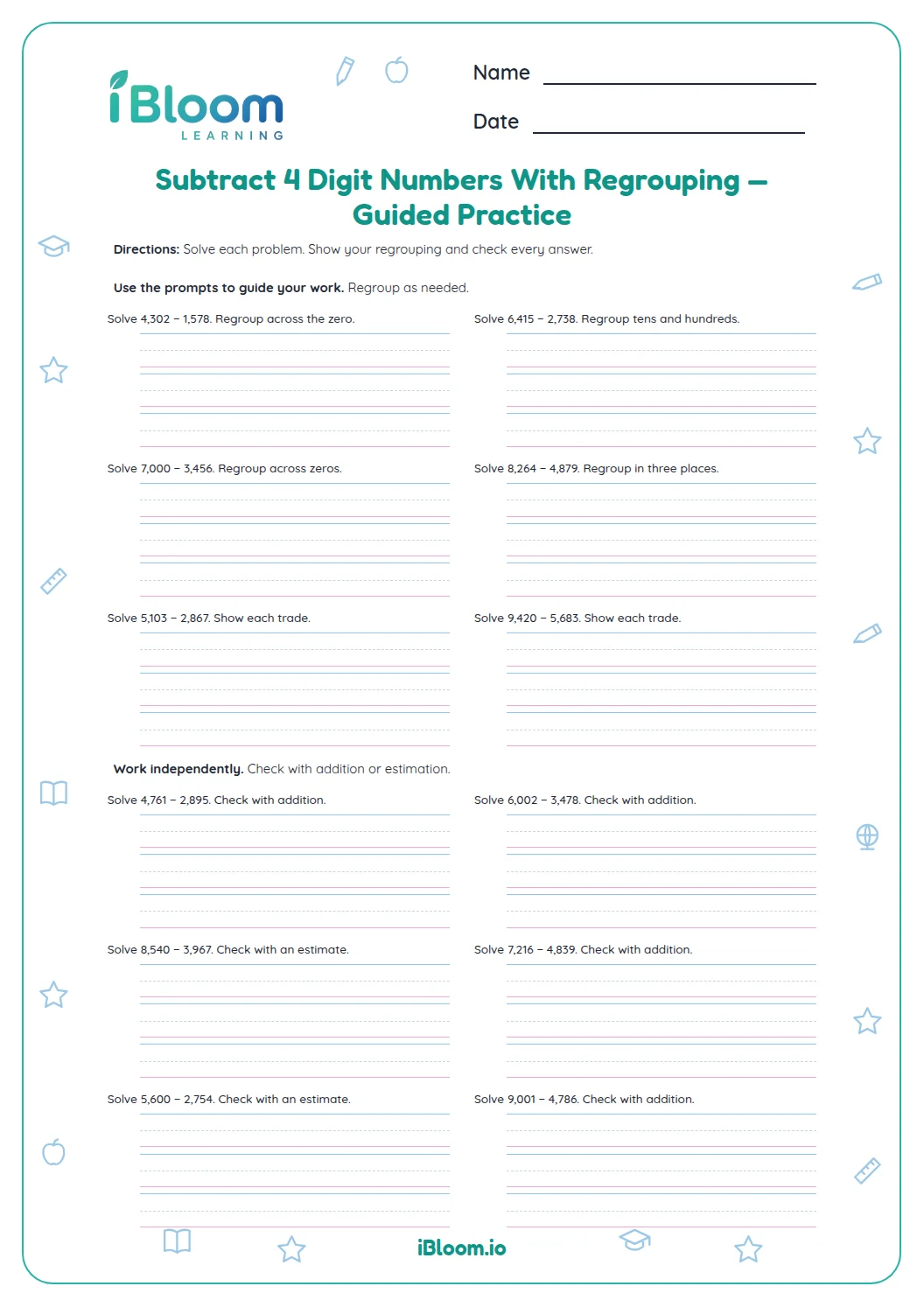
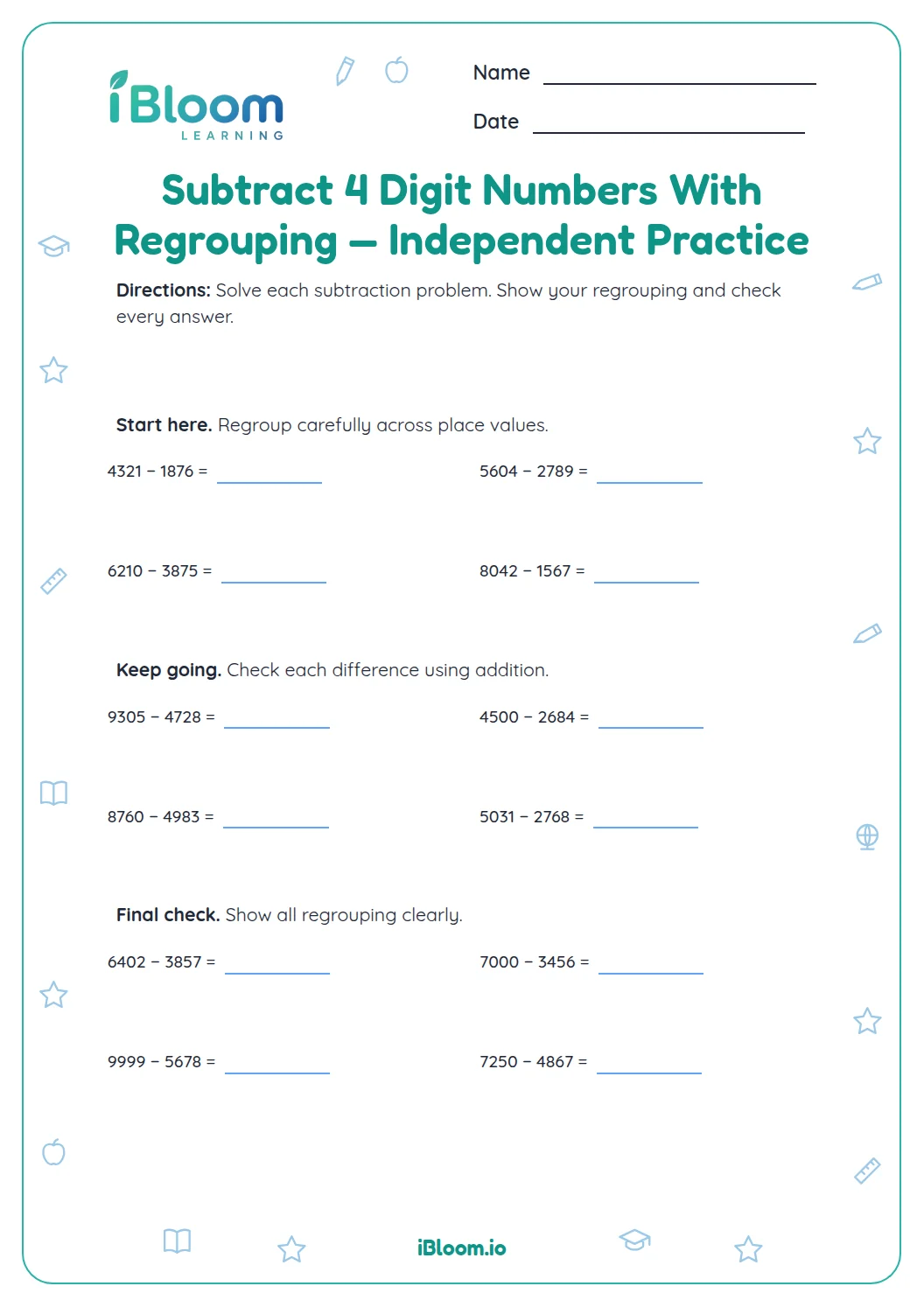
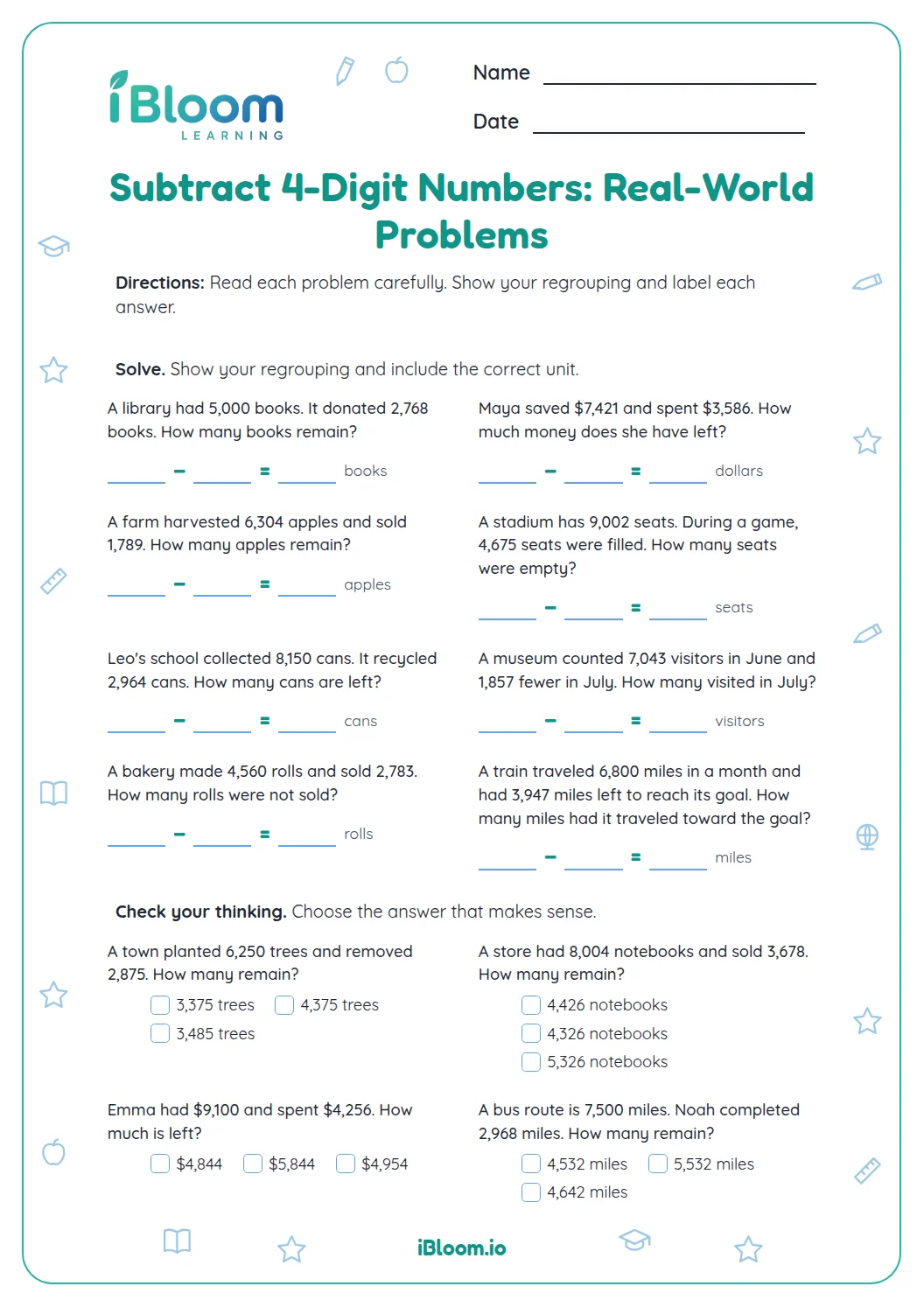
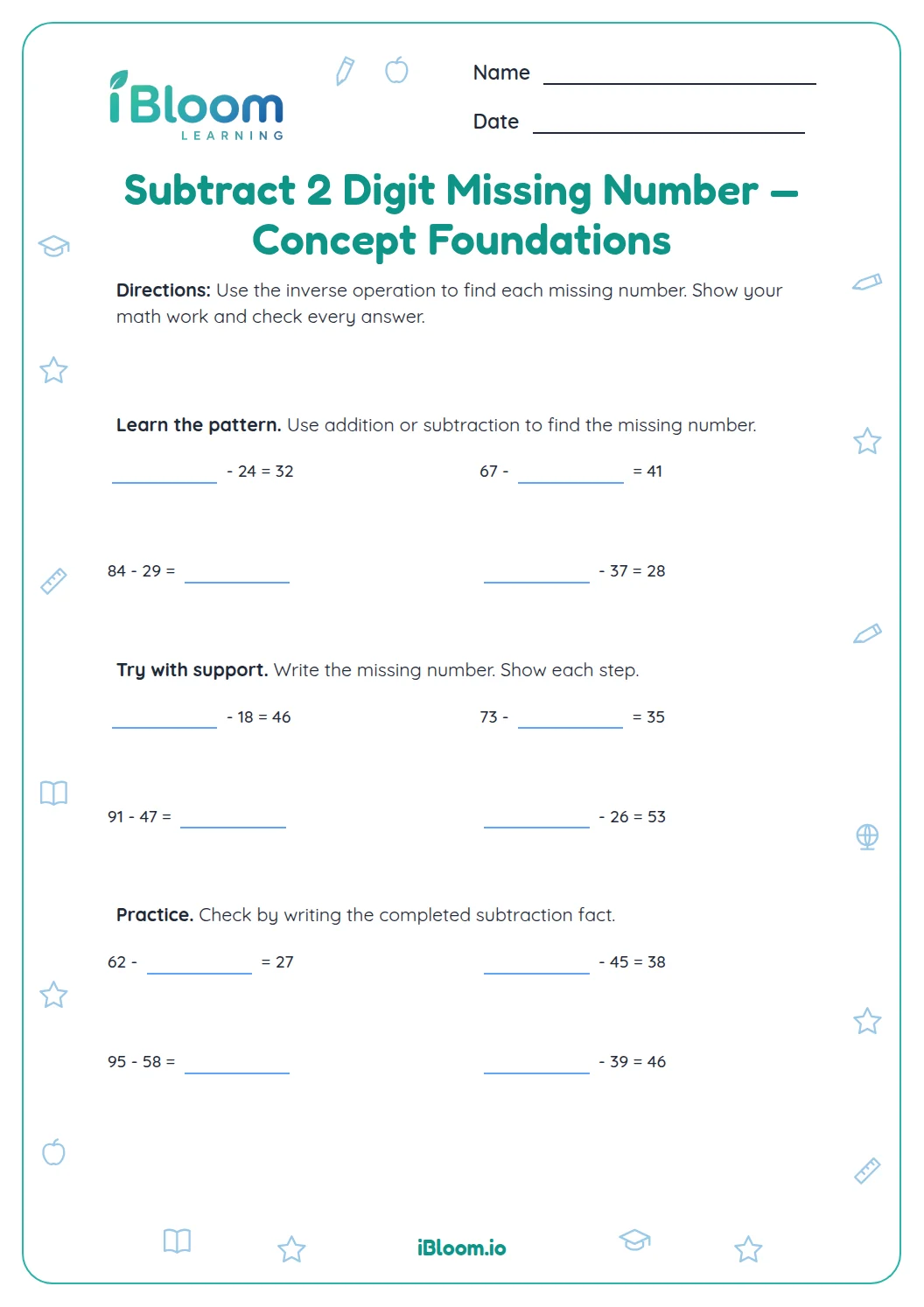
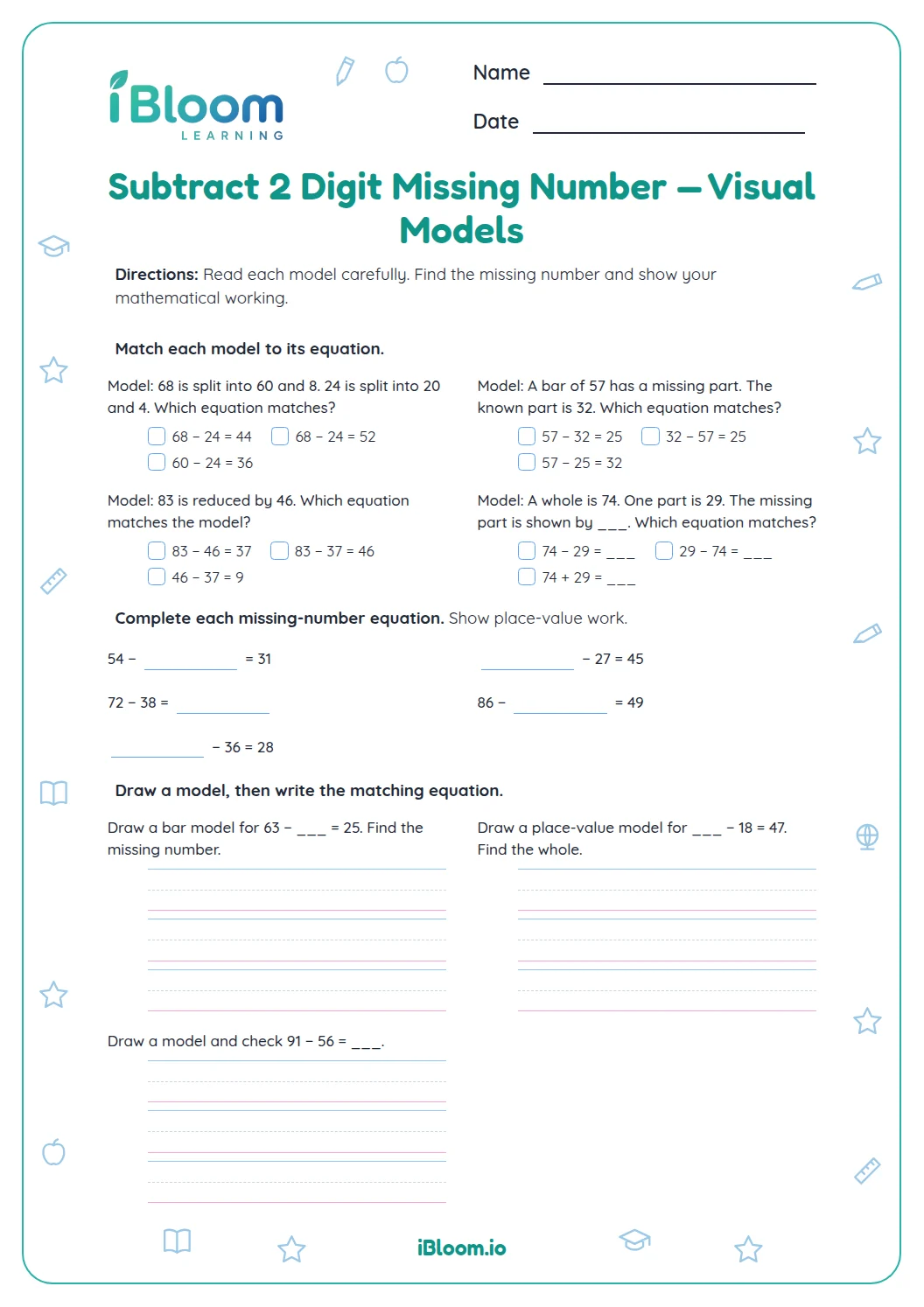
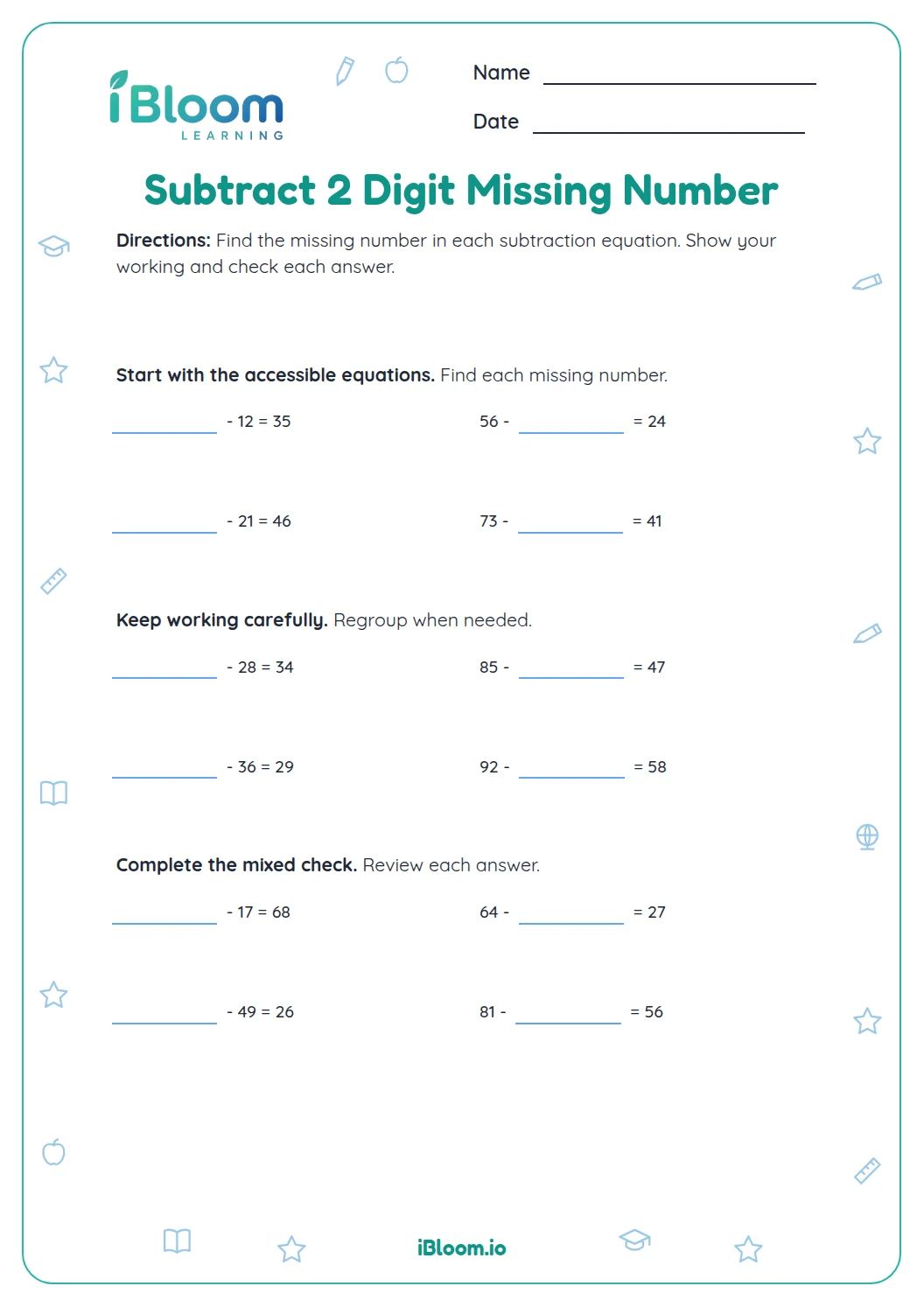
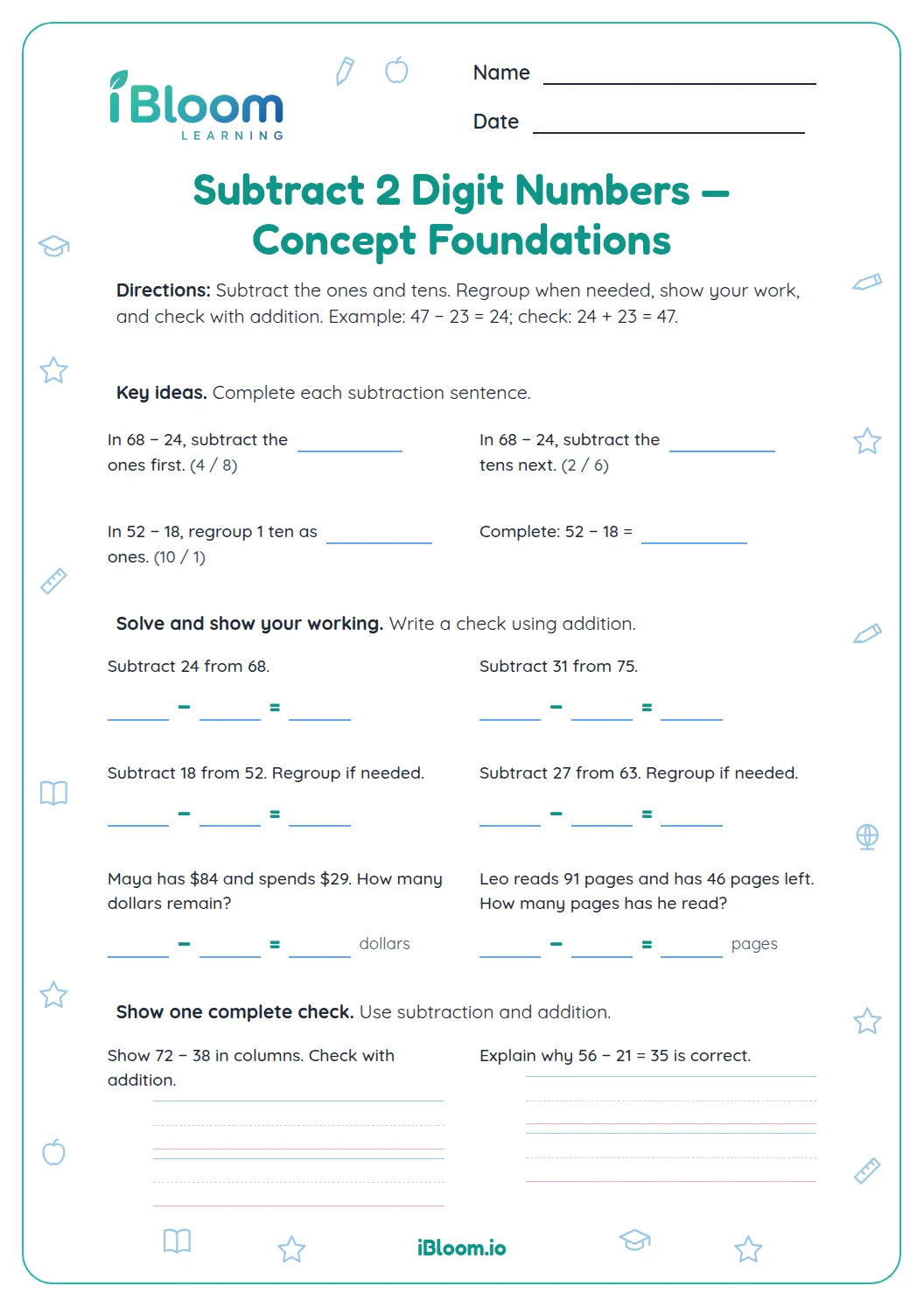
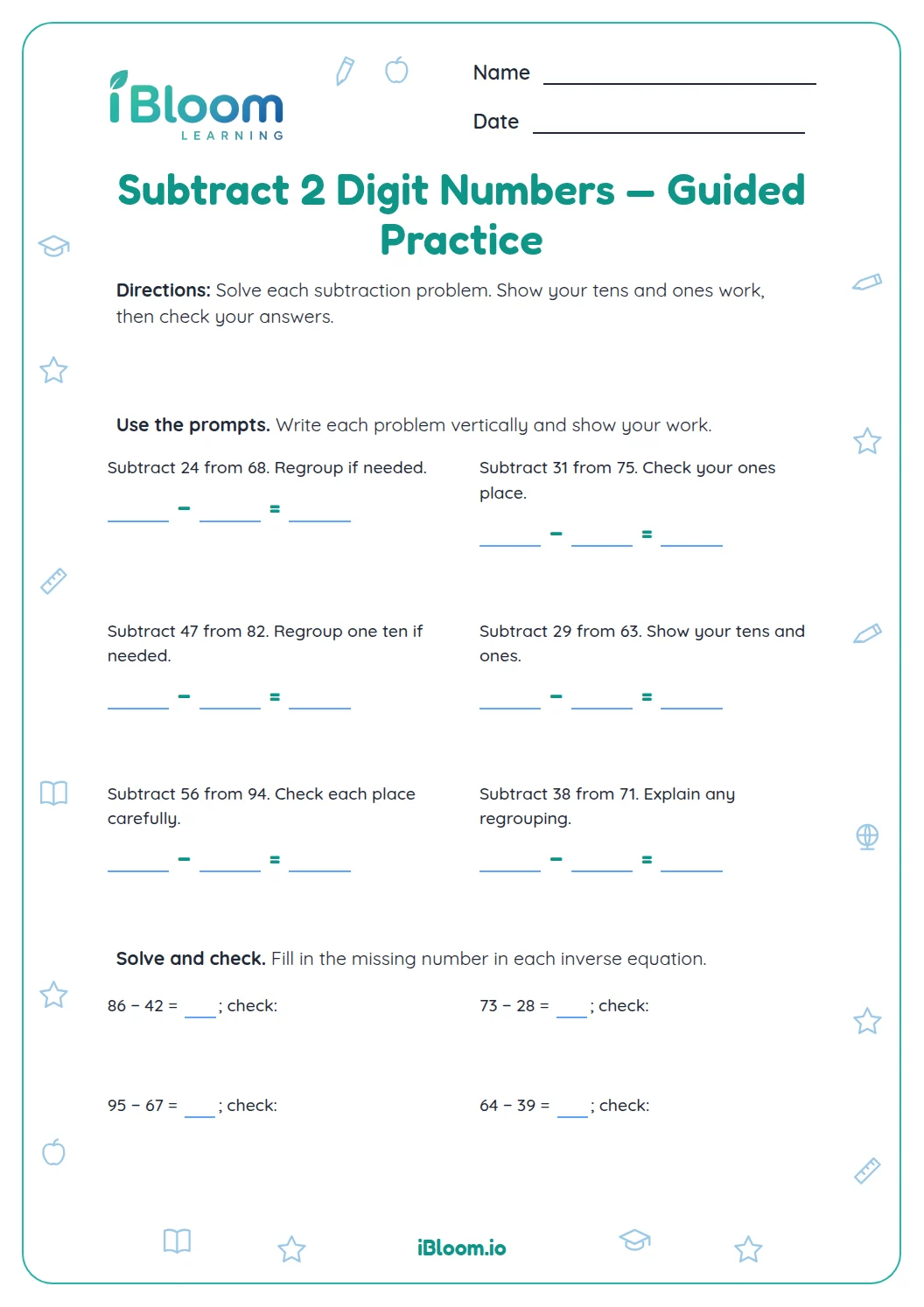
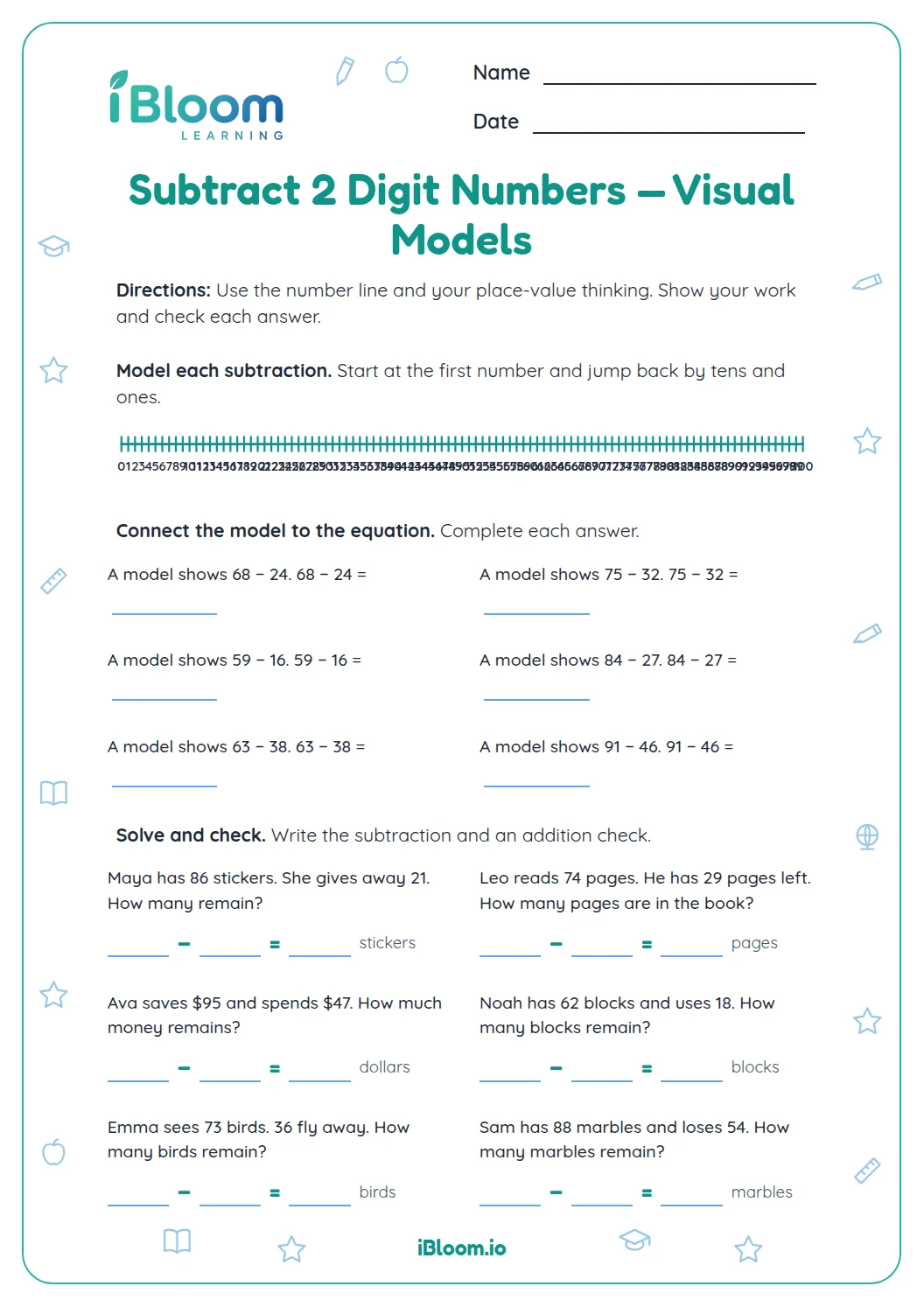
This free printable Grade 4 worksheet gives students 16 subtraction problems. Each prompt prints the numbers to subtract or a complete missing-number equation, and the final part leaves room to show a written method. The separate answer key includes the results. Students practice regrouping and place-value computation for CCSS 4.NBT.B.4.
Aligned to 4.NBT.B.4
How should students set up each problem?
Line up digits by place value before you subtract. For example, 4,326 − 1,758; work across the columns and check the result.
- 14,326 − 1,758
- 2Answer: 2,568
What changes across the four parts?
Part A gives direct computations. Part B asks for a missing factor or number. Part C gives more computations, and Part D provides work grids for recording a method.
How many problems are included?
There are 16 questions across 2 worksheet pages, followed by 2 answer-key pages. Each student prompt includes the numbers needed to solve.
How to work through the page
- 1Read the full number sentence and identify the operation.
- 2Align digits by place value before you subtract.
- 3Work one place at a time and record regrouping or partial products.
- 4Use an estimate or inverse operation to check the result.
- 5Compare with the separate answer key after solving.
Common mistakes and quick fixes
The mistake
Digits drift into the wrong place-value column.
The fix
Write ones under ones, tens under tens, and so on before computing.
The mistake
A regrouped value is not reduced in the column it came from.
The fix
After regrouping, update both affected digits before continuing.
The mistake
A place value is skipped during the calculation.
The fix
Check each column or partial product before combining the results.
Common Core alignment
This worksheet practices multi-digit computation using place-value strategies.
Fluently subtract multi-digit whole numbers using the standard algorithm.
On this sheet: Students subtract whole numbers using regrouping across place-value columns.
Show the official wordingHide the official wording
Fluently add and subtract multi-digit whole numbers using the standard algorithm.
What to practice next
Make more practice
Further reading
Questions parents and teachers ask
Are the numbers printed on the student page?
Yes. Every calculation shows its operands, and every missing-number item shows the full equation with its known values. Students can solve from the worksheet without referring to the key. The answer key is printed separately for checking after the work is complete.
How many problems are on the worksheet?
The worksheet has 16 questions in four parts across 2 student pages. The answer key follows on 2 pages. The parts move from direct computations to missing-number equations and a final set with work space. Students can complete one part at a time and use the separate key only after solving.
What should students do in the first part?
Students solve the printed differences in Part A. They should align digits by place value and work carefully through each place. For multiplication, partial products keep the values organized; for subtraction, regroup when needed. Estimating first helps check whether the result is reasonable.
How does the missing-number part work?
Each Part B item shows an equation with one unknown. Students can use the known values and the inverse operation to find the missing number, then substitute it back to check. The printed operands and result make each equation solvable without the answer key.
What does the answer key include?
The key lists the answer for each of the 16 questions on separate pages. The written computation items include their final result so an adult can compare the student’s work with the correct answer. Check the operations and the place values before reviewing speed.
Which standard does this page practice?
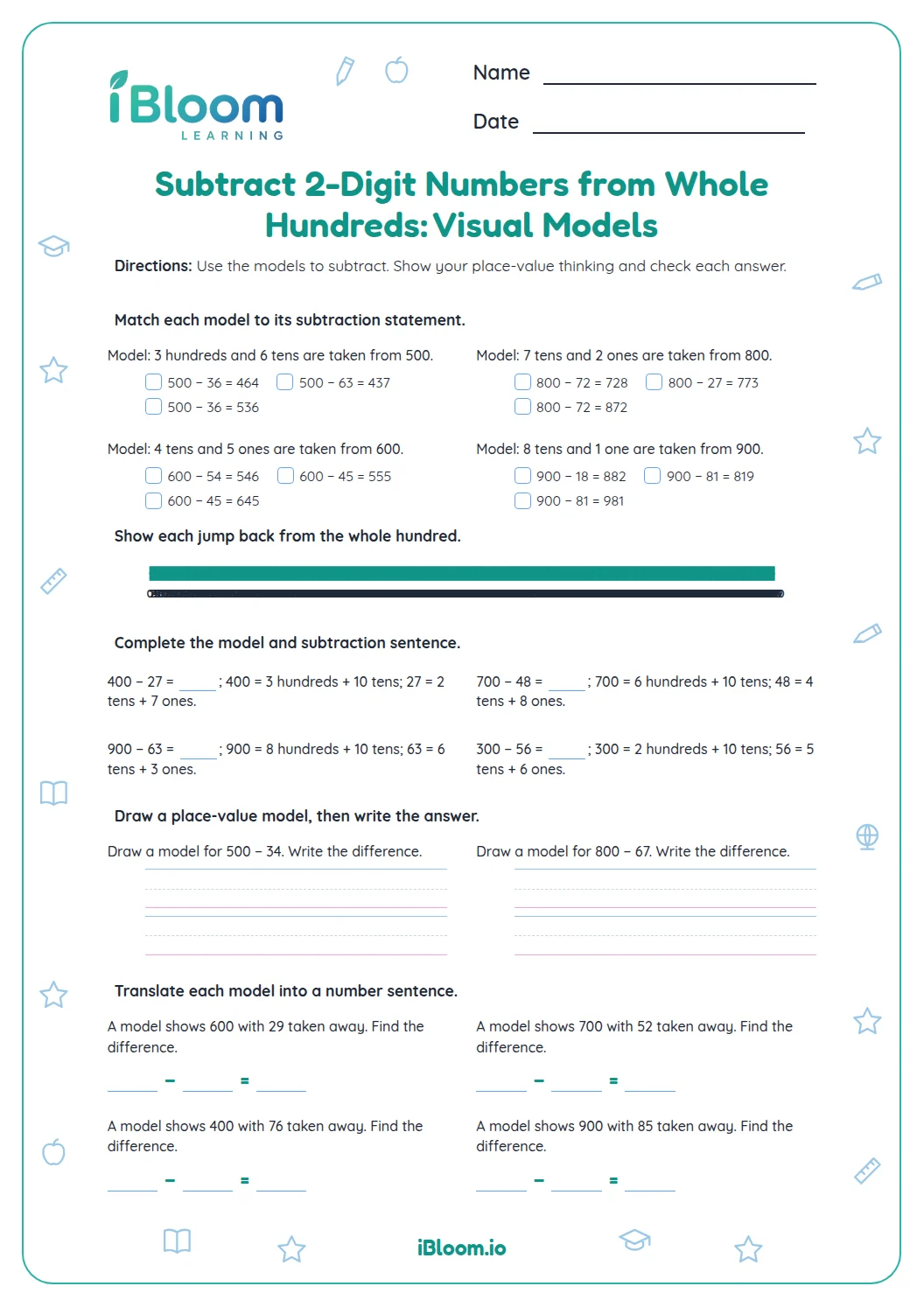
It practices CCSS 4.NBT.B.4 by asking students to subtract multi-digit whole numbers using place-value organization. The four-digit sheet includes regrouping across places; the whole-hundreds sheet subtracts two-digit numbers from multiples of one hundred. Students can check a difference by adding it to the number being subtracted.