
About this worksheet
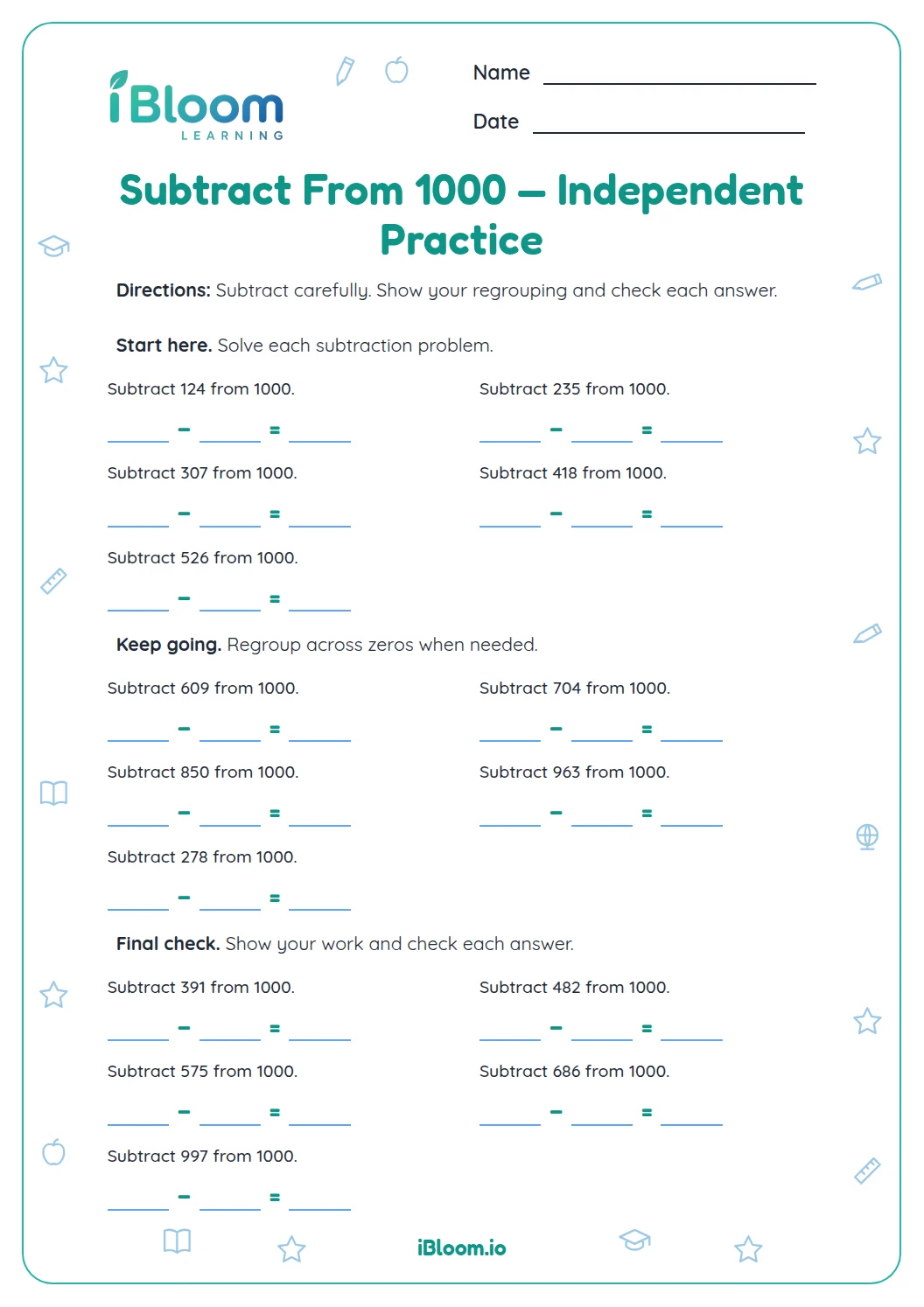
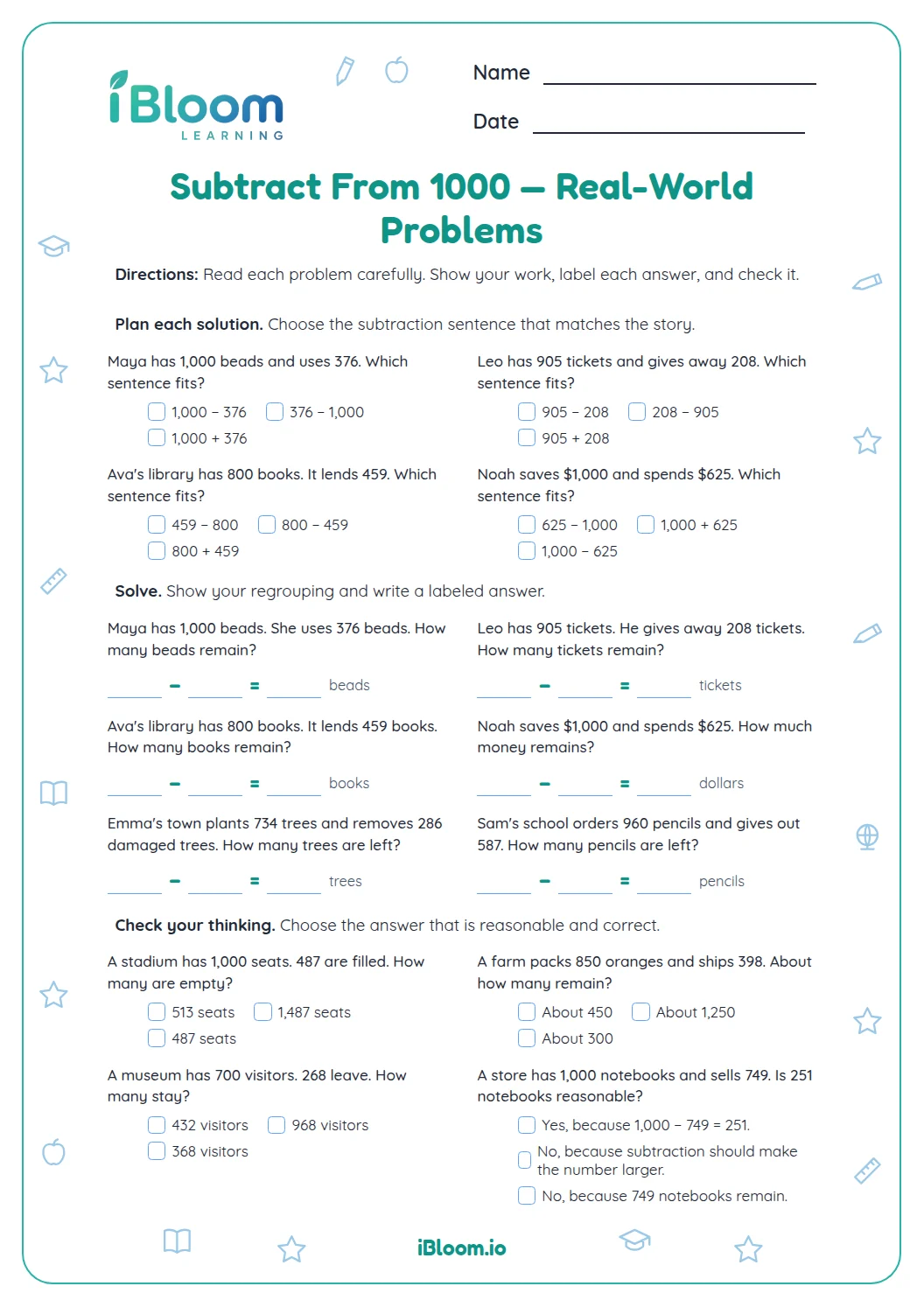
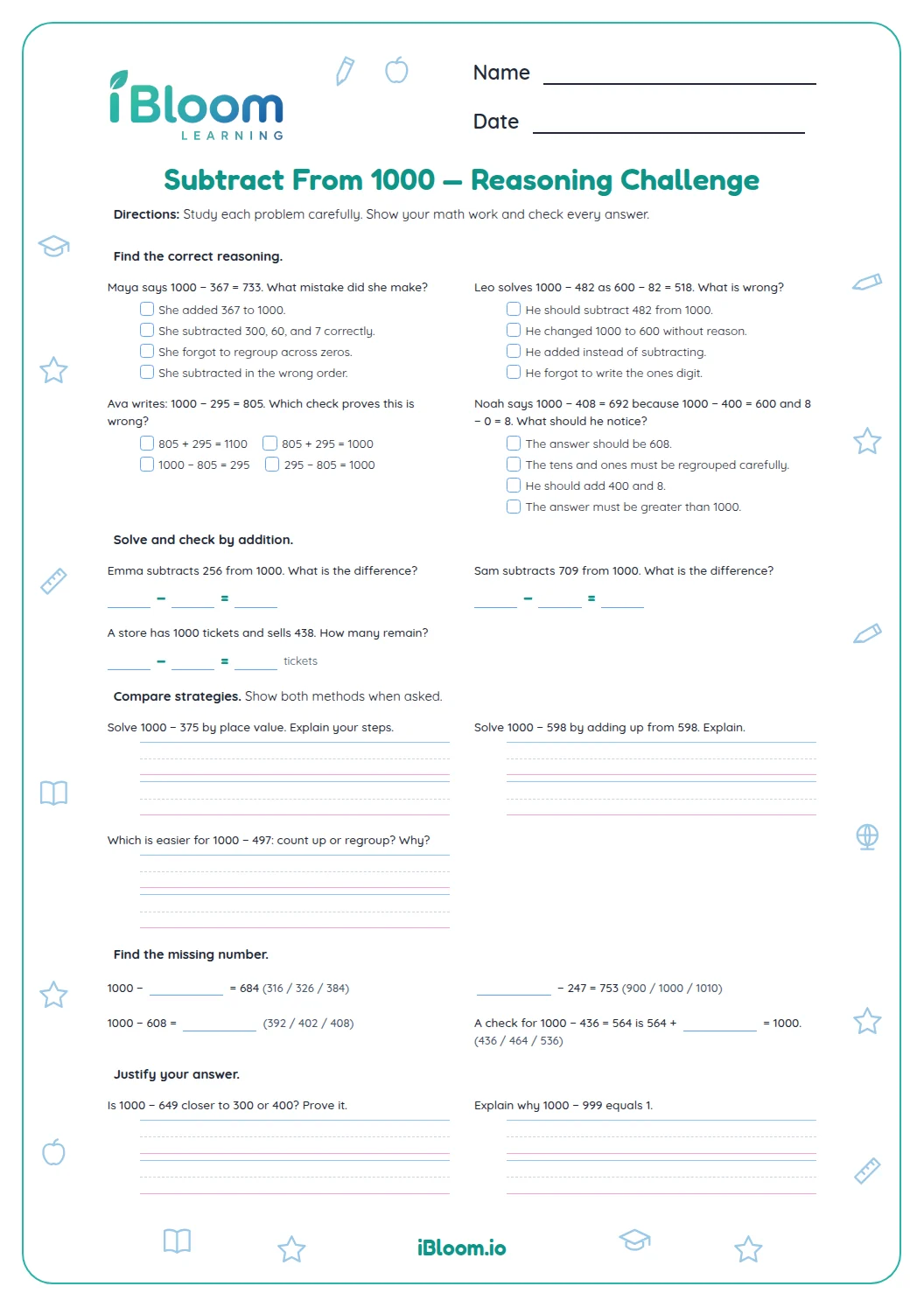
This Grade 4 worksheet gives students practice with use place-value models to subtract from 1,000. It has 16 printed questions on two worksheet pages, followed by a two-page answer key. Students work through 2 sections, using the printed numbers and equations on the student pages. The answer key provides the results for checking each item. The problems practice CCSS 4.NBT.B.4, as described in the curriculum alignment below.
Aligned to CCSS.MATH.CONTENT.4.NBT.B.4
How can a number bond show subtraction from 1,000?
Each number bond shows 1,000 as the whole. One part is the amount taken away; find the missing part to get the difference. For example, removing 236 leaves 764 because 236 + 764 = 1,000.
What else does the worksheet ask students to solve?
After the four number bonds, students solve subtraction equations and short situations involving boxes and seedlings. The final questions include regrouping 1,000 into hundreds, tens, and ones.
How can the answers be checked?
Add the subtracted amount to the difference. The total should be 1,000, or the original starting amount shown in a story problem.
How to work through the sheet
- 1Read the section direction before beginning its problems.
- 2Copy or use the numbers printed in each question.
- 3Show calculation steps in the working space when provided.
- 4Check the result against the answer key after solving.
Check your work
The mistake
Forgetting place value or sign rules while calculating.
The fix
Write each step clearly, then estimate or use the inverse operation to check.
Curriculum alignment
This worksheet practices the named grade-level skill.
Fluently add and subtract multi-digit whole numbers using the standard algorithm.
On this sheet:
Show the official wordingHide the official wording
Fluently add and subtract multi-digit whole numbers using the standard algorithm.
What to practice next
Questions parents and teachers ask
How do the number bonds model subtraction?
Each bond shows 1,000 as the whole and the amount removed as one part. The missing part is the difference. For example, 1,000 split into 236 and 764 shows that 1,000 − 236 = 764; adding the parts checks the model.
What is included on the worksheet?
The 16 questions include four number bonds, subtraction equations, two short applications, and a place-value regrouping question. The numbers are printed on the student pages, and the answer key follows on two pages for checking. Use the printed factors and directions to guide each step, then compare the result with the answer key.
How can a student check a difference?
Add the amount that was taken away to the difference. For a subtraction from 1,000, the sum should return to 1,000. For a story problem, it should return to the starting amount described in that question. Use the printed factors and directions to guide each step, then compare the result with the answer key.
What standard does this worksheet practice?
The questions practice CCSS 4.NBT.B.4, which calls for fluent multi-digit addition and subtraction using the standard algorithm. Students solve whole-number subtraction, with number bonds to represent the starting whole and the remaining part. Use the printed factors and directions to guide each step, then compare the result with the answer key.
Are the models shown on the student page?
Yes. The first four questions each show a number bond with 1,000 as the whole, a printed amount removed, and a blank part to complete. Students use those values to find each difference before moving to the equations and applications.