
About this worksheet
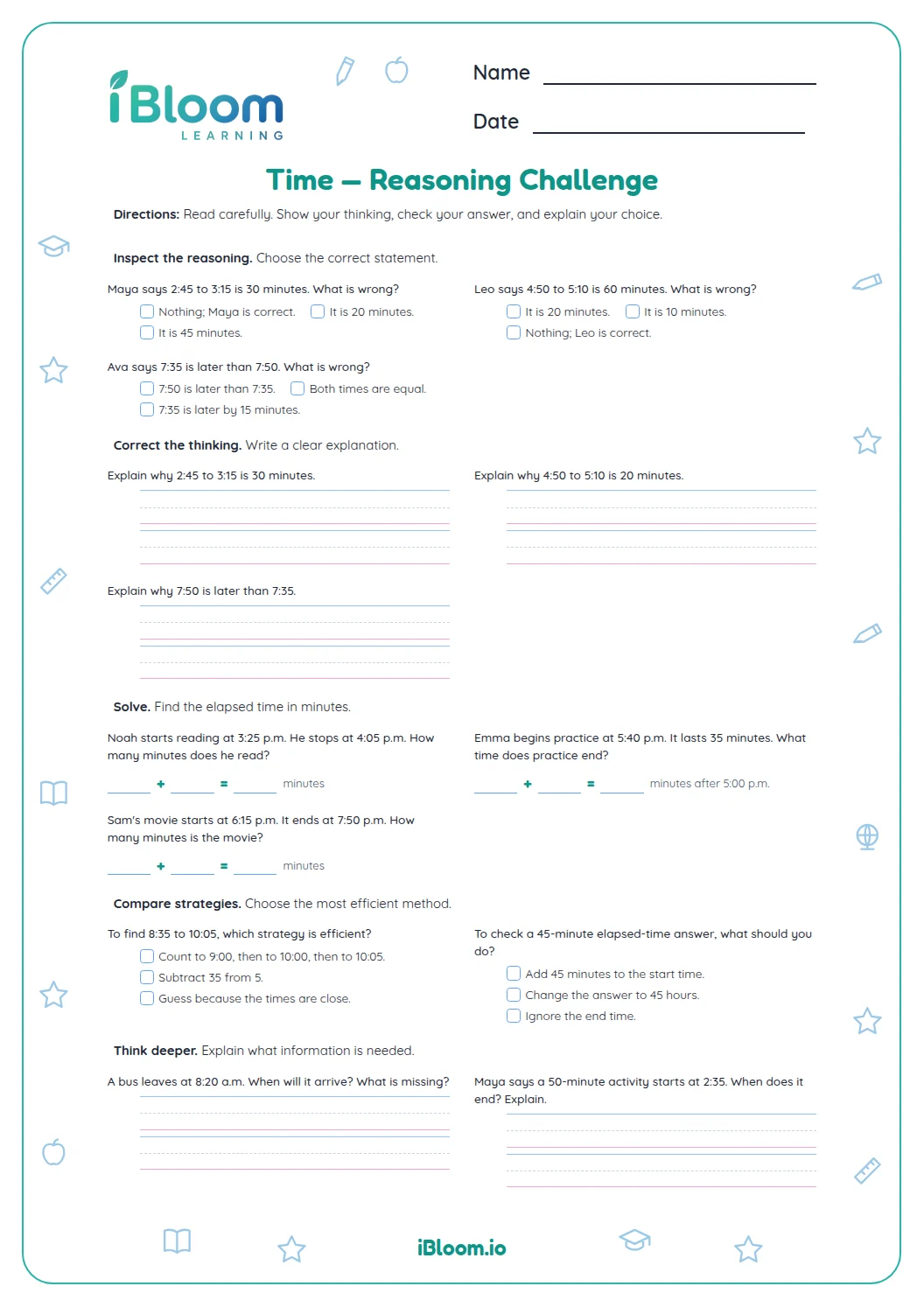
This Grade 4 worksheet gives students 16 time word problems about schedules, trips, and activities. They add a duration to find an end time, compare start and finish times to find elapsed time, or work backward from a finish. Several problems cross an hour boundary or noon. Students can show a timeline or equation, then check the final times and durations in the answer key. The set practices CCSS 4.MD.A.2.
Aligned to 4.MD.A.2
How do you find an end time?
For q1, add 50 minutes to 3:25 p.m. Since 25 + 50 = 75 minutes, regroup 60 minutes as one hour; 4:15 p.m. is the finish.
How do you find elapsed time?
For q3, count from 6:18 p.m. to 7:03 p.m. The interval is 45 minutes.
How can you find a missing start?
For q13, subtract 3 hours 45 minutes from 2:17 p.m. The flight left at 10:32 a.m.
How to use this worksheet
- 1Mark the start and finish on a timeline.
- 2Add minutes first; regroup 60 minutes as 1 hour.
- 3For elapsed time, count up in friendly hour and minute jumps.
- 4For a missing start, subtract the duration from the finish.
Common mistakes and quick fixes
The mistake
Keeping 75 minutes in the minutes place.
The fix
Trade 60 minutes for 1 hour; 3:25 p.m. plus 50 minutes is 4:15 p.m.
The mistake
Forgetting that a duration can cross noon.
The fix
Move the clock forward through 12:00 and switch from a.m. to p.m. when needed.
The mistake
Subtracting minutes without regrouping.
The fix
Trade 1 hour for 60 minutes before subtracting when the ending minutes are smaller.
Common Core alignment
The questions practice this standard through the specific calculations and models on the sheet.
Solve elapsed-time word problems by converting between hours and minutes.
On this sheet: Every item uses elapsed time in a real-world context.
Show the official wordingHide the official wording
Use the four operations to solve word problems involving distances, intervals of time, liquid volumes, masses of objects, and money, including problems involving simple fractions or decimals, and problems that require expressing measurements given in a larger unit in terms of a smaller unit. Represent measurement quantities using diagrams such as number line diagrams that feature a measurement scale.
What to practice next
Further reading
Questions parents and teachers ask
How do students find elapsed time?
Find the amount of time between the start and finish. For example, q3 runs from 6:18 p.m. to 7:03 p.m., which is 45 minutes. Count up to the next hour, then add the remaining minutes; the answer key lists each duration.
Does the worksheet include a.m. and p.m.?
Yes. Several questions mark morning and afternoon, and q10 crosses noon. When a time passes 12:00, change a.m. to p.m. or p.m. to a.m. as appropriate. Keep that label with the final time so the answer matches the story. The key shows each result. This example uses the same timeline method as the worksheet.
How can a child check an elapsed-time answer?
Add the duration to the start time, or subtract it from an end time if the problem asks when an event began. For instance, q2 adds 1 hour 35 minutes to 8:42 a.m. to reach 10:17 a.m. The key gives a result for every item.
What should students write in the work space?
A timeline, clock arithmetic, or an equation can show the steps. Break the duration into hours and minutes, and regroup 60 minutes as one hour when needed. For a missing start, subtract the duration from the known finish. Each story gives a different context and interval. Students can check the result with a timeline.
How is this useful outside school?
The stories use practice, travel, school, cooking, and events to make start times and durations concrete. Students decide whether to add, find an interval, or work backward. Those same calculations help interpret schedules and estimate when an activity will finish.