


About this worksheet
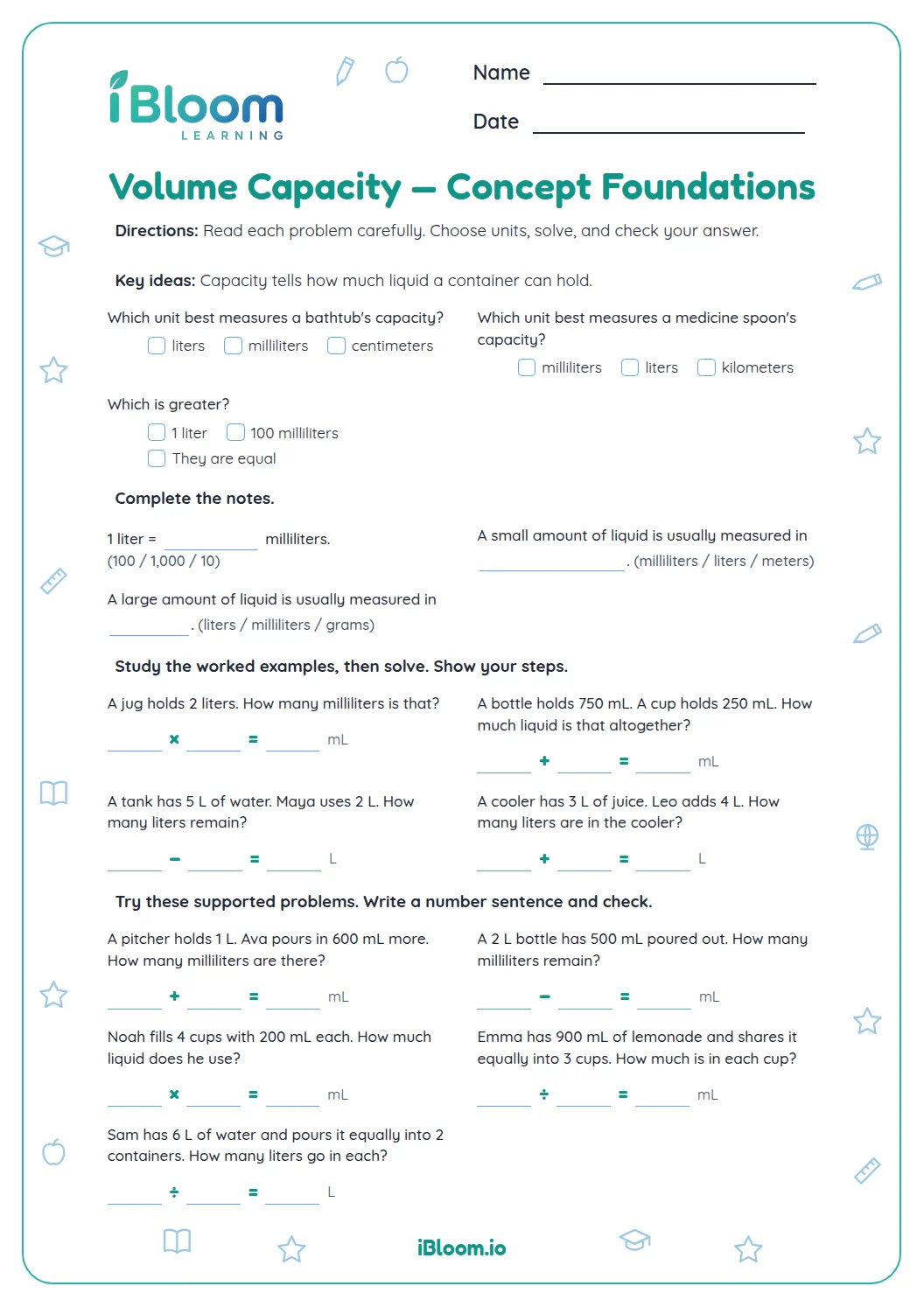
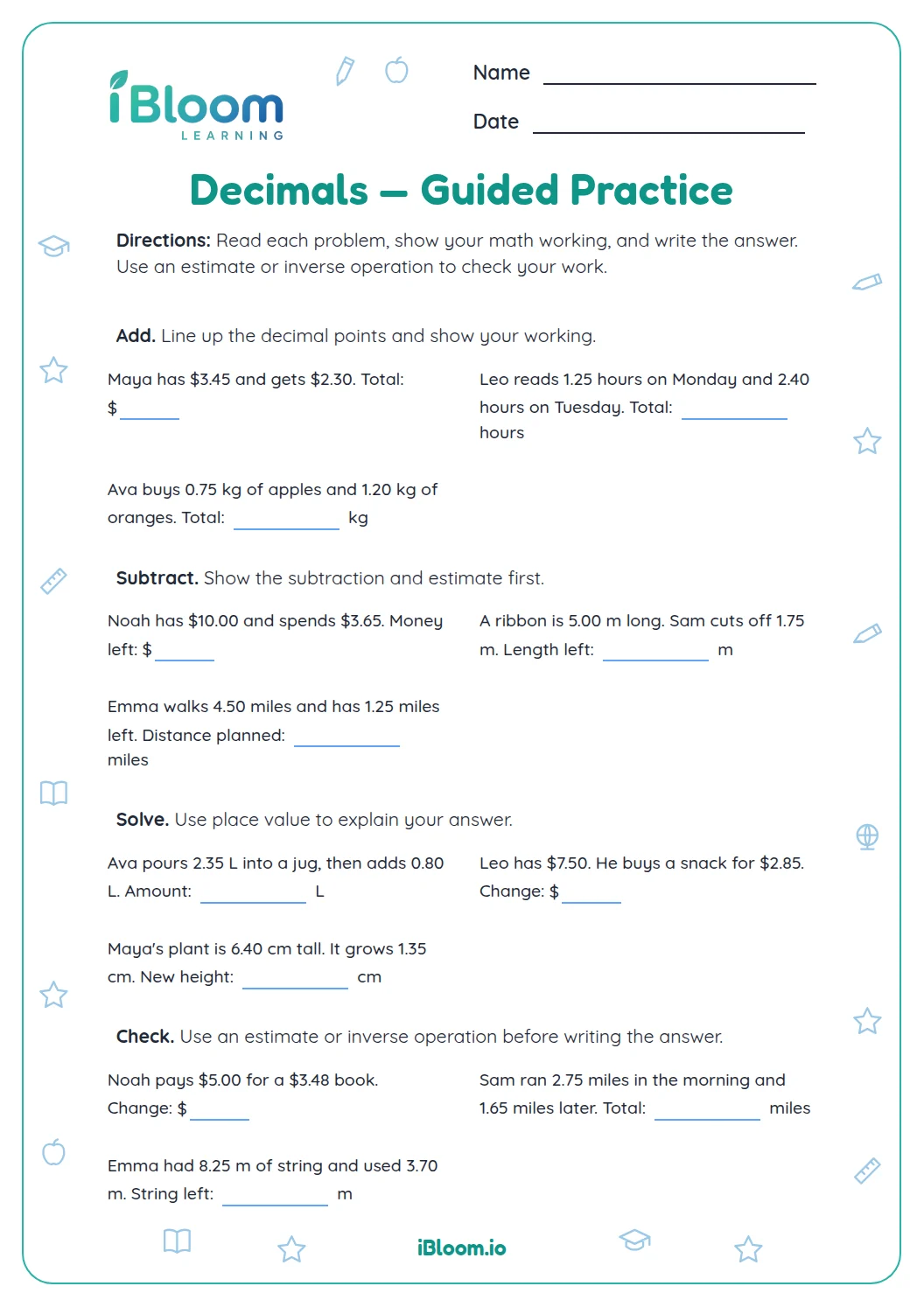
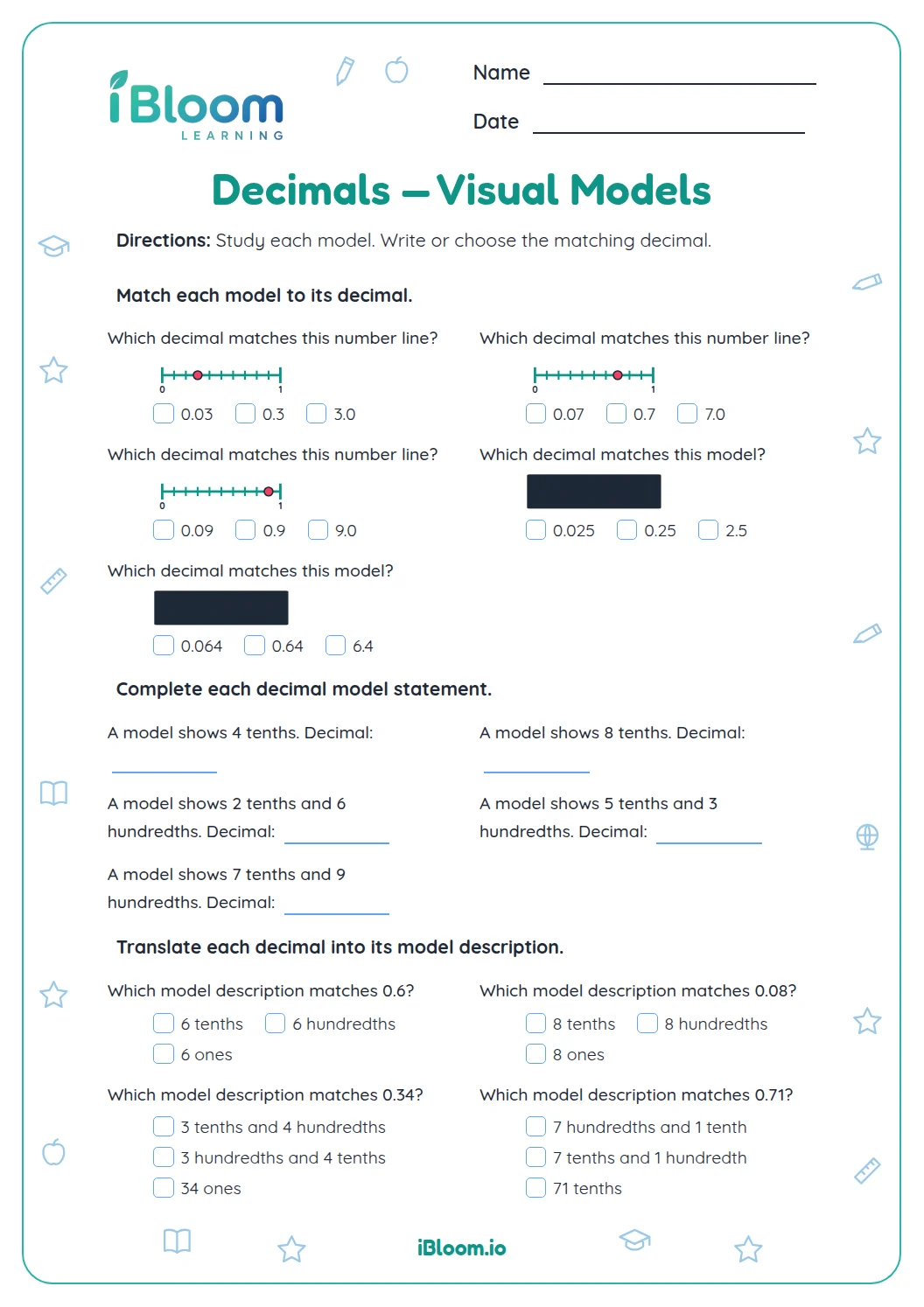
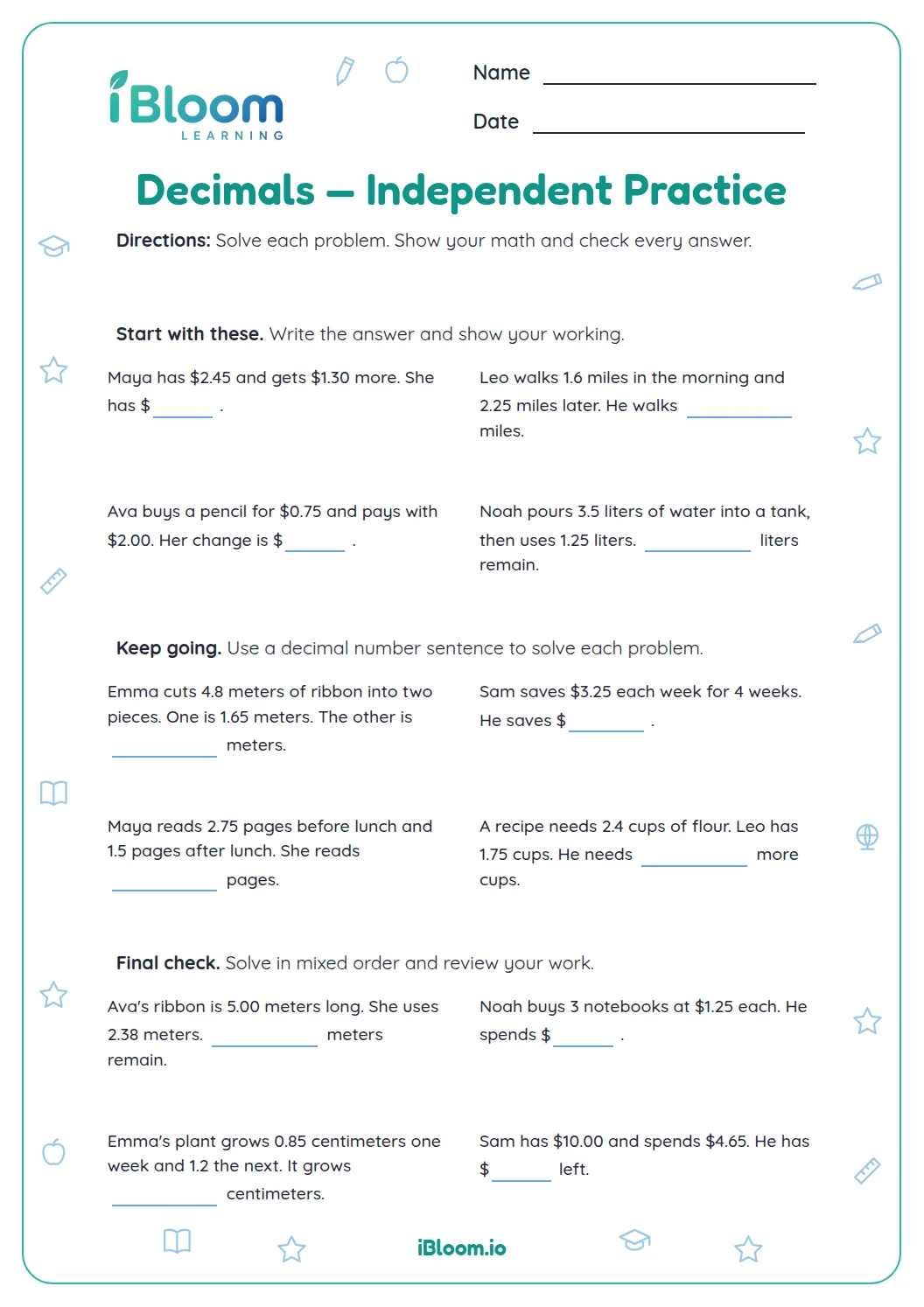
This Grade 4 worksheet gives students practice converting liters to milliliters, combining and comparing amounts, and choosing a measuring plan that uses fewer containers. It includes 14 word problems across three parts and a separate answer key. Students will need to track units as carefully as the numbers, especially when a problem mixes liters and milliliters.
Aligned to 4.MD.A.2
How do liters and milliliters relate?
One liter equals 1,000 milliliters. Convert liters to milliliters before adding or subtracting mixed units.
- 1Four 250 mL cups plus 300 mL
- 2Answer: 1,300 mL
How do you compare measuring plans?
These questions define efficiency by the number of pours or containers. Count the measures each plan needs, while checking that both plans reach the same total volume.
What will students solve?
Part A uses conversions and addition or subtraction. Part B compares measuring plans by counting containers. Part C combines multiple amounts, finds a remainder, or determines how many measures are needed.
How to solve a volume problem
- 1Mark the unit beside every amount.
- 2Convert liters to milliliters when combining mixed units.
- 3Choose addition, subtraction, or multiplication from the situation.
- 4For a measuring plan, count containers and verify the total capacity.
- 5Write the answer with the unit the question requests.
Volume mistakes and fixes
The mistake
Treating 1 L as 100 mL.
The fix
Use 1 L = 1,000 mL and check the size of the amount.
The mistake
Ignoring an added or remaining amount.
The fix
Underline every quantity in the story and include it in the equation.
The mistake
Calling a plan more efficient without a criterion.
The fix
Here, compare the number of pours or containers required.
Common Core alignment
This worksheet practices 4.MD.A.2 through its calculation and reasoning tasks.
Solve liquid-volume word problems, including larger-to-smaller unit conversions.
On this sheet: Solve liquid-volume word problems, including larger-to-smaller unit conversions.
Show the official wordingHide the official wording
Use the four operations to solve word problems involving distances, intervals of time, liquid volumes, masses of objects, and money, including problems involving simple fractions or decimals, and problems that require expressing measurements given in a larger unit in terms of a smaller unit. Represent measurement quantities using diagrams such as number line diagrams that feature a measurement scale.
What to practice next
Make more practice
Further reading
Questions parents and teachers ask
How many milliliters are in one liter?
One liter equals 1,000 milliliters. For example, a 2 L pitcher holds 2,000 mL. Convert liters to milliliters before combining amounts written in different units, then keep the requested unit in the final answer. This conversion appears in several questions.
How does the worksheet define an efficient measuring plan?
The comparison questions ask which plan uses fewer pours or containers. Both plans are checked against the same target amount, so students can compare the count directly instead of guessing which container looks easier to use. The target amount stays equal in each pair. The target amount stays equal in each pair.
Does the Maya cups problem include the extra 300 mL?
Yes. Four cups of 250 mL hold 1,000 mL; adding 300 mL gives 1,300 mL. The problem is useful for practicing how to include every quantity in a story before choosing an operation. Students can show the multiplication and addition. Students can show the multiplication and addition.
What units should students write in their answers?
Use the unit named in the question. Many questions request milliliters, while one asks for a count of cups. Keeping the unit beside each calculation helps prevent a correct number from being reported as the wrong kind of amount. This makes the answer easier to interpret.
What does the answer key show?
The answer key follows the three worksheet pages and lists a result for every question. For longer problems, students can compare the unit conversion and operation as well as the final amount to find where their work diverged. The unit labels help locate the calculation to revisit.