

About this worksheet
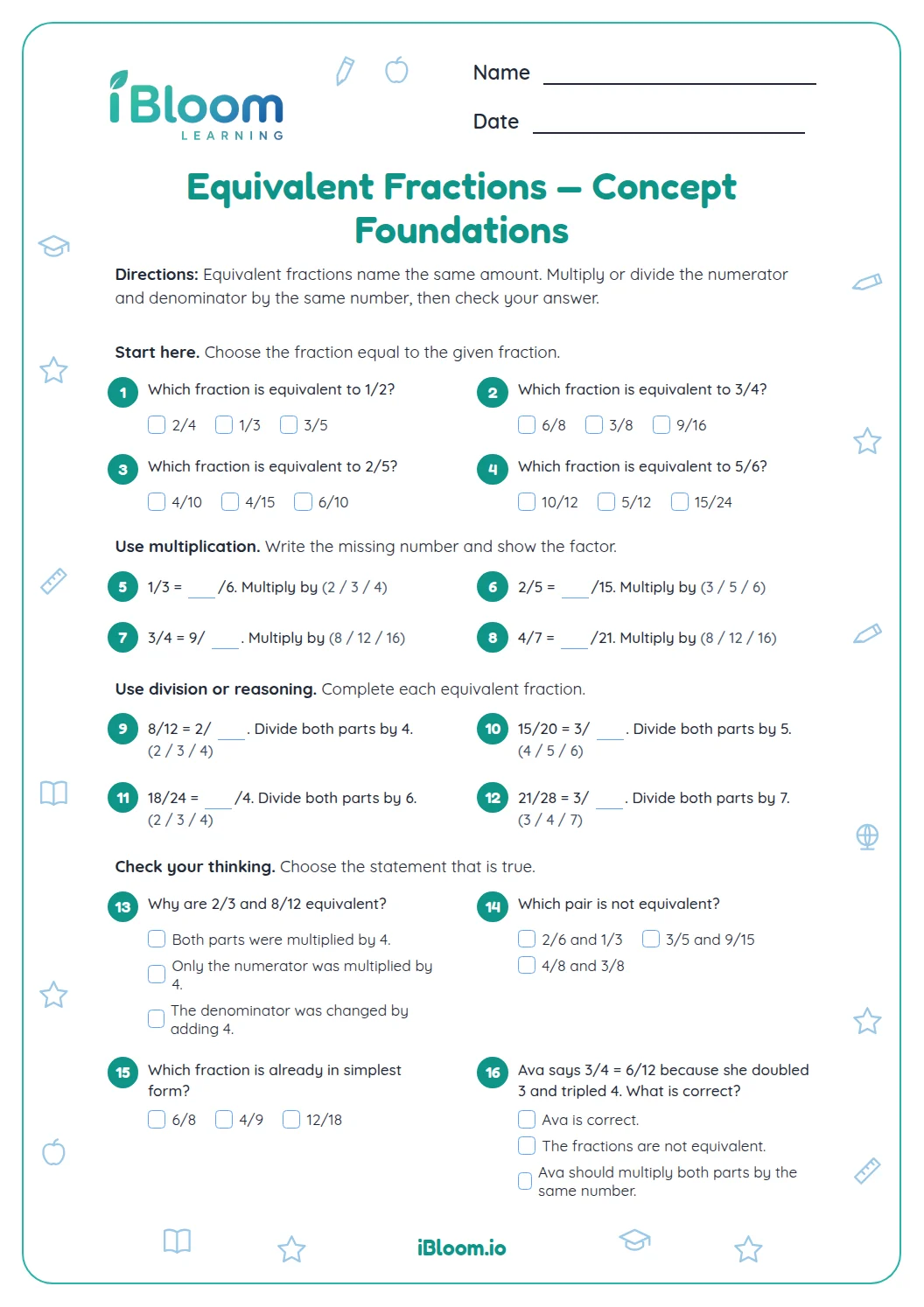
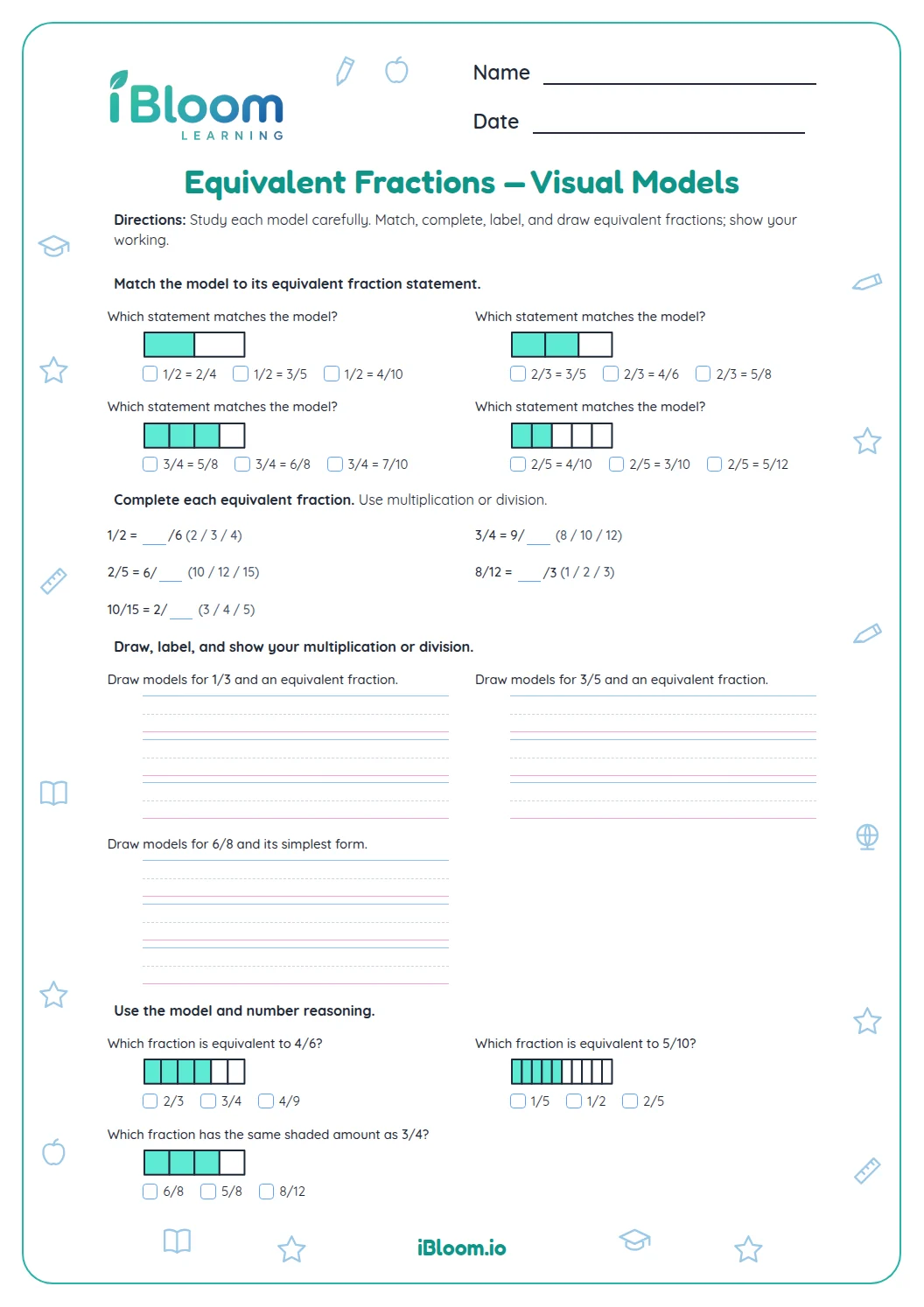
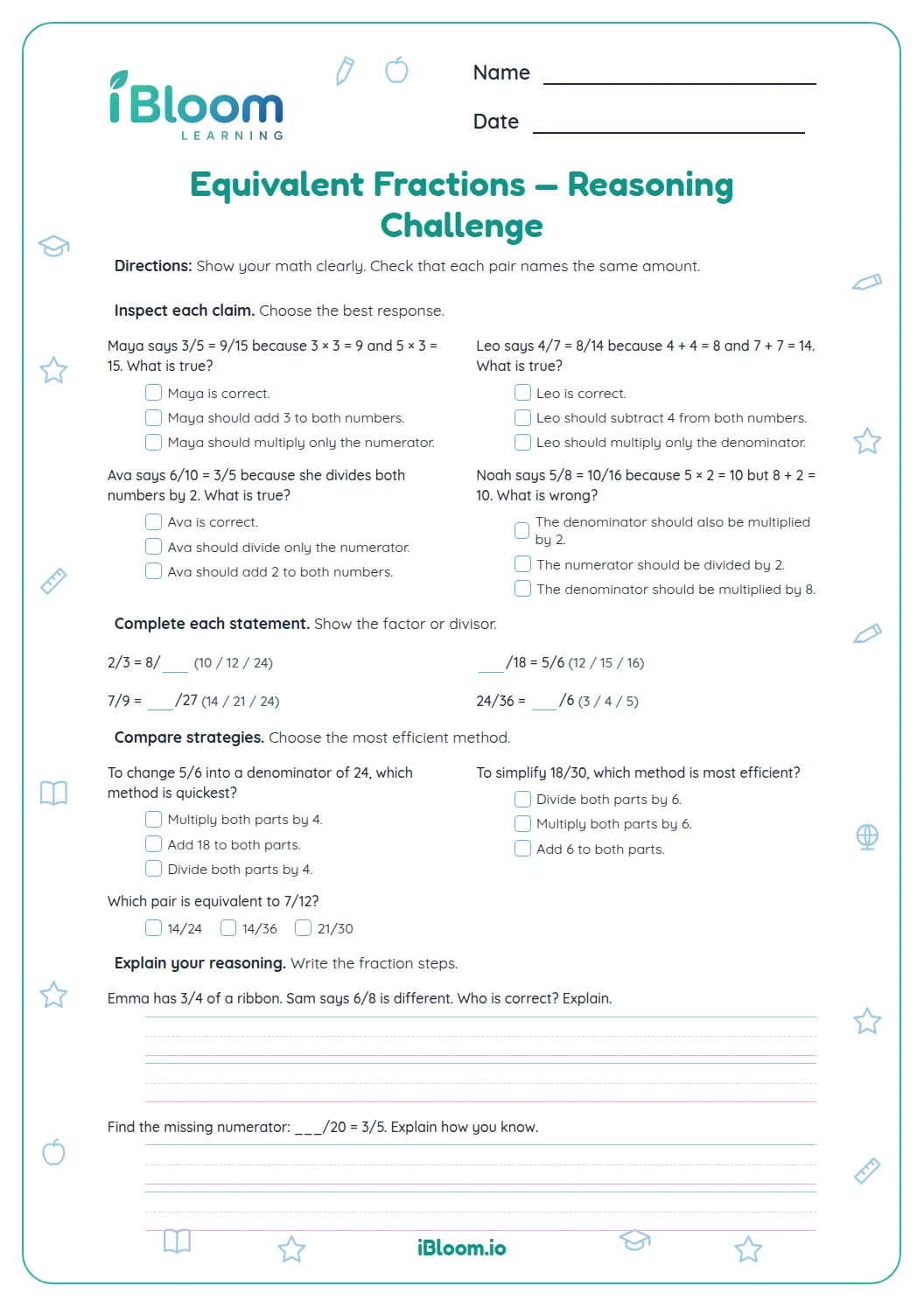
Sixteen questions practice generating equivalent fractions and writing fractions in simplest form. The printable provides work space and an answer key for checking each result.
Aligned to CCSS.MATH.CONTENT.5.NF.A.1
How can you work through the sheet?
For 3/5 = ___/10, the denominator is multiplied by 2, so multiply the numerator by 2 as well: 6/10.
What should learners check?
Use the place-value columns and directions printed on the worksheet. Work one item at a time, then use the key to locate and correct any calculation error. Use the answer key after completing the student pages to check each response.
How to use this worksheet
- 1Compare the known denominator or numerator with its matching value.
- 2Find the factor that changes one denominator or numerator into the other.
- 3Apply the same factor to the other part of the fraction.
- 4For simplest form, divide numerator and denominator by a common factor.
- 5Check that the new fraction has the same value as the original.
Common mistakes and quick fixes
The mistake
Changing only the denominator: multiply or divide both parts by the same factor.
The fix
multiply or divide both parts by the same factor.
The mistake
Using different factors: equivalent fractions require the same operation on numerator and denominator.
The fix
equivalent fractions require the same operation on numerator and denominator.
The mistake
Stopping before simplest form: check whether numerator and denominator still share a factor greater than one.
The fix
check whether numerator and denominator still share a factor greater than one.
Generate equivalent fractions by multiplying or dividing numerator and denominator by the same factor.
On this sheet:
Show the official wordingHide the official wording
Add and subtract fractions with unlike denominators (including mixed numbers) by replacing given fractions with equivalent fractions in such a way as to produce an equivalent sum or difference of fractions with like denominators.
What to practice next
Make more practice
Further reading
Questions parents and teachers ask
How many questions does the worksheet have?
There are 16 questions in two parts. The first set completes equivalent fractions, and the second set includes simplifying fractions and a few more equivalent-fraction items. Encourage the learner to write each step clearly and review the relevant columns or fraction parts when checking.
How do I complete an equivalent fraction?
Find the factor that changes the known numerator or denominator. Multiply or divide the other part by that same factor to preserve the fraction’s value. Encourage the learner to write each step clearly and review the relevant columns or fraction parts when checking.
What does simplest form mean?
A fraction is in simplest form when its numerator and denominator have no common factor greater than one. Divide both by their greatest common factor. Encourage the learner to write each step clearly and review the relevant columns or fraction parts when checking.
Why does the numerator need the same change as the denominator?
Multiplying or dividing both parts by the same nonzero number keeps the ratio unchanged. Changing only one part changes the fraction’s value. Encourage the learner to write each step clearly and review the relevant columns or fraction parts when checking.
Is an answer key included?
Yes. The key includes an answer for each of the 16 items, including complete fractions for the simplification questions. Encourage the learner to write each step clearly and review the relevant columns or fraction parts when checking. Have learners compare every written step with the place-value or fraction relationship shown by the problem, then correct the work before moving on.