






About this worksheet
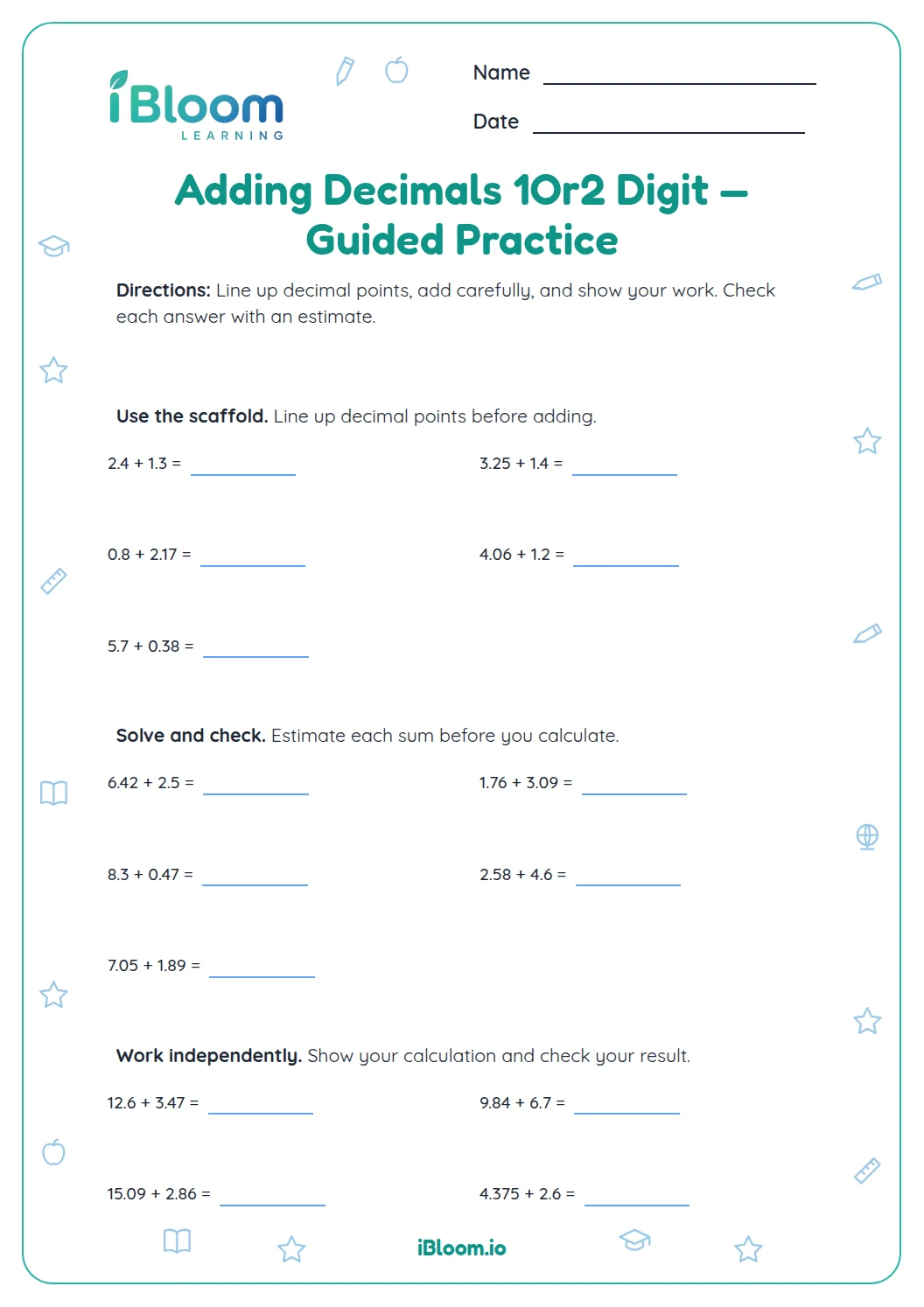
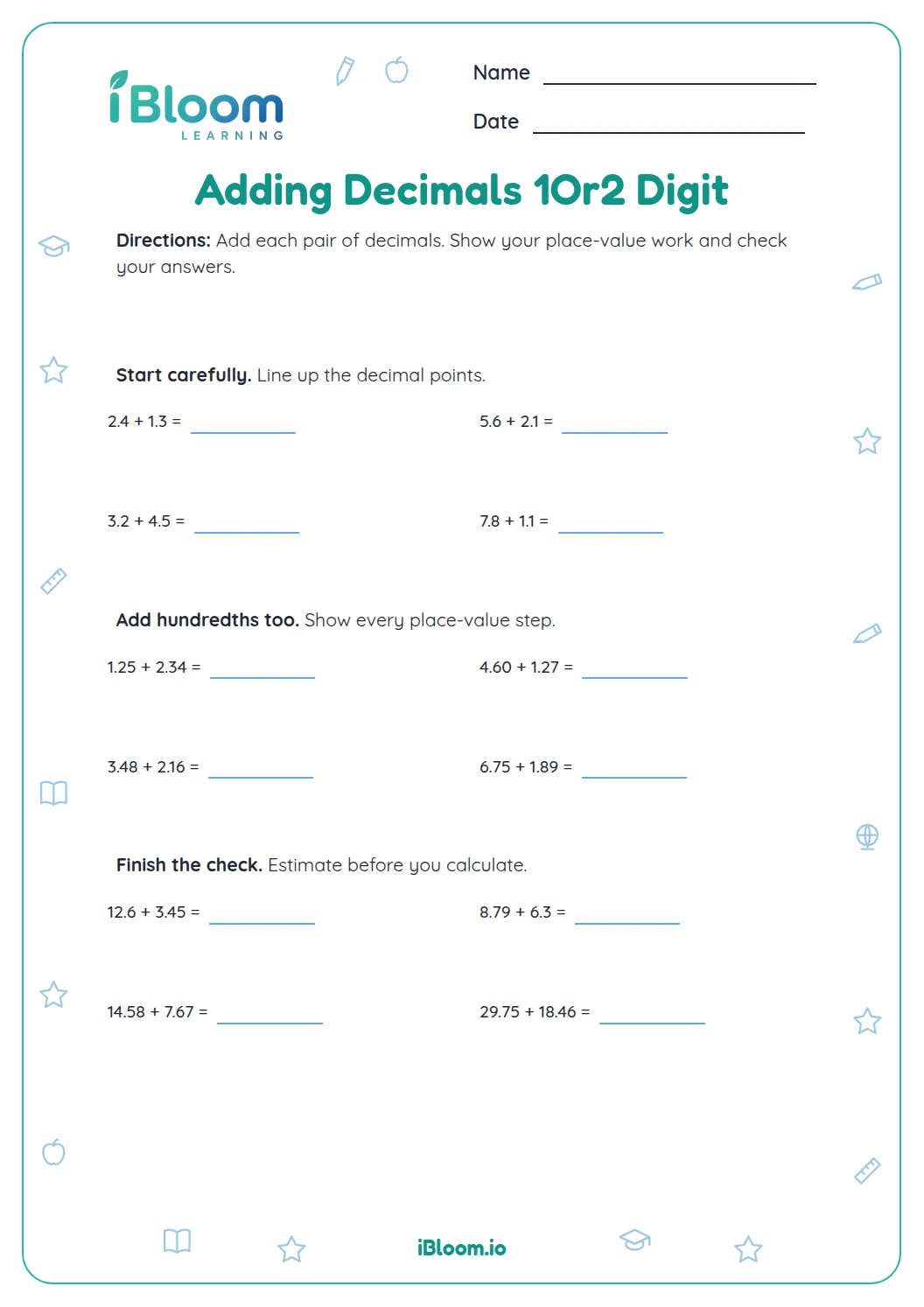
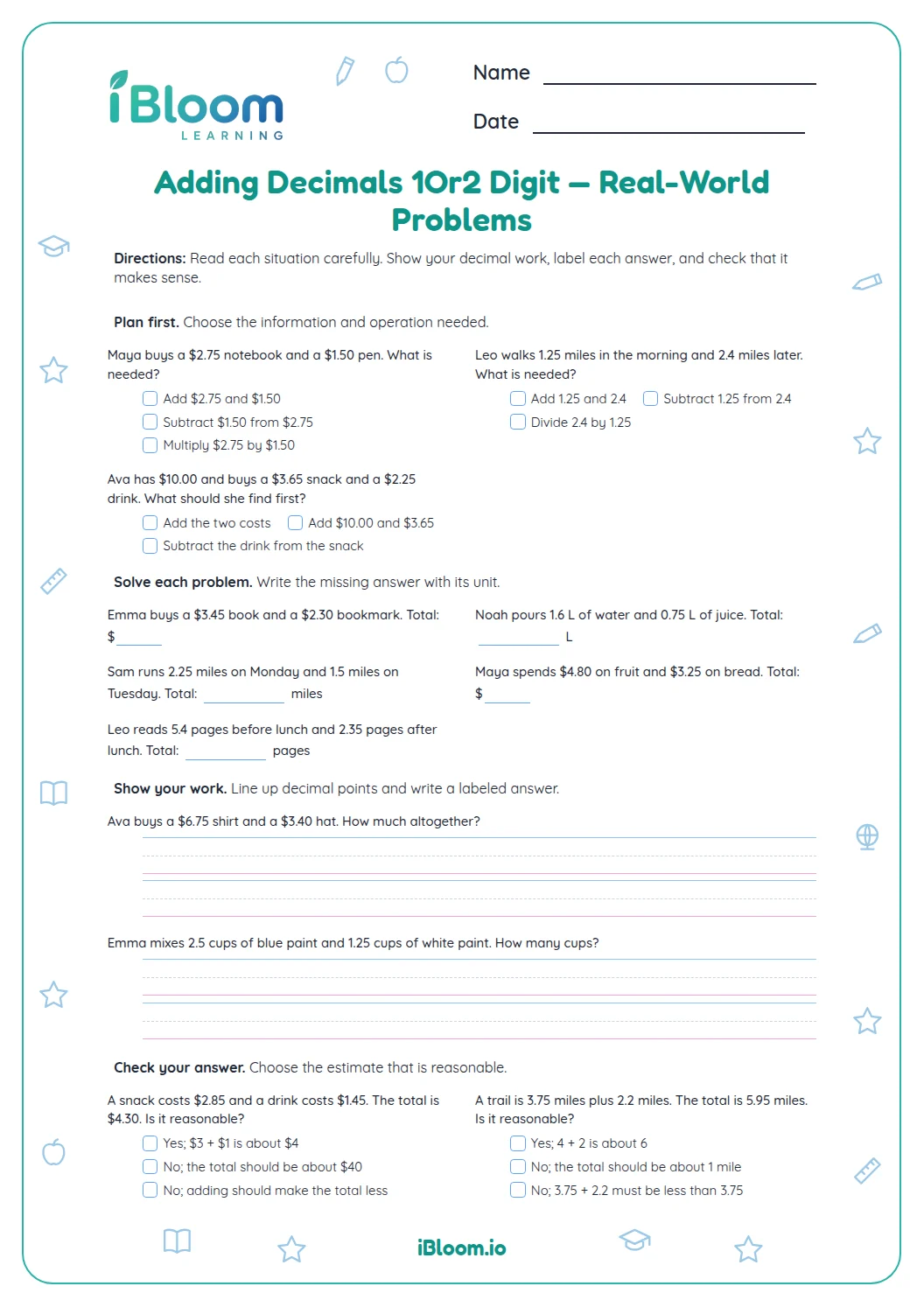
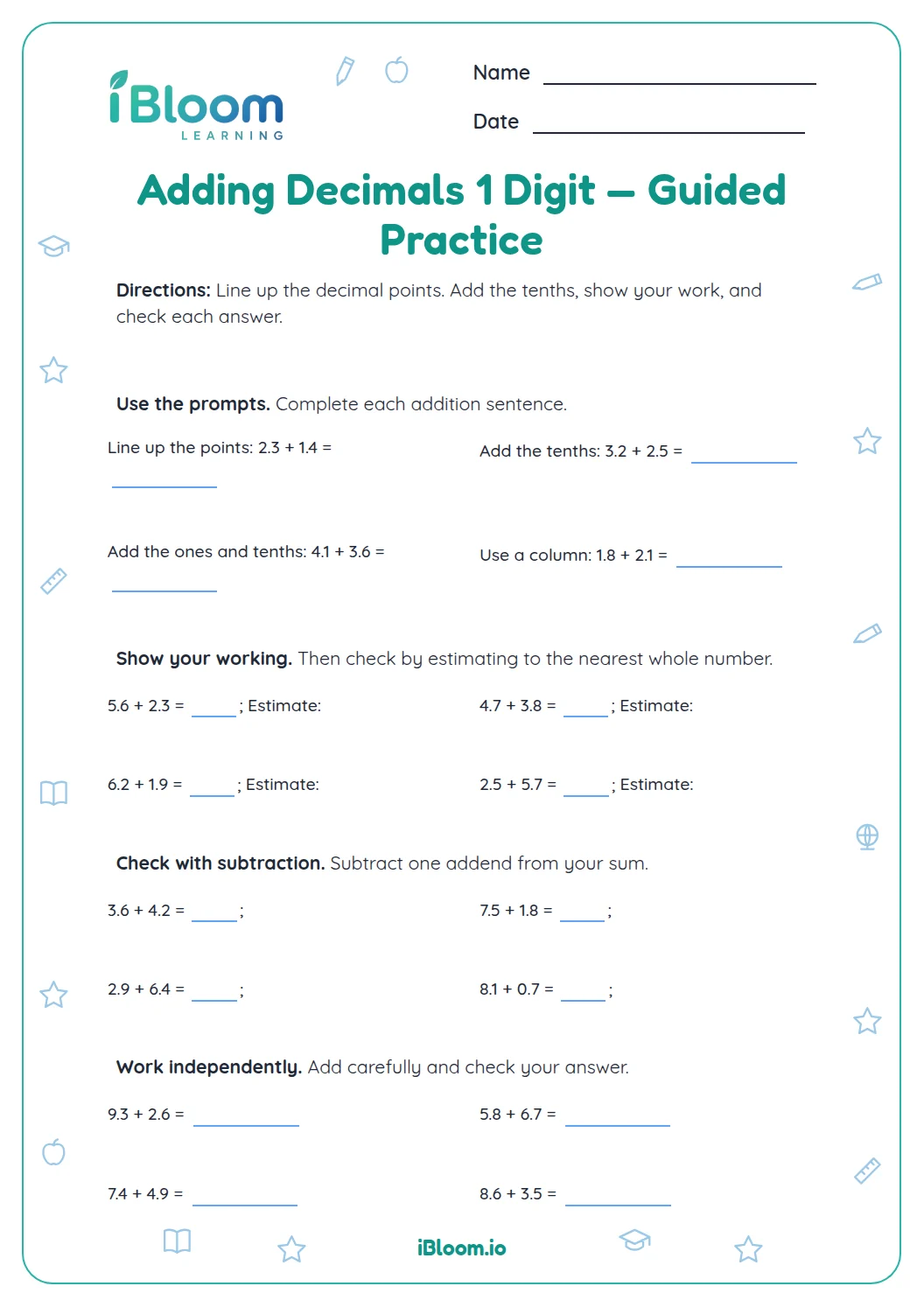
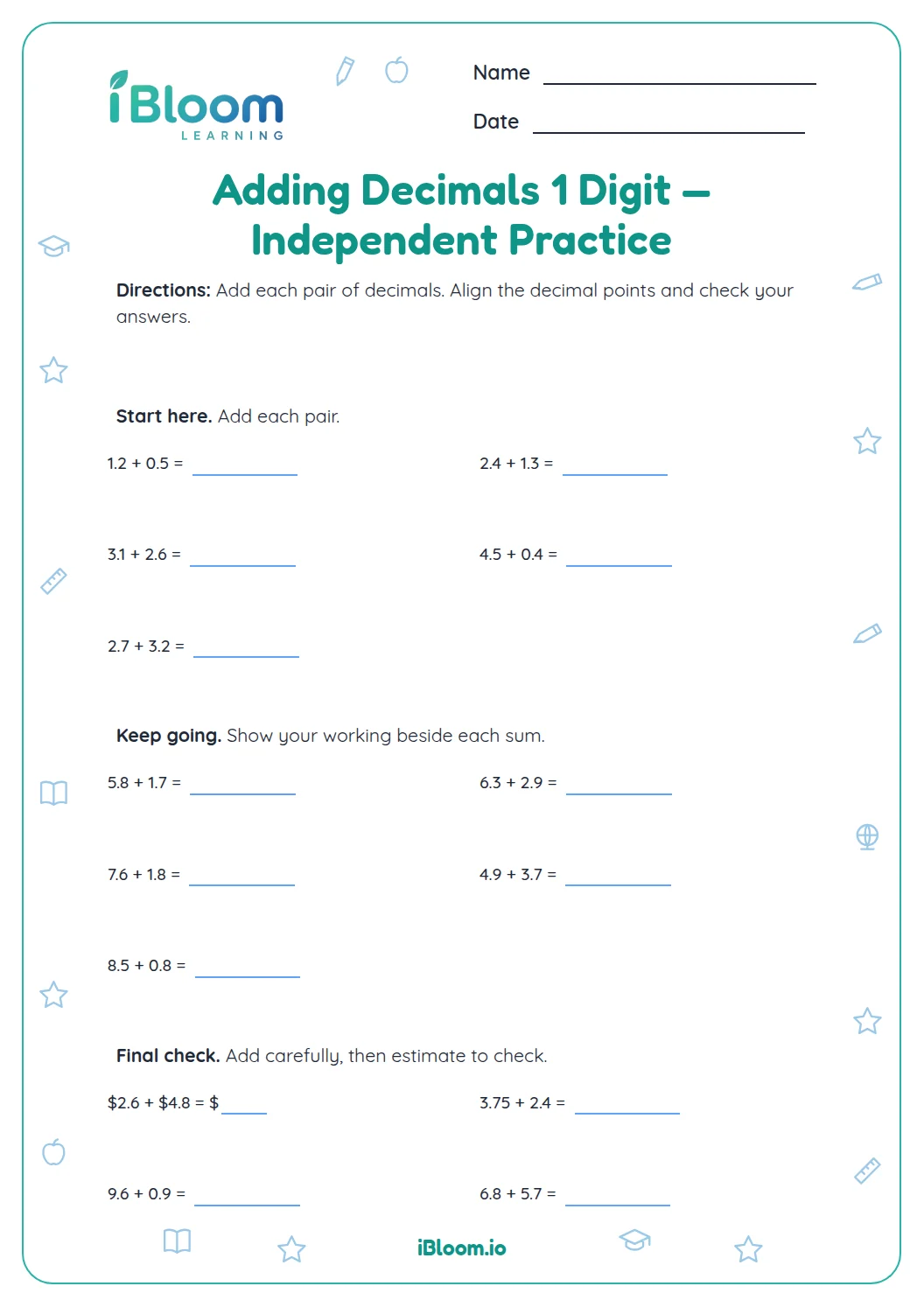
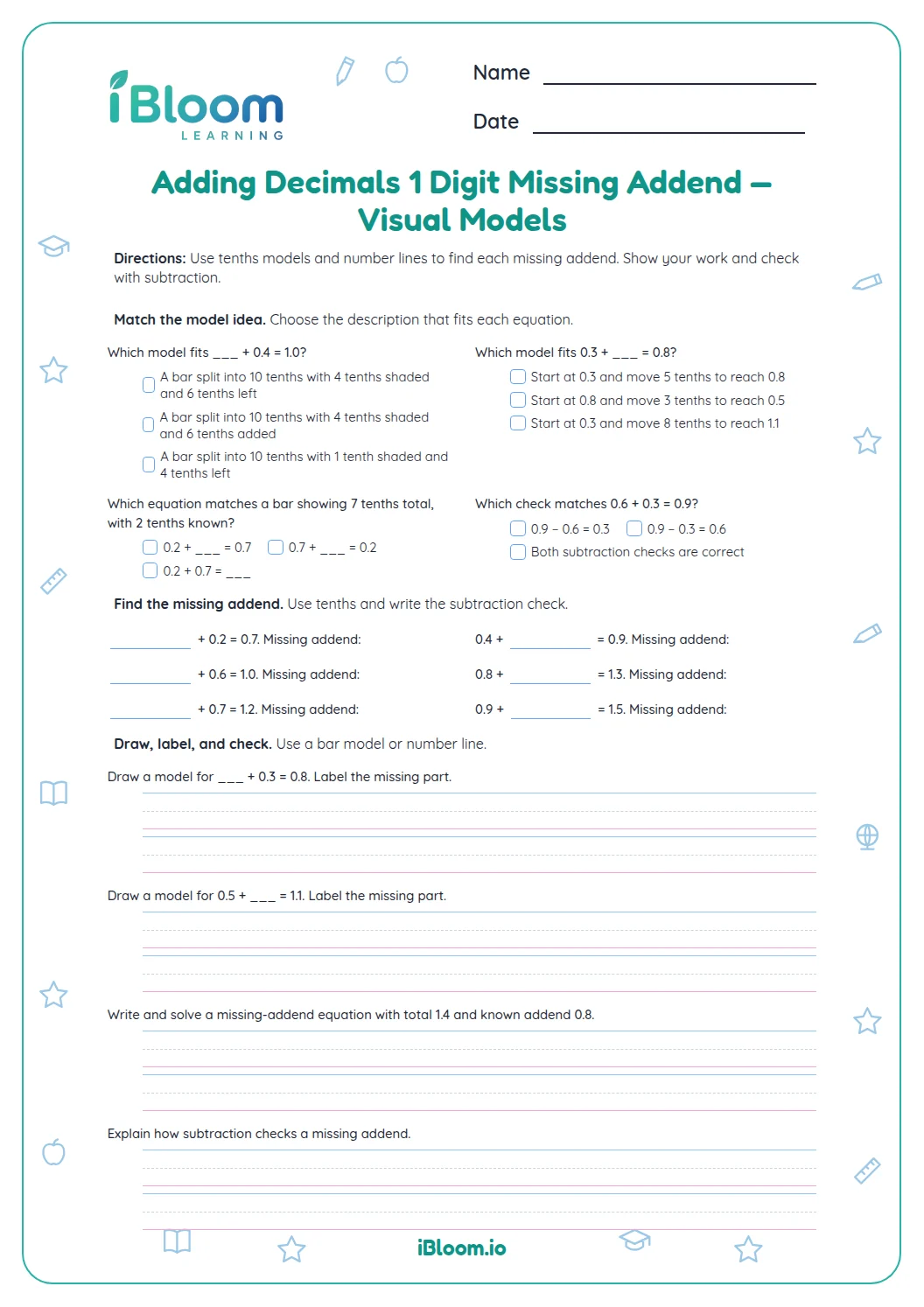
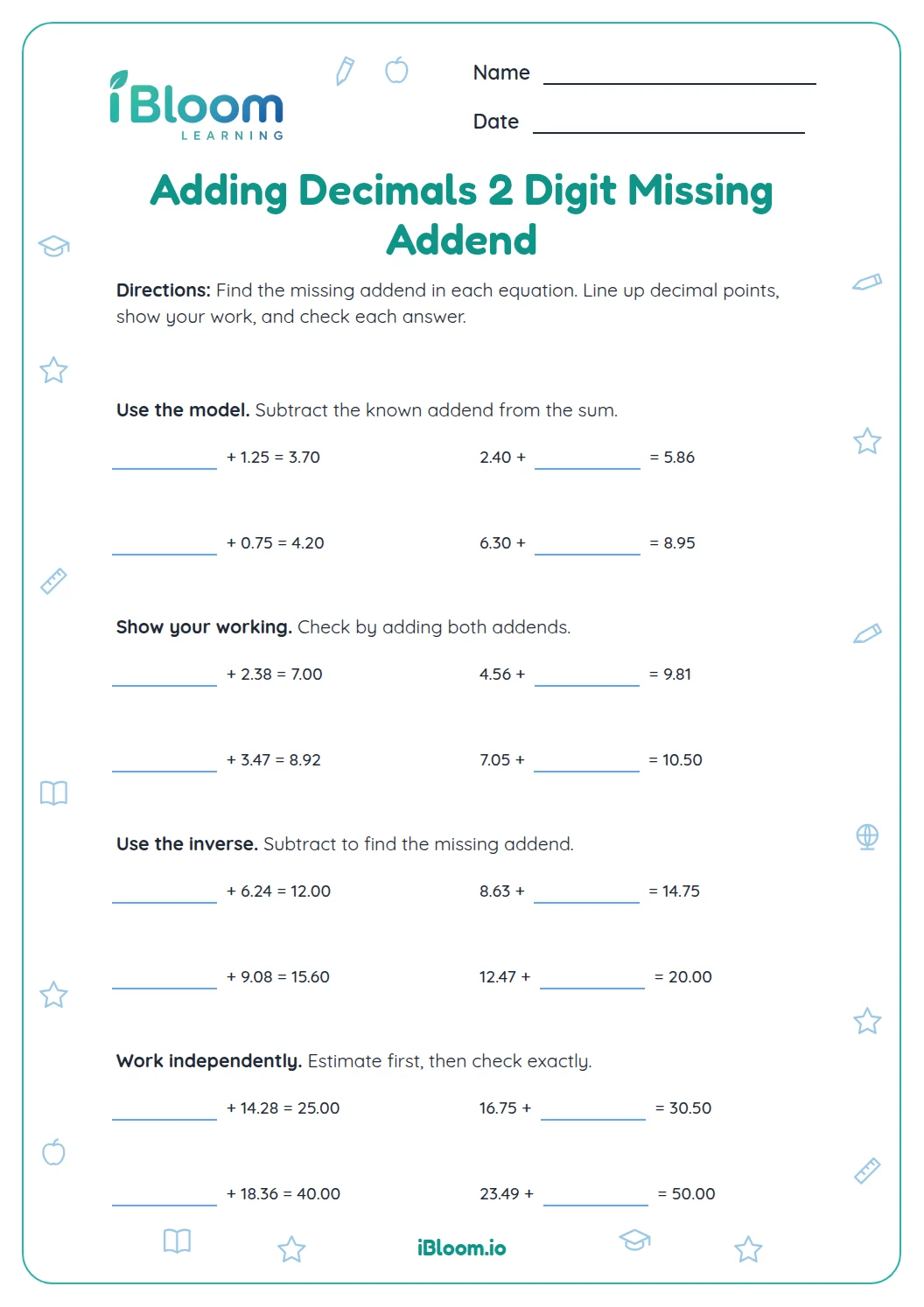
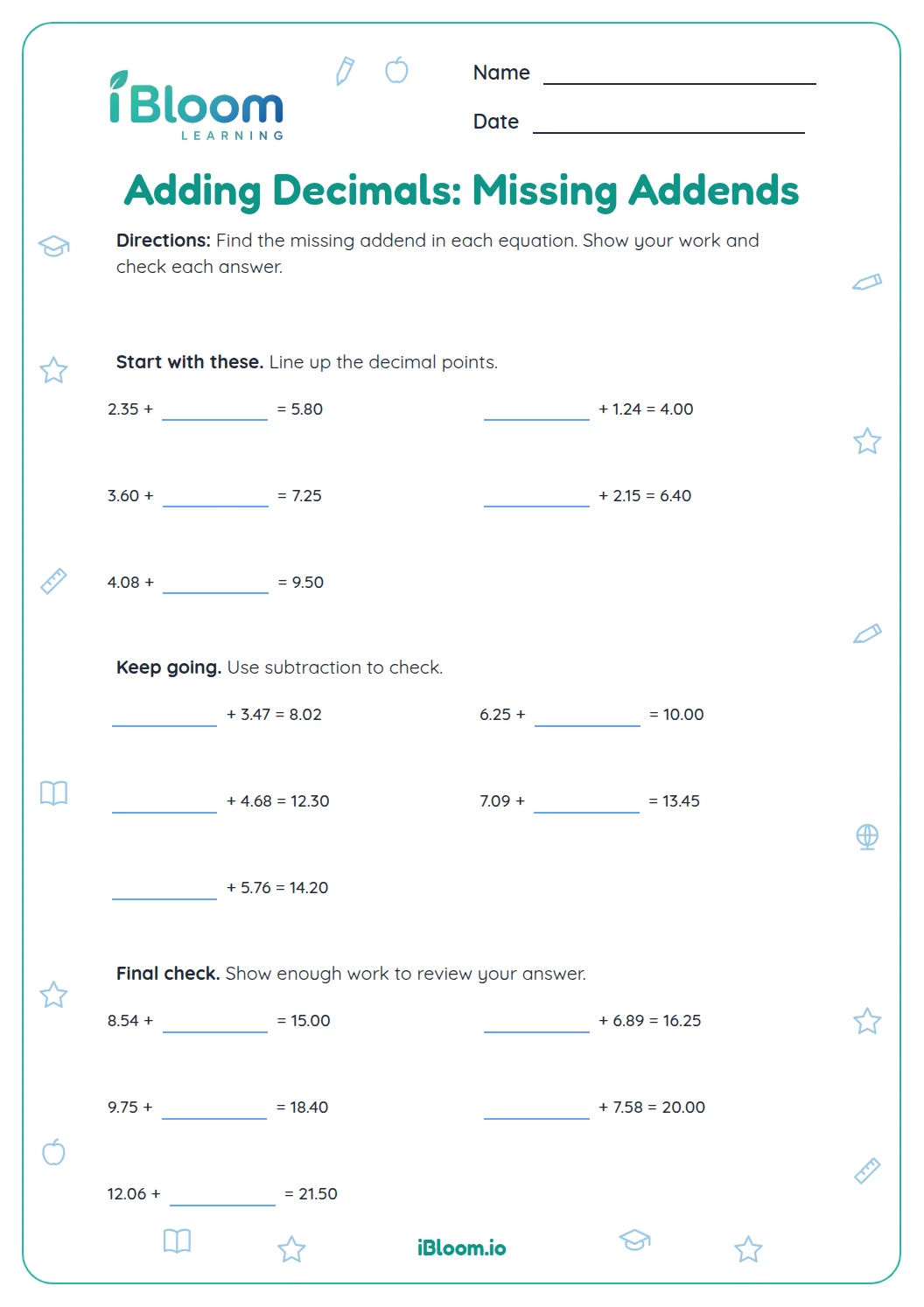
This Grade 5 decimal addition worksheet has 12 questions on sums with tenths and hundredths, diagnosing incorrect sums, and applying addition to short problems. Students line up place values, explain realistic slips, and check answers with subtraction. The printable includes a separate answer key and supports CCSS 5.NBT.B.7 through decimal computation and place-value reasoning.
Aligned to 5.NBT.B.7
How does place value help with decimal addition?
Align the decimal points so ones, tenths, and hundredths are added in matching places. In the claim questions, compare the reported total with the place-value sum.
The page contains 10 questions and a separate answer key.
- 13.4 + 2.15 = ___
- 2Answer: 5.55
- 3Subtract 2.15 from 5.55 to check.
What will students practice on the page?
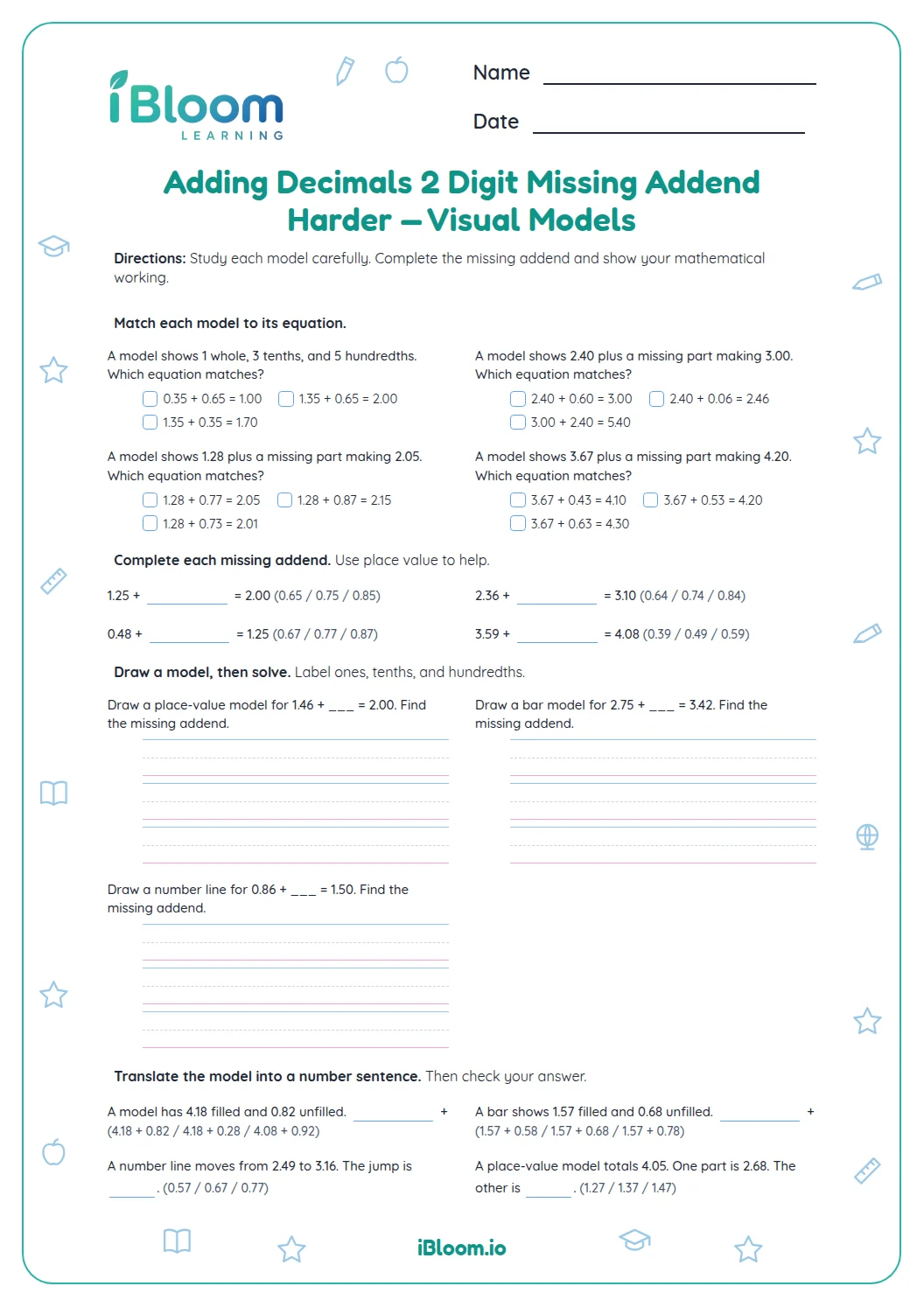
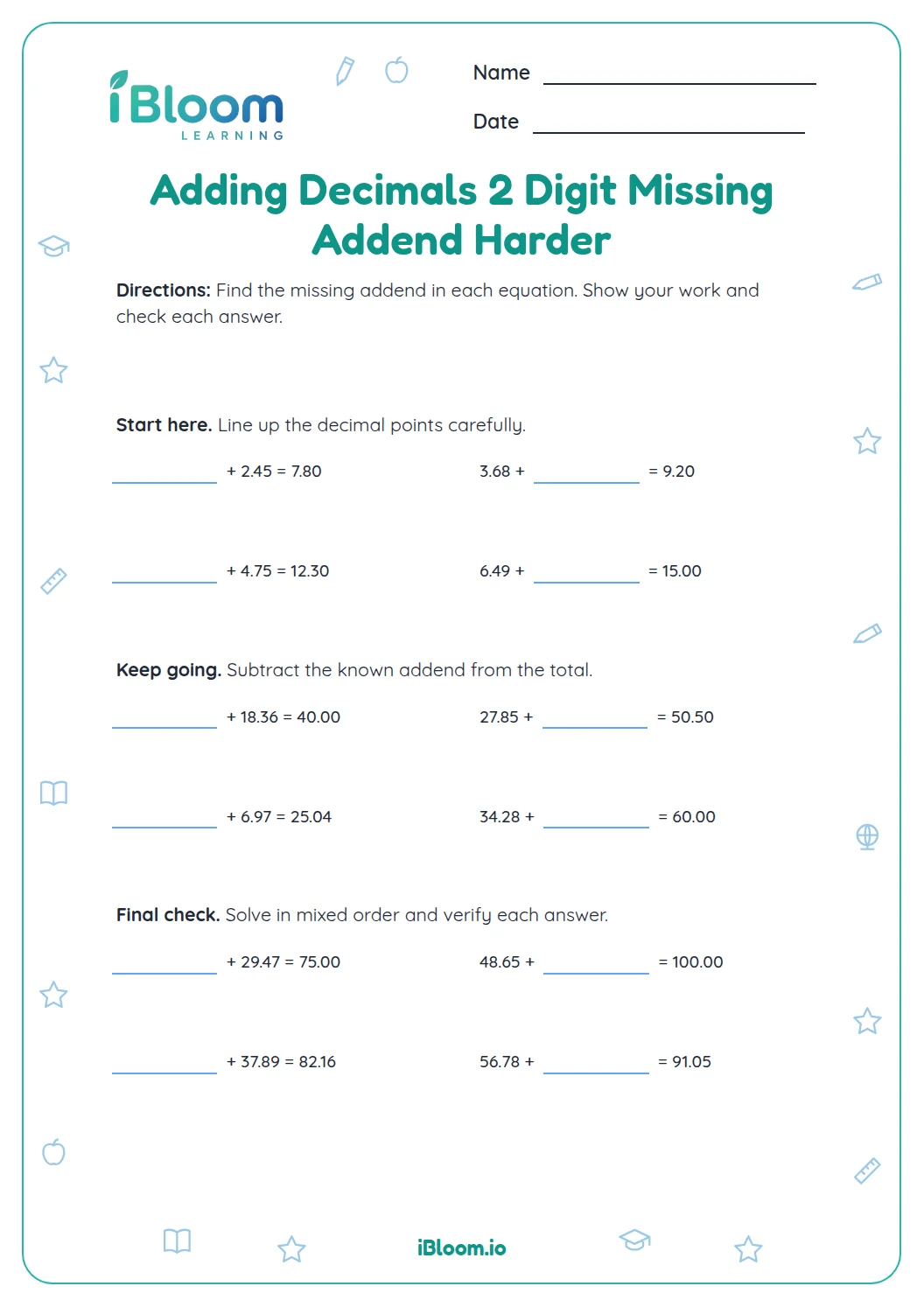
Students calculate decimal sums, diagnose place-value mistakes, and use addition in length and total problems.
- 12 questions across focused parts
- Place-value reasoning with a checked answer key
How can students check the work?
Subtract one addend from the sum and see whether the other addend remains. For a missing addend, add the answer to the known addend.
How to work through this sheet
- 1Read the direction for the current part.
- 2Align matching decimal place values.
- 3Estimate when the question asks for a reasonableness check.
- 4Calculate carefully and keep units with measured answers.
- 5Check sums by subtraction or products and quotients with an estimate or inverse operation.
- 6Use the separate key after completing the work.
Decimal slips to watch for
The mistake
Adding digits in unlike decimal places.
The fix
Align decimal points and use zeros as placeholders.
The mistake
Dropping a tenths digit while combining hundredths.
The fix
Write each addend by place before adding.
The mistake
Accepting a sum without checking its size.
The fix
Estimate first or subtract an addend to verify.
Common Core alignment
This worksheet practices decimal computation using place-value reasoning.
Use place value and written methods to compute with decimals.
On this sheet: Students add decimals to hundredths using place value, explain errors, and check sums with subtraction.
Show the official wordingHide the official wording
Add, subtract, multiply, and divide decimals to hundredths, using concrete models or drawings and strategies based on place value, properties of operations, and/or the relationship between addition and subtraction; relate the strategy to a written method and explain the reasoning used.
What to practice next
Make more practice
Further reading
Questions parents and teachers ask
How do students line up decimal addends?
Subtract one addend from the sum and see whether the other addend remains. For a missing addend, add your result to the known addend. Both checks use the relationship between addition and subtraction, so students can verify the result instead of relying only on a remembered answer.
What does the error analysis ask students to notice?
Yes. The printable includes a separate answer key for all 10 questions. Students can finish the worksheet first, then review sums, error explanations, and application answers with a parent or teacher. The key makes it easy to revisit a place-value step that led to an incorrect total.
Does the worksheet include word problems?
Yes. The final part uses short length and growth contexts, plus missing-addend situations. Students write an addition equation or use the known total and addend to find the unknown. Units are included where the context calls for them. Students can compare each calculation with the answer key after finishing the worksheet.
How can students check an addition answer?
Subtract one addend from the sum and see whether the other addend remains. For a missing addend, add your result to the known addend. Both checks use the relationship between addition and subtraction, letting students verify the answer instead of relying on memory.
Is an answer key included?
Yes. The printable includes a separate answer key for all 10 questions. Students can finish the worksheet first, then review sums, error explanations, and application answers with a parent or teacher. The key makes it easy to revisit a place-value step that led to an incorrect total.