




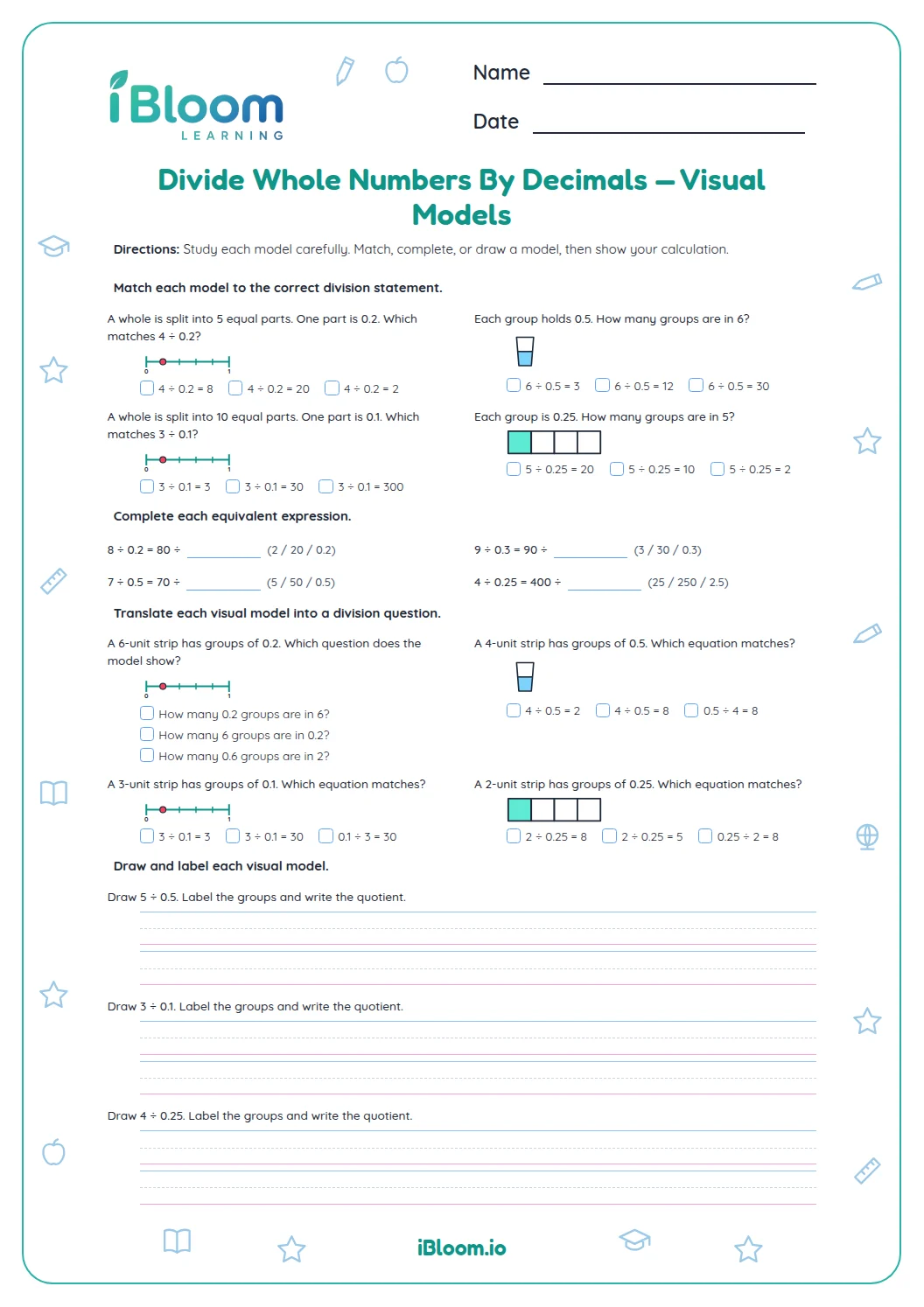
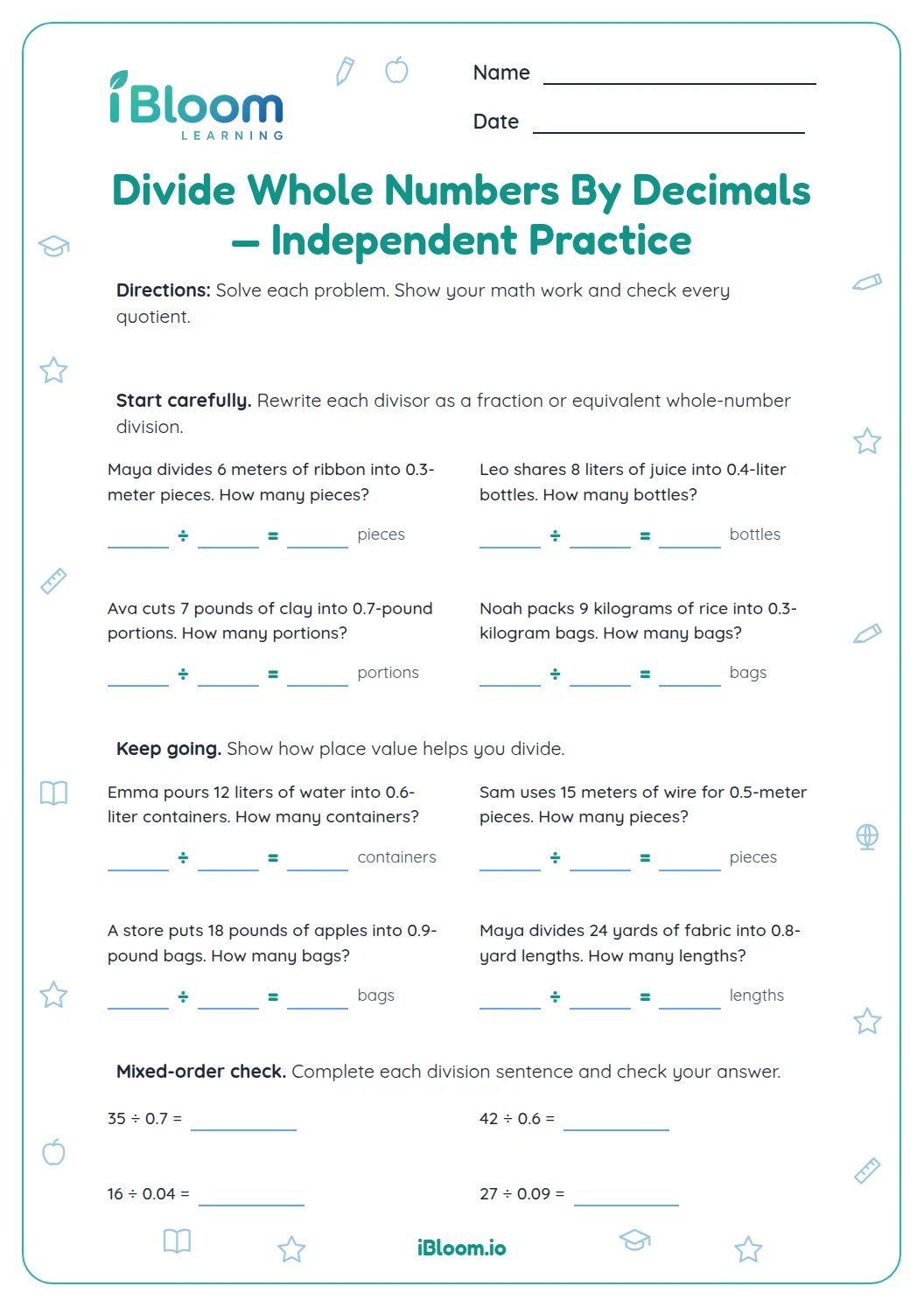
About this worksheet
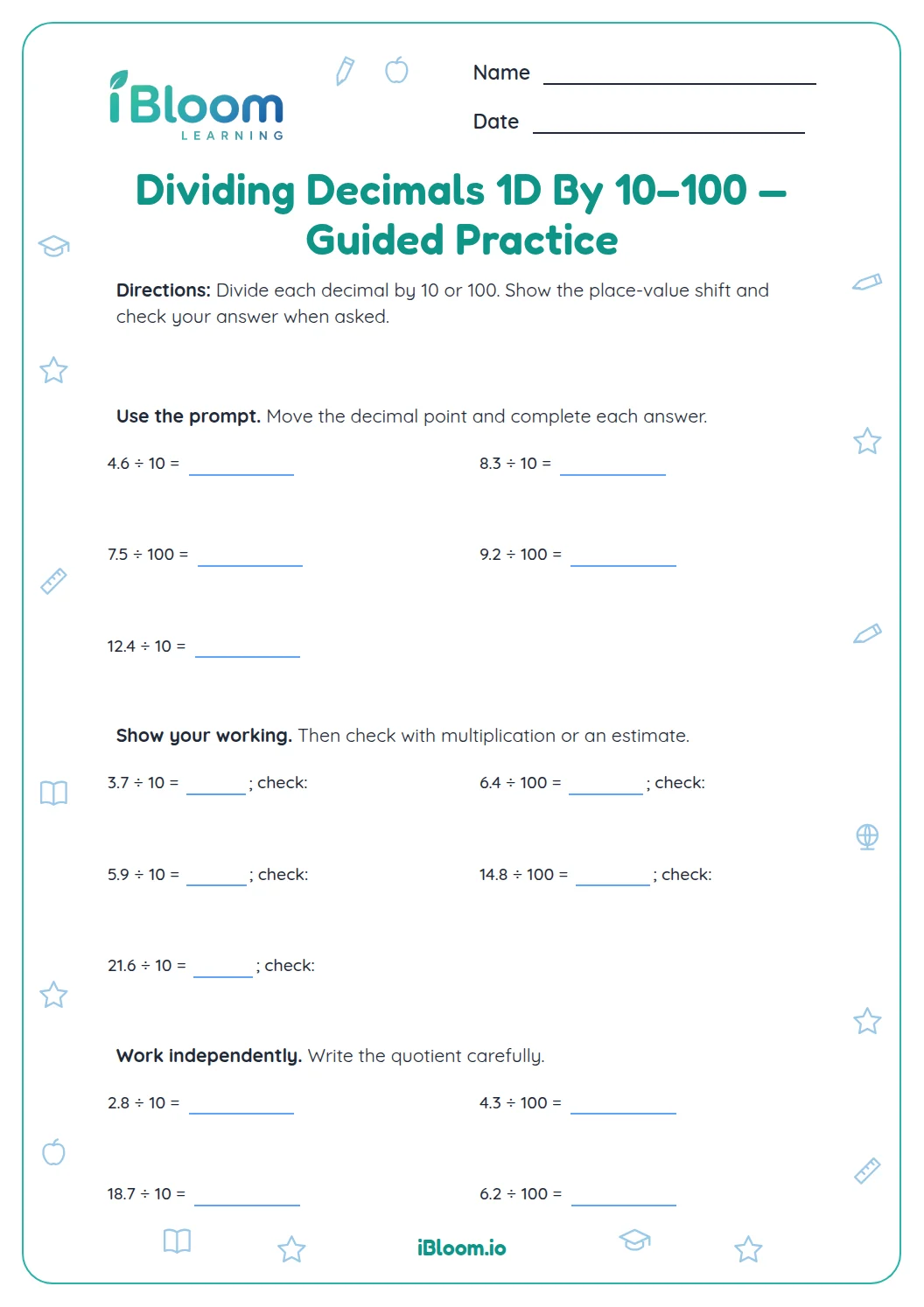
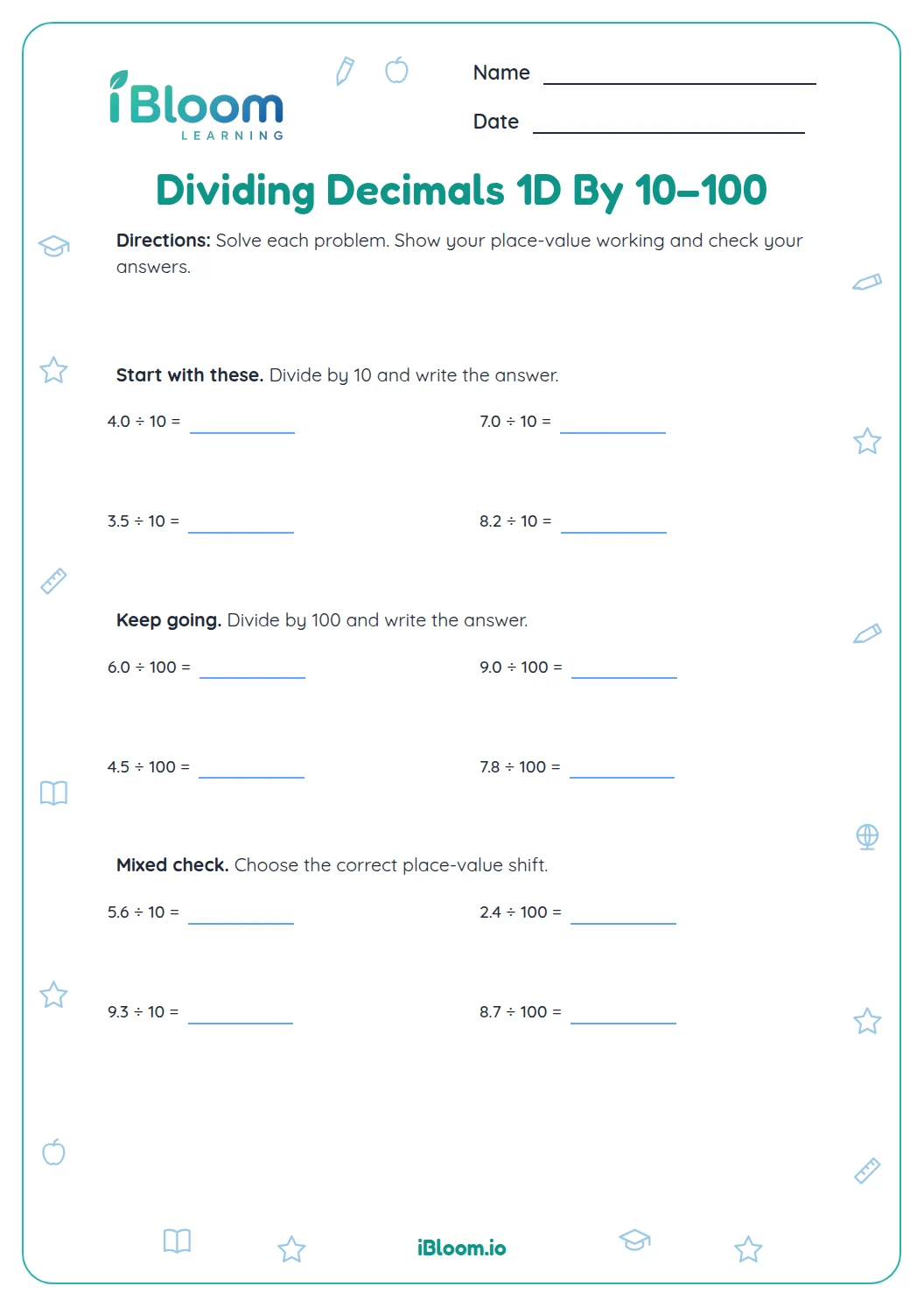
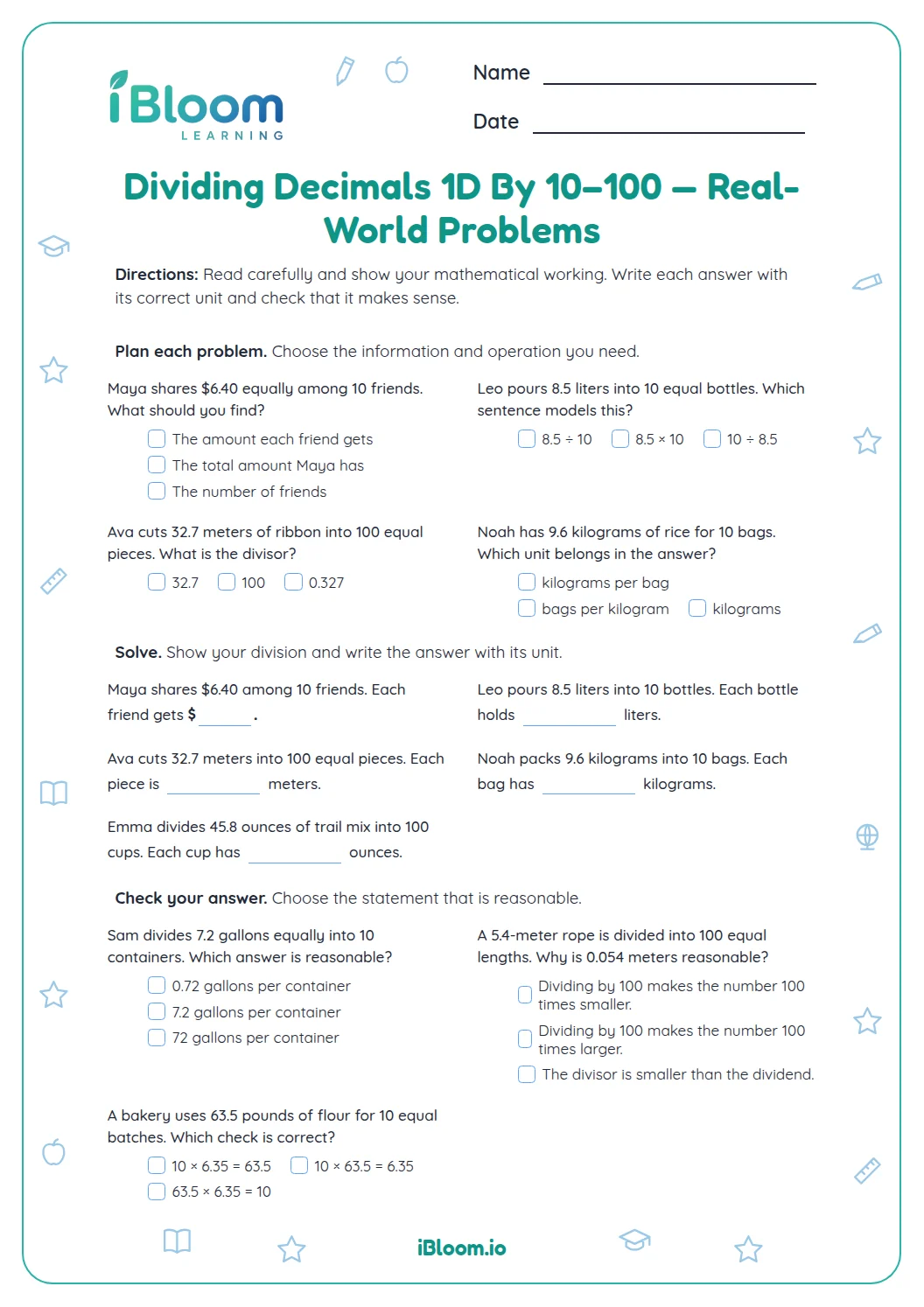
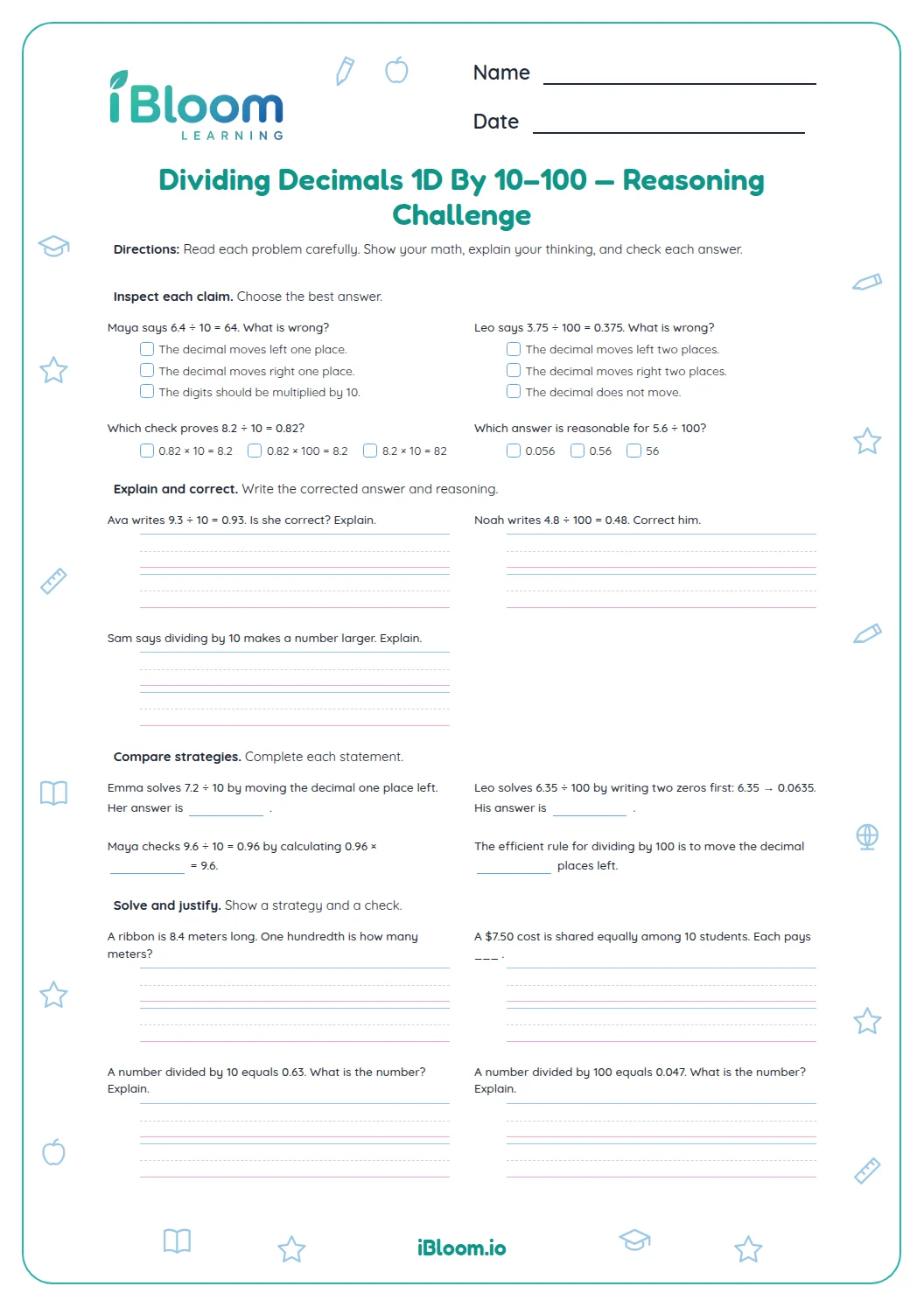
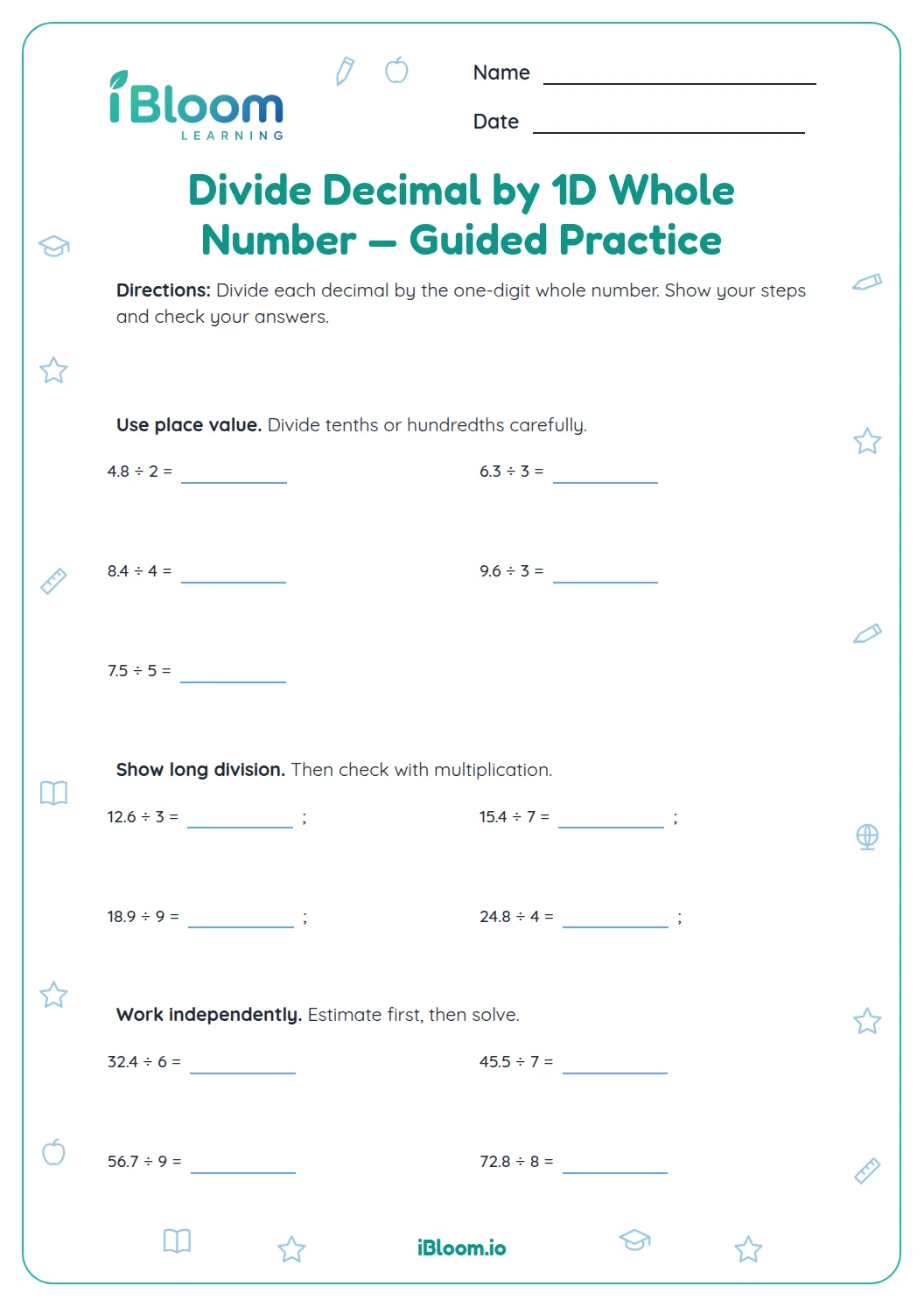
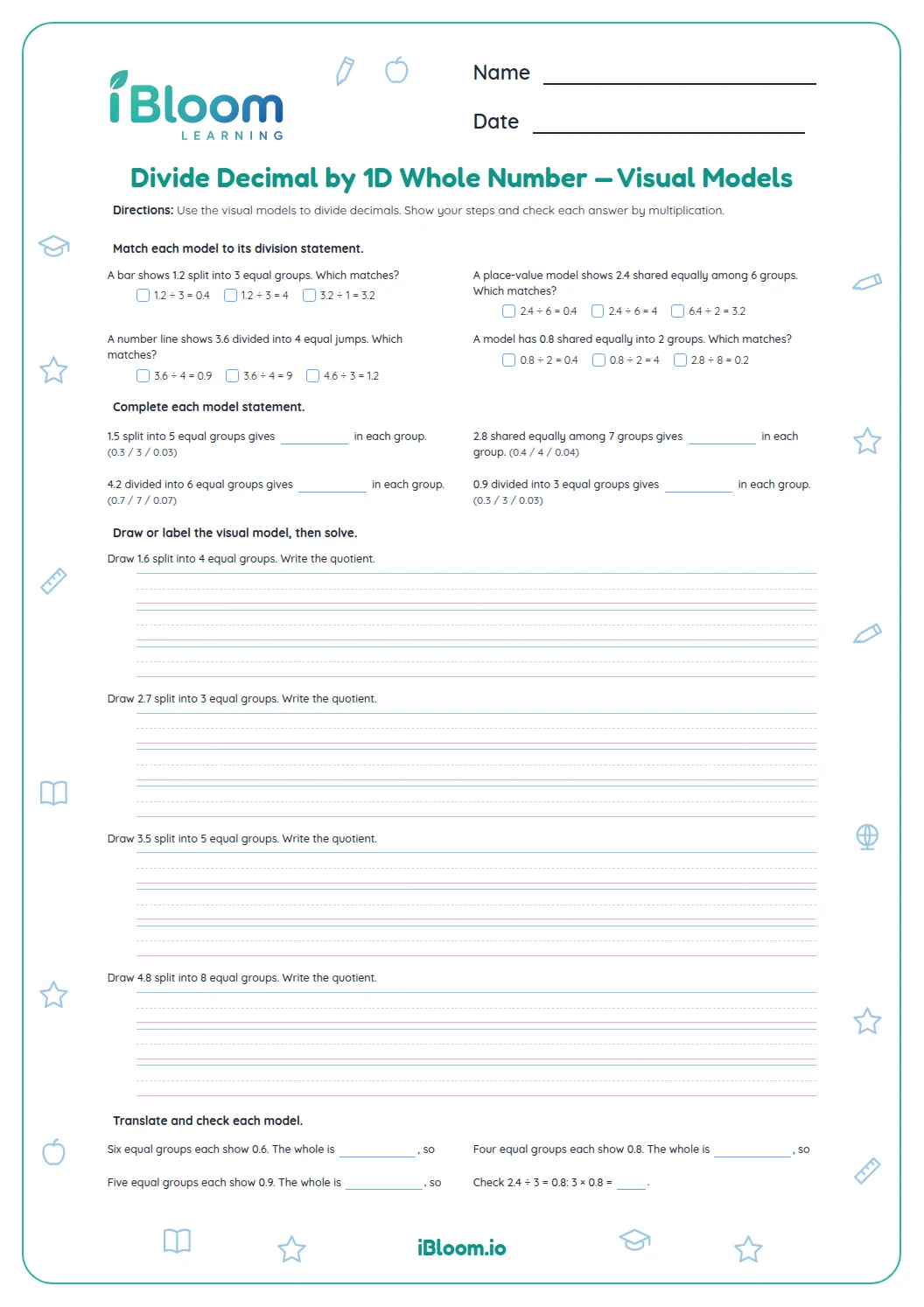
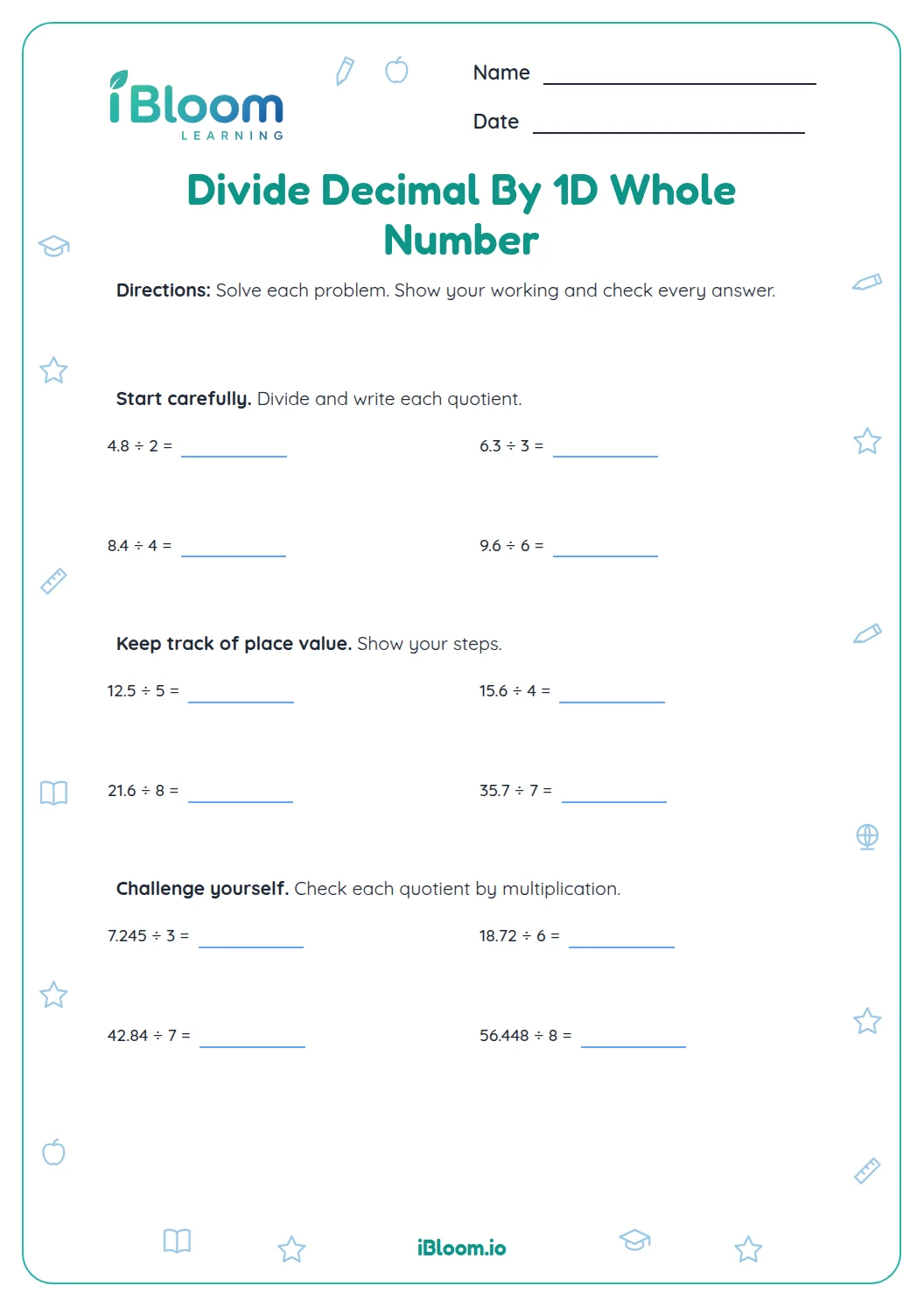
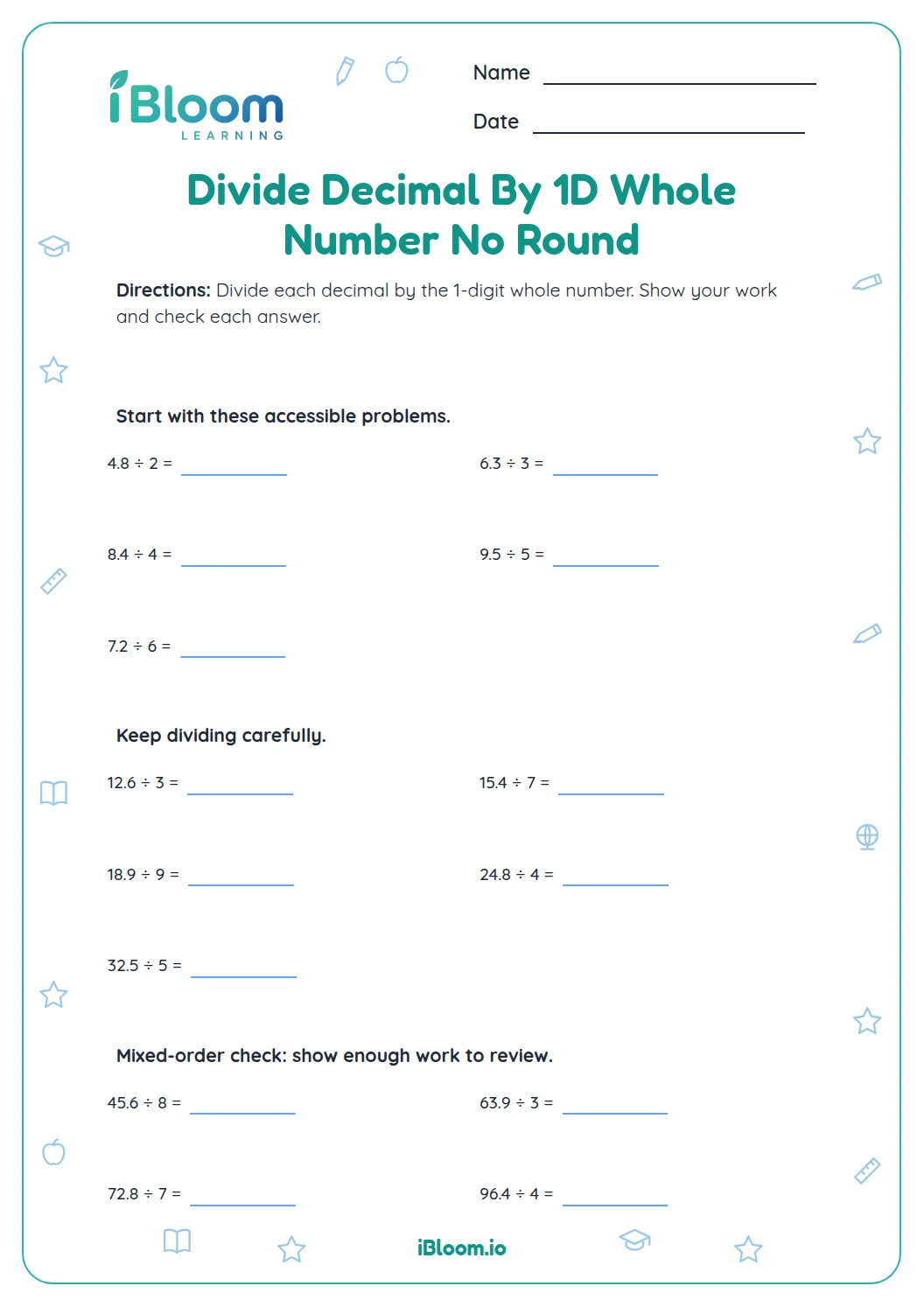
This Grade 5 printable has 14 questions on dividing decimals by 10 and 100. Students first read tenths on number lines and hundredths grids, then calculate quotients and name their values in thousandths or ten-thousandths. Each blank has one clear response, and the separate answer key gives the quotient and place-value name. The sheet supports CCSS 5.NBT.B.7 through decimal computation and place-value reasoning.
Aligned to 5.NBT.B.7
How do models connect to decimal quotients?
The models establish decimal values in tenths and hundredths. Division by 10 or 100 makes each digit’s value ten or one hundred times smaller.
The page contains 14 questions and a separate answer key.
- 10.42 ÷ 10 = ___
- 2Answer: 0.042
- 3The quotient is 42 thousandths.
What will students practice on the page?
The opening models show tenths and hundredths. Later questions divide decimals by 10 or 100 and name selected quotients by place value.
- 14 questions across focused parts
- Place-value reasoning with a checked answer key
How can students check the work?
Check a division by 10 or 100 by multiplying the quotient by the divisor. Name the value of the resulting digits, not just their written places.
How to work through this sheet
- 1Read the direction for the current part.
- 2Align matching decimal place values.
- 3Estimate when the question asks for a reasonableness check.
- 4Calculate carefully and keep units with measured answers.
- 5Check sums by subtraction or products and quotients with an estimate or inverse operation.
- 6Use the separate key after completing the work.
Decimal slips to watch for
The mistake
Moving the decimal without tracking digit values.
The fix
Say how each digit’s value changes by a factor of 10 or 100.
The mistake
Leaving out a zero in a small quotient.
The fix
Use placeholder zeros so the digits keep their places.
The mistake
Confusing thousandths with ten-thousandths.
The fix
Read the final place name from the last decimal digit.
Common Core alignment
This worksheet practices decimal computation using place-value reasoning.
Use place value and written methods to compute with decimals.
On this sheet: Students divide decimals by powers of ten and use models and place-value names to explain quotients.
Show the official wordingHide the official wording
Add, subtract, multiply, and divide decimals to hundredths, using concrete models or drawings and strategies based on place value, properties of operations, and/or the relationship between addition and subtraction; relate the strategy to a written method and explain the reasoning used.
What to practice next
Make more practice
Further reading
Questions parents and teachers ask
What do the models show?
The number lines mark tenths, and the hundredths grids shade equal parts of one whole. Students read those values before dividing. The remaining questions connect the size of a decimal quotient to its place values and ask students to write selected values in words.
How does dividing by 10 change a decimal?
Each digit’s value becomes one tenth as large, so its written position shifts one place to the right. For example, 0.42 ÷ 10 = 0.042. Reading the quotient as 42 thousandths helps explain why a zero is needed in the hundredths place.
How does dividing by 100 change a decimal?
Each digit’s value becomes one hundredth as large, or shifts two places right in the written digits. The page includes 0.75 ÷ 100 = 0.0075, which is 75 ten-thousandths. The quotient stays small even though the written digits include a zero.
Why are quotient and place-value answers separate?
The questions give one blank for the quotient and a second blank for its place-value name. This keeps the numeric result distinct from the statement that 0.042 is 42 thousandths. Students can check both parts independently in the answer key.
What is included in the answer key?
The key gives the decimal values read from each model, all quotients, and the place-value names. Students can compare each model-reading answer before reviewing division work. It also separates the quotient from its word name for the two-part questions. Students can compare each calculation with the answer key after finishing the worksheet.