






About this worksheet
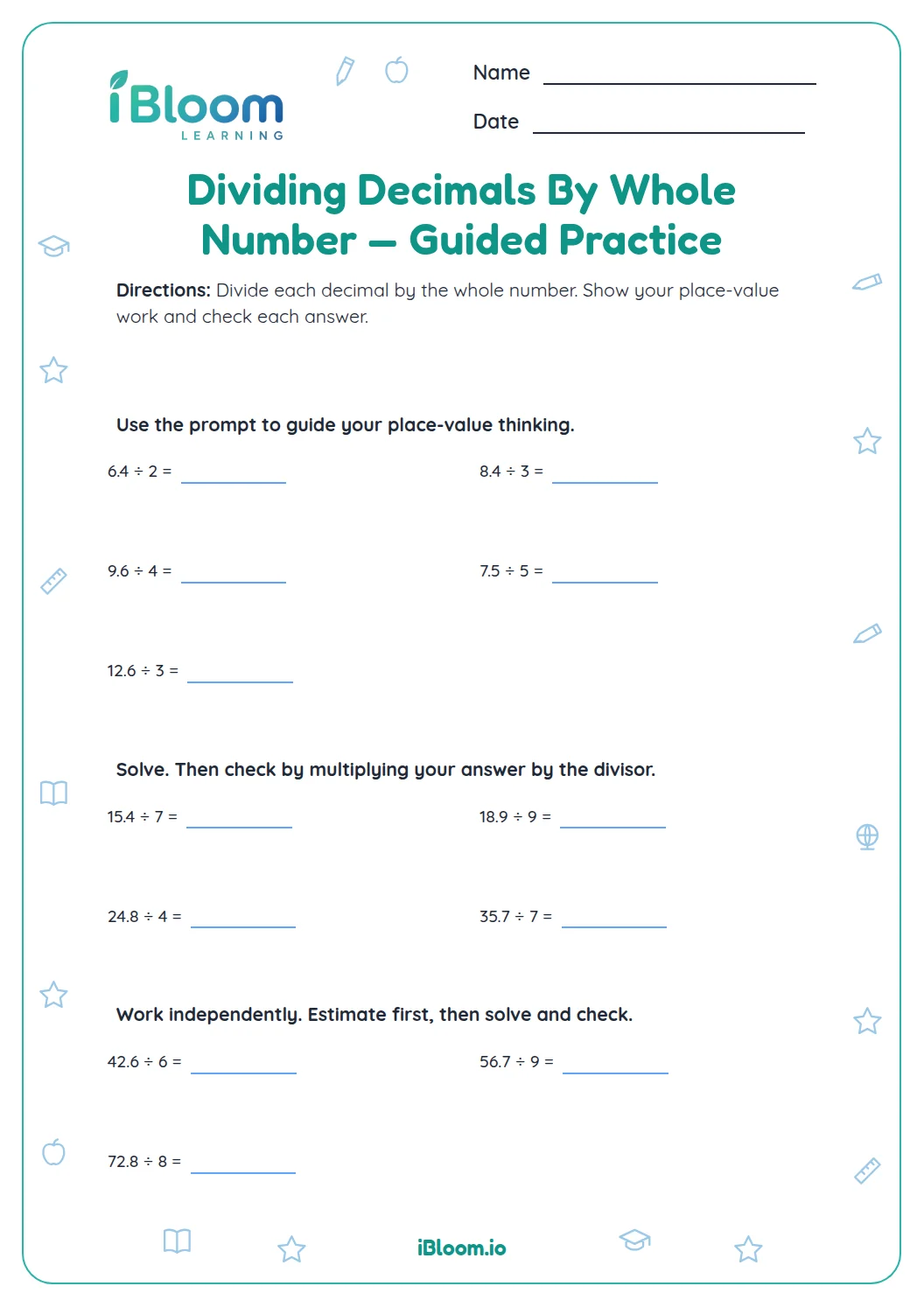
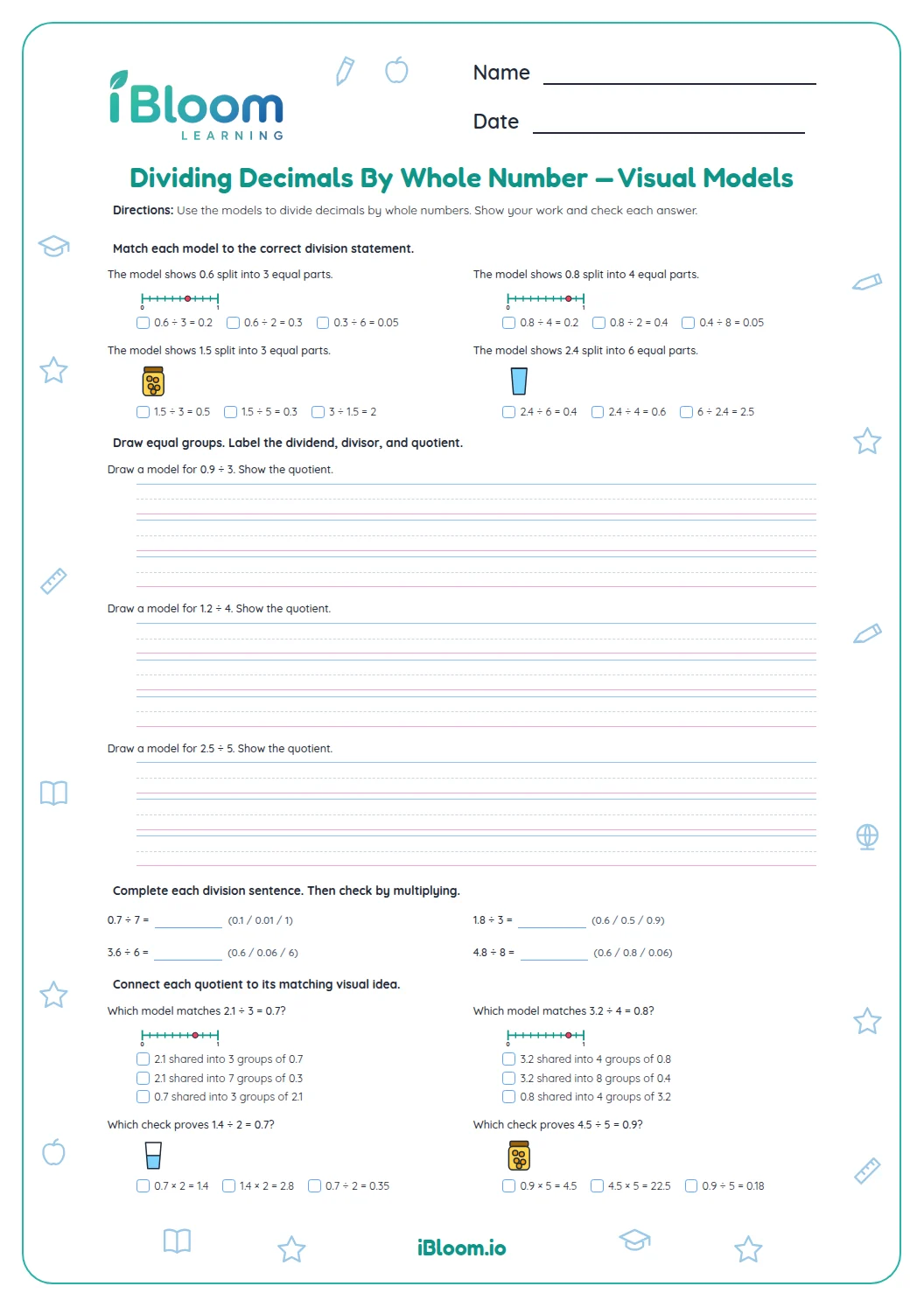
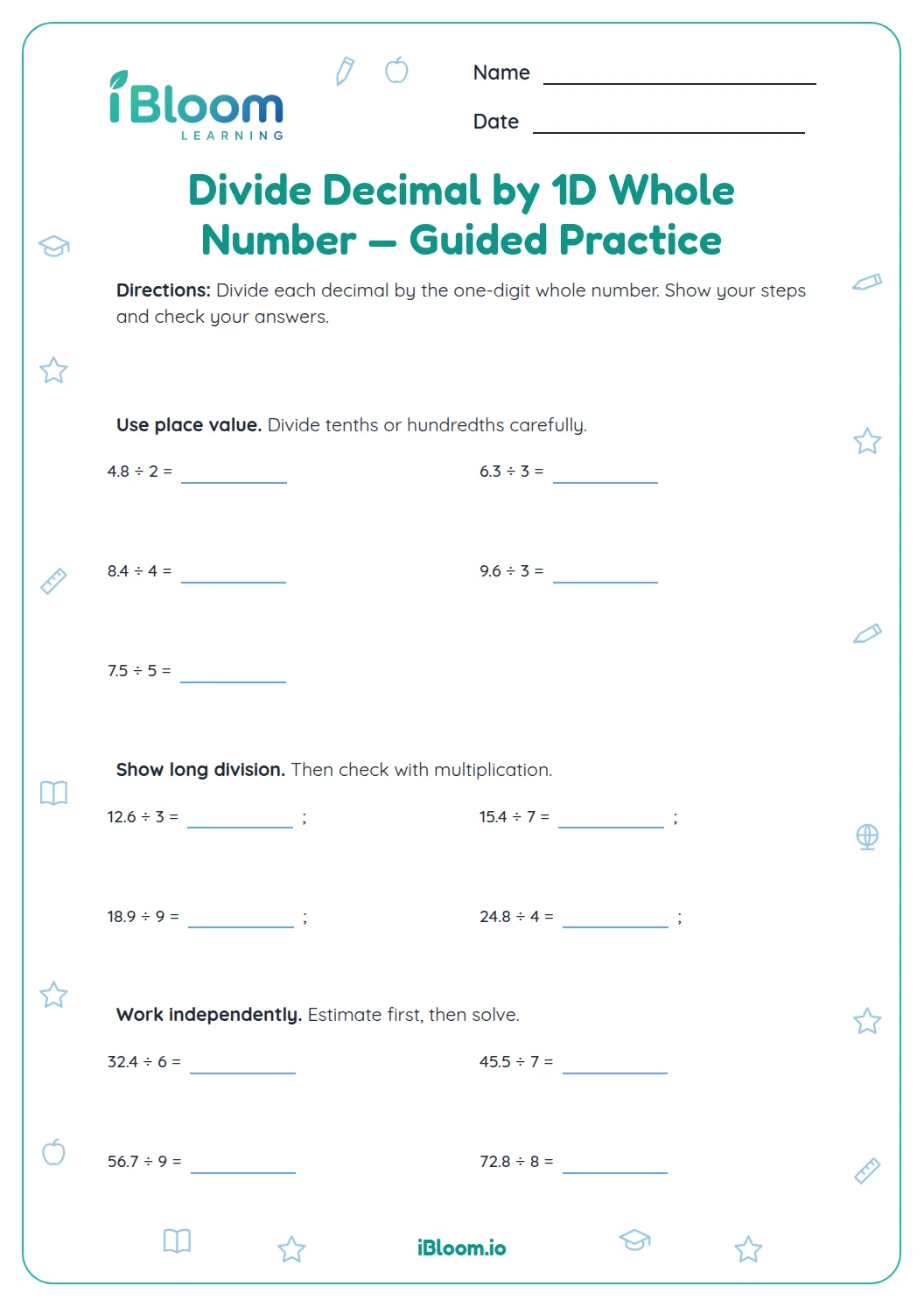
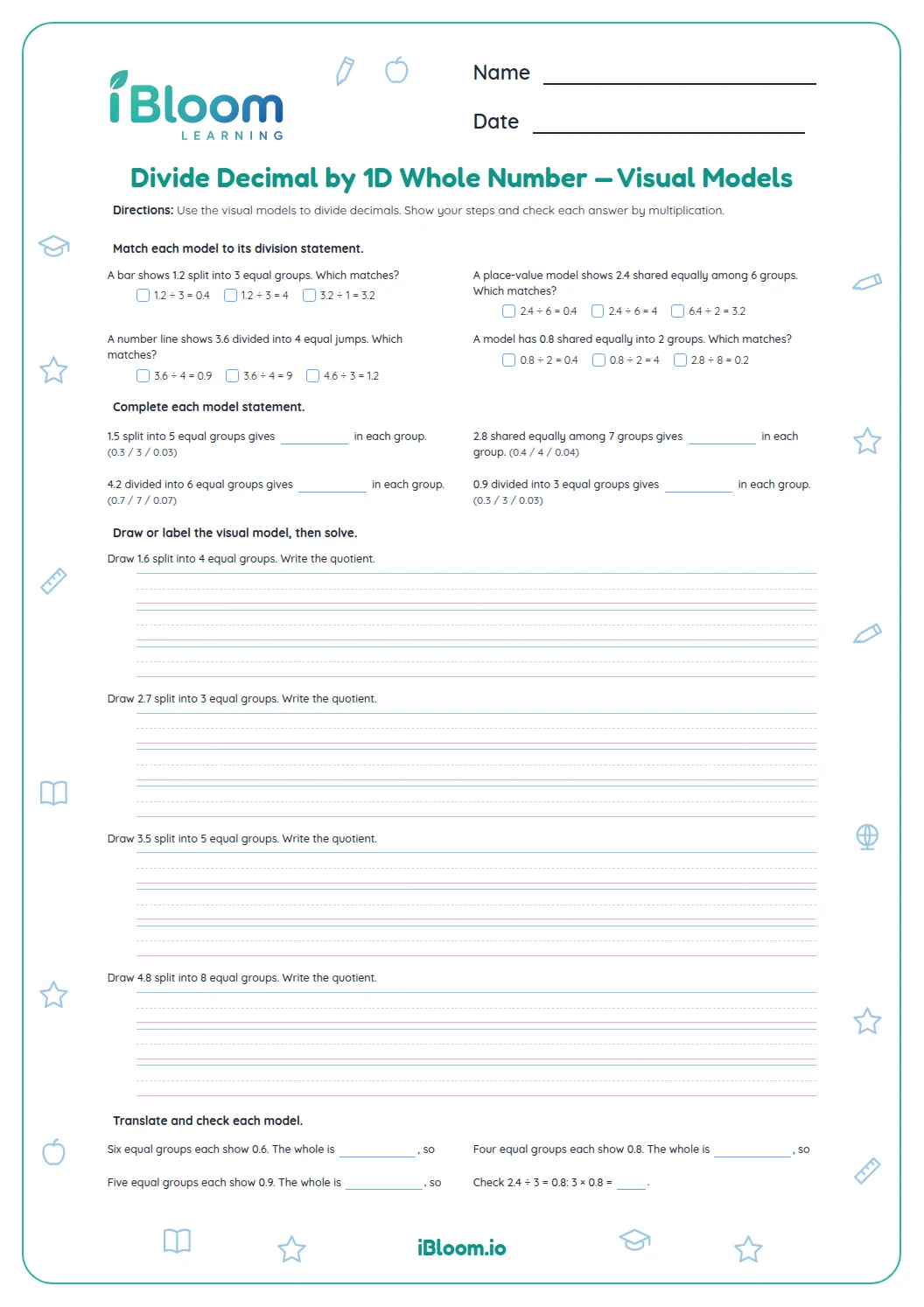
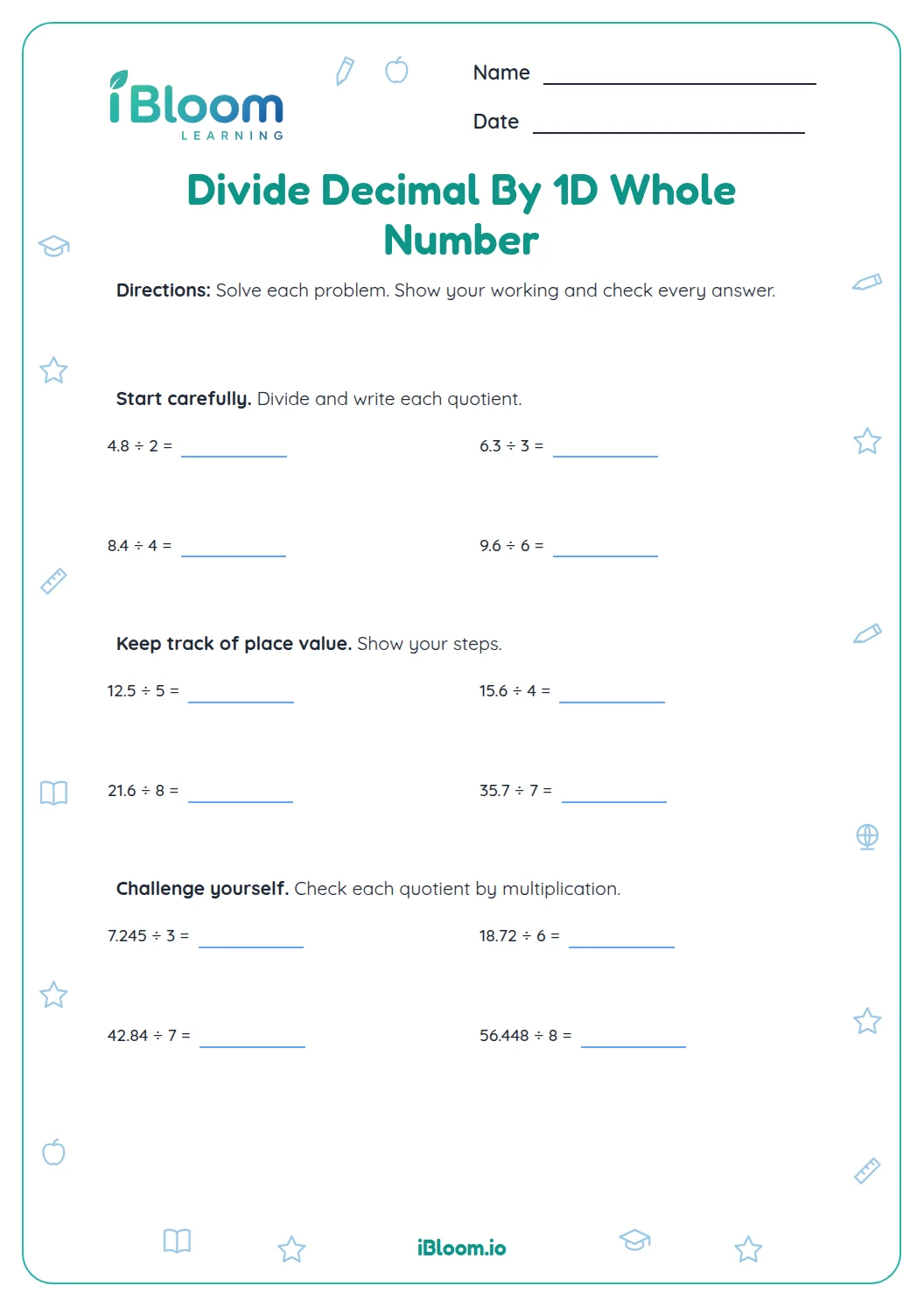
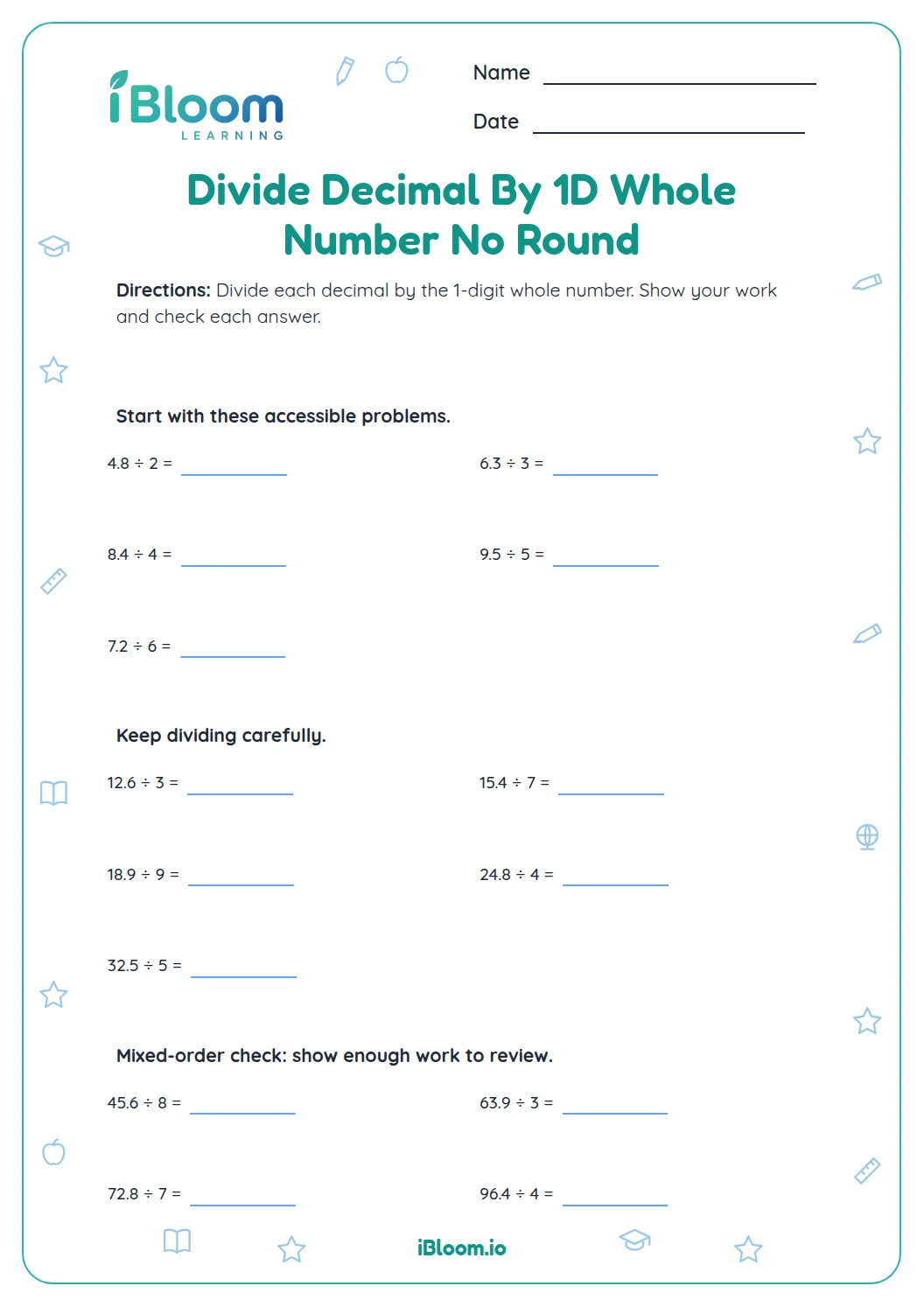
This Grade 5 worksheet includes 12 questions dividing decimals by whole numbers. Students calculate and check with multiplication, assess equivalent scaling, diagnose an extra-zero error, and solve equal-sharing problems. The separate answer key includes concise results and a model check. These tasks practice CCSS 5.NBT.B.7 by connecting decimal place value with written division and multiplication checks.
Aligned to 5.NBT.B.7
How can multiplication check a decimal quotient?
A quotient should multiply back to the dividend. Students use that relationship alongside place-value reasoning to check division and recognize an extra-zero error.
The page contains 12 questions and a separate answer key.
- 14.8 ÷ 3 = ___
- 2Answer: 1.6
- 3Check: 1.6 × 3 = 4.8.
What will students practice on the page?
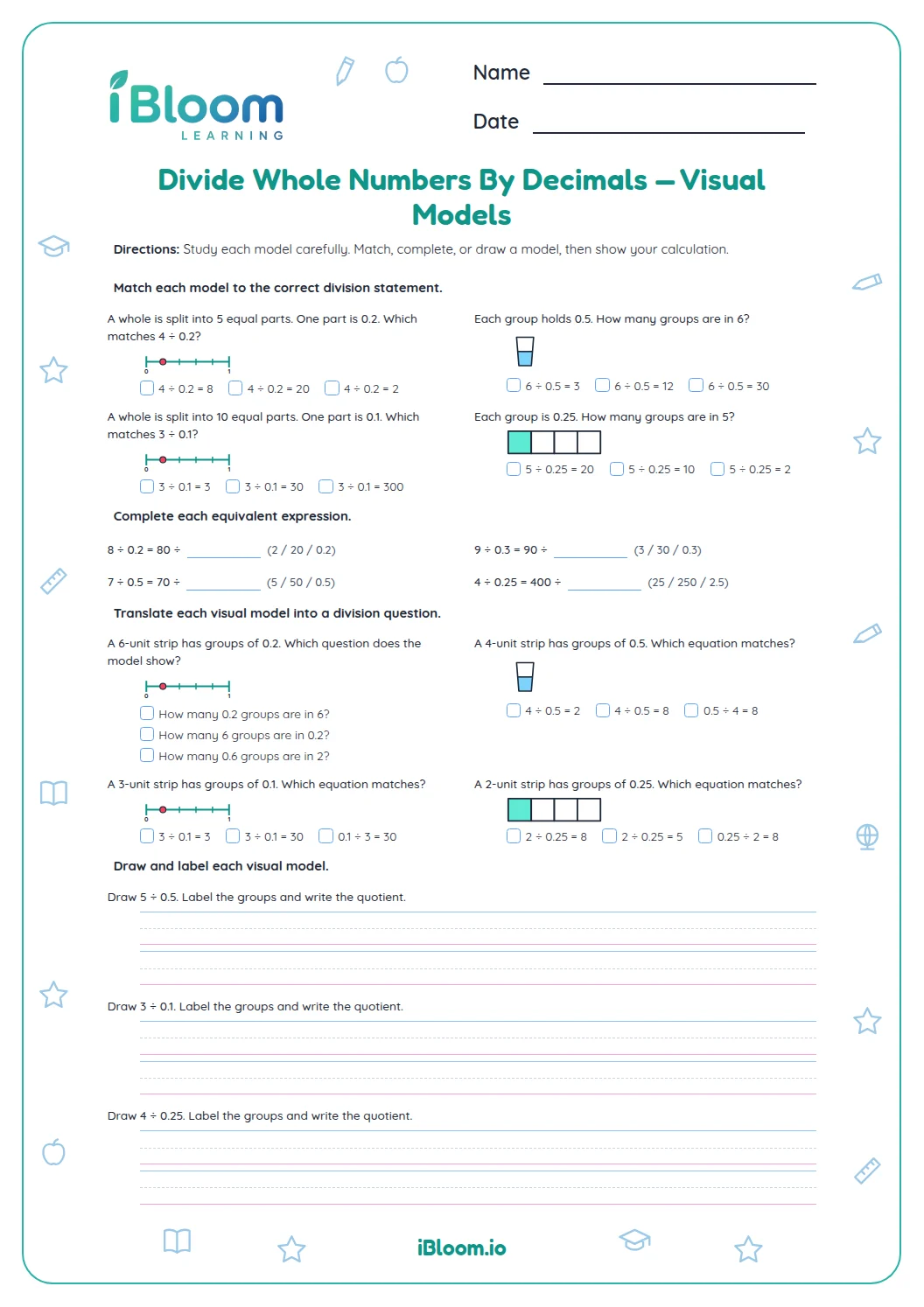
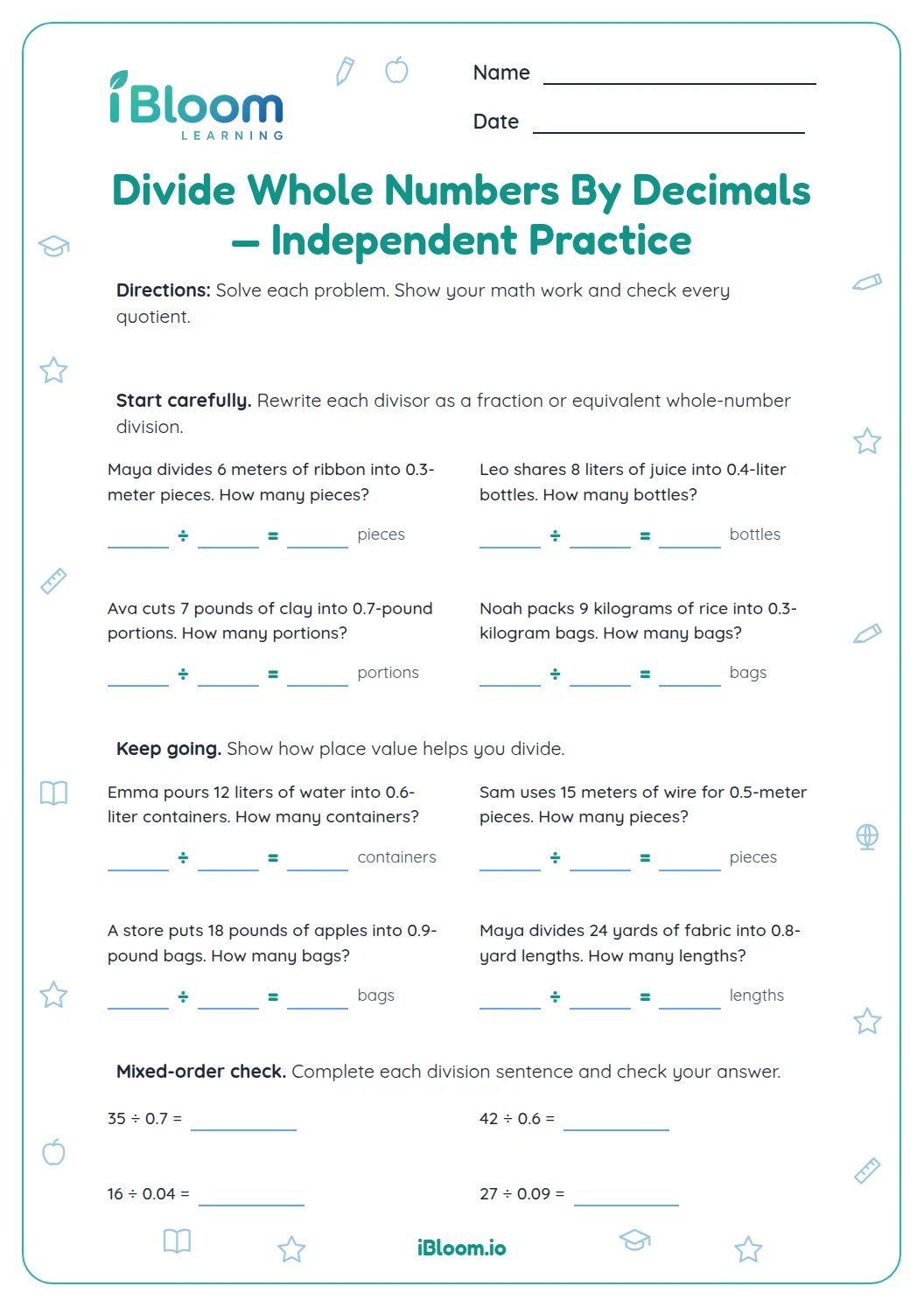
Students solve direct division, evaluate a valid scaling method, diagnose a quotient error, and apply equal sharing to measurements.
- 12 questions across focused parts
- Place-value reasoning with a checked answer key
How can students check the work?
Multiply each quotient by its divisor. In an equal-sharing problem, confirm that the number of groups times the amount per group returns the original amount.
How to work through this sheet
- 1Read the direction for the current part.
- 2Align matching decimal place values.
- 3Estimate when the question asks for a reasonableness check.
- 4Calculate carefully and keep units with measured answers.
- 5Check sums by subtraction or products and quotients with an estimate or inverse operation.
- 6Use the separate key after completing the work.
Decimal slips to watch for
The mistake
Changing the dividend but not the divisor when scaling.
The fix
Multiply both numbers by the same factor.
The mistake
Adding an extra zero to a quotient.
The fix
Estimate and multiply the quotient by the divisor.
The mistake
Dropping the unit in an equal-sharing answer.
The fix
Keep the original measurement unit with each share.
Common Core alignment
This worksheet practices decimal computation using place-value reasoning.
Use place value and written methods to compute with decimals.
On this sheet: Students divide decimals by whole numbers and relate quotient calculations to multiplication checks.
Show the official wordingHide the official wording
Add, subtract, multiply, and divide decimals to hundredths, using concrete models or drawings and strategies based on place value, properties of operations, and/or the relationship between addition and subtraction; relate the strategy to a written method and explain the reasoning used.
What to practice next
Make more practice
Further reading
Questions parents and teachers ask
How can students check decimal division?
Multiply the quotient by the divisor. For 4.8 ÷ 3 = 1.6, the check is 1.6 × 3 = 4.8. This inverse operation helps confirm both the quotient and its decimal placement. Students can use the same check in the equal-sharing problems.
Is changing 4.8 ÷ 3 into 48 ÷ 30 valid?
Yes. Multiplying both the dividend and divisor by 10 keeps the quotient unchanged: 48 ÷ 30 = 1.6. The method check asks students to identify why both quantities must be scaled together. Dividing 48 by 30 gives the same quotient as 4.8 divided by 3.
What causes the answer 1.04 for 8.4 ÷ 6?
The likely error is inserting an extra zero. Since 8.4 ÷ 6 = 1.4, multiplying 1.4 by 6 returns 8.4; 1.04 × 6 does not. Students select the explanation that matches the incorrect quotient and compare it with the correct calculation.
What kinds of applications are on the page?
Students divide a drink among containers, cut rope into equal lengths, share grain among bins, and split ribbon into equal pieces. Each situation has a clear divisor and keeps the original measurement unit with the amount in each group. Students can compare each calculation with the answer key after finishing the worksheet.
Is the answer key included?
Yes. A separate answer key gives all 12 quotients, the correct method and error explanations, and a sample multiplication check for the final question. Students can complete their work first and then use the key to review specific steps. Students can compare each calculation with the answer key after finishing the worksheet.