






About this worksheet
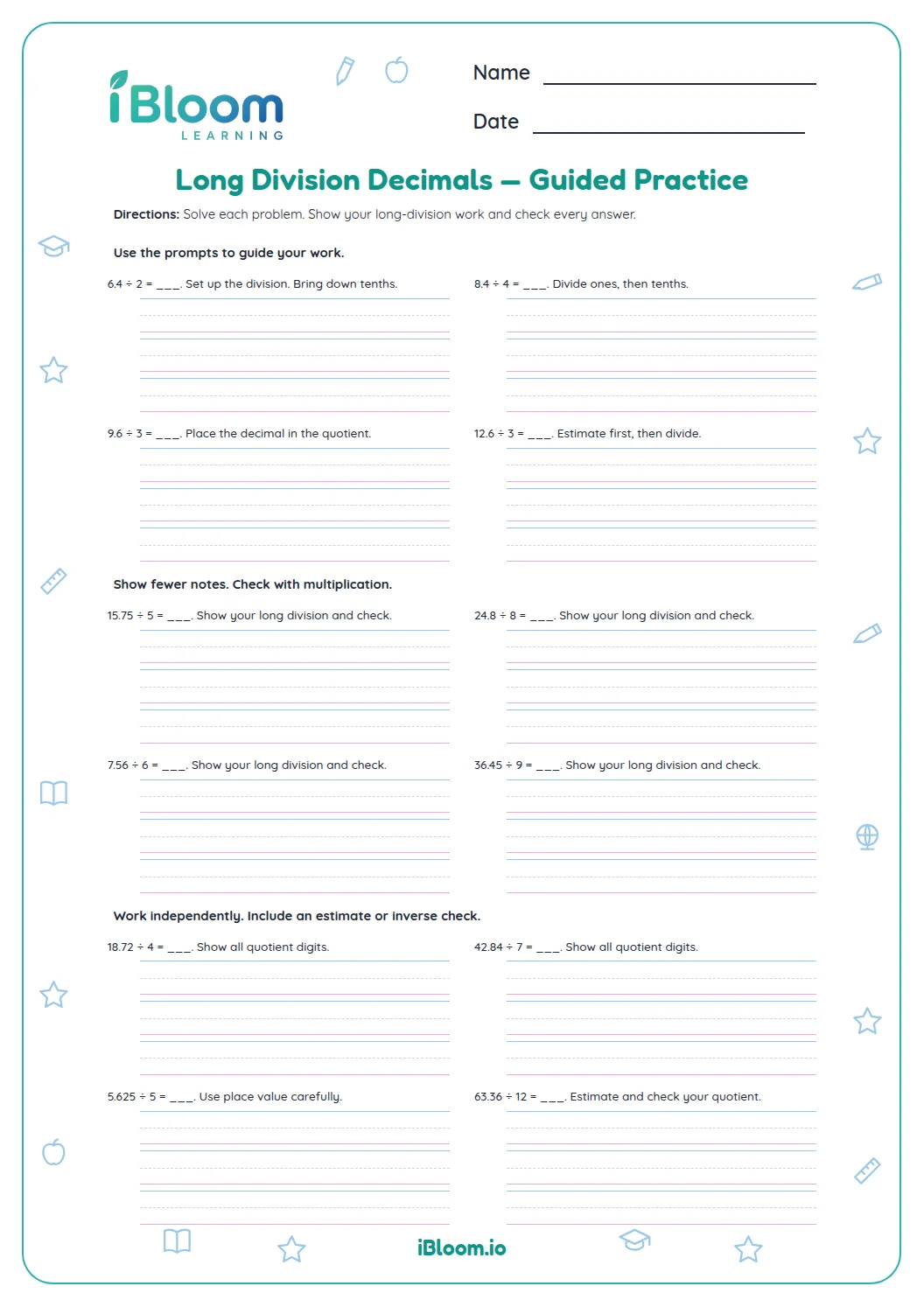
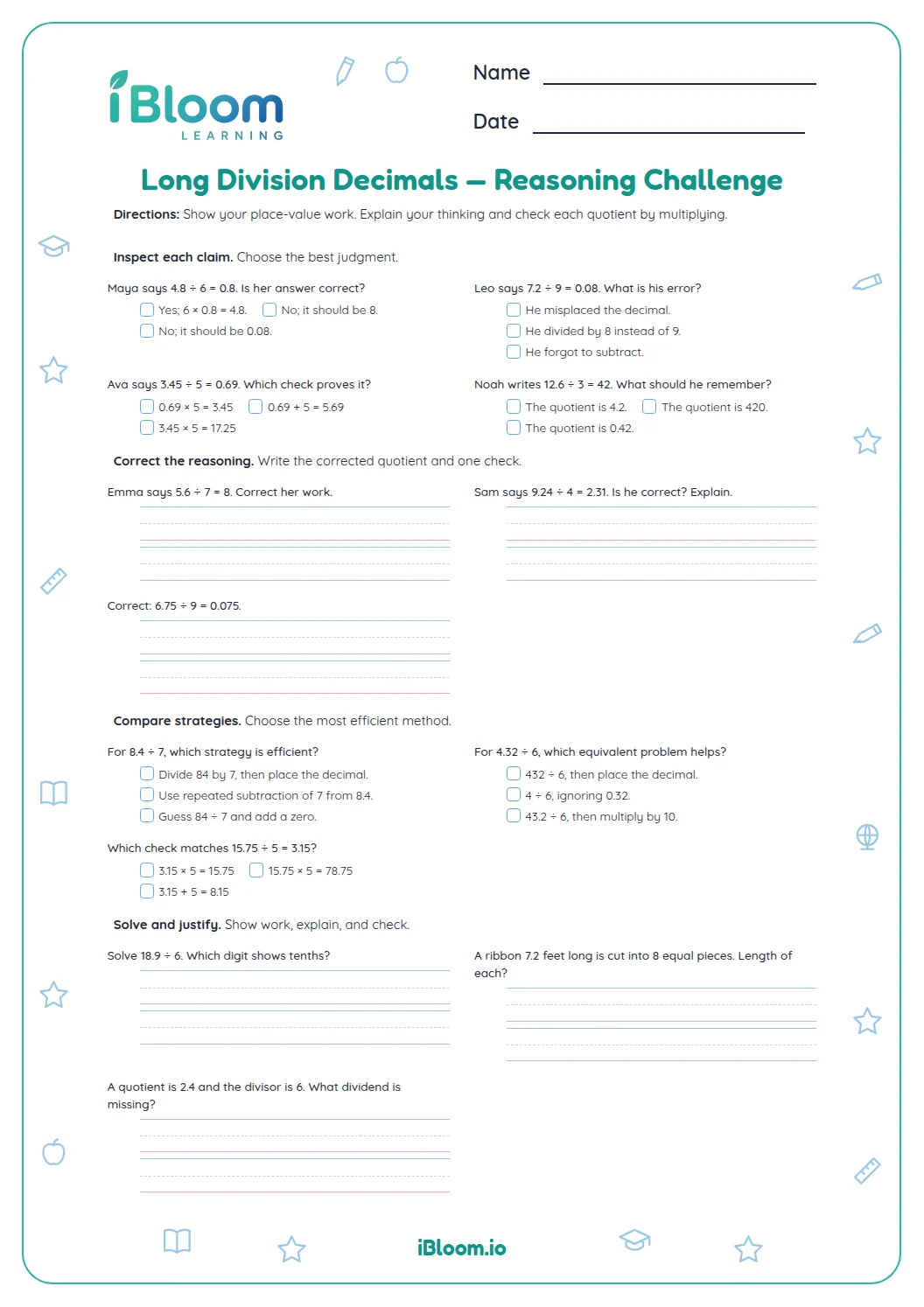
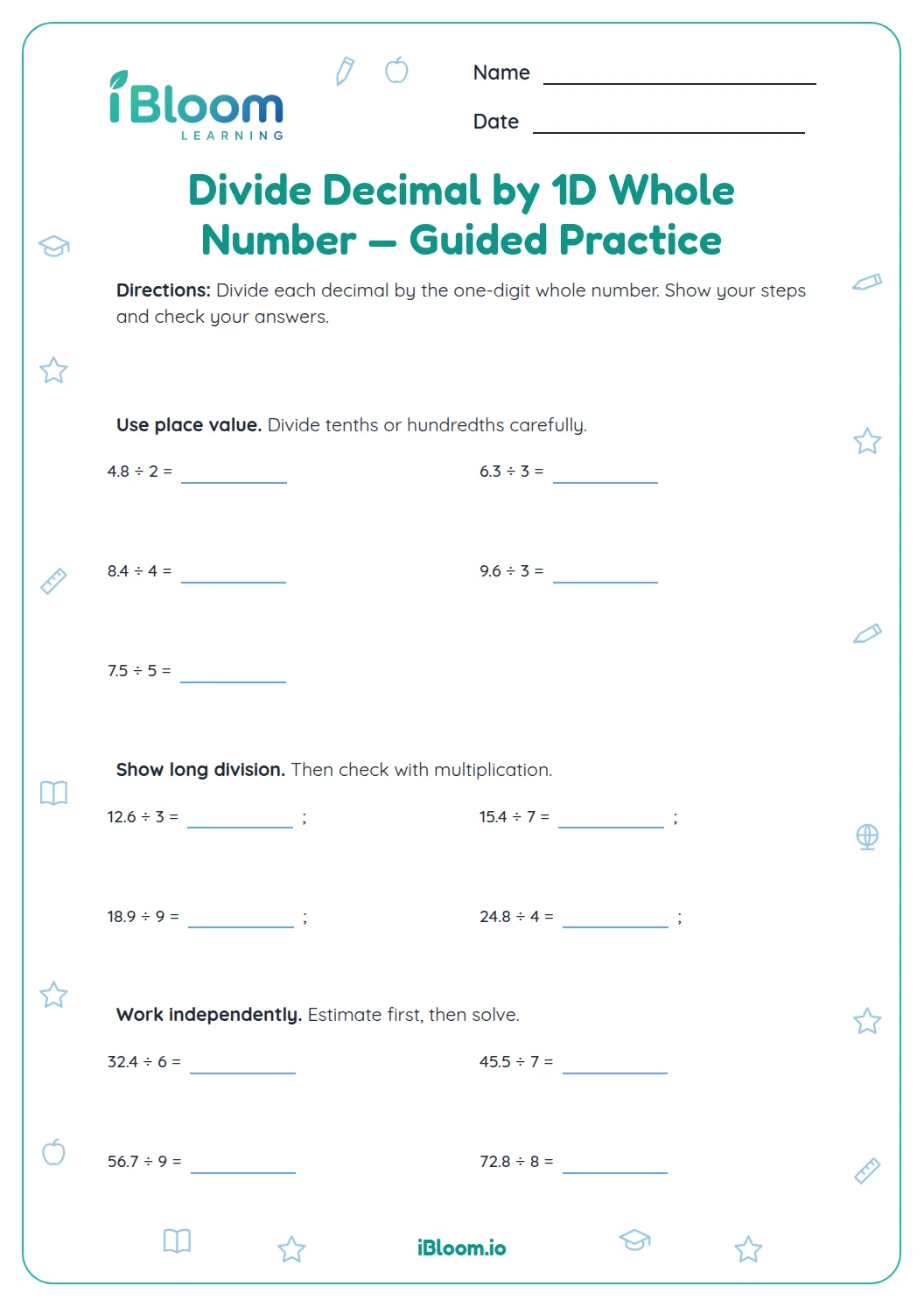
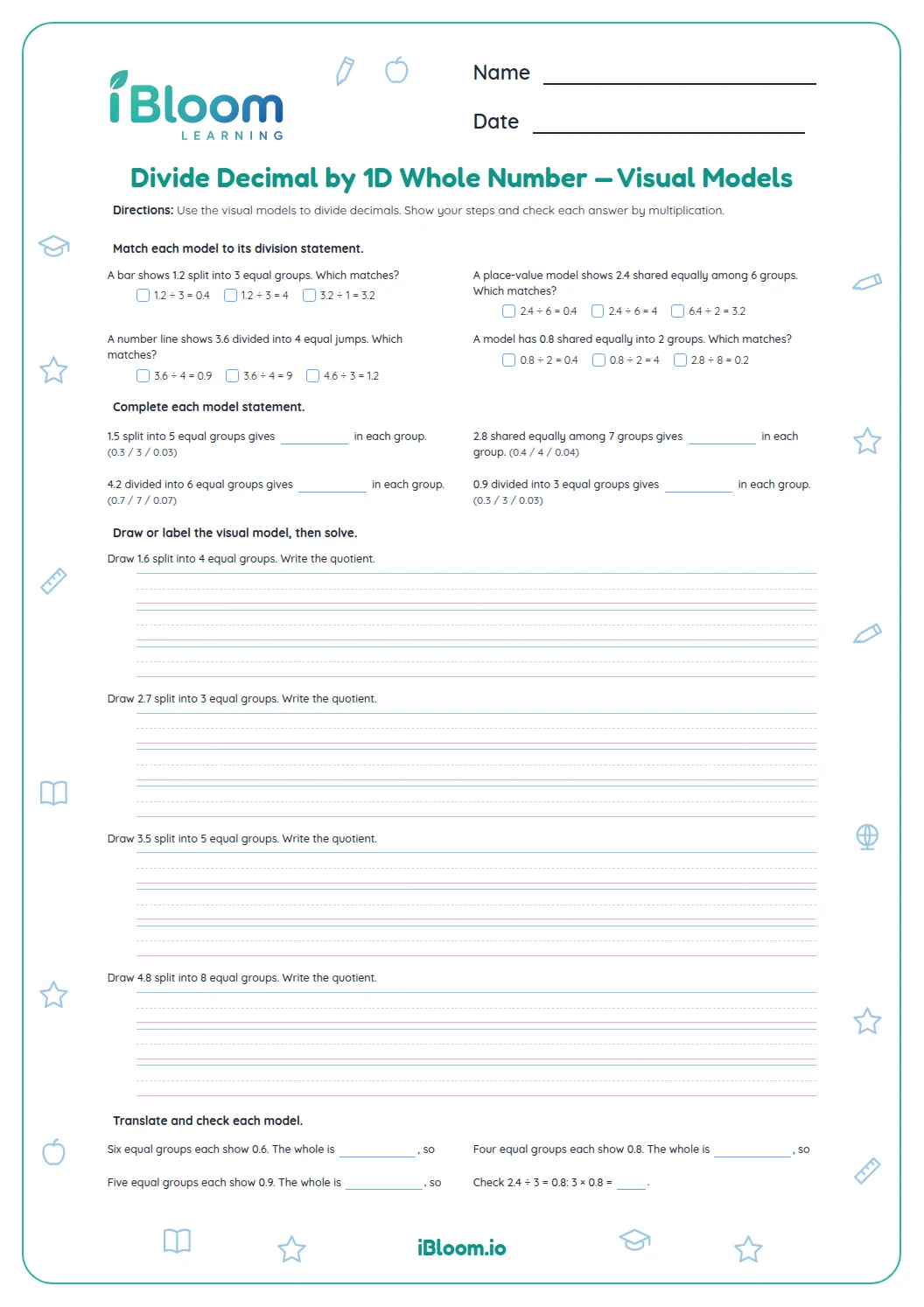
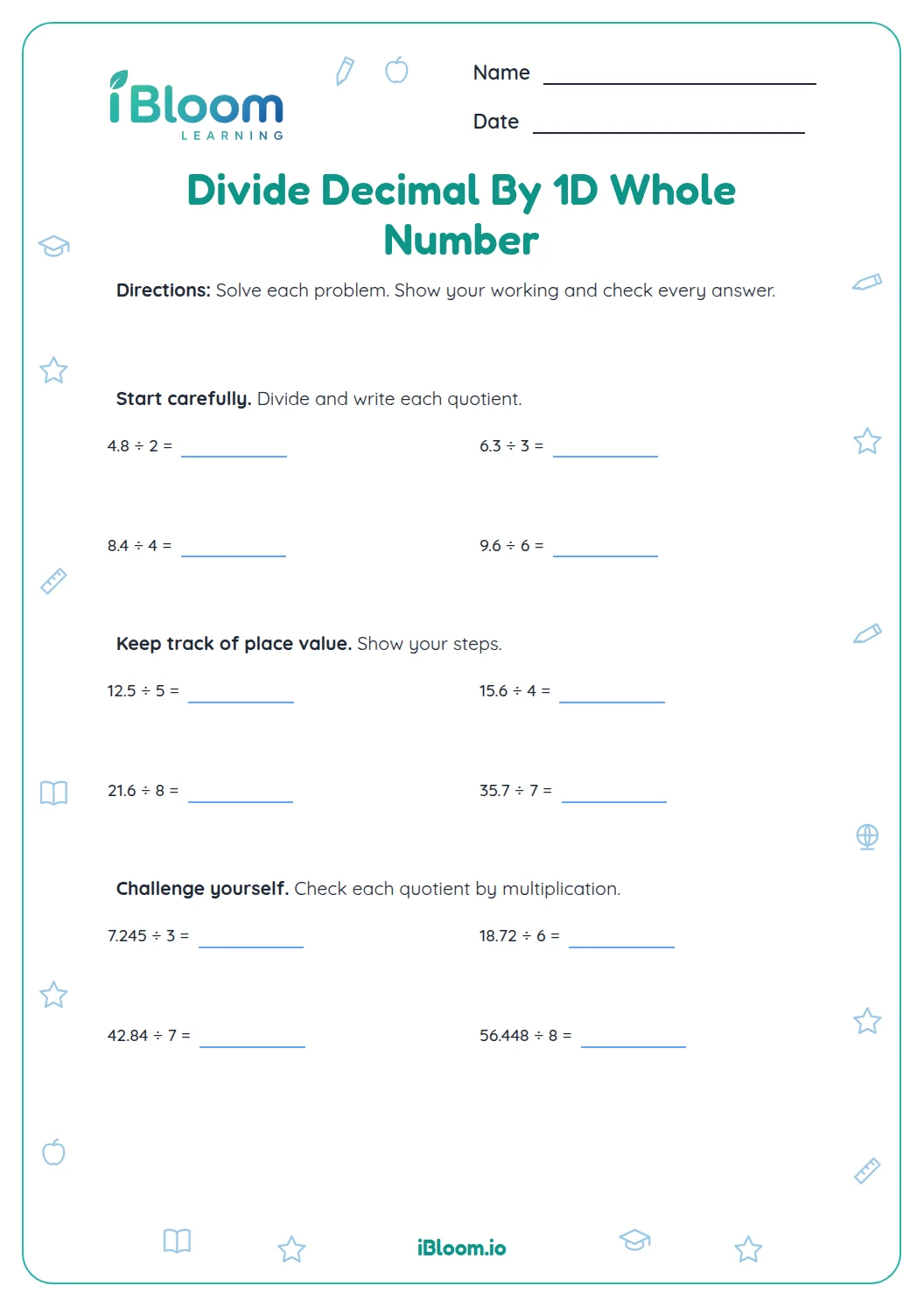
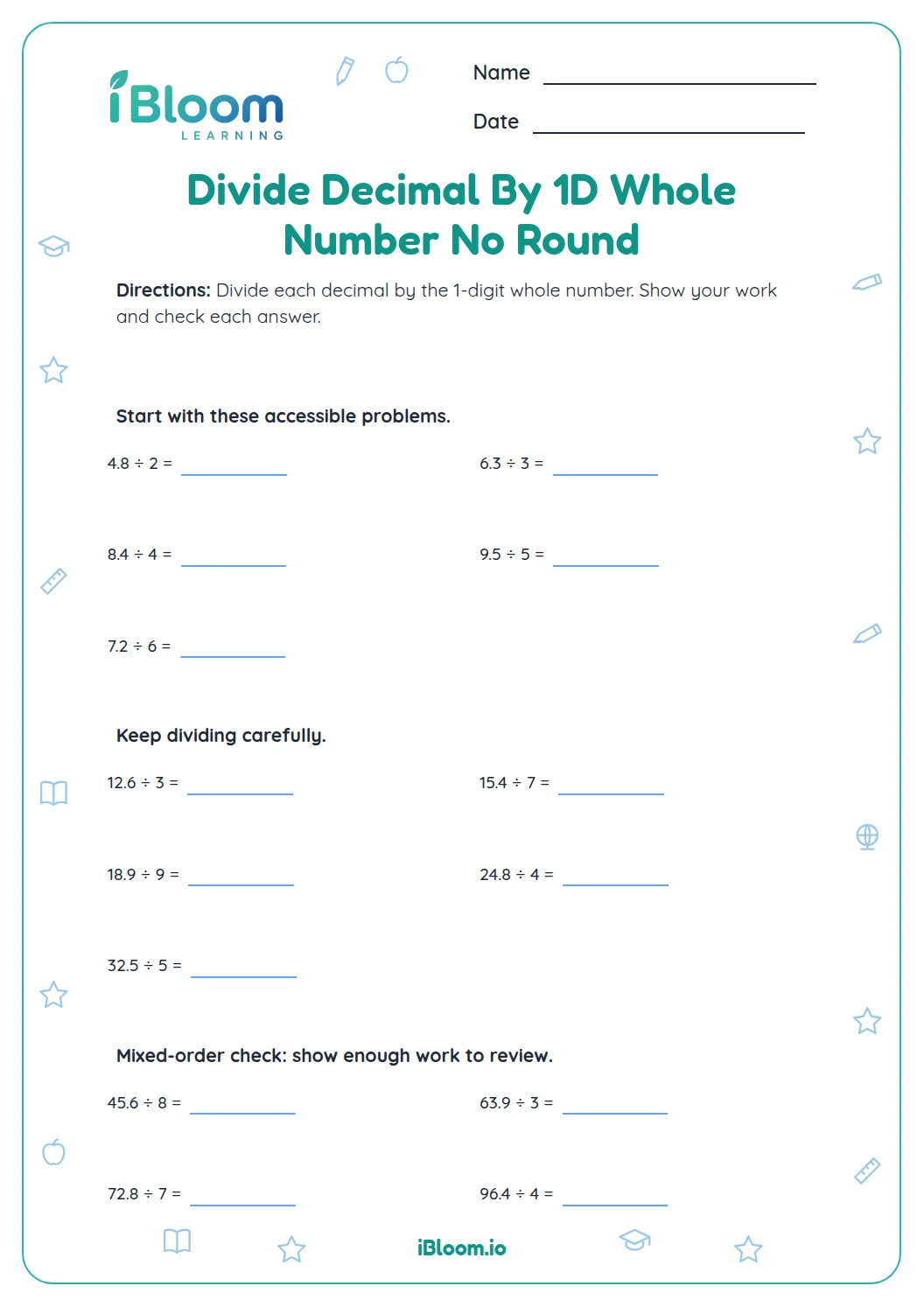
This Grade 5 printable gives children focused practice dividing decimals by whole numbers with long division. It includes ten number sentences with terminating quotients and five short equal-sharing problems, so every quotient can be checked by multiplying. A separate key shows the answers and units.
Aligned to 5.NBT.B.7
How do you divide a decimal by a whole number?
Divide as with whole numbers and place the decimal point in the quotient directly above the decimal point in the dividend. Continue with zeros when a place needs a placeholder.
- 118.4 ÷ 4 = 4.6; check: 4.6 × 4 = 18.4
Why check by multiplying?
Multiplication reverses division. Multiply the quotient by the divisor; the product should equal the original dividend.
How can a child check the work?
Finish each division before checking the separate answer key. Multiply the quotient by its divisor; the result should match the original dividend. In a word problem, include the unit named in the situation.
How to use this worksheet
- 1Set up the dividend and whole-number divisor.
- 2Divide one place at a time as with whole numbers.
- 3Place the quotient decimal above the dividend decimal.
- 4Continue through the hundredths when needed.
- 5Multiply the quotient by the divisor to check.
Common mistakes and quick fixes
The mistake
Placing the quotient decimal in the wrong place.
The fix
Put it directly above the decimal in the dividend.
The mistake
Stopping before the needed decimal places are divided.
The fix
Bring down each remaining digit and use a zero when needed.
The mistake
Forgetting to check the quotient.
The fix
Multiply quotient × divisor; the product should equal the dividend.
This worksheet practices the following Common Core skill.
Use place-value understanding to solve decimal computation problems.
On this sheet:
Show the official wordingHide the official wording
Add, subtract, multiply, and divide decimals to hundredths, using concrete models or drawings and strategies based on place value, properties of operations, and/or the relationship between addition and subtraction; relate the strategy to a written method and explain the reasoning used.
What to practice next
Make more practice
Further reading
Questions parents and teachers ask
Will each quotient end?
Yes. The worksheet uses dividends and divisors chosen to produce terminating decimal quotients, so each long-division problem can be completed exactly. Complete the calculation first, then check the printed key. Explain any correction using the numbers in the problem to make each step clear.
What should a word-problem answer include?
Use the unit named in the situation, such as inches, liters, pounds, miles, or meters. Then check the quotient with multiplication. Complete the calculation first, then check the printed key. Explain any correction using the numbers in the problem to make each step clear.
How can a child catch a misplaced decimal?
Estimate the size of the quotient before calculating. After division, multiply back and compare the product with the original dividend. Complete the calculation first, then check the printed key. Explain any correction using the numbers in the problem to make each step clear.
How many questions are on this worksheet?
There are 15 questions: 10 decimal quotients and 5 equal-sharing situations. Each problem divides a decimal by a whole number and can be checked with multiplication. The answer key lists the quotients and units for the sharing problems.
How can an adult support practice?
Have the child estimate whether the quotient should be greater or less than the dividend, then check the decimal placement. Multiplying the quotient by the divisor should recover the dividend. The answer key provides a final check after the work is complete.