


About this worksheet
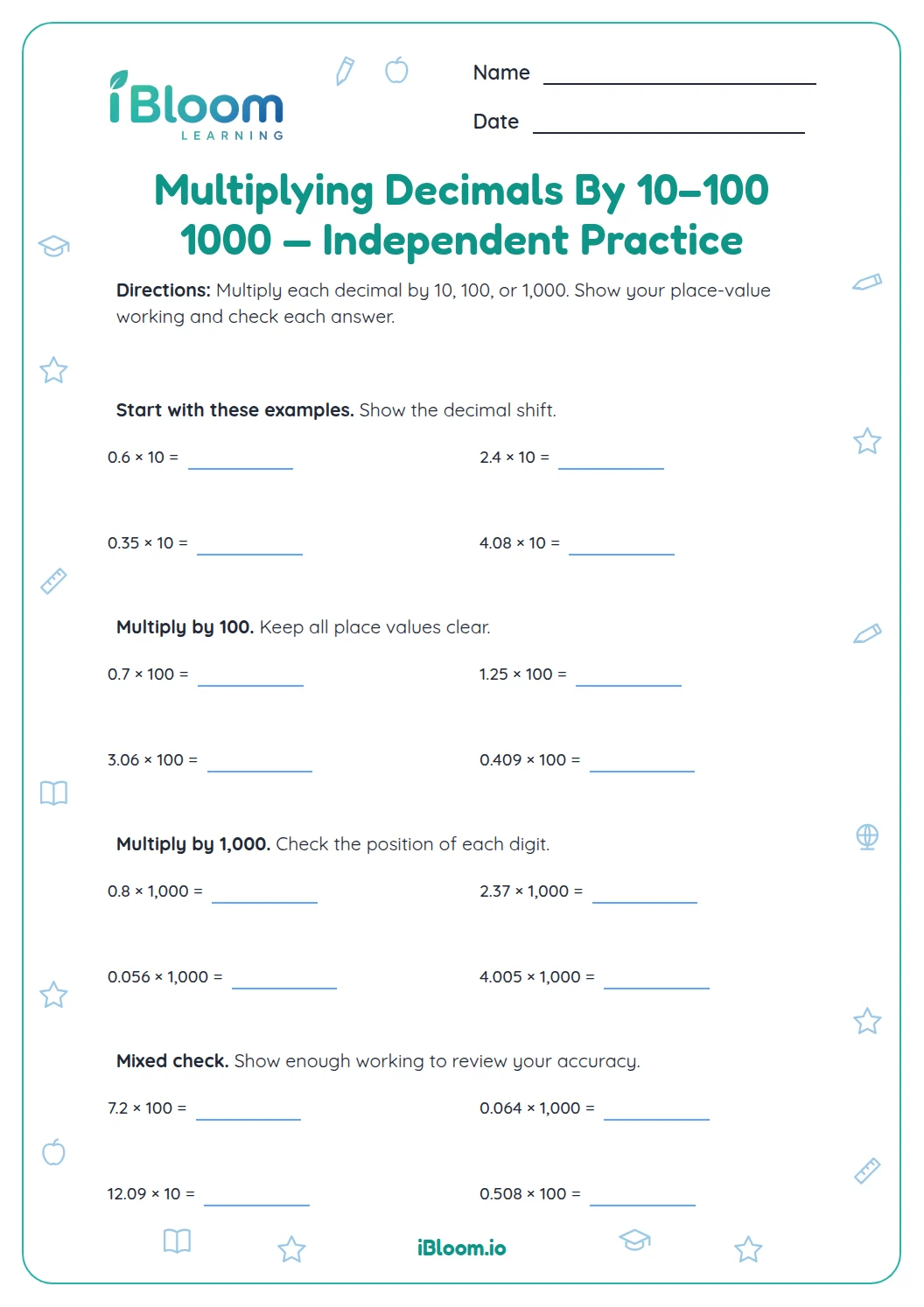
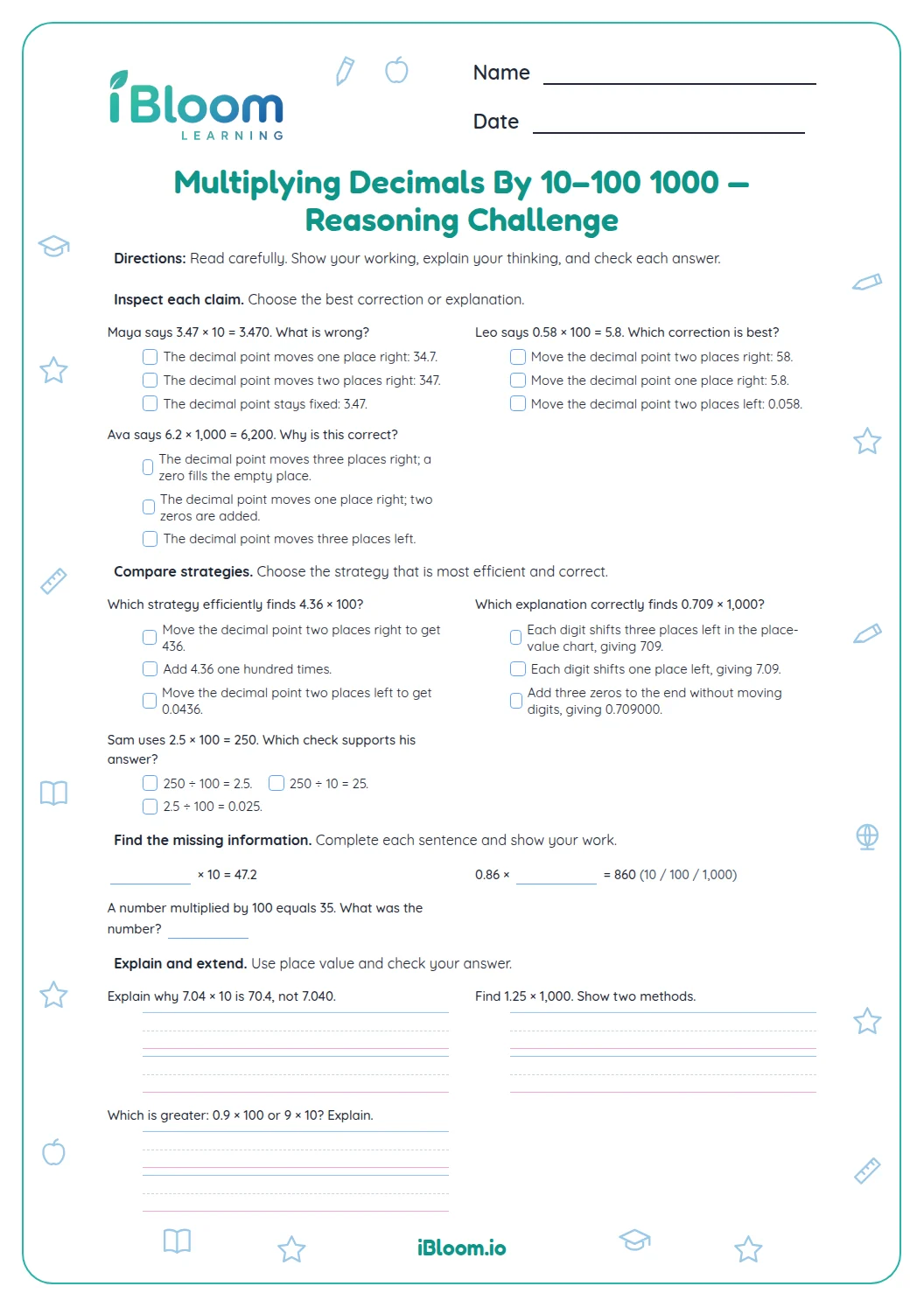
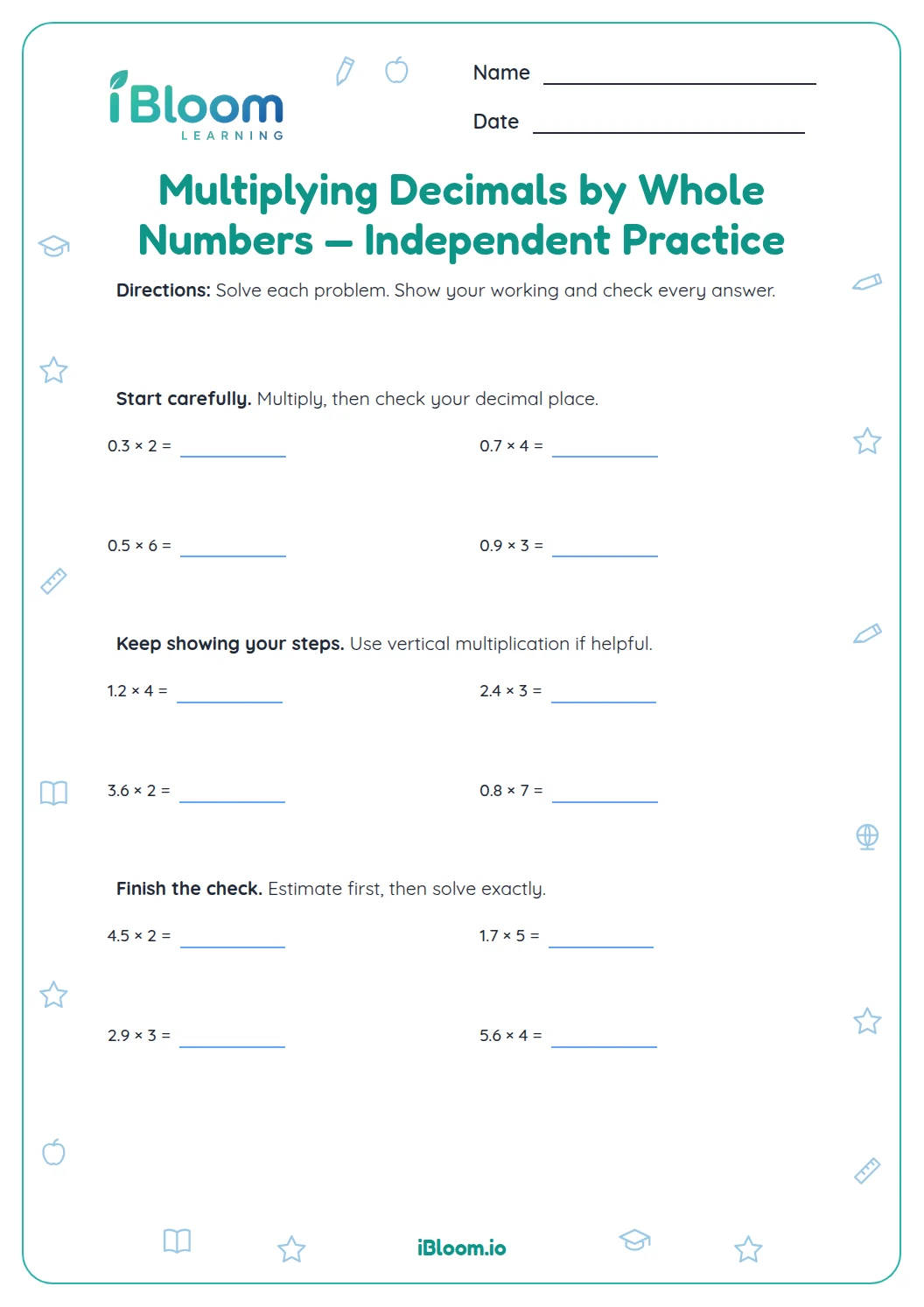
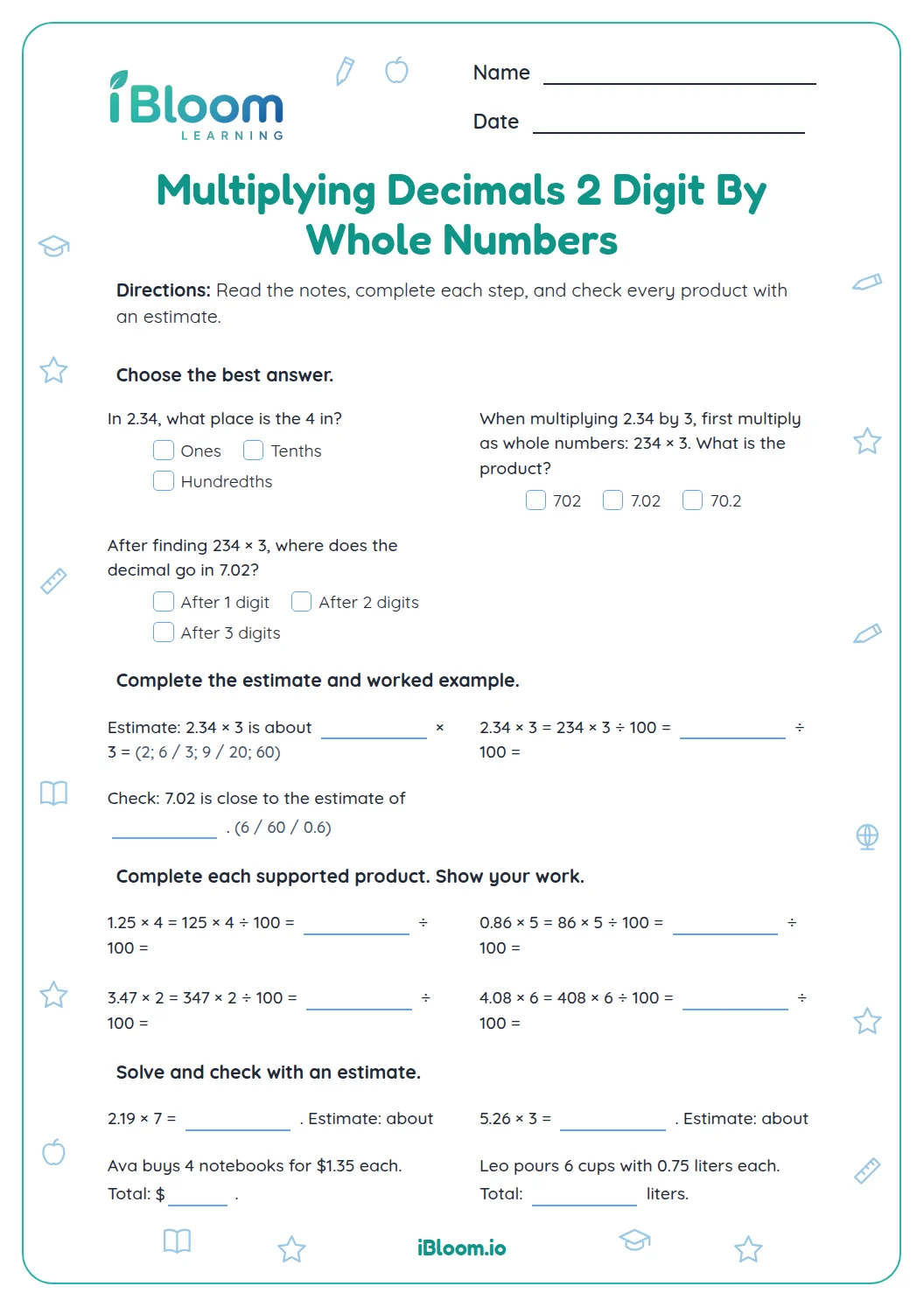
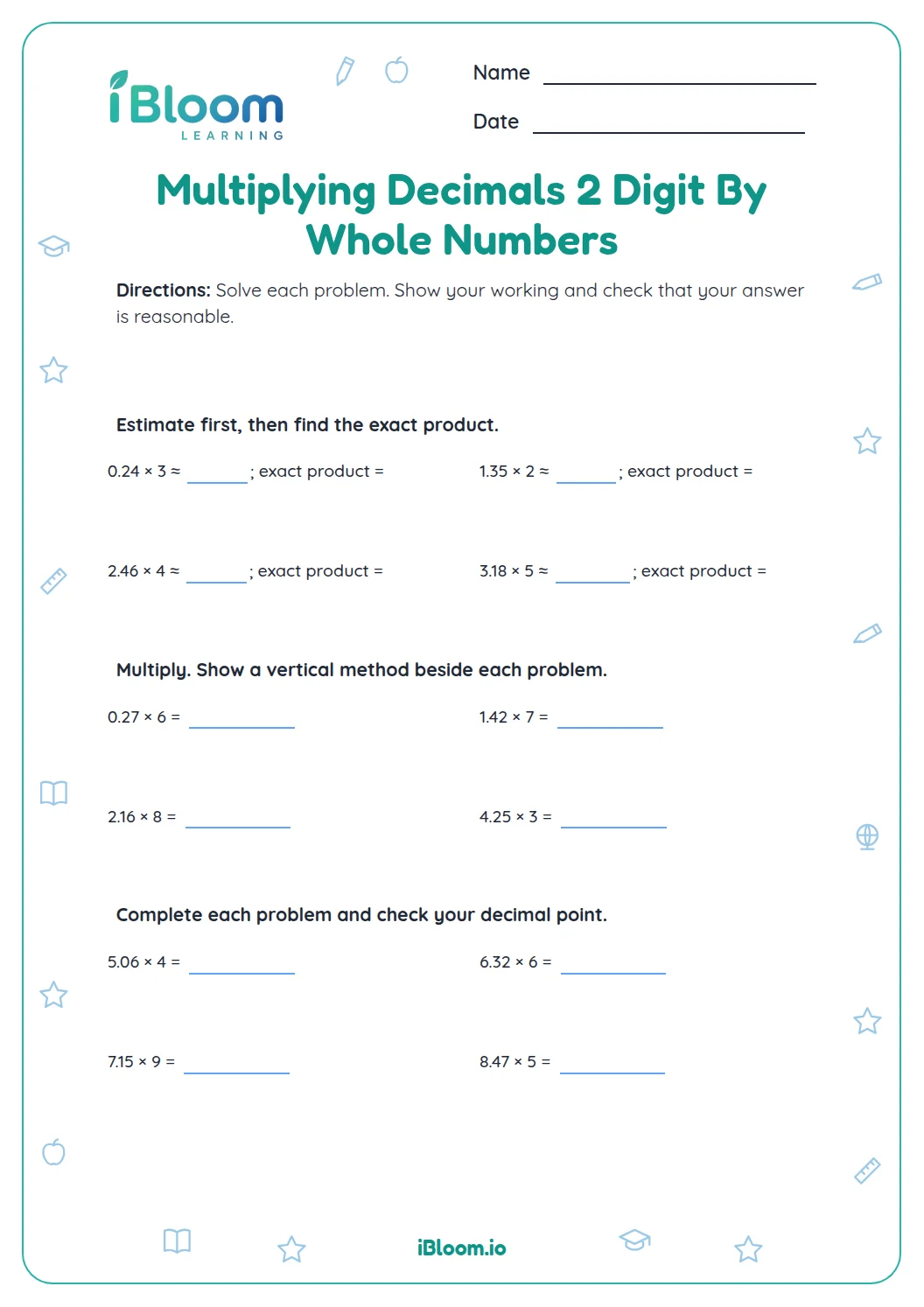
This Grade 5 printable focuses on how decimal digits change place when multiplied by powers of ten. Each of the 15 prompts gives a product blank and a separate multiplication-check blank, including values with zeros before or after significant digits. The answer key shows both entries for each question.
Aligned to 5.NBT.A.2
What happens to place value when multiplying by 10, 100, or 1,000?
Each factor of ten shifts every digit one place to the left in value: ×10, ×100, and ×1,000 shift two and three places. Zeros may be needed to hold empty places.
- 16.4 × 100 = 640
- 2Check: 640 ÷ 100 = 6.4
How can multiplication verify the product?
Multiply the starting decimal by the stated power of ten to verify the product. For example, 6.4 × 100 = 640 confirms the product in the first item.
- 16.4 × 100 = 640
How can a child check the work?
Complete both blanks before checking the answer key: the first is the product and the second is the product in the verification equation. The check shows the original decimal multiplied by the same power of ten.
How to use this worksheet
- 1Identify whether the multiplier is 10, 100, or 1,000.
- 2Shift each digit one, two, or three places in value.
- 3Use zeros to hold any empty places.
- 4Write the product in the first blank.
- 5Complete the multiplication check in the second blank.
Common mistakes and quick fixes
The mistake
Moving digits the wrong way.
The fix
Multiplying by a power of ten increases each digit’s place value.
The mistake
Leaving a place empty when a zero is needed.
The fix
Write a zero as a placeholder in the product.
The mistake
Combining the product and check in one blank.
The fix
Write the product first, then complete the separate check equation.
This worksheet practices the following Common Core skill.
Use place-value understanding to solve decimal computation problems.
On this sheet:
Show the official wordingHide the official wording
Explain patterns in the number of zeros of the product when multiplying a number by powers of 10, and explain patterns in the placement of the decimal point when a decimal is multiplied or divided by a power of 10. Use whole-number exponents to denote powers of 10.
What to practice next
Make more practice
Further reading
Questions parents and teachers ask
Why does 0.046 × 1,000 equal 46?
The digits move three place values left in the product: thousandths become ones. Equivalently, 46 thousandths groups of 1,000 equal 46. Complete the calculation first, then check the printed key. Explain any correction using the numbers in the problem to make each step clear.
What if the product has a trailing zero?
A trailing zero can be included to make place value visible, but it does not change the value. Always use the inverse check to confirm. Complete the calculation first, then check the printed key. Explain any correction using the numbers in the problem to make each step clear.
What error do the check blanks prevent?
They separate the product from its check so both are recorded clearly. A correct product divided by the multiplier should return the starting decimal. Complete the calculation first, then check the printed key. Explain any correction using the numbers in the problem to make each step clear.
How many questions are on this worksheet?
There are 15 questions. Each asks for a decimal product using 10, 100, or 1,000, followed by a separate multiplication check. The answer key shows both the product and the completed check so the child can compare the two entries.
How can an adult support practice?
Have the child say how many places each digit’s value changes for ×10, ×100, or ×1,000. Then check the product by repeating the multiplication in the second blank and compare with the answer key. Ask them to explain any zeros used as placeholders.