



About this worksheet
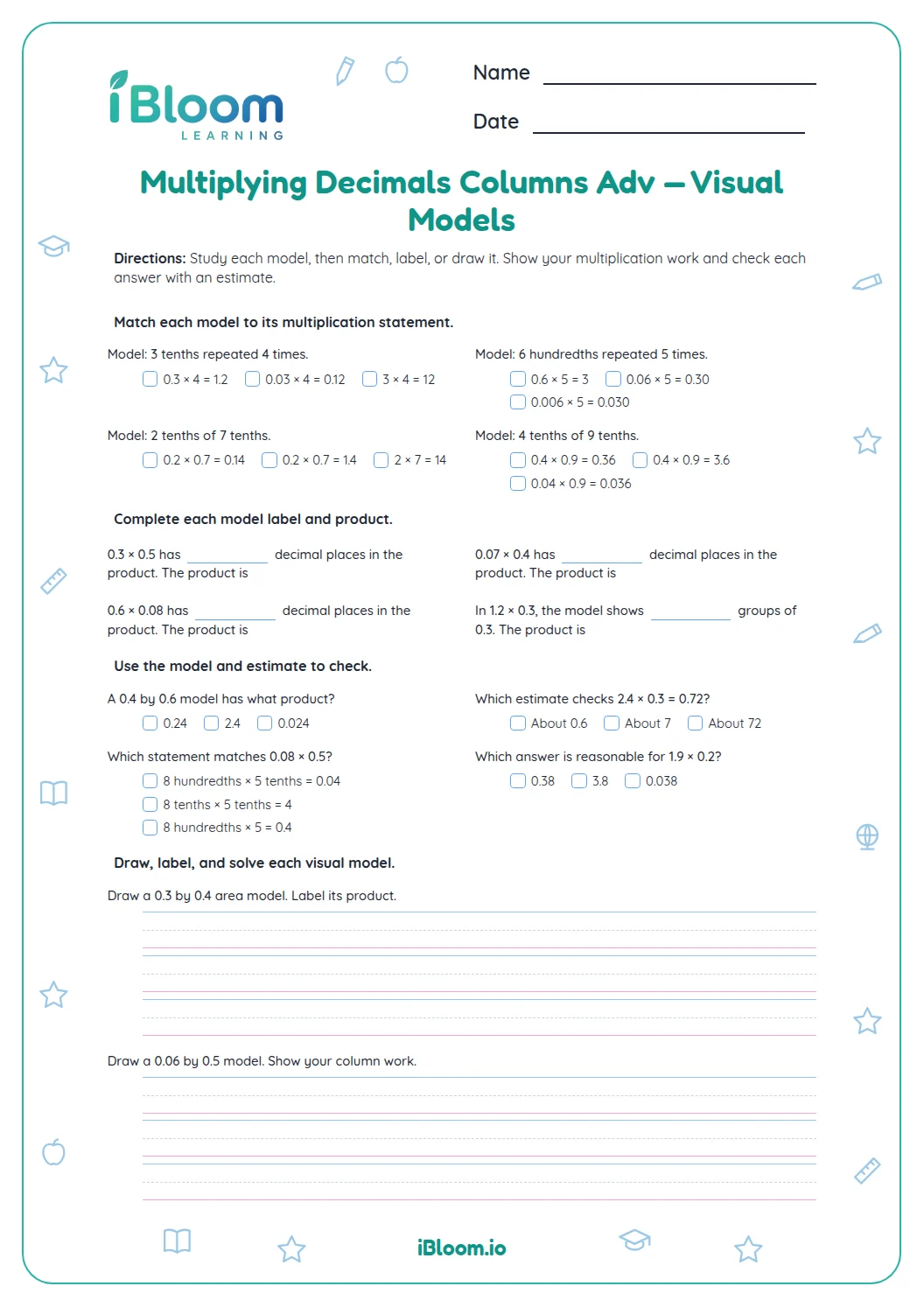
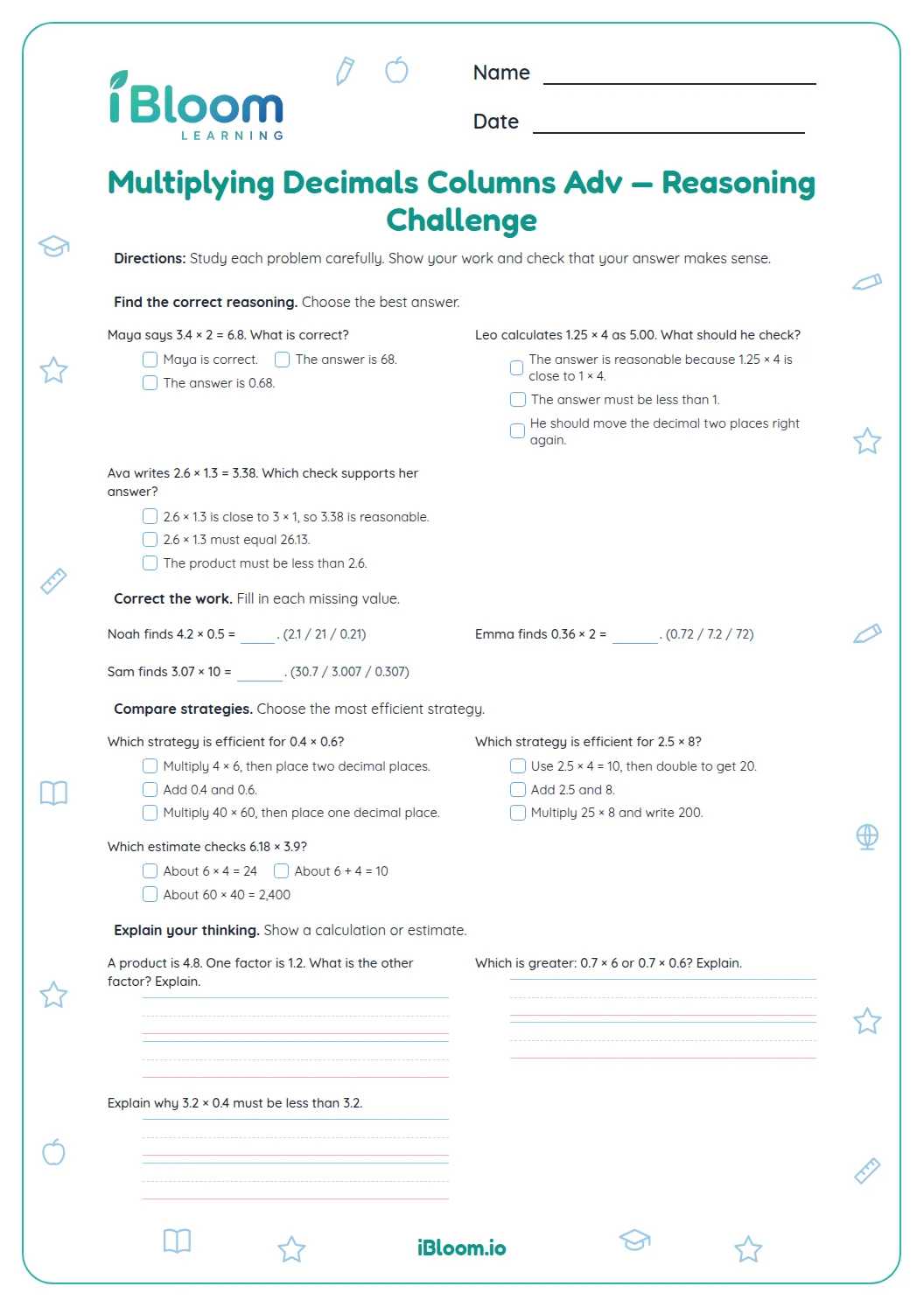
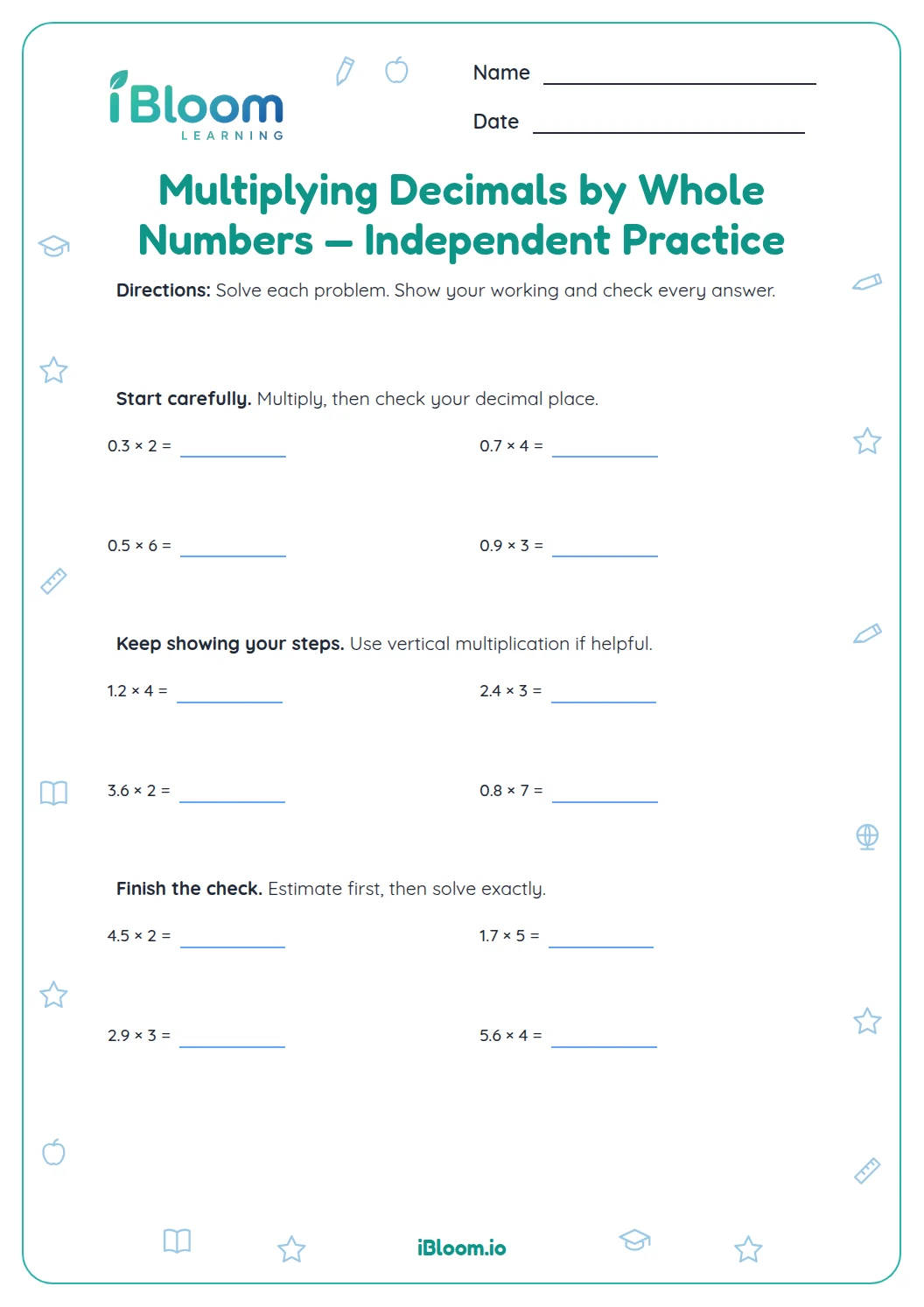
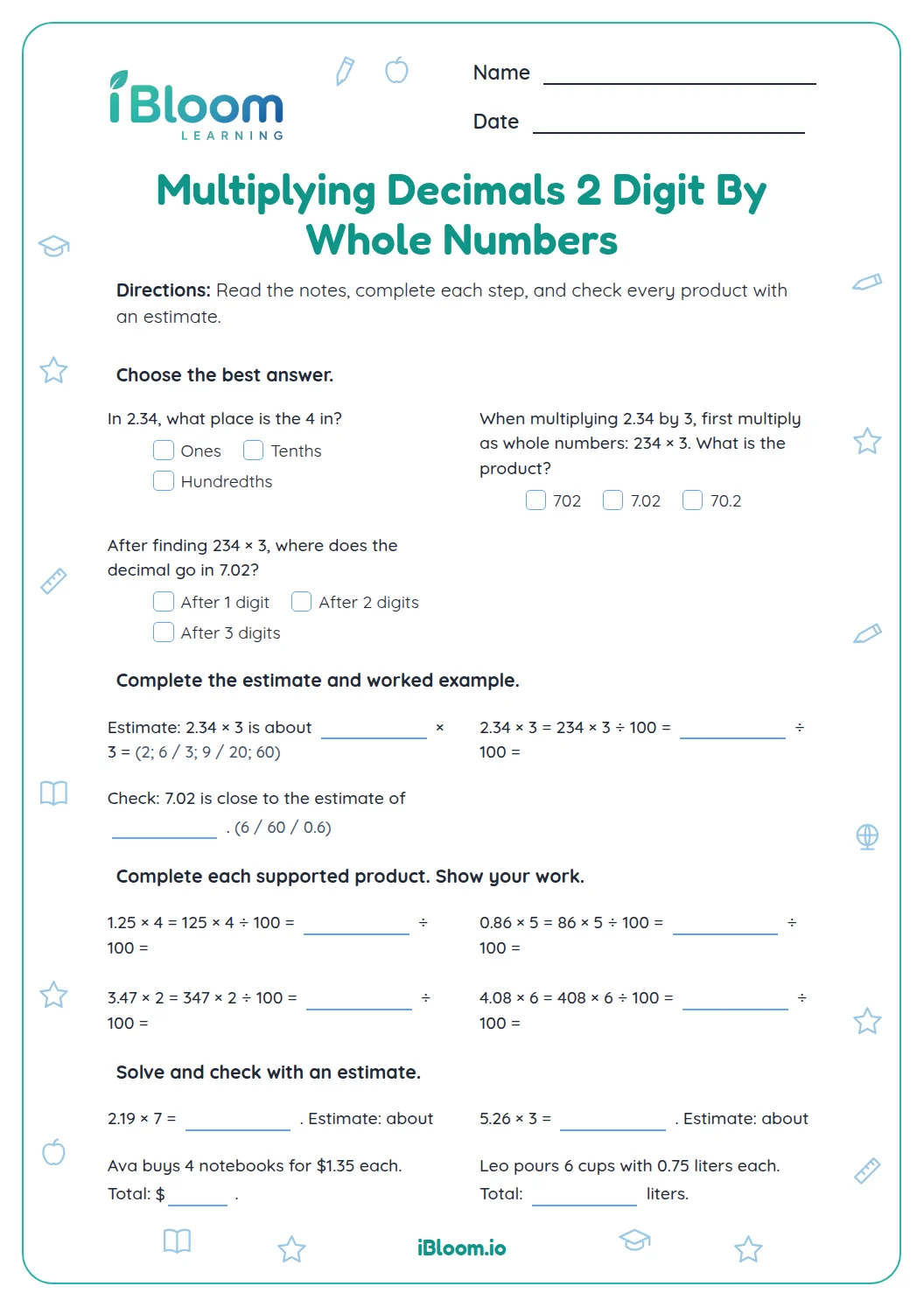
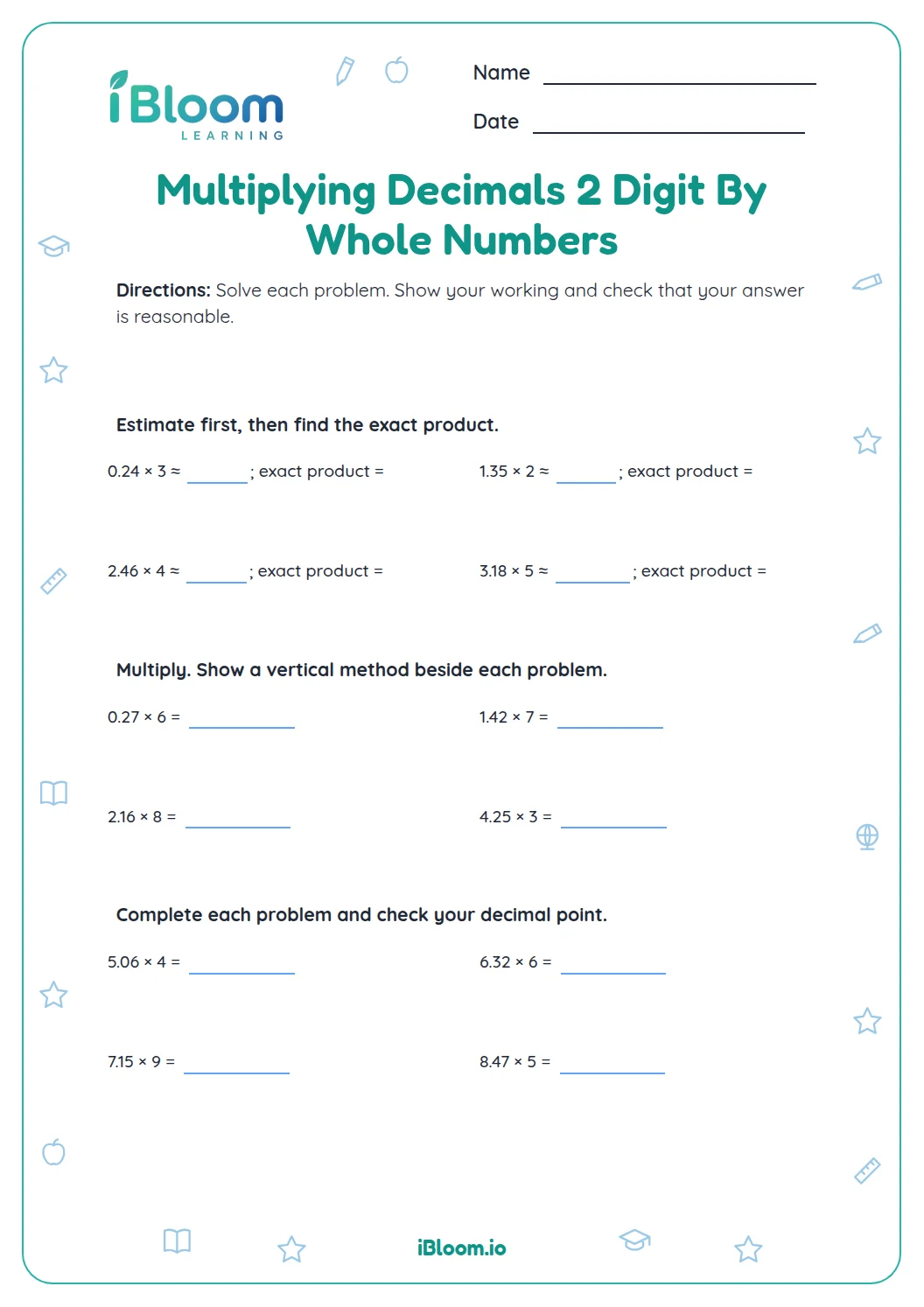
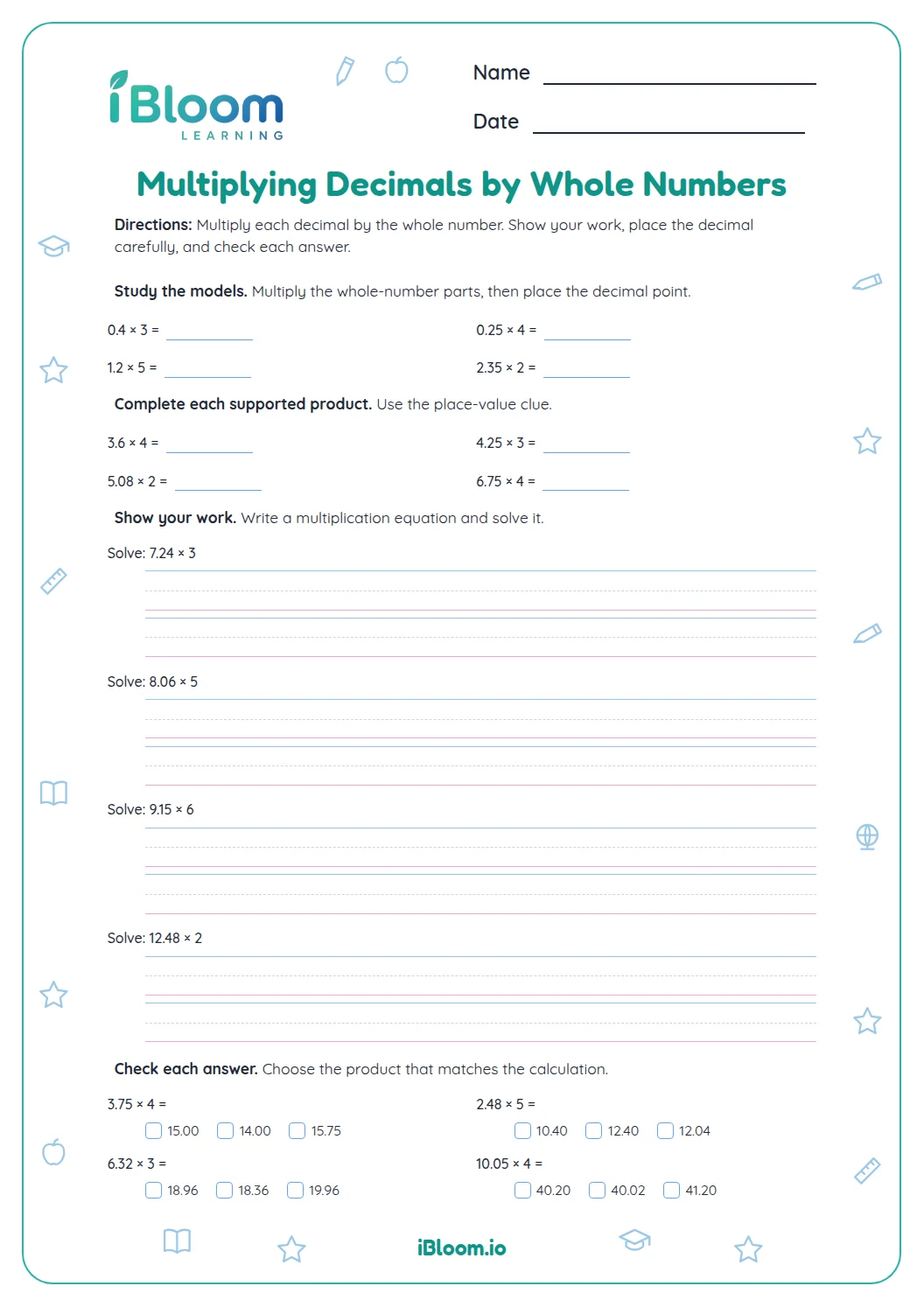
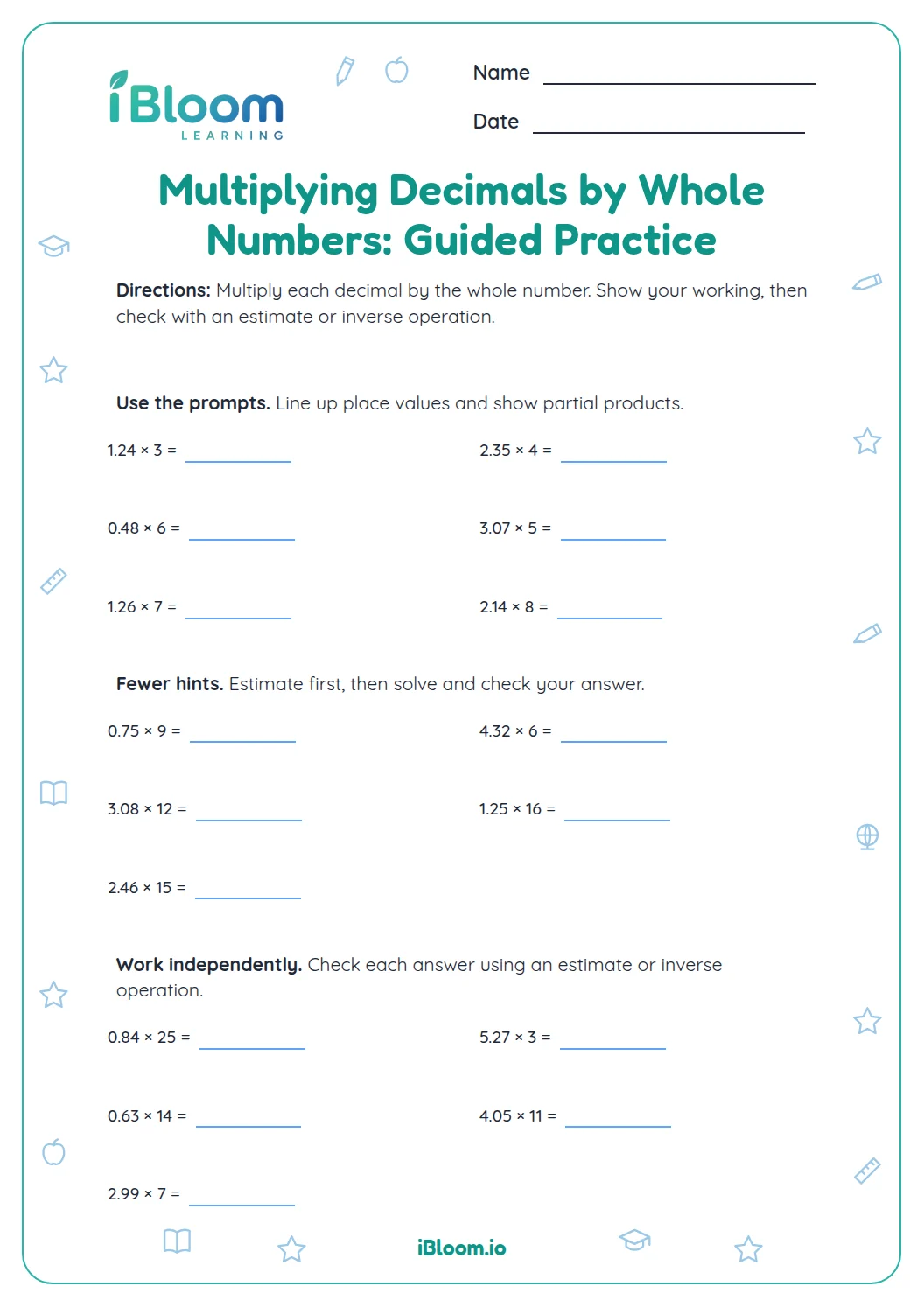
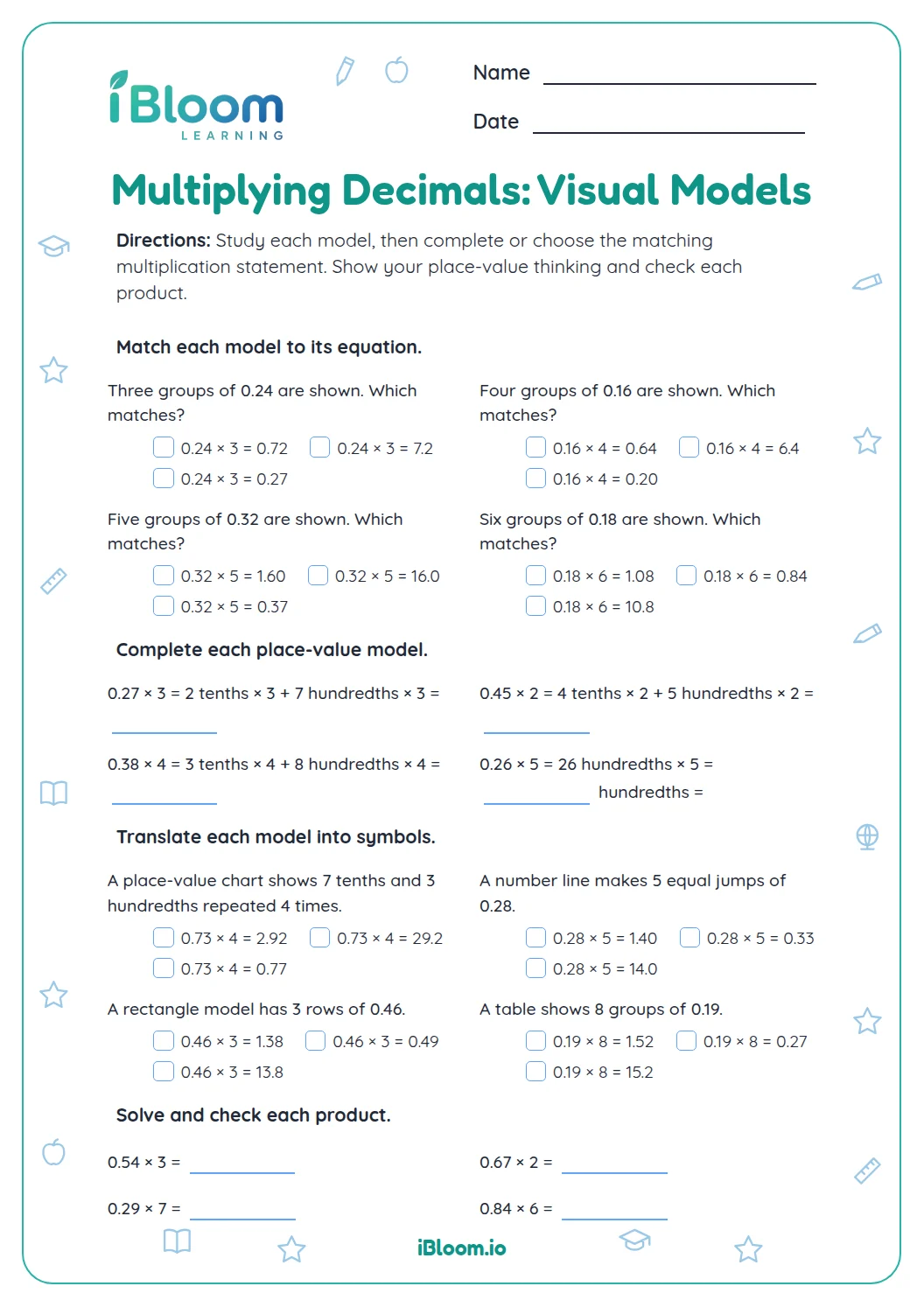
This Grade 5 guided practice sheet has 12 questions on multiplying decimals in columns. Students estimate two products before calculating exactly, solve additional products, apply multiplication to area and package weight, and choose reasonable estimates. The key lists distinct estimates and exact products. The work supports CCSS 5.NBT.B.7 through written decimal multiplication and place-value reasoning.
Aligned to 5.NBT.B.7
How can an estimate guide decimal multiplication?
Rounding the factors gives a useful size check. The exact product then comes from multiplying the digits and placing the decimal according to both factors.
The page contains 12 questions and a separate answer key.
- 1Estimate 0.6 × 4.2 ≈ ___
- 2Exact: 0.6 × 4.2 = ___
- 3Answers: about 2; 2.52.
What will students practice on the page?
The guided examples ask for both an estimate and an exact product. Later items practice column products, area, package weight, and reasonableness.
- 12 questions across focused parts
- Place-value reasoning with a checked answer key
How can students check the work?
Compare each exact product with the estimate. For an area context, multiply the side lengths and include square units.
How to work through this sheet
- 1Read the direction for the current part.
- 2Align matching decimal place values.
- 3Estimate when the question asks for a reasonableness check.
- 4Calculate carefully and keep units with measured answers.
- 5Check sums by subtraction or products and quotients with an estimate or inverse operation.
- 6Use the separate key after completing the work.
Decimal slips to watch for
The mistake
Placing the decimal before counting factor places.
The fix
Count the decimal places in both factors after multiplying.
The mistake
Using an estimate as the exact product.
The fix
Keep the estimate and exact answer in their separate blanks.
The mistake
Reporting area in linear units.
The fix
Use square units for a rectangle’s area.
Common Core alignment
This worksheet practices decimal computation using place-value reasoning.
Use place value and written methods to compute with decimals.
On this sheet: Students estimate and multiply decimals, relate written methods to place value, and explain the size of products.
Show the official wordingHide the official wording
Add, subtract, multiply, and divide decimals to hundredths, using concrete models or drawings and strategies based on place value, properties of operations, and/or the relationship between addition and subtraction; relate the strategy to a written method and explain the reasoning used.
What to practice next
Make more practice
Further reading
Questions parents and teachers ask
Why estimate before multiplying decimals?
An estimate gives a size check before the exact calculation. For 0.6 × 4.2, rounding to 0.5 × 4 gives about 2, which is close to the exact product 2.52 and helps catch a misplaced decimal. Students keep the estimate separate from the exact answer.
How do students place the decimal in a product?
Multiply the digits as whole numbers, count the total decimal places in both factors, then place the decimal in the product. For 5.06 × 0.07, the factors have four decimal places altogether, so the exact product is 0.3542. Students can compare each calculation with the answer key after finishing the worksheet.
What applications are included?
Students find the area of a rectangle with decimal side lengths and the combined weight of eight packages. Each context translates directly into multiplication and keeps the requested unit in the answer. Area is written in square meters. Students can compare each calculation with the answer key after finishing the worksheet.
What makes a product estimate reasonable?
Round factors to nearby convenient values and multiply those values. Since 3.08 is near 3 and 0.19 is near 0.2, their product is near 0.6, not 6 or 60. The exact result can then be compared with that estimate. Students can compare each calculation with the answer key after finishing the worksheet.
Does the answer key show estimates and exact products?
Yes. The key lists an estimate and exact product separately for the two guided items, then gives exact products and selected reasonable estimates for the other questions. This lets students check the size and the precise calculation separately. Students can compare each calculation with the answer key after finishing the worksheet.