




About this worksheet
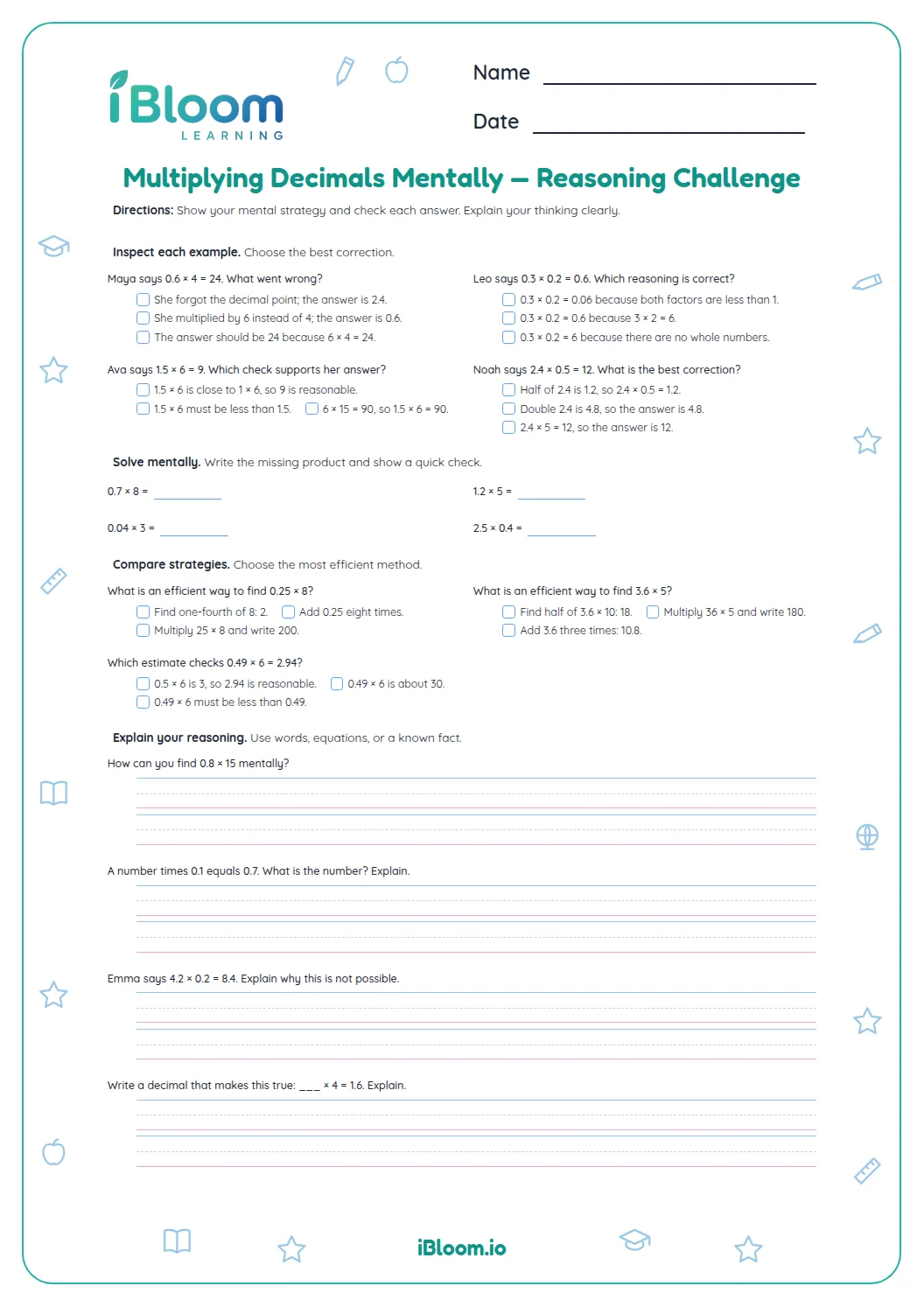
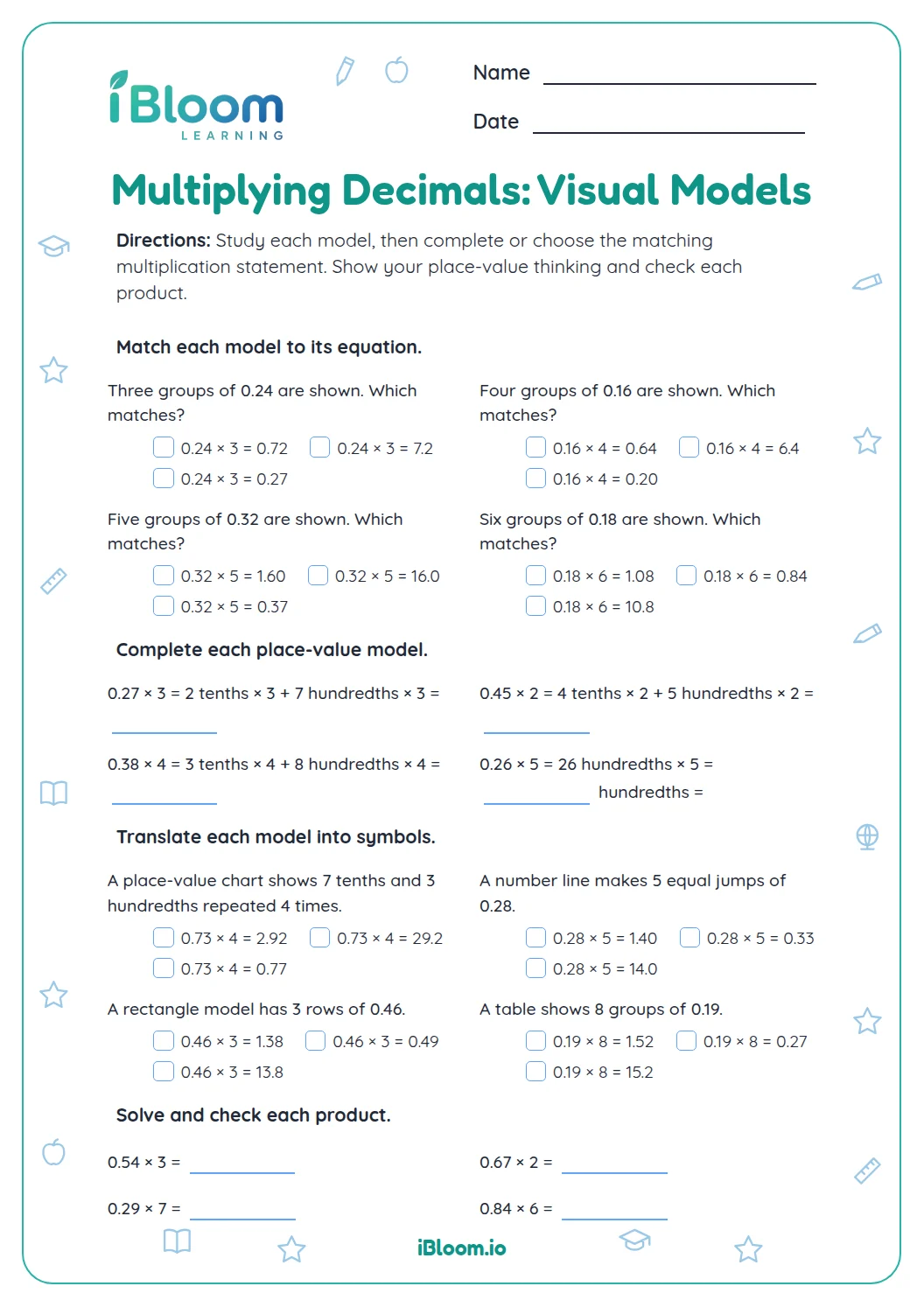
This free printable Grade 5 worksheet helps students practice multiplying decimals mentally. It includes shaded fraction and number-line models, focused problems, and short situations that apply the same idea. Students can use the models to connect equal parts with fraction notation. The sheet has 16 questions in three parts and a separate answer key. It practices CCSS 5.NBT.B.7.
Aligned to 5.NBT.B.7
How do the models show decimal products?
Hundredths grids show products such as tenths times tenths. A tenths strip can show a product greater than one.
Count shaded units and connect the count to the multiplication expression.
- 1Question 1 shows 12 shaded hundredths, so 0.4 × 0.3 = 0.12.
- 2Check that the model and the written expression describe the same value.
How should students solve each problem?
Use a whole-number multiplication fact, then place the decimal according to the factors’ place values.
Estimate first: when both positive factors are below one, the product is smaller than either factor.
What is on the printable?
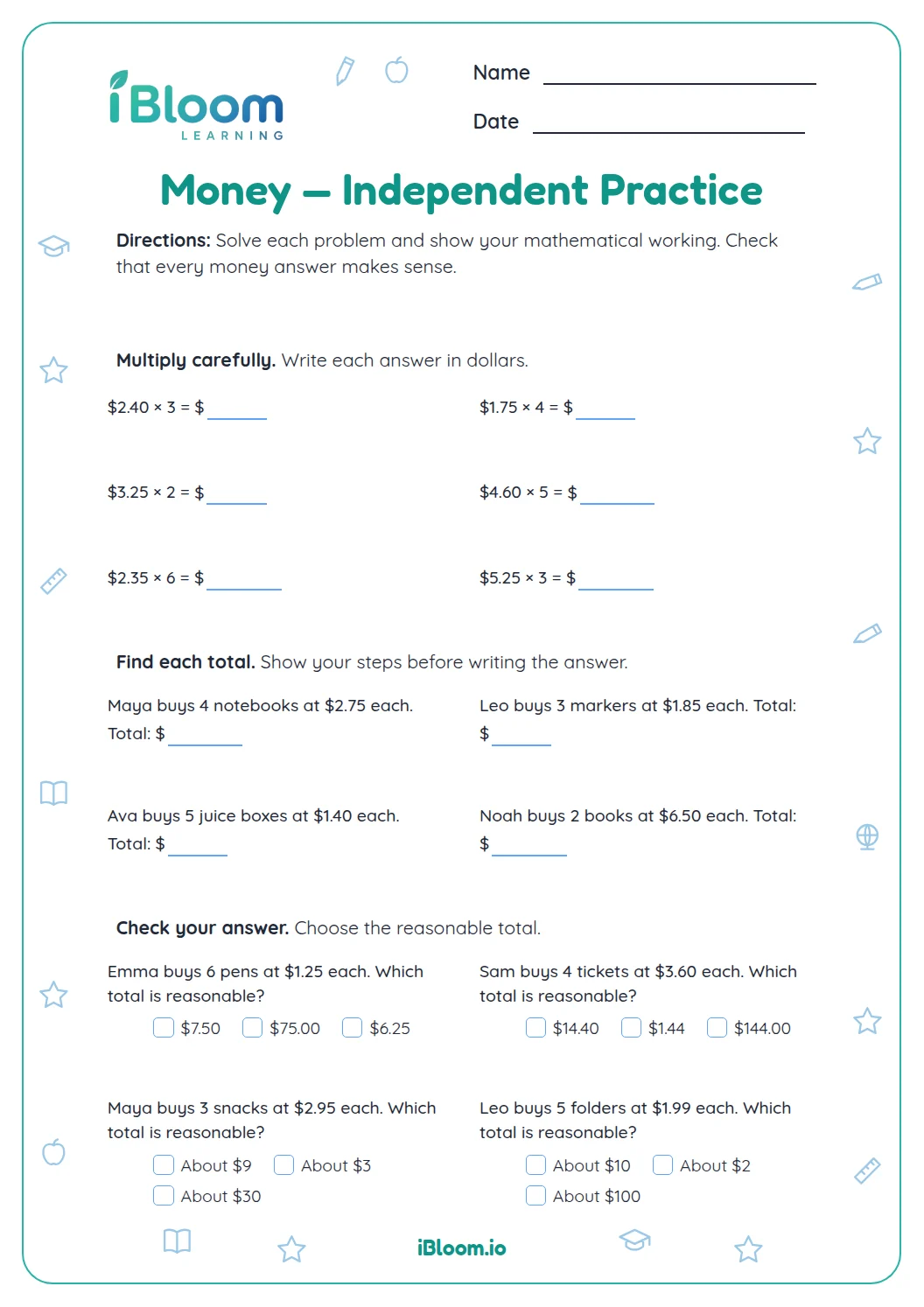
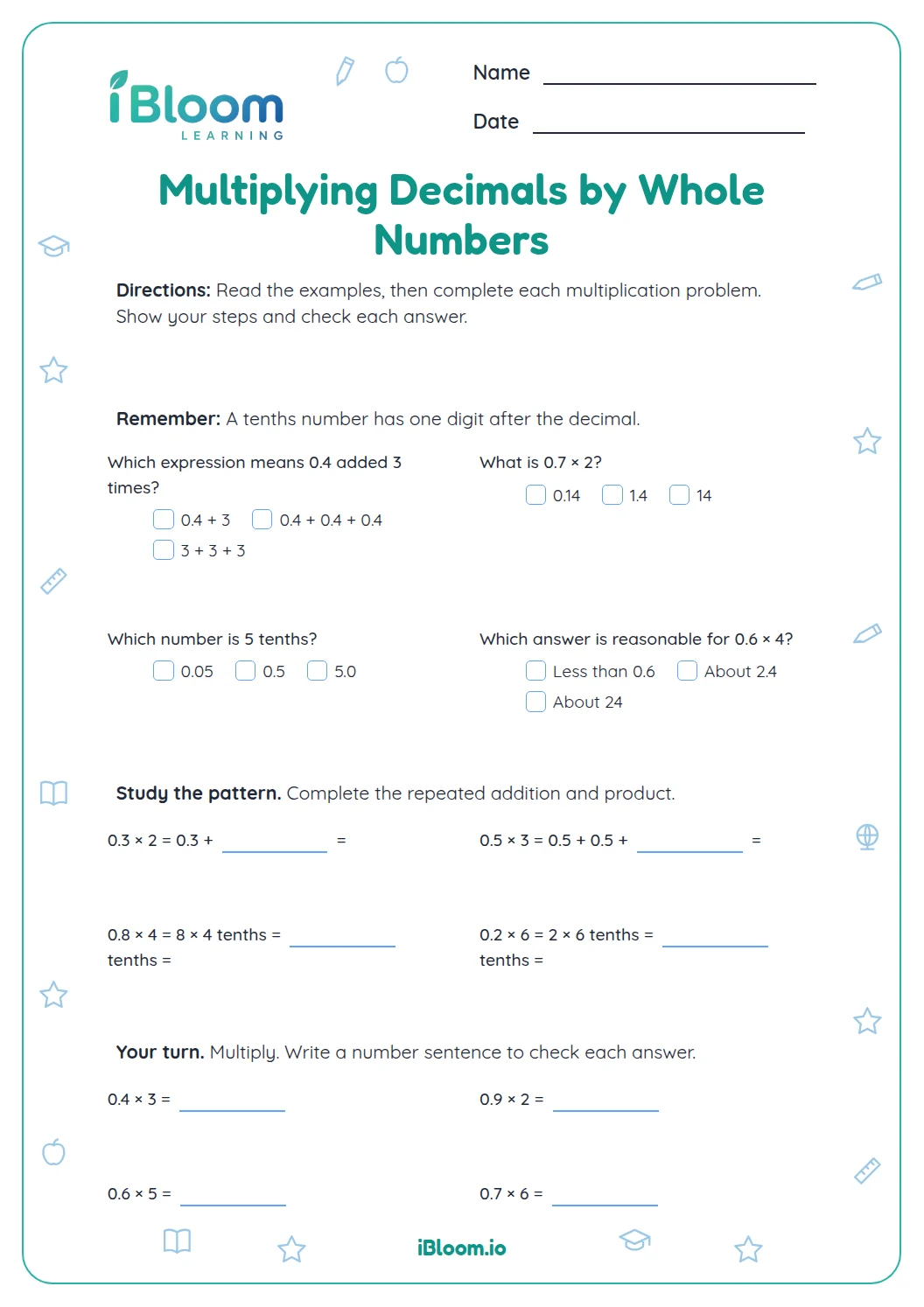
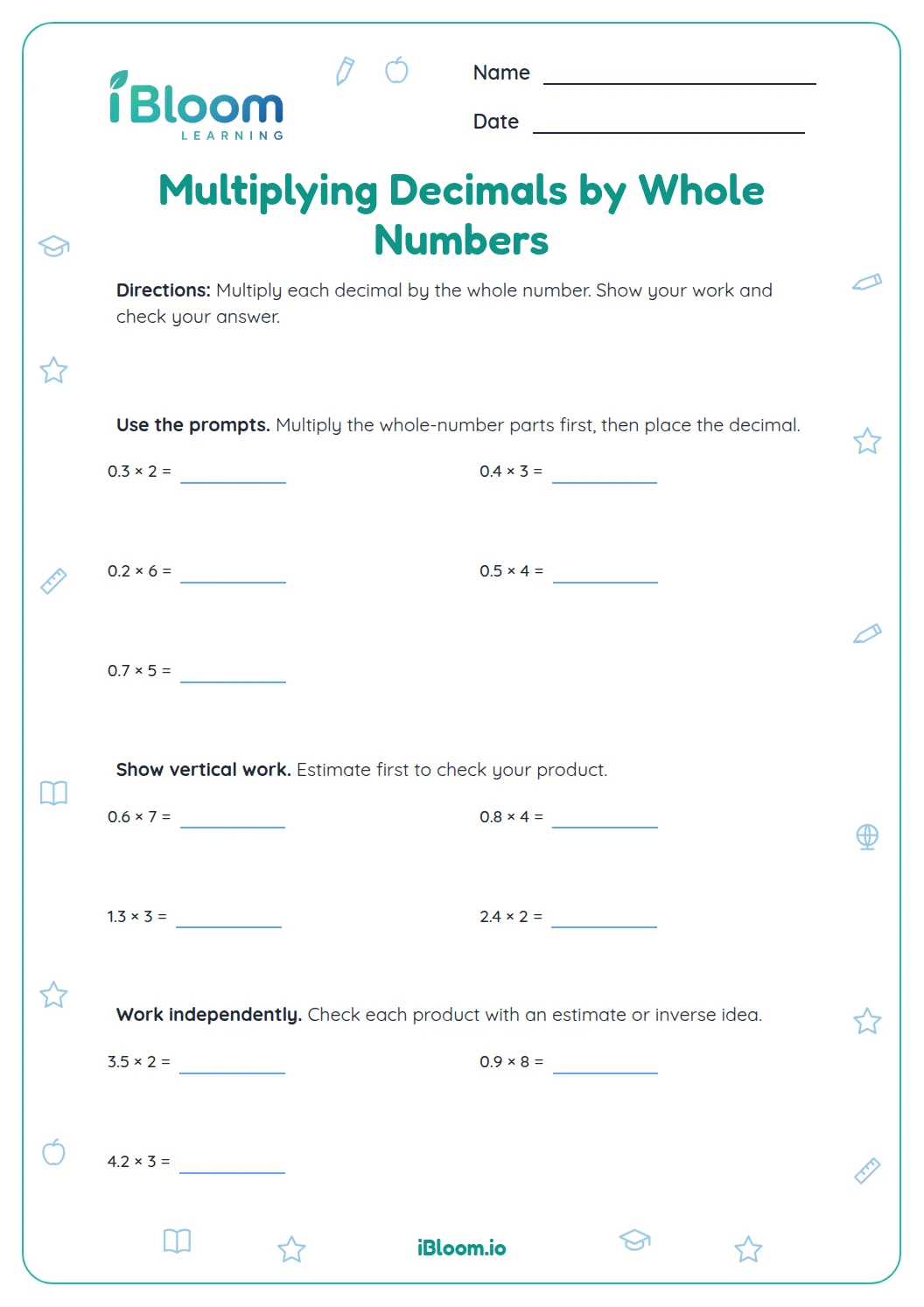
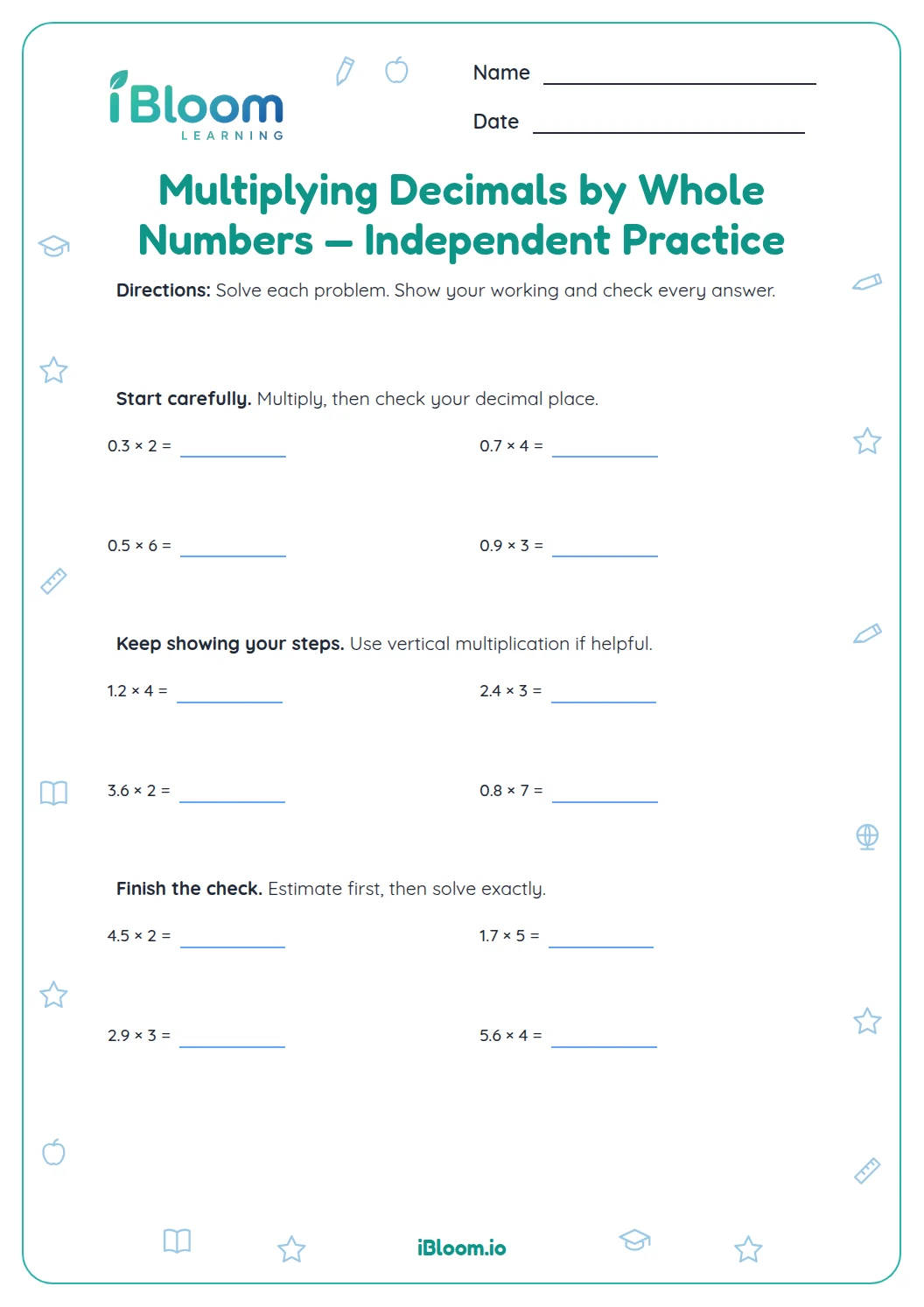
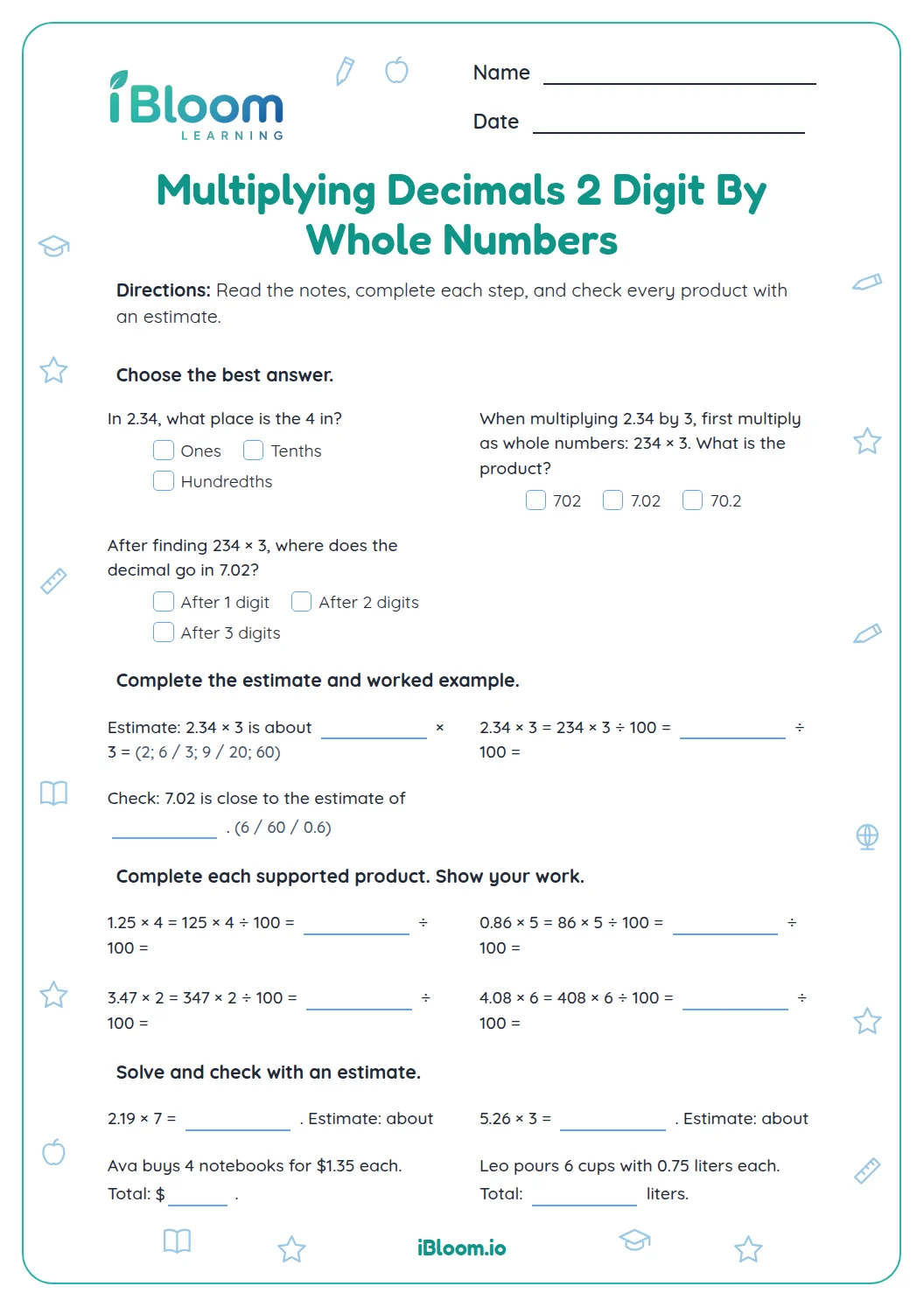
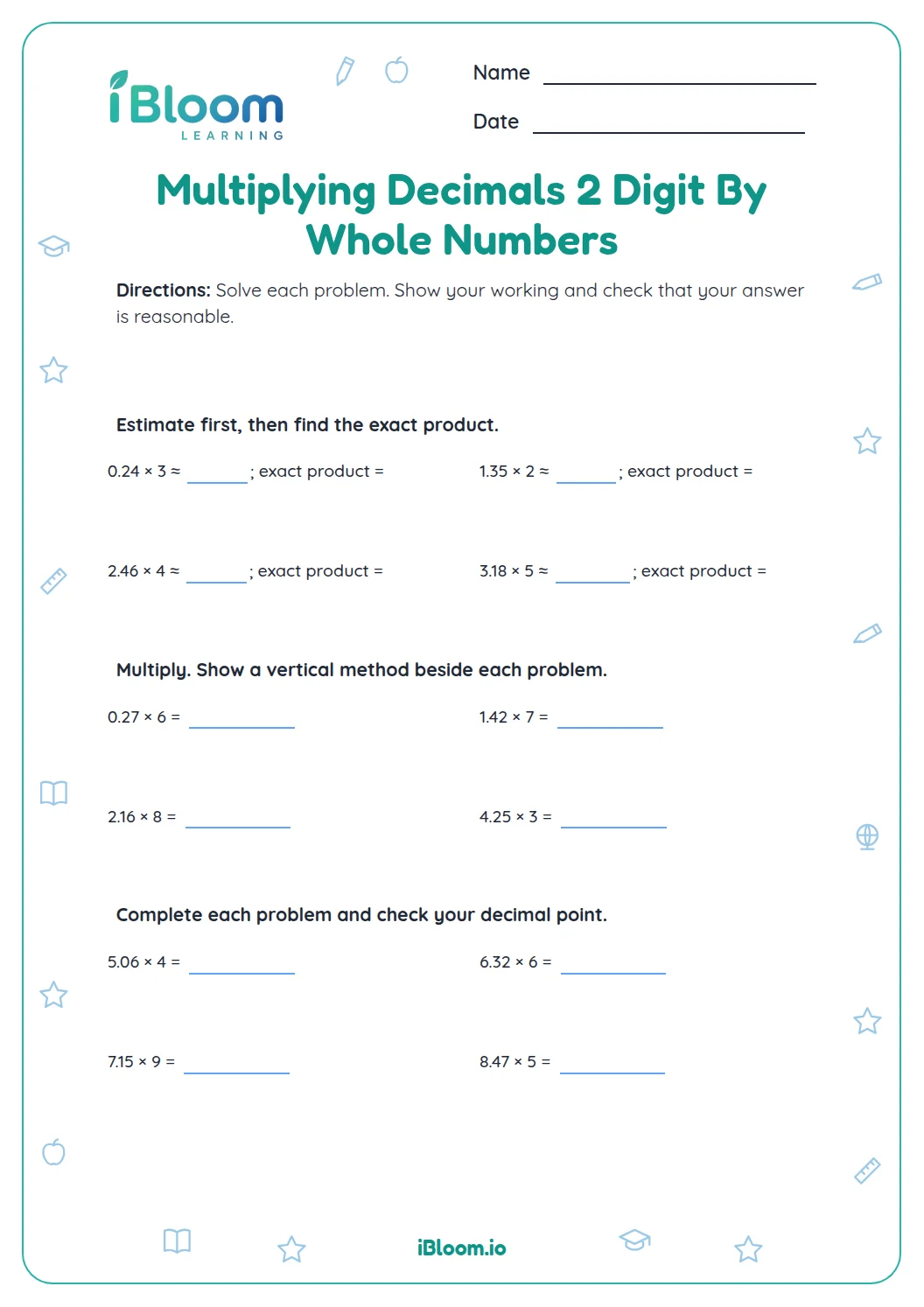
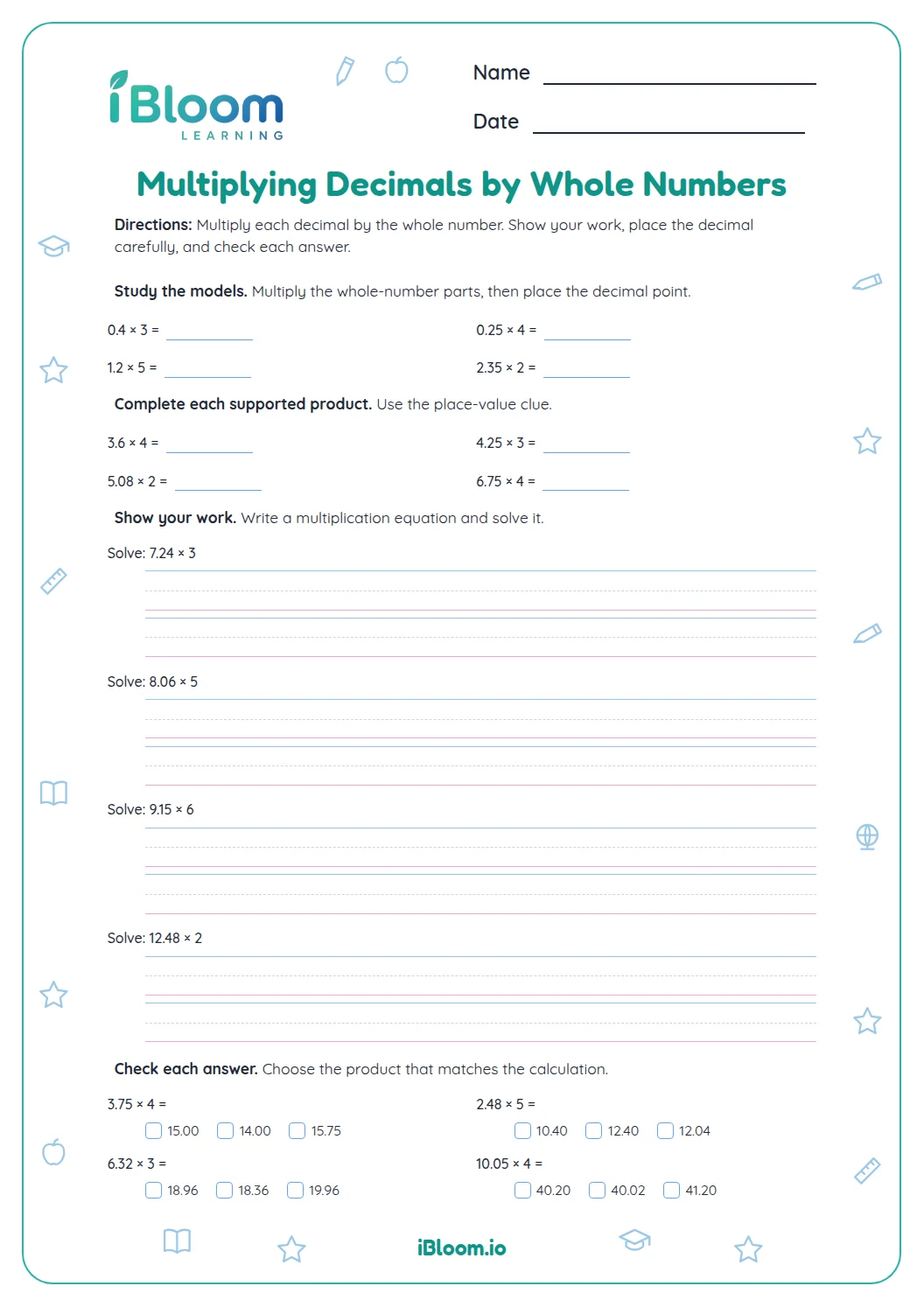
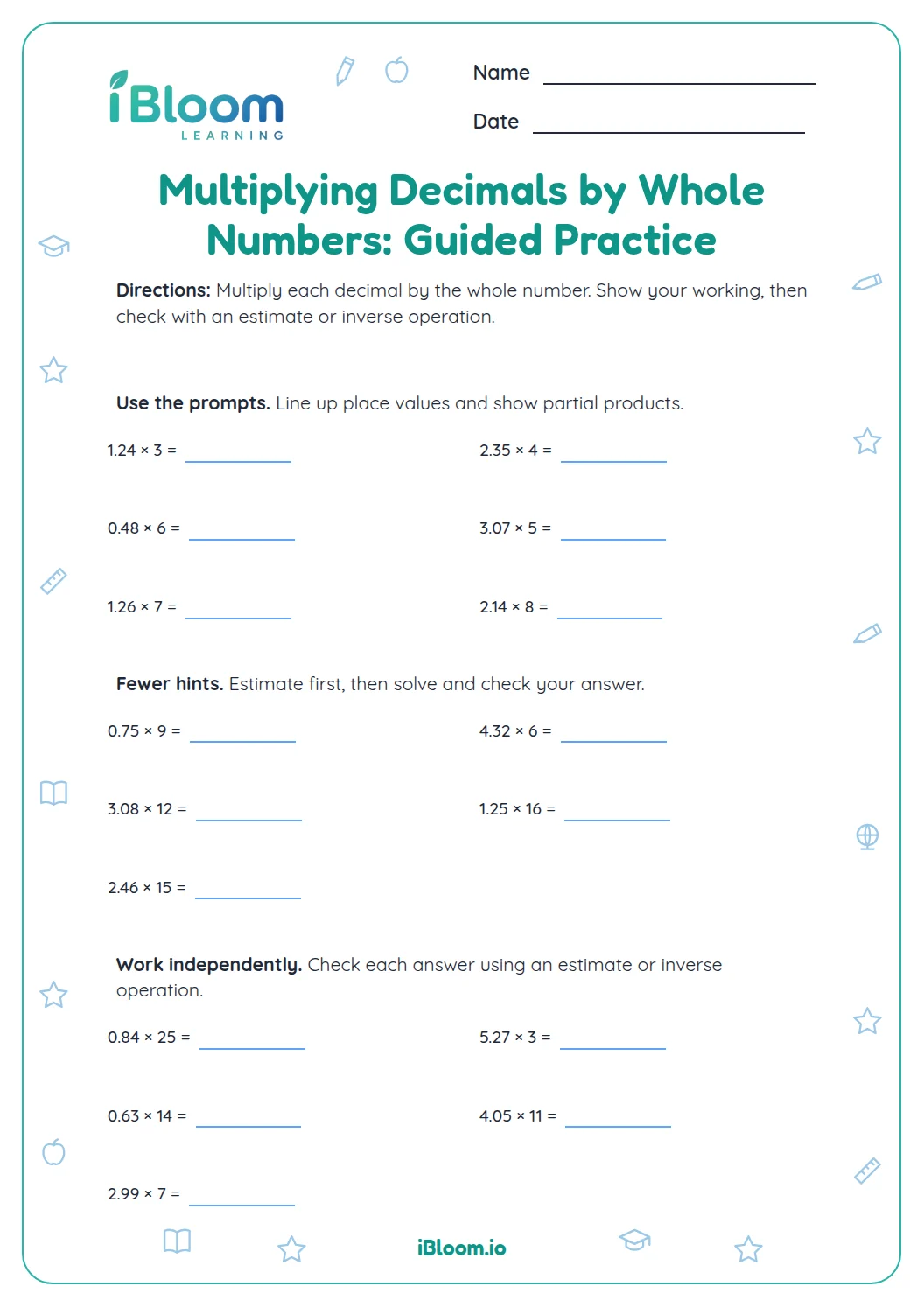
Part A has six model questions, Part B has six focused problems, and Part C has four applications. The answer key follows the worksheet.
- Read six decimal product models
- Multiply six decimal expressions mentally
- Solve four short multiplication situations
- Use the key to check results
How can students use this worksheet?
- 1Read both factors and the operation sign.
- 2Estimate the product before calculating.
- 3Use a model or whole-number fact to multiply.
- 4Use place value to write the product as a decimal.
- 5Check that the product size makes sense for the factors.
Common mistakes and quick fixes
The mistake
Treating 0.4 × 0.3 as 1.2.
The fix
Four tenths times three tenths is twelve hundredths, or 0.12.
The mistake
Moving the decimal point without accounting for the factor.
The fix
Use place value or an equivalent whole-number fact to locate the decimal.
The mistake
Assuming the product is larger than both factors when both are less than one.
The fix
Check that the product is less than either positive factor below one.
Common Core alignment
This worksheet practices multiplying decimals mentally through models and written problems.
Multiply decimals to hundredths using models and place value.
On this sheet: The questions use decimal models and place-value reasoning to multiply decimal numbers.
Show the official wordingHide the official wording
Add, subtract, multiply, and divide decimals to hundredths, using concrete models or drawings and strategies based on place value, properties of operations, and/or the relationship between addition and subtraction; relate the strategy to a written method and explain the reasoning used.
What to practice next
Make more practice
Further reading
Questions parents and teachers ask
How many questions are on the printable?
There are 16 questions across three parts: six model questions, six focused problems, and four applications. The worksheet and answer key take four pages in all. About 20 minutes gives time to work, compare answers with the models, and review any calculation that needs another look.
How should students use the models?
The hundredths grids show shaded squares for products of tenths, and the number line marks a decimal product. Students should read the factors in the prompt, then check that the shaded or marked value matches their multiplication. Ask the student to explain what each part stands for before calculating, then compare the final answer with the picture.
Does the answer key include units?
The answer key gives a result for every question. When a story asks for a measurement, students should include the unit in their own answer. If a unit is printed after the answer blank, the key gives only the number so the unit is not repeated.
What should students do when they get stuck?
Return to the specific model or expression in that question. Ask what one equal part represents, then identify how many parts the situation combines or removes. For a story, a quick equation can help connect the words to the operation.
Can students show their work?
Yes. The focused problems and applications provide space for written work, and students can write a short equation before giving each result. Encourage them to keep the units with measurement answers and to check their calculations against any model.