


About this worksheet
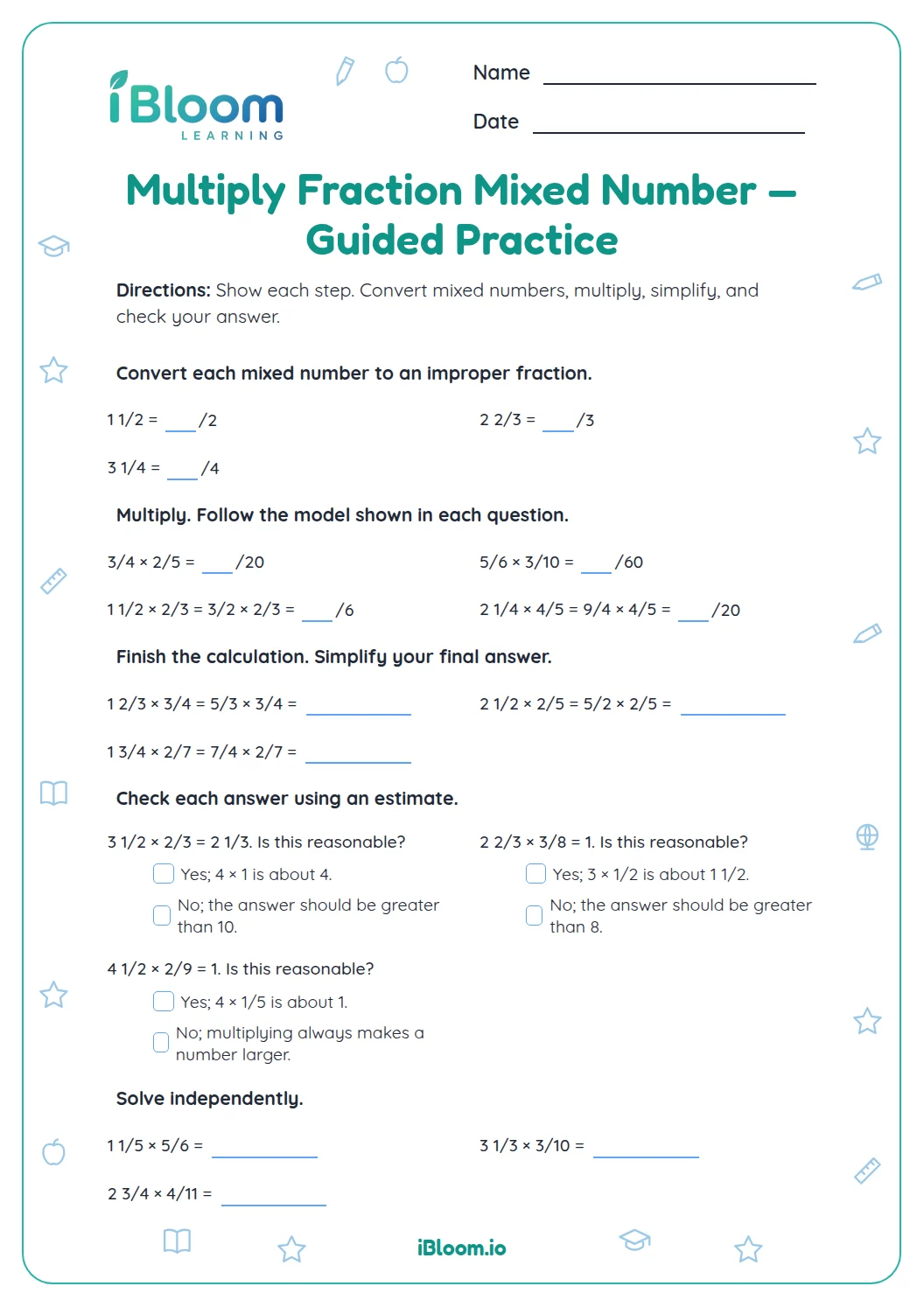
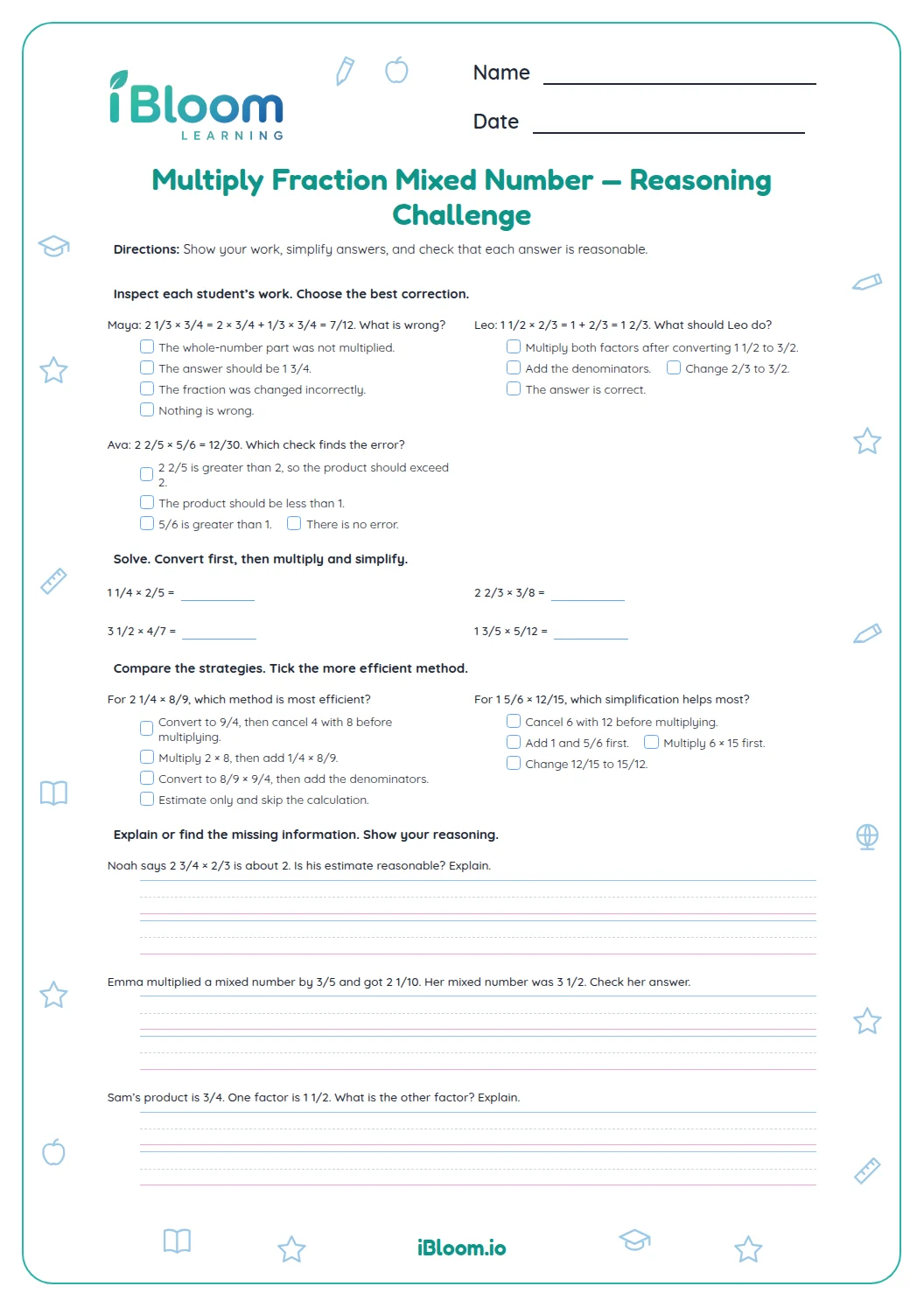
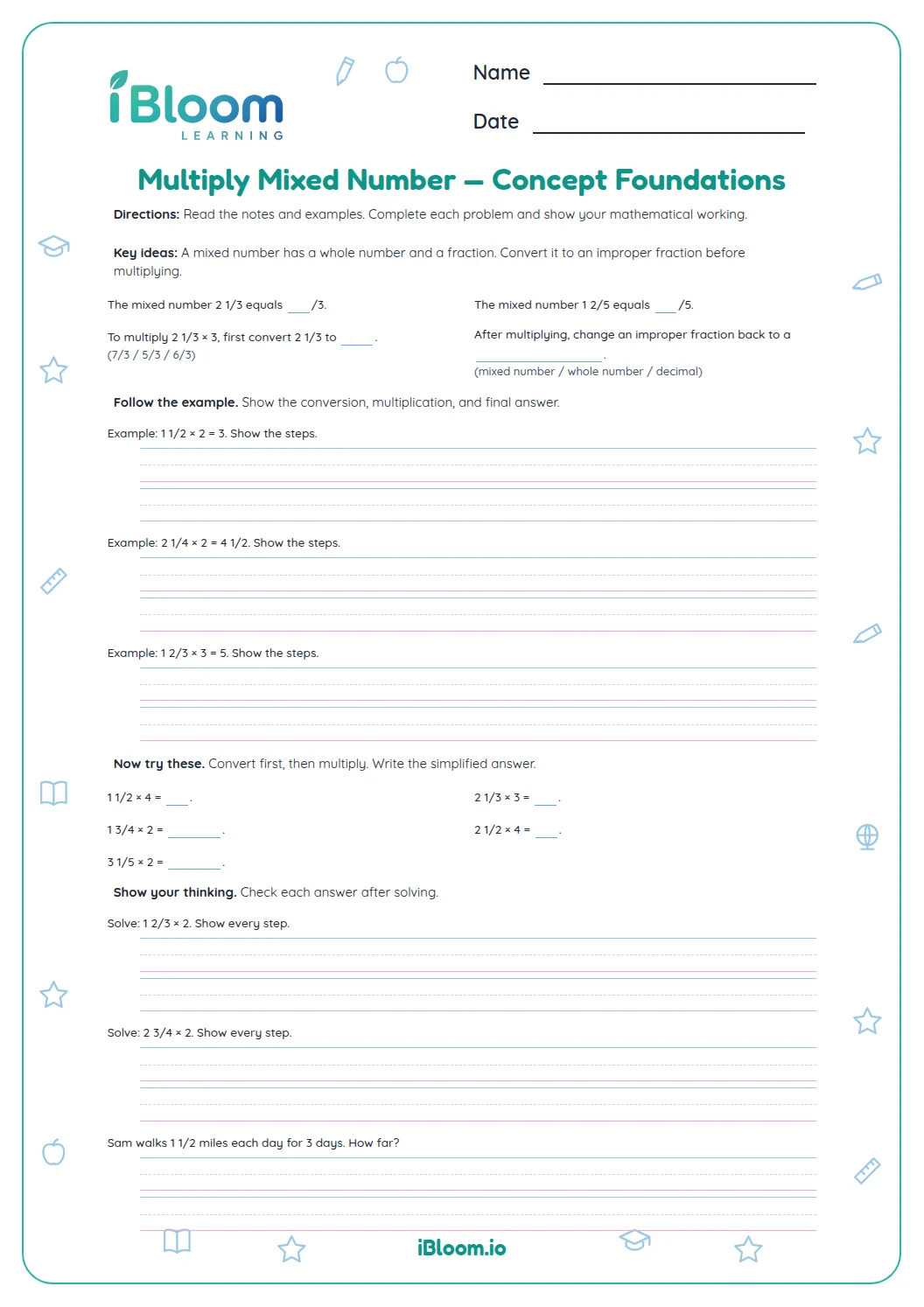
This Grade 5 concept-foundations sheet introduces multiplying a fraction by a mixed number. Students first convert mixed numbers to improper fractions, then interpret fraction products with shaded models, and finally solve computations and a recipe situation. Fourteen questions build from conversion to application, with a separate answer key. The practice aligns with CCSS 5.NF.B.4.
Aligned to 5.NF.B.4
How can you solve one example?
Convert 2 2/3 by multiplying the whole number by the denominator and adding the numerator: 2 × 3 + 2 = 8, so 2 2/3 = 8/3. Then 3/4 × 8/3 = 24/12 = 2.
- 12 2/3 = 8/3; 3/4 × 8/3 = 2
What will the practice ask you to do?
Convert mixed numbers, interpret multiplication with fraction models, and solve products and one recipe problem.
How can you check an answer?
Check that the result fits the size of the factors and that each answer matches the requested unit, fraction form or repeating cycle. Use the separate key after completing the page.
How can I use this worksheet?
- 1Read the direction at the start of each part.
- 2Write one answer for each prompt and keep its units or notation clear.
- 3Use a model, estimate or inverse operation to check the result.
- 4Compare completed work with the separate answer key.
What mistakes should students watch for?
The mistake
Dropping the whole-number part during conversion.
The fix
Multiply the whole number by the denominator, then add the numerator.
The mistake
Multiplying the mixed number as though it were a whole number.
The fix
Rewrite it as an improper fraction first.
The mistake
Leaving a product unsimplified.
The fix
Find and divide by a common factor in the numerator and denominator.
Common Core alignment
Students extend multiplication to fraction factors and interpret products with models.
Interpret multiplication as scaling and multiply fractions by whole numbers or fractions.
On this sheet: Students multiply a fraction by a mixed number after converting the mixed number to a fraction.
Show the official wordingHide the official wording
Apply and extend previous understandings of multiplication to multiply a fraction or whole number by a fraction.
What to practice next
Make more practice
Further reading
Questions parents and teachers ask
How many questions are on this foundations worksheet?
There are 12 questions in three parts. Students convert four mixed numbers, interpret four products using models, and solve six products or applications. The answer key is separate and includes simplified forms for the fraction products. Four items convert mixed numbers, four use models, and six apply multiplication. The key shows the conversion or product needed to check each answer.
How do you change 2 2/3 to an improper fraction?
Multiply the whole number by the denominator, then add the numerator: 2 × 3 + 2 = 8. Keep the denominator 3, so 2 2/3 = 8/3. This conversion is the first step in the worked multiplication example. Keep the original denominator after multiplying the whole number and adding the numerator. The result is 8/3, which equals 2 2/3.
What is 3/4 × 2 2/3?
The product is 2. Rewrite 2 2/3 as 8/3, then multiply: 3/4 × 8/3 = 24/12 = 2. Keeping the conversion and multiplication in separate steps makes each part of the reasoning visible. Rewriting the mixed number as 8/3 gives 3/4 × 8/3 = 24/12, which simplifies to 2. The factors cancel cleanly in this example.
Why do the first problems ask for improper fractions?
Converting mixed numbers gives a single fraction factor that can be multiplied using numerator and denominator products. It also helps students see why 2 1/3 is seven thirds rather than two thirds, avoiding a common conversion error. The improper fraction keeps the number of equal-sized pieces explicit. This prevents dropping the whole-number portion when multiplying.
Which Common Core standard is practiced?
The worksheet practices CCSS 5.NF.B.4, applying and extending multiplication understandings to multiply a fraction or whole number by a fraction. The problems include mixed-number factors rewritten as improper fractions before multiplying. The worksheet applies multiplication understanding to fraction factors and uses models and mixed-number conversion to support the computation.