Free printable practice
3D Models Practice Activities
Grade 5 geometry worksheets for recognizing, describing, and working with 3D models using faces, edges, vertices, nets, and visual reasoning.
Free printable worksheet PDFs
Preview every available page, then download the free worksheet PDF for home, homeschool, tutoring, or classroom practice.
Preview the exact activity before downloading it.
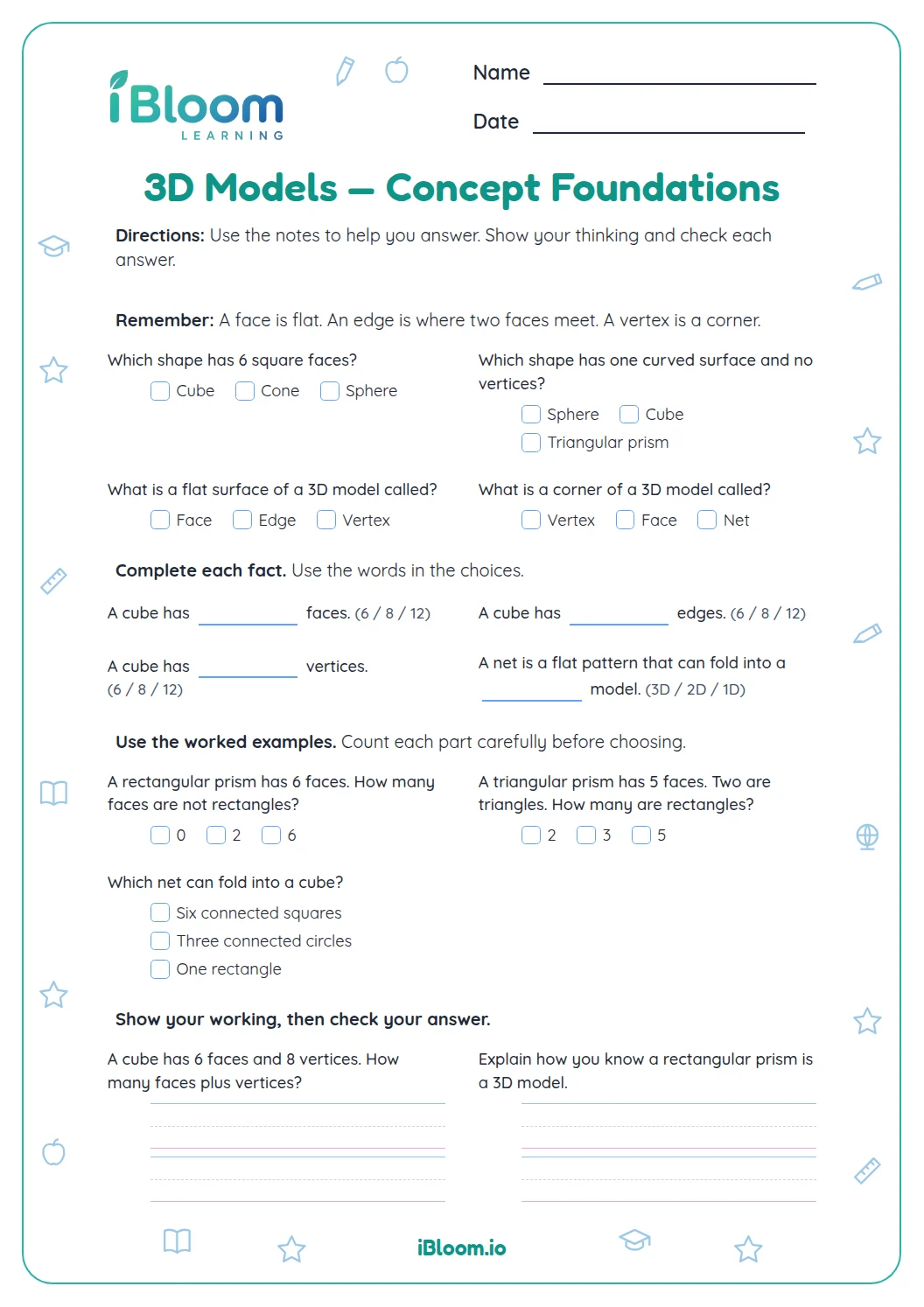 3D Models — Concept FoundationsGrade 5 geometry worksheets for recognizing, describing, and working with 3D models using faces, edges, vertices, nets, and visual reasoning. This Grade 5 foundations worksheet adds concise teaching notes, worked examples, and supported first attempts.Grade 5Free PDF preview6 pages
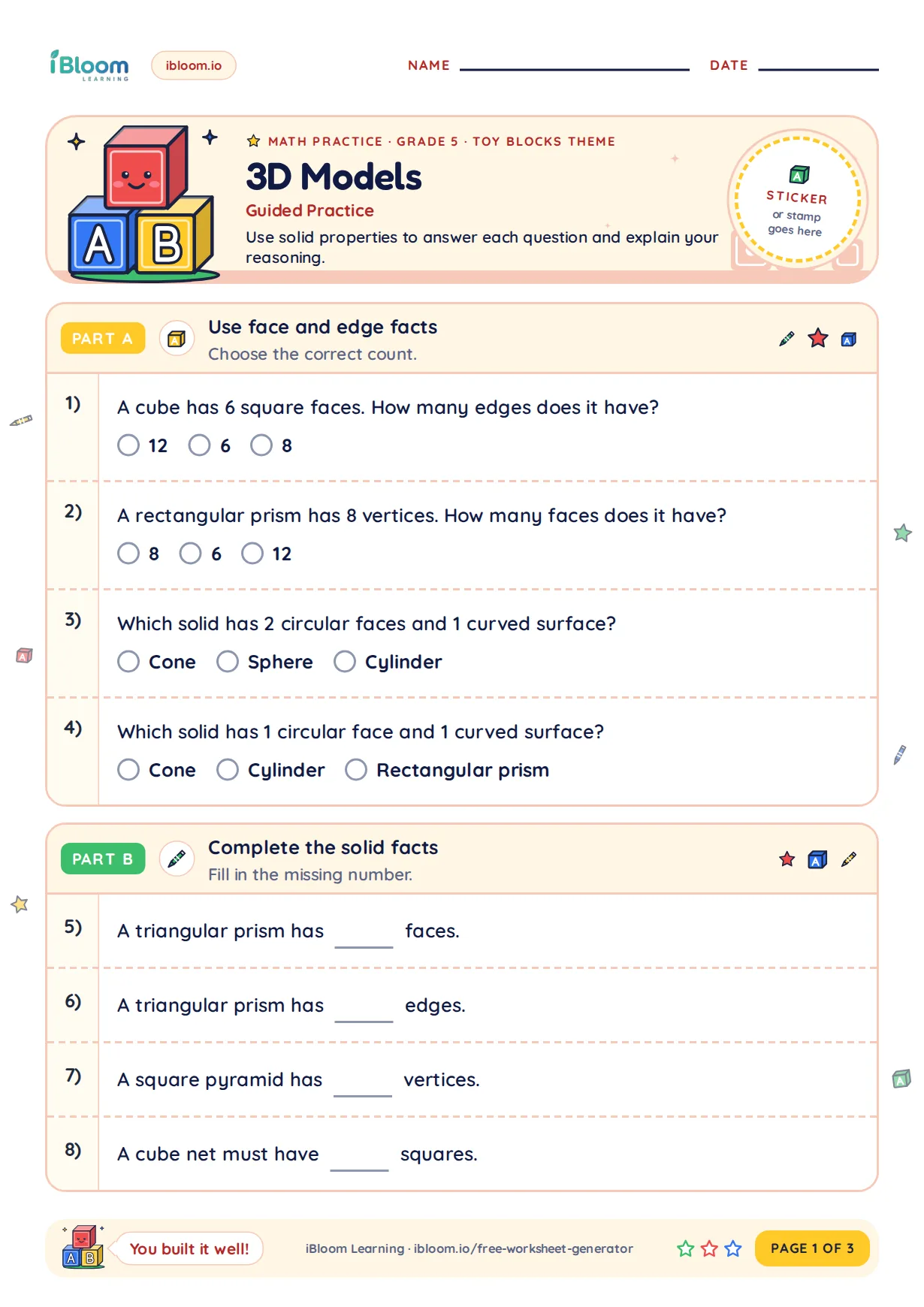 3D Models — Guided PracticeGrade 5 geometry worksheets for recognizing, describing, and working with 3D models using faces, edges, vertices, nets, and visual reasoning. This Grade 5 guided-practice worksheet progresses from prompts and checkpoints to independent questions.Grade 5Free PDF preview
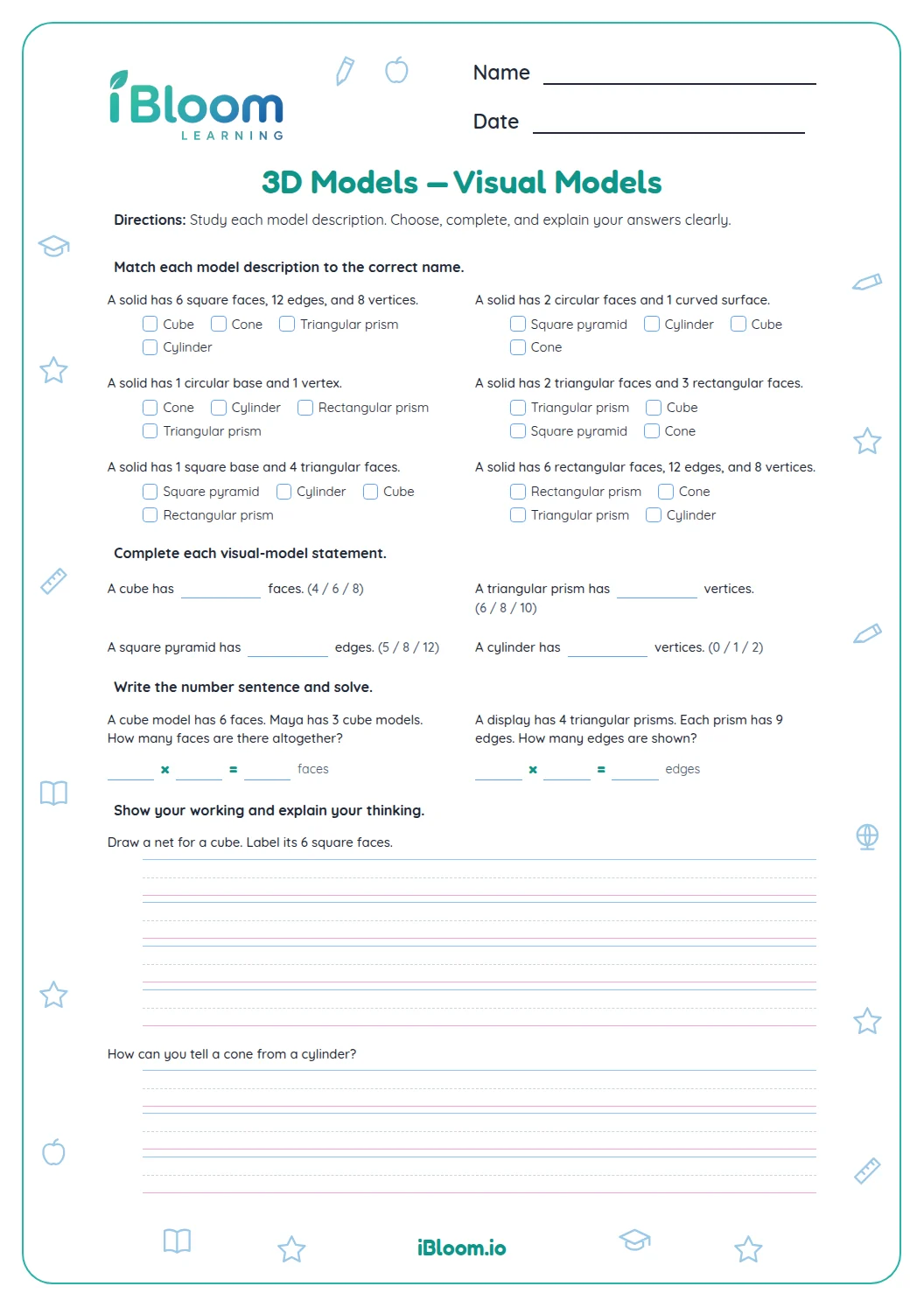 3D Models — Visual ModelsGrade 5 geometry worksheets for recognizing, describing, and working with 3D models using faces, edges, vertices, nets, and visual reasoning. This Grade 5 visual-model worksheet connects suitable diagrams, tables, number lines, or place-value models to mathematical notation.Grade 5Free PDF preview
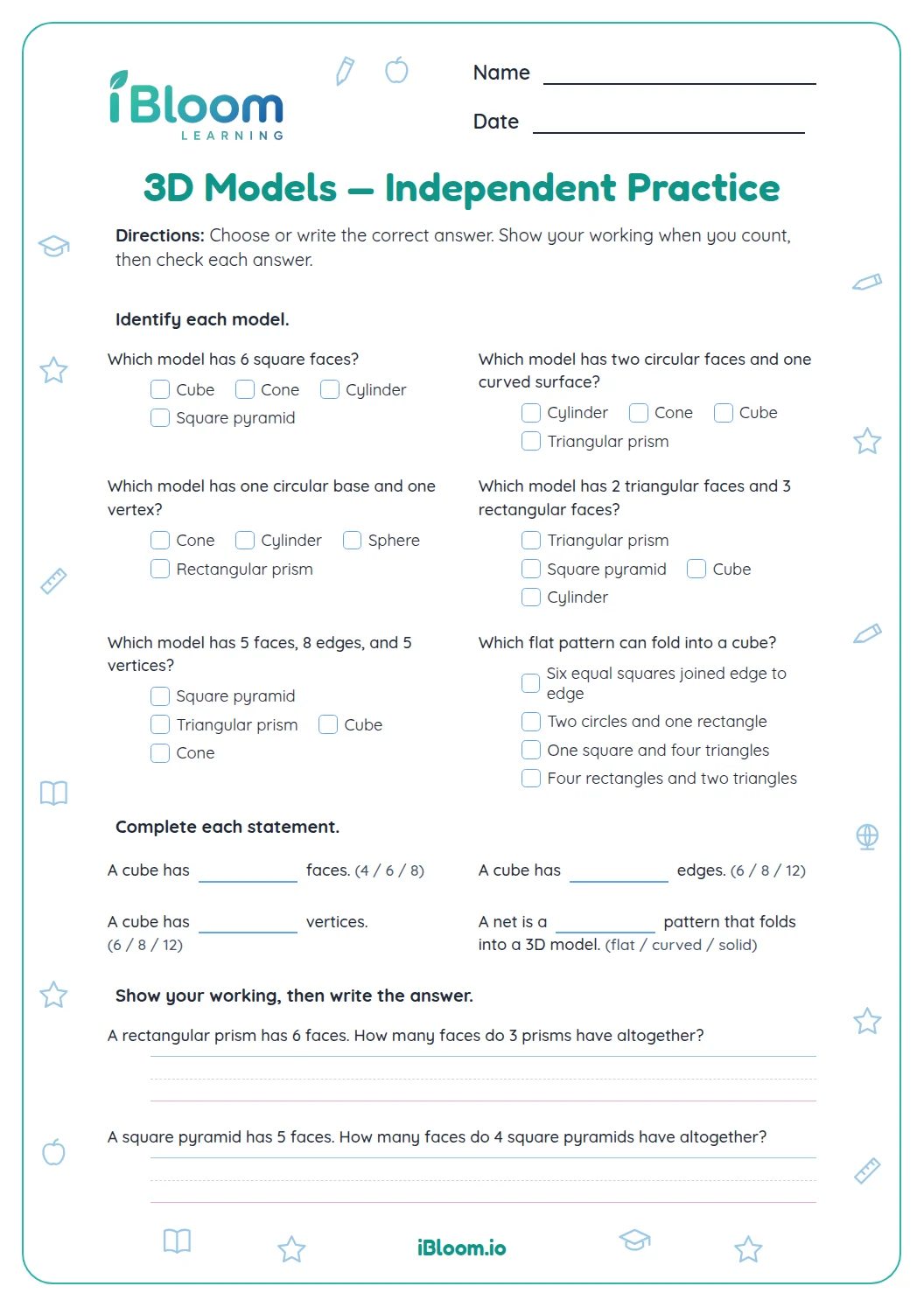 3D Models — Independent PracticeGrade 5 geometry worksheets for recognizing, describing, and working with 3D models using faces, edges, vertices, nets, and visual reasoning. This Grade 5 independent-practice worksheet provides a balanced sequence of accurate, grade-level exercises.Grade 5Free PDF preview
 3D Models — Real-World ProblemsGrade 5 geometry worksheets for recognizing, describing, and working with 3D models using faces, edges, vertices, nets, and visual reasoning. This Grade 5 application worksheet uses realistic one-step and multi-step situations with room to model and solve.Grade 5Free PDF preview
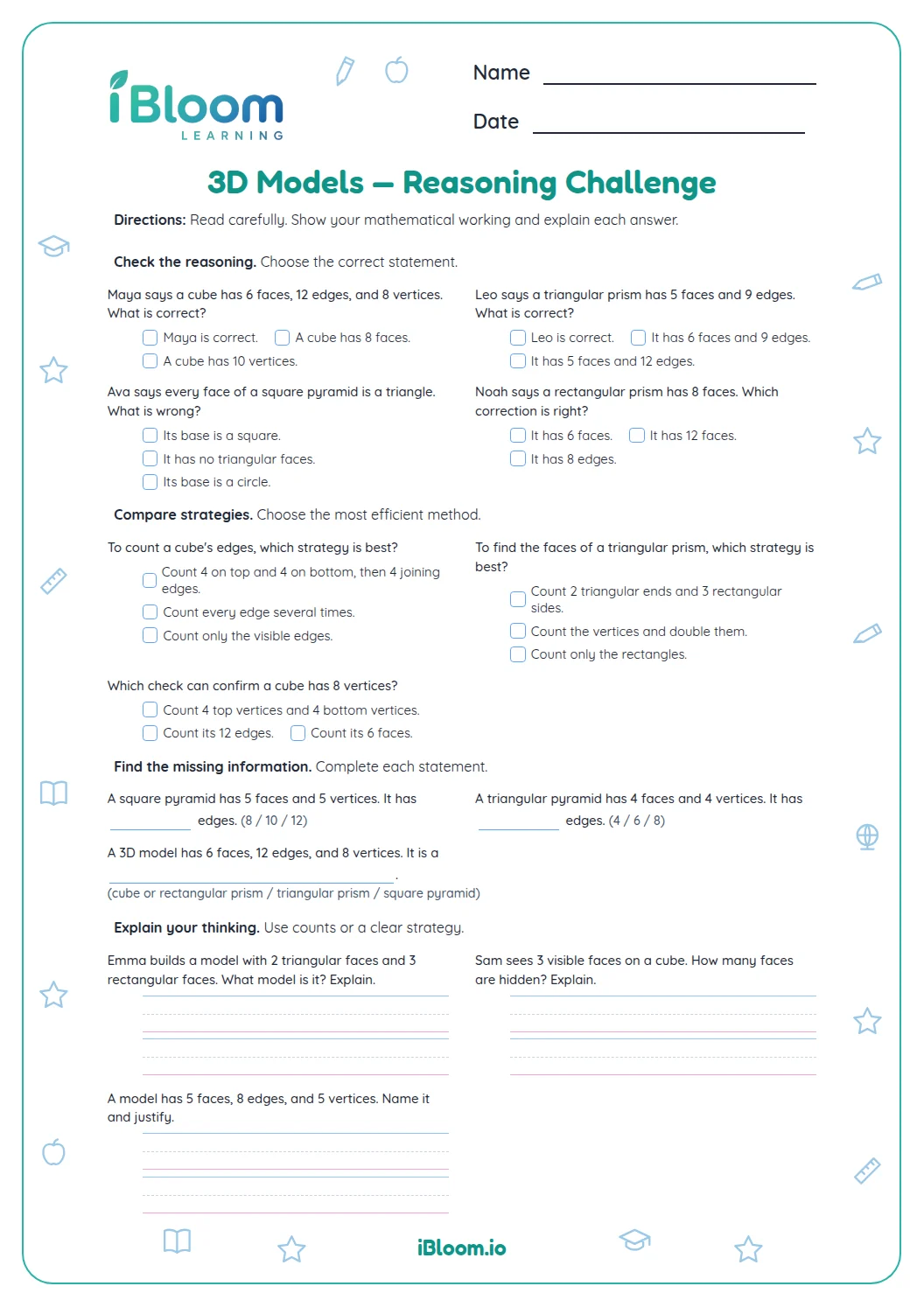 3D Models — Reasoning ChallengeGrade 5 geometry worksheets for recognizing, describing, and working with 3D models using faces, edges, vertices, nets, and visual reasoning. This Grade 5 reasoning worksheet combines error analysis, strategy comparison, missing information, and a gentle extension.Grade 5Free PDF preview
Practice that builds confidence
Understanding 3D models
These Grade 5 geometry worksheets help children examine 3D models as real solids, not just flat pictures. Students practice identifying common solid figures, naming their parts, and comparing models by faces, edges, vertices, bases, and curved surfaces.
The printable activities include visual matching, model descriptions, counting tasks, net-to-solid thinking, and short reasoning prompts. Children build the habit of looking carefully at how a solid is made before choosing its name or properties.
A 3D model has length, width, and height, so students must think beyond the outline they see on the page. These worksheets guide Grade 5 learners to recognize solids such as cubes, rectangular prisms, triangular prisms, pyramids, cylinders, cones, and spheres. The focus is on structure: which shapes make the faces, where edges meet, and how the model would look if turned.

Vocabulary that supports reasoning
Children use precise geometry words while they work: face, edge, vertex, base, curved surface, prism, pyramid, cube, and net. For example, a rectangular prism has rectangular faces, while a triangular prism has two triangular bases. A cylinder has flat circular bases and one curved surface, so it should not be counted the same way as a prism with only flat faces.
From pictures to mental rotation
The activities move from naming familiar solids to comparing models, counting parts, and matching a flat net to the solid it can form. Students may be asked to decide whether a drawing shows a cube or rectangular prism, count visible and hidden edges, or explain why a certain net folds into a pyramid. This progression strengthens spatial visualization, an important Grade 5 geometry skill.
A simple parent routine
At home, place a cereal box, dice, can, party hat, and ball on the table. Ask your child to sort them by solid type, then describe each one using geometry vocabulary. Next, choose one object and ask: How many flat faces does it have? Are any surfaces curved? What shape is the base? Finish by drawing the object and labeling one face, edge, and vertex when possible.

Classroom uses for teachers
Teachers can use these printables for geometry centers, small-group review, warm-ups before a lesson on nets, or quick checks after hands-on model building. They also work well after students construct solids with paper, cubes, straws, or modeling clay, because the worksheet questions connect physical models to diagrams and written explanations.

Common errors and a child-friendly strategy
Watch for students counting only the edges they can see, calling every box a cube, or treating curved surfaces like flat faces. A helpful strategy is: Name it, touch it, count it. First name the solid, then trace each face or edge with a finger, and finally count in an organized pattern so no part is skipped or counted twice.
Free printable PDF download
Use this grade 5 3d models worksheet page to preview the activity, print it, or download it as a PDF for quick practice. It works well for homework, homeschool lessons, tutoring, morning work, revision, and classroom centers.
Answers and answer key support
After the child completes the worksheet independently, parents and teachers can use the answer support or answer key information to check the work, review mistakes, and choose the next practice step.
Why iBloom worksheets help
The worksheets use clear diagrams and varied question types so students do more than memorize shape names. They compare, count, match, describe, and explain, which helps them connect visual models with accurate geometry language.
Helpful answers
Frequently asked questions
What do Grade 5 students practice in 3D model worksheets?
They practice identifying solid figures, counting faces, edges, and vertices, recognizing bases and curved surfaces, comparing models, and connecting some flat nets to the solids they form.
How are 3D models different from 2D shapes in these worksheets?
2D shapes are flat, such as rectangles or triangles. 3D models have depth and include solids such as cubes, prisms, pyramids, cylinders, cones, and spheres.
Should students count hidden edges and vertices?
Yes, when the question asks for the total number of parts in a solid. Students should think about the complete model, not only the lines visible in the drawing.
Are nets included in this 3D models practice?
The collection may include net-based tasks where students match a flat arrangement of faces to the solid it can fold into, helping them visualize how 2D layouts create 3D models.
What is a common mistake with cylinders, cones, and spheres?
Students often count curved surfaces as flat faces or try to find vertices on a sphere. Encourage them to separate flat faces from curved surfaces before counting.
How can I support my child if 3D diagrams are confusing?
Use real objects first, such as a box, can, dice, or ball. Let your child touch the faces and edges, then compare the object to the drawing on the worksheet.
Is this grade 5 3d models worksheet free?
Yes. You can preview it for free and use the printable worksheet for home or classroom practice.
Can I download this grade 5 3d models worksheet as a PDF?
Yes. Use the worksheet download option to save a printable PDF, or print the worksheet directly from the page.