


About this worksheet
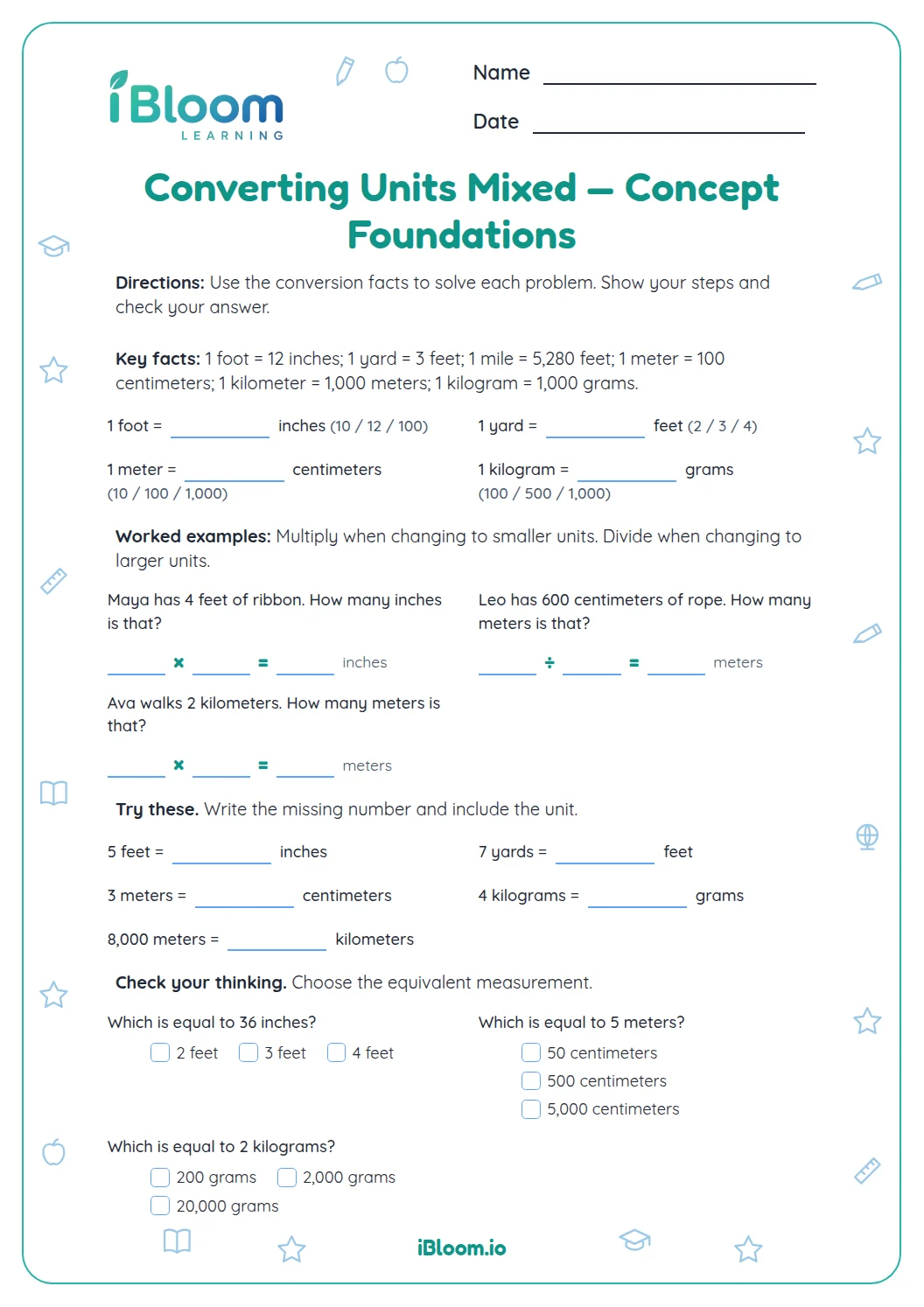
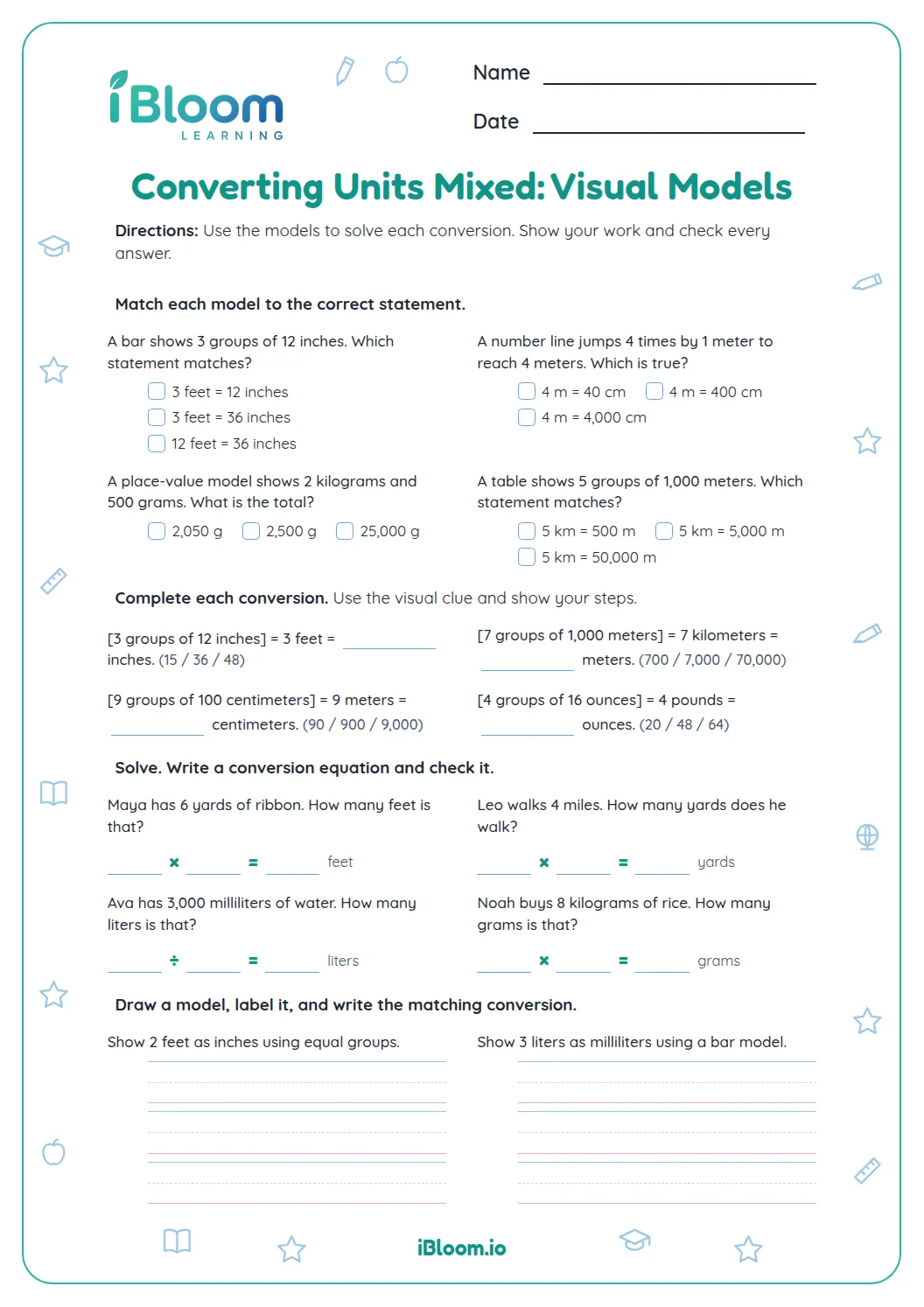
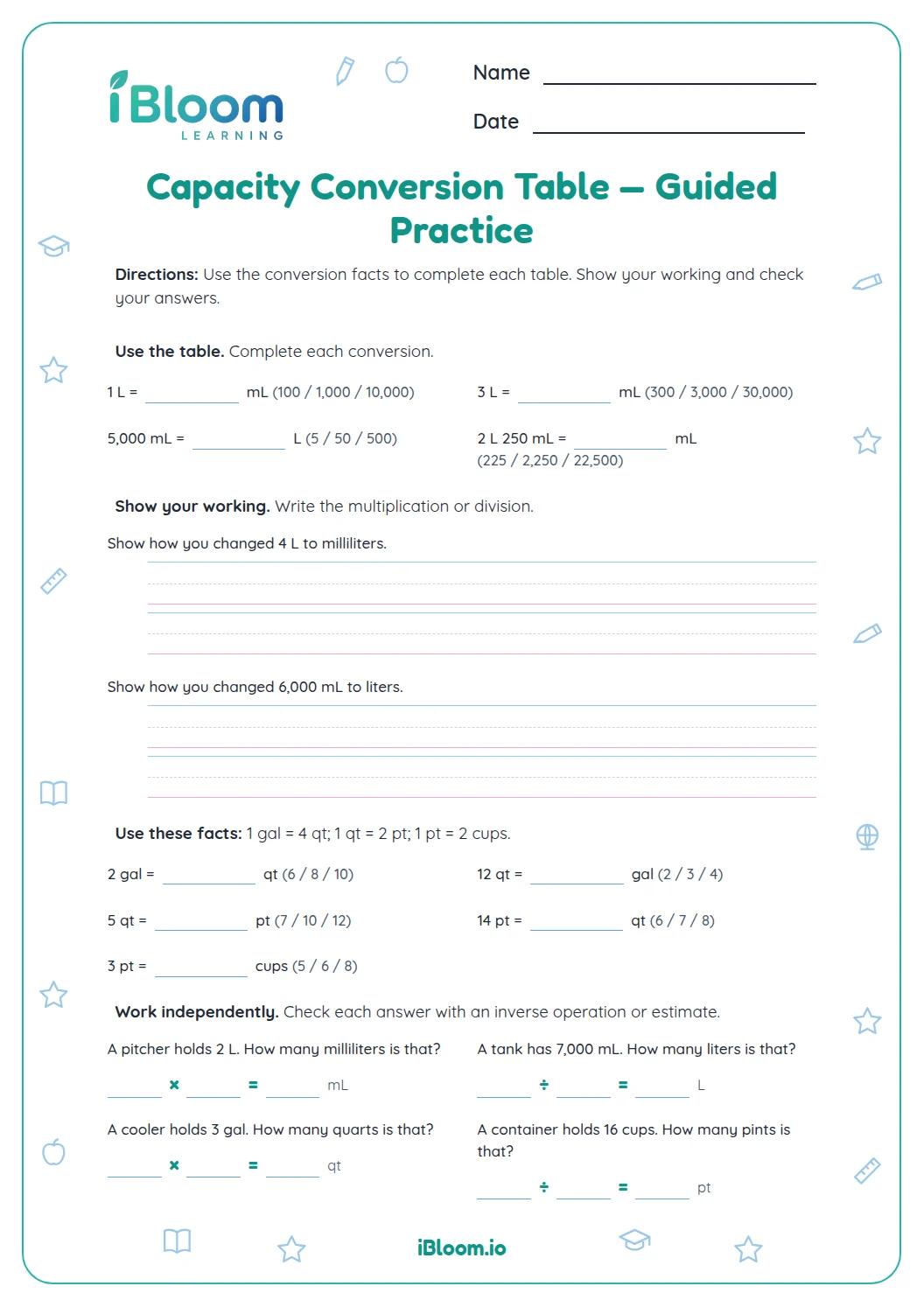
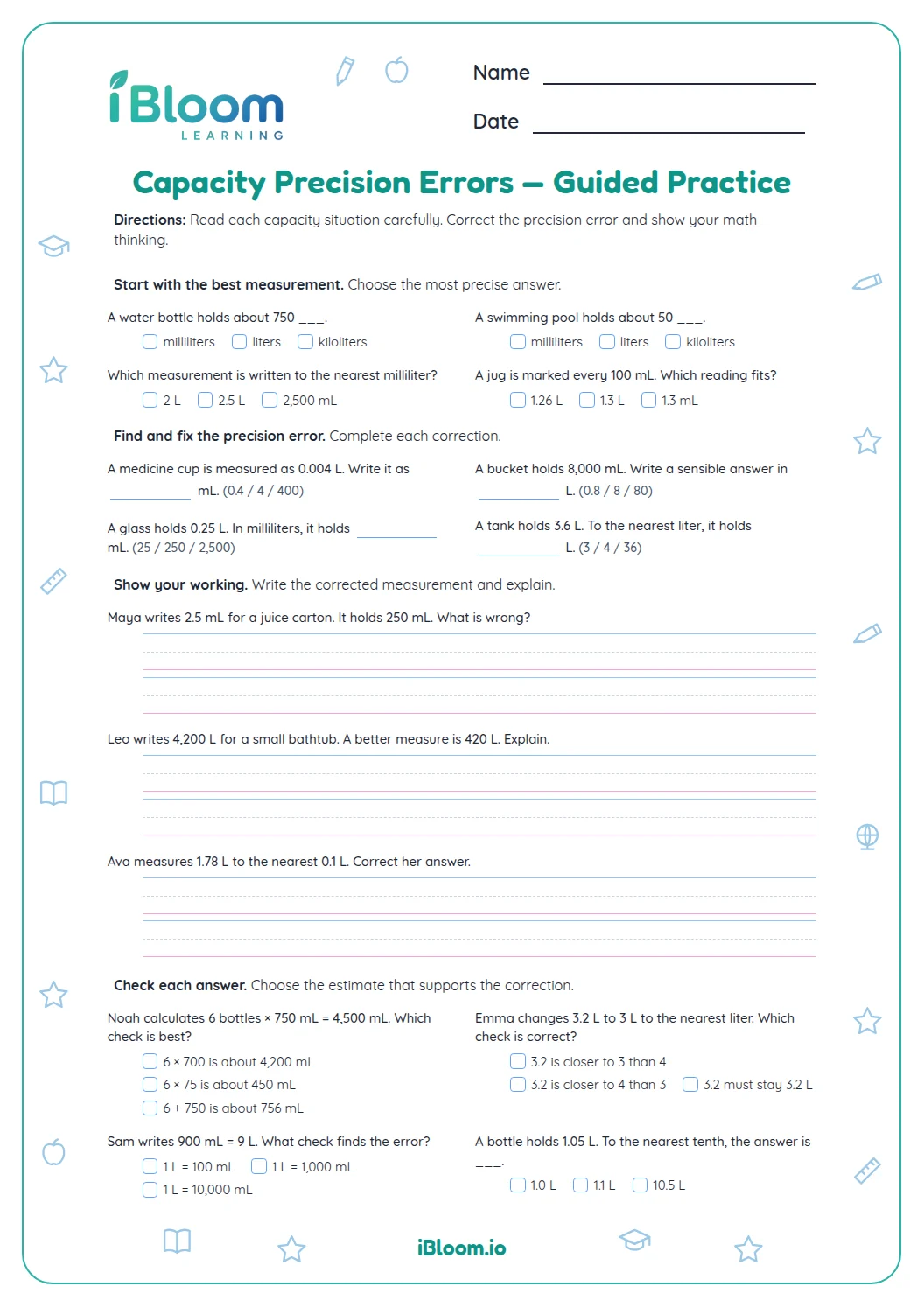
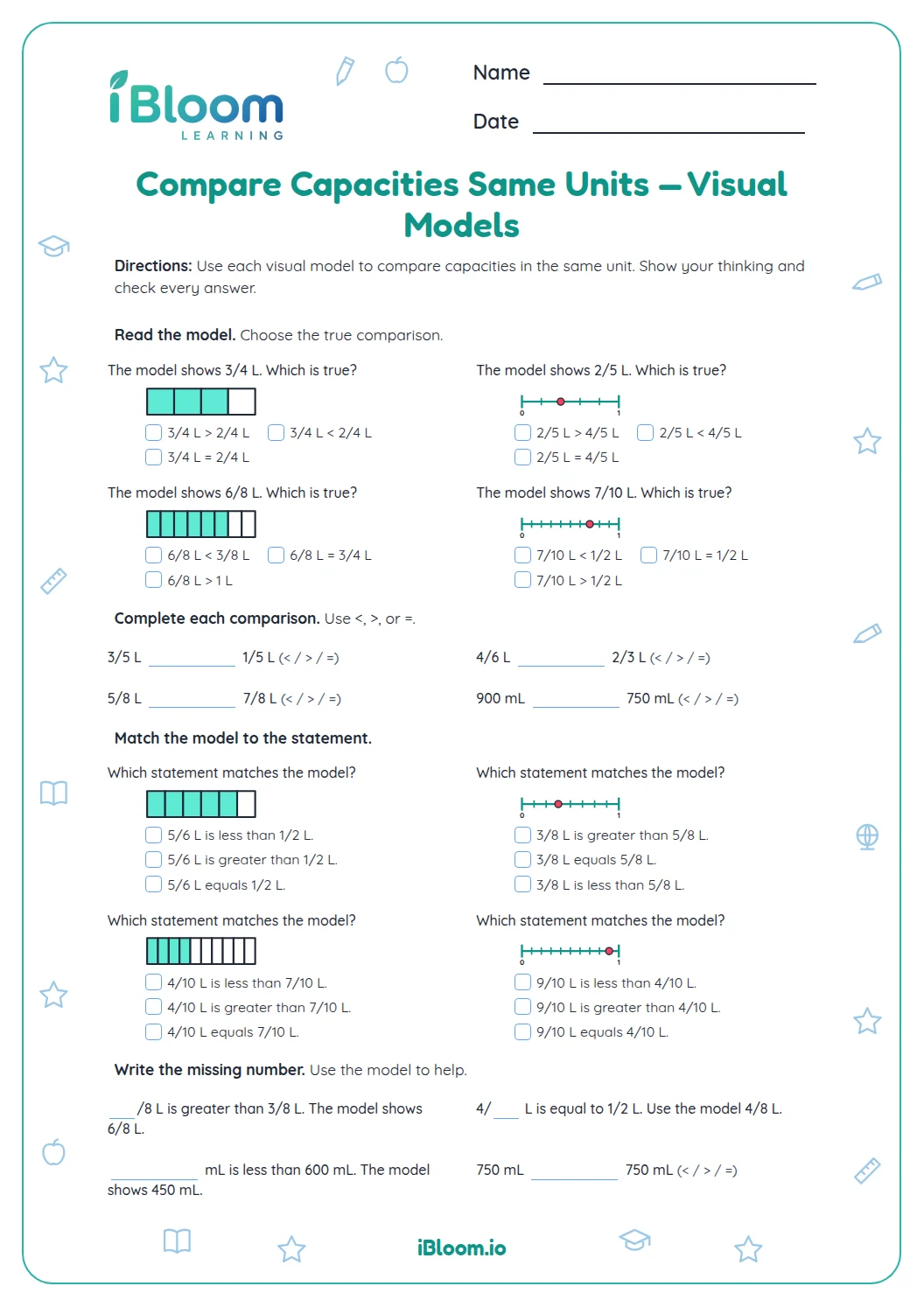
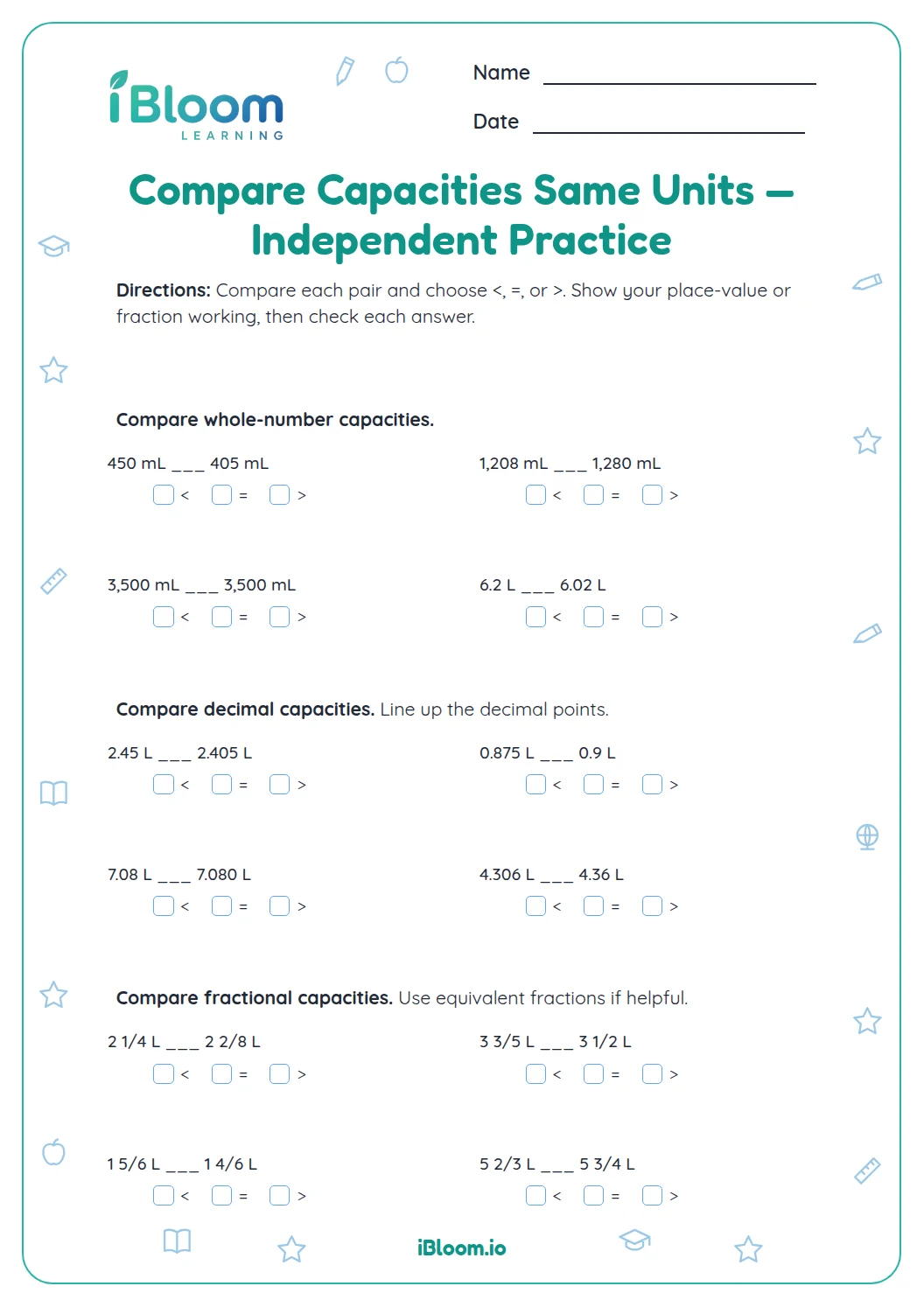
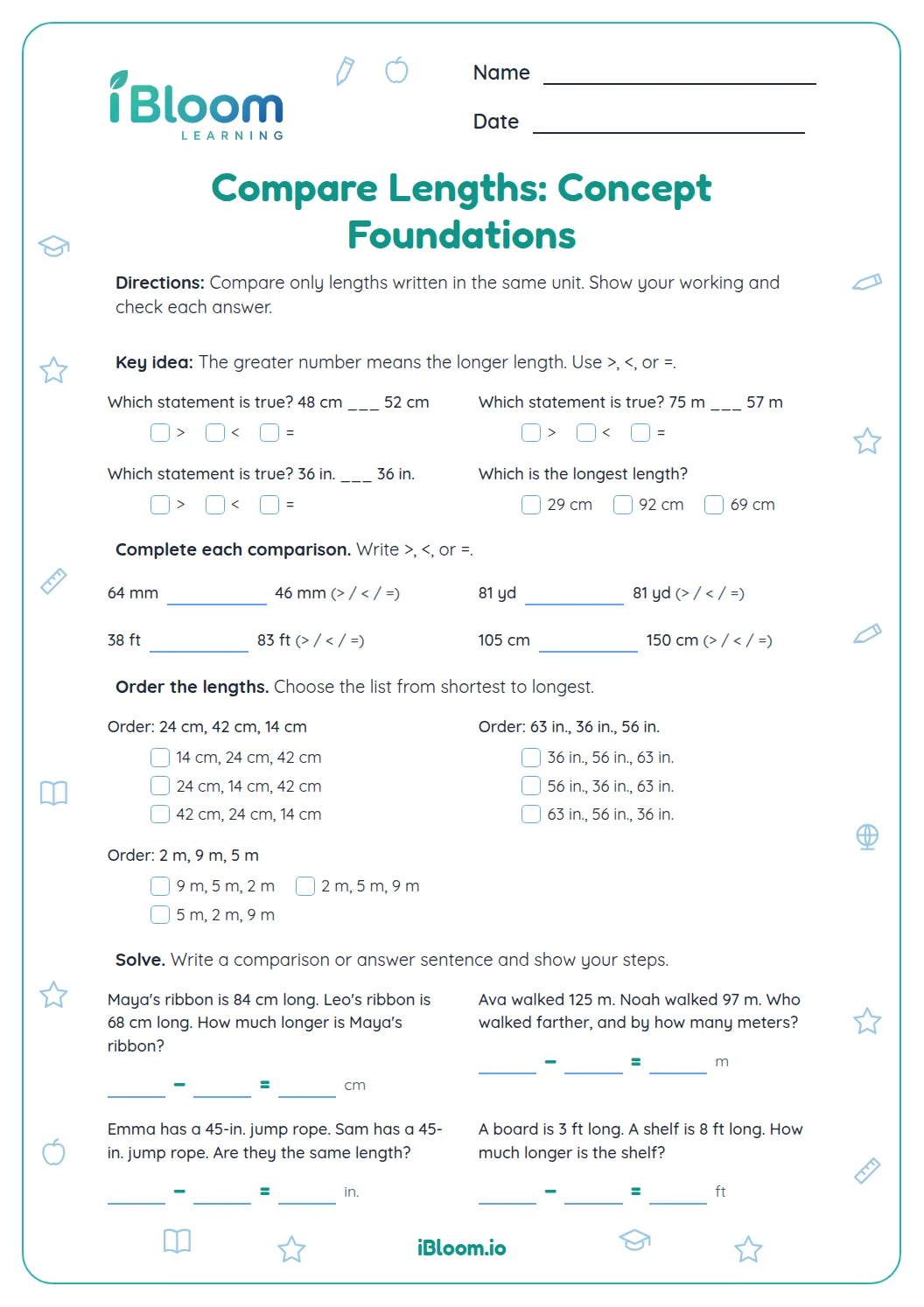
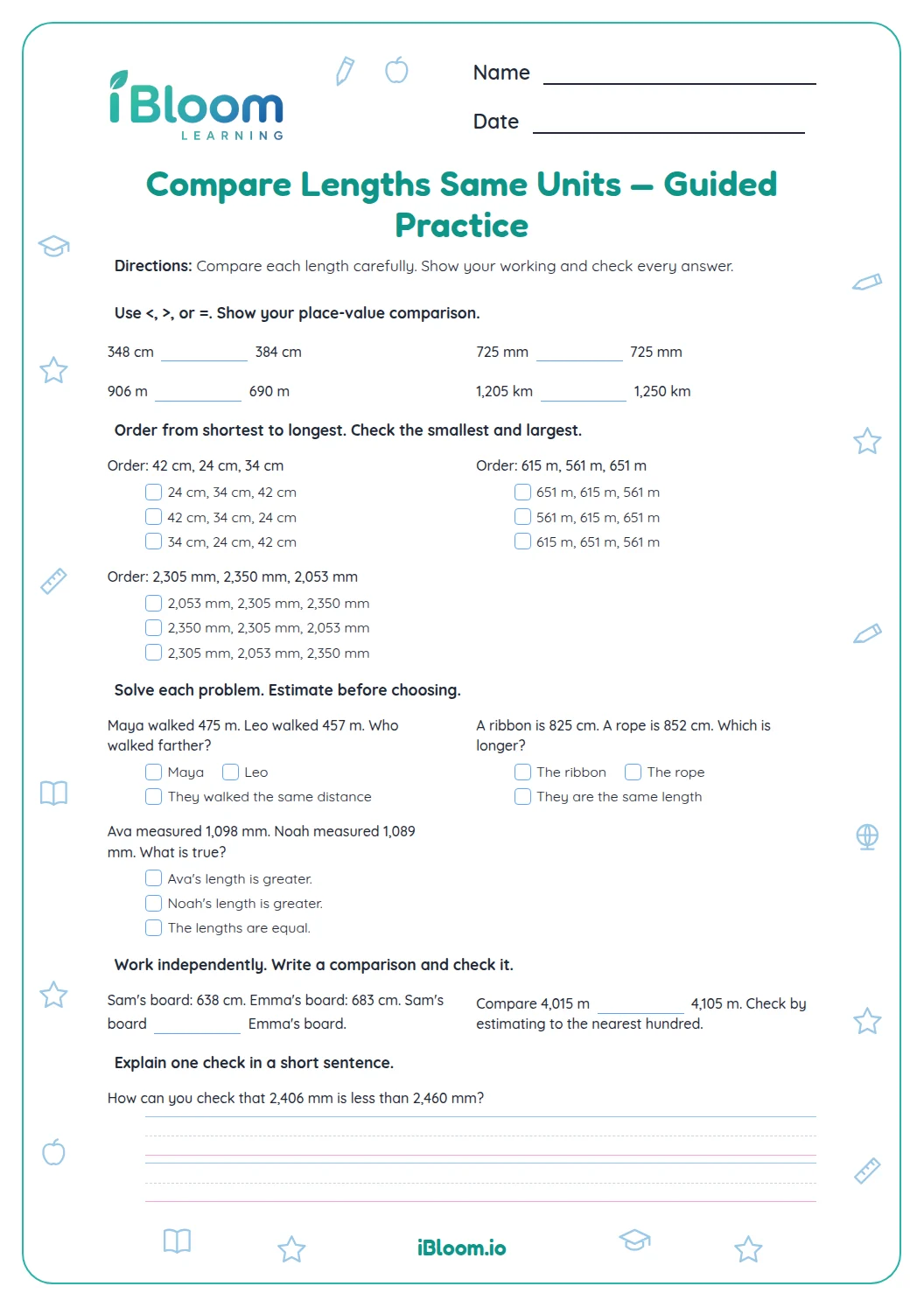
This Grade 5 printable has 15 mixed unit conversions. Students use the given unit relationships to convert measurements, including decimal values, and write the missing number in each prompt. The worksheet is divided into three parts, with a separate answer key for checking results. It practices measurement conversion skills related to Common Core 5.MD.A.1.
Aligned to 5.MD.A.1
How can a unit relationship guide a conversion?
Write an equivalent-unit relationship, then multiply or divide so the starting unit changes to the requested unit. Keep the labels beside the numbers while calculating.
Check whether the answer should be larger or smaller: converting to a smaller unit usually increases the number of units.
- 14 yd × 3 ft per yd = 12 ft
- 2The yards cancel, leaving feet.
How can you check the direction of a conversion?
Compare the size of the starting and target units before calculating. If one foot is 12 inches, a length measured in inches has a larger number than the same length measured in feet.
For metric conversions, use the given relationship and count the factor carefully. For example, 1 meter equals 100 centimeters.
How is the worksheet organized?
The 15 fill-in questions are grouped into three parts: length and distance, weight and capacity, and mixed-unit review. Each prompt gives the target unit, and the answer key contains the missing value without repeating that printed unit.
- Part A: Conversion practice A
- Part B: Conversion practice B
- Part C: Conversion practice C
- Two worksheet pages and two answer-key pages
How to solve a conversion
- 1Identify the starting unit and the unit requested.
- 2Write or recall an equivalent-unit relationship.
- 3Choose multiplication or division based on the unit sizes.
- 4Calculate and check whether the result is reasonable.
- 5Write only the missing value when the unit is already printed.
- 6Use the answer key to check the conversion.
Common conversion mistakes
The mistake
Multiplying when converting to a larger unit, so the answer grows.
The fix
Estimate first: fewer larger units should describe the same length, mass, or capacity.
The mistake
Moving a decimal without counting the unit steps.
The fix
Write the equality, such as 1 L = 1,000 mL, then multiply or divide by that factor.
The mistake
Repeating a unit that is already printed after the blank.
The fix
Write only the missing number in that blank; include a unit only when the prompt asks for a complete answer.
Common Core alignment
This worksheet practices converting measurements and using those conversions in context.
Convert between measurement units and use the conversions to solve problems.
On this sheet: Students convert measurement values between units and apply conversions to practical situations.
Show the official wordingHide the official wording
Convert among different-sized standard measurement units within a given measurement system (e.g., convert 5 cm to 0.05 m), and use these conversions in solving multi-step, real world problems.
What to practice next
Make more practice
Further reading
Questions parents and teachers ask
How do students decide whether to multiply or divide?
Compare the starting unit with the target unit. Converting to a smaller unit usually means multiplying because more of those units fit the same measurement. Converting to a larger unit usually means dividing. Estimate first, then check whether the calculated value grows or shrinks as expected.
Should students write the unit in every answer blank?
No. Each prompt prints the target unit after its blank, so the answer key gives only the missing value. Students should write the number in the blank and use the printed label to keep track of the requested unit. A complete response outside the worksheet may include both number and unit.
What should students do when a conversion gives a repeating decimal?
Use the worksheet direction to round a nonterminating decimal to the nearest hundredth. Keep enough digits while calculating, then round only the final value. For example, if the third digit after the decimal is 5 or more, increase the hundredths digit by one.
How many questions and pages are included?
The worksheet has 15 questions in three parts and prints across two pages. A separate two-page answer key lists the corresponding values. Students can complete one part at a time and use the key afterward to locate any conversion that needs another check.
What is a quick way to catch a decimal-place error?
Use the size of the units to predict the direction before calculating. A change from meters to centimeters should make the number larger, while centimeters to meters should make it smaller. Then reverse the conversion mentally or with the same factor to see whether you return to the starting measurement.