

About this worksheet
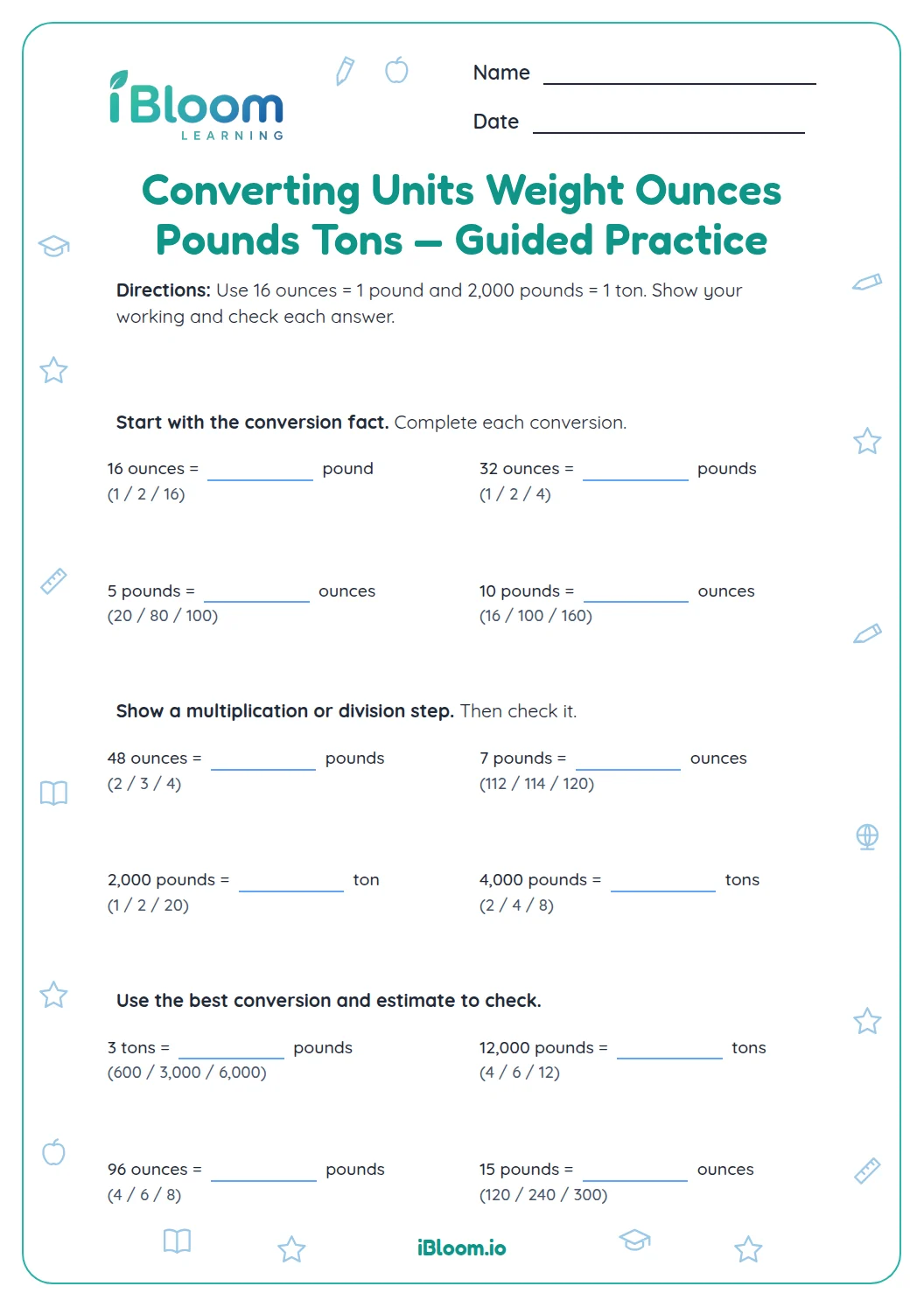
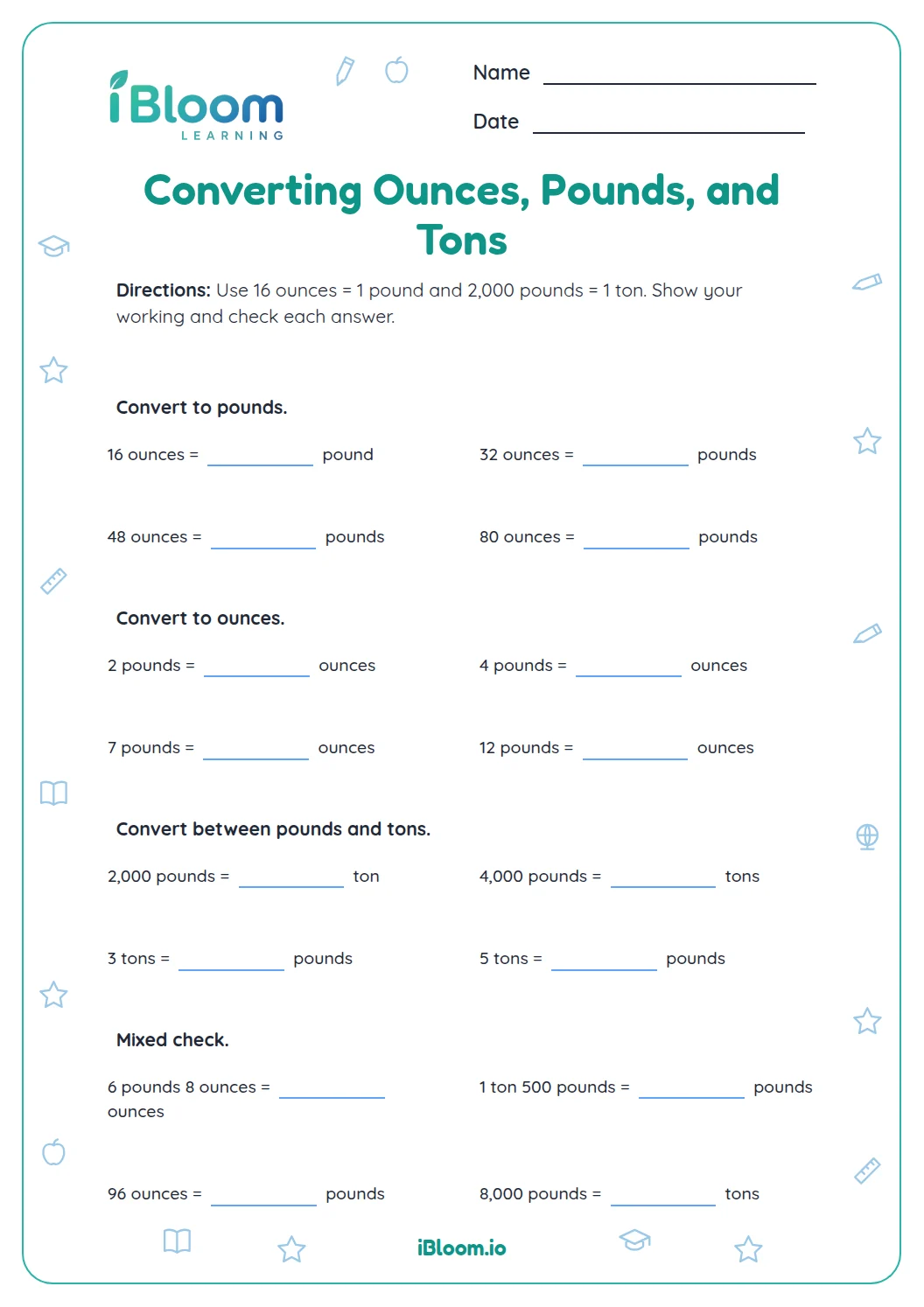
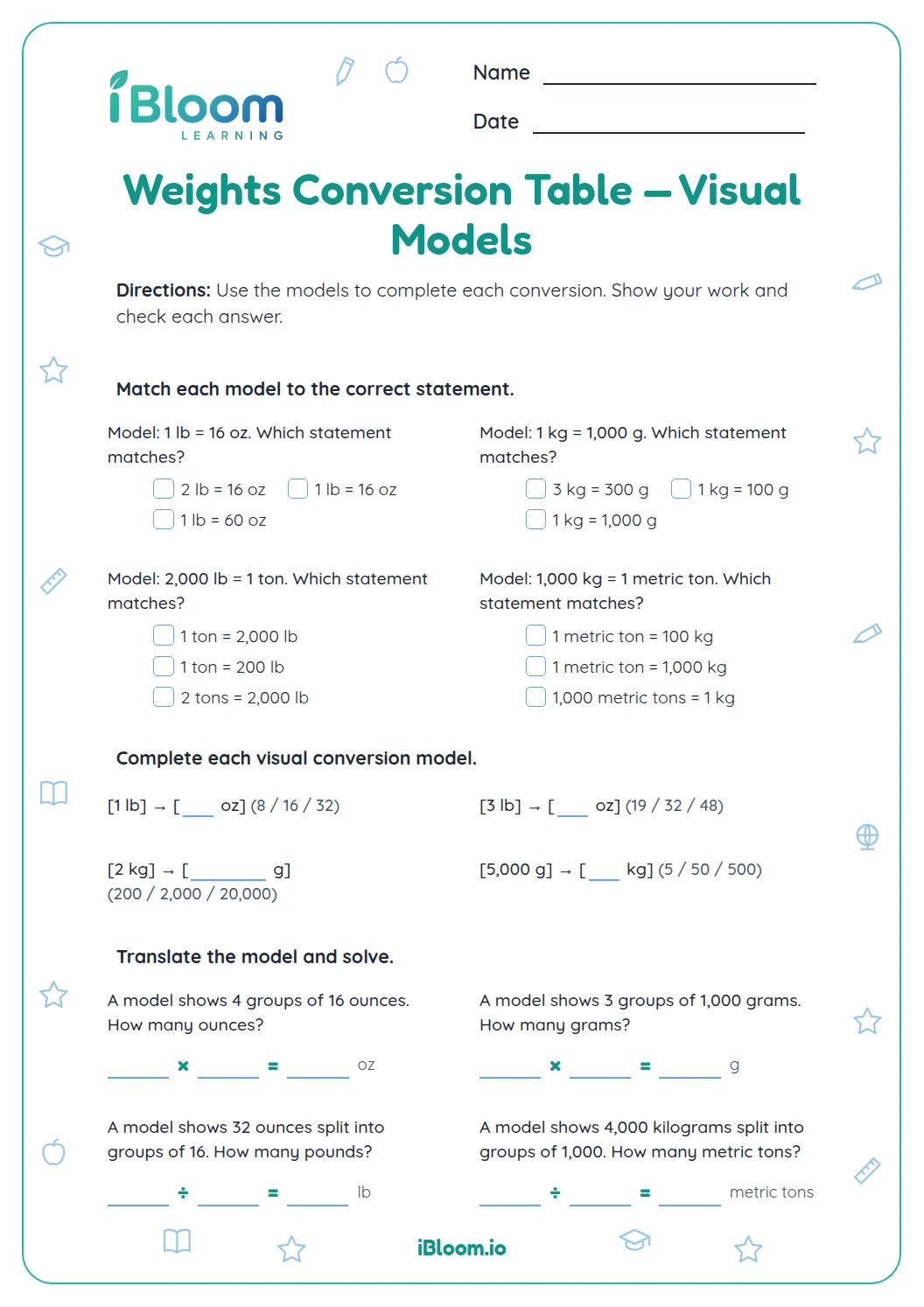
This free Grade 5 worksheet builds reasoning with customary weight units: ounces, pounds, and tons. Students convert in both directions, compare equivalent measurements, and solve short shipment and packaging problems. The 16 questions move from single conversions to multi-step reasoning, with answer space and a separate key. It practices CCSS 5.MD.A.1 using the relationships 16 ounces = 1 pound and 2,000 pounds = 1 ton.
Aligned to 5.MD.A.1
Which weight relationships should students use?
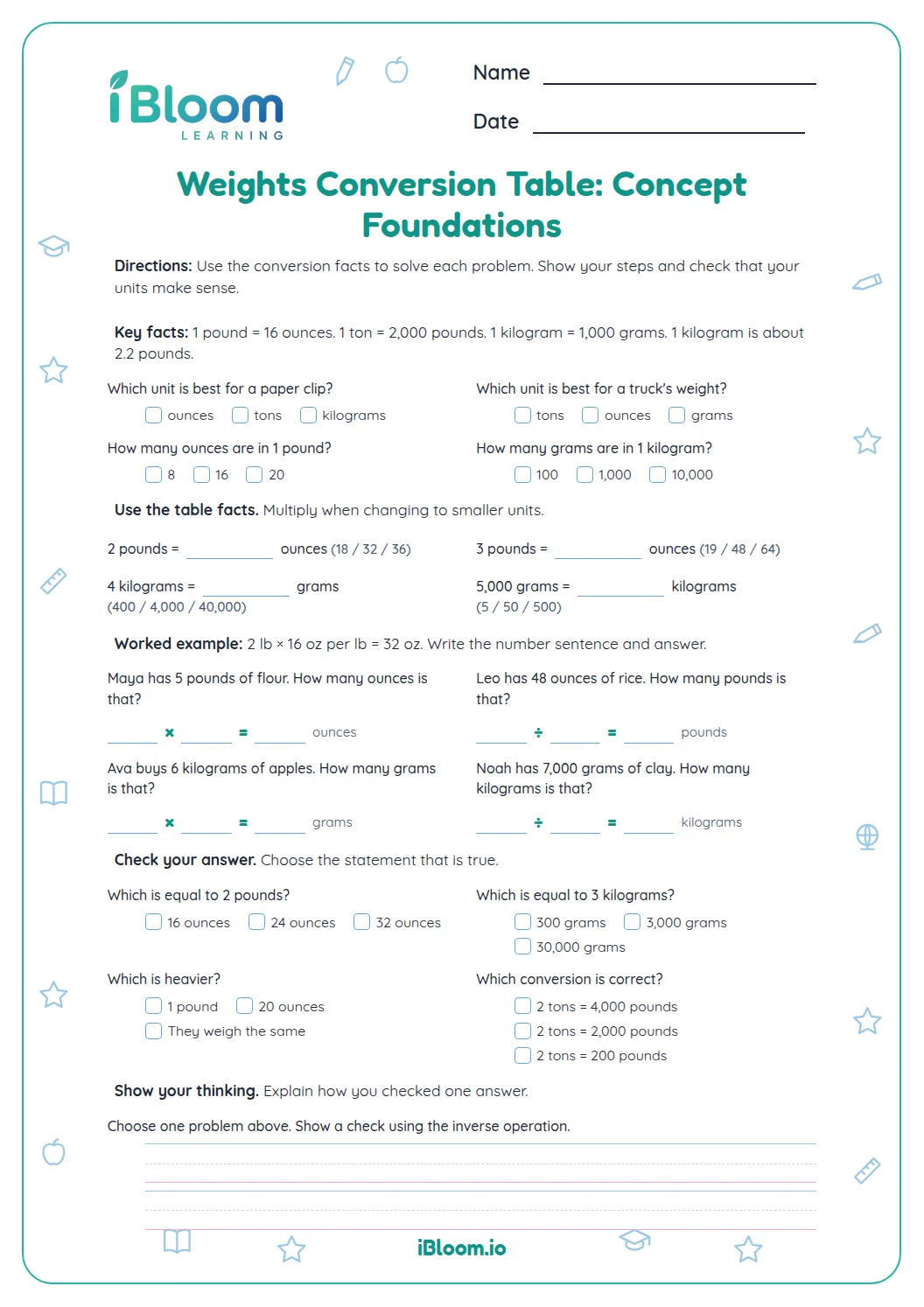
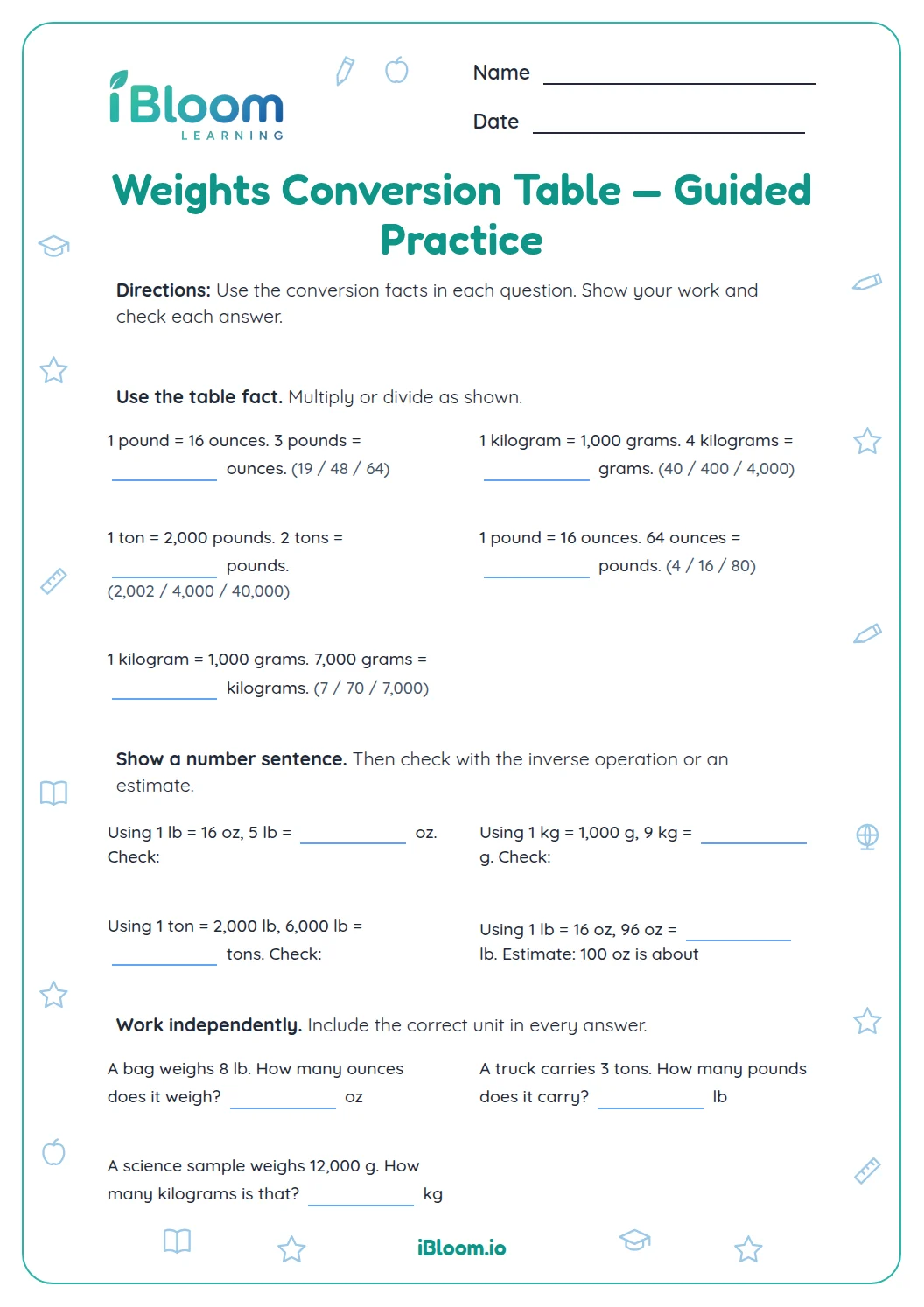
The sheet states two customary relationships: 16 ounces make 1 pound, and 2,000 pounds make 1 ton. Multiplication changes a larger unit into smaller units; division changes smaller units into larger units.
Question 7 compares 40 ounces with 2 pounds. Rewrite 2 pounds as 32 ounces, then subtract 32 from 40 to find an 8-ounce difference.
- 12 lb = 2 × 16 = 32 oz
- 240 oz − 32 oz = 8 oz
- 3So 40 oz is 8 oz heavier.
How do mixed pounds and ounces work?
Convert the pounds first, then add the ounces. For question 10, 3 pounds is 48 ounces, and 48 + 8 = 56 ounces.
For question 16, group 4,000 pounds as 2 tons; the remaining 500 pounds stays as pounds.
What reasoning appears in the challenge questions?
Students check a claim, split a weight into equal portions, calculate a remainder, and combine repeated package weights. These tasks use the same conversion facts as the direct conversions, but require choosing the operation as well.
How to work through the sheet
- 1Write the conversion fact before using it.
- 2Convert both quantities into the same unit before comparing.
- 3For mixed pounds and ounces, change pounds into ounces, then add.
- 4For division stories, check whether the number of groups is whole.
- 5After a multi-step calculation, write the unit asked for.
Common mistakes and quick fixes
The mistake
Comparing without converting.
The fix
Change both weights to pounds or both to ounces first.
The mistake
Using 100 instead of 16 ounces per pound.
The fix
Use the stated conversion fact and multiply by 16.
The mistake
Treating a ton like 1,000 pounds.
The fix
Use 2,000 pounds per ton, then check the scale of the answer.
Common Core alignment
This worksheet gives children practice applying the measurement and number skills described below.
Use customary weight conversions to solve grade-level problems.
On this sheet: The questions ask students to customary weight conversions in several contexts.
Show the official wordingHide the official wording
Convert among different-sized standard measurement units within a given measurement system (e.g., convert 5 cm to 0.05 m), and use these conversions in solving multi-step, real world problems.
What to practice next
Make more practice
Further reading
Questions parents and teachers ask
What conversion facts does this sheet use?
The worksheet gives 16 ounces = 1 pound and 2,000 pounds = 1 ton. Students use multiplication to express pounds or tons in smaller units and division to express ounces or pounds in larger units. Keeping those two facts visible helps them choose the correct operation.
How do you compare 40 ounces and 2 pounds?
Convert 2 pounds to ounces: 2 × 16 = 32 ounces. Then compare 40 ounces with 32 ounces. The first amount is heavier by 8 ounces, which is the answer requested in question 7. Converting first makes the subtraction a comparison of like units.
How can a student combine pounds and ounces?
Convert the pounds into ounces first, then add the remaining ounces. In question 10, 3 pounds becomes 48 ounces; adding 8 ounces gives 56 ounces. The answer stays in ounces because that is the unit the question asks for.
Why is 4,500 pounds written as tons and pounds?
Two tons account for 4,000 pounds because each ton is 2,000 pounds. The remaining 500 pounds is left over, so the complete measurement is 2 tons 500 pounds. This is a grouping problem rather than a decimal conversion.
Is the answer key separate?
Yes. The practice section is followed by a separate answer key. The key lists the results with the unit requested by each question, making it easier to check conversions, comparisons, and story calculations. Each response includes the requested unit, such as ounces, pounds, or tons.