

About this worksheet
This printable Grade 5 practice page uses cups, pints, quarts, and gallons in everyday cooking and sharing situations. Students convert between units, combine amounts, find what remains, and check a conversion claim. It includes 16 problems across three parts and a separate answer key. CCSS 5.MD.A.1 supports converting units within a system and using those conversions in real-world problems.
Aligned to 5.MD.A.1
How are customary volume units related?
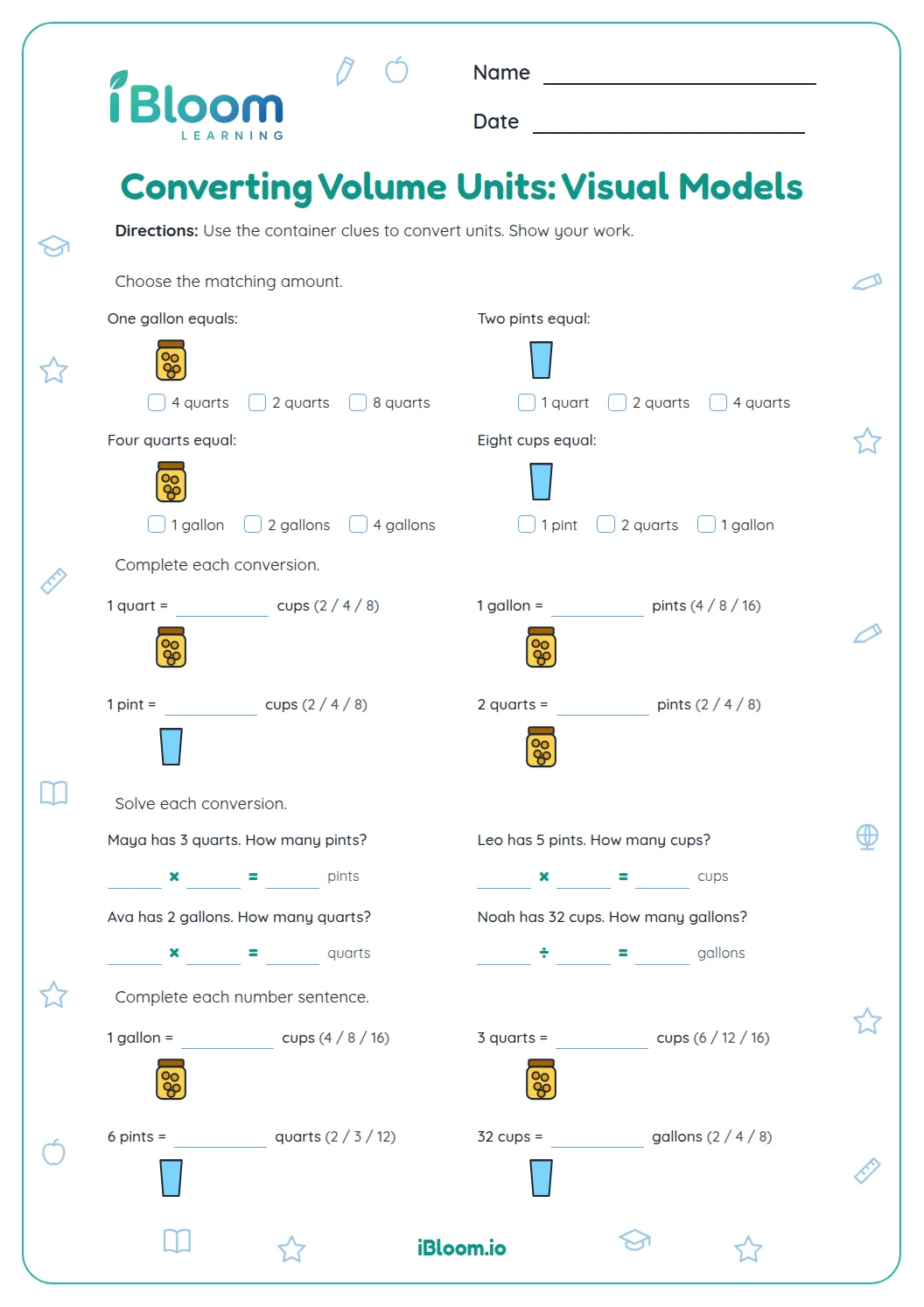
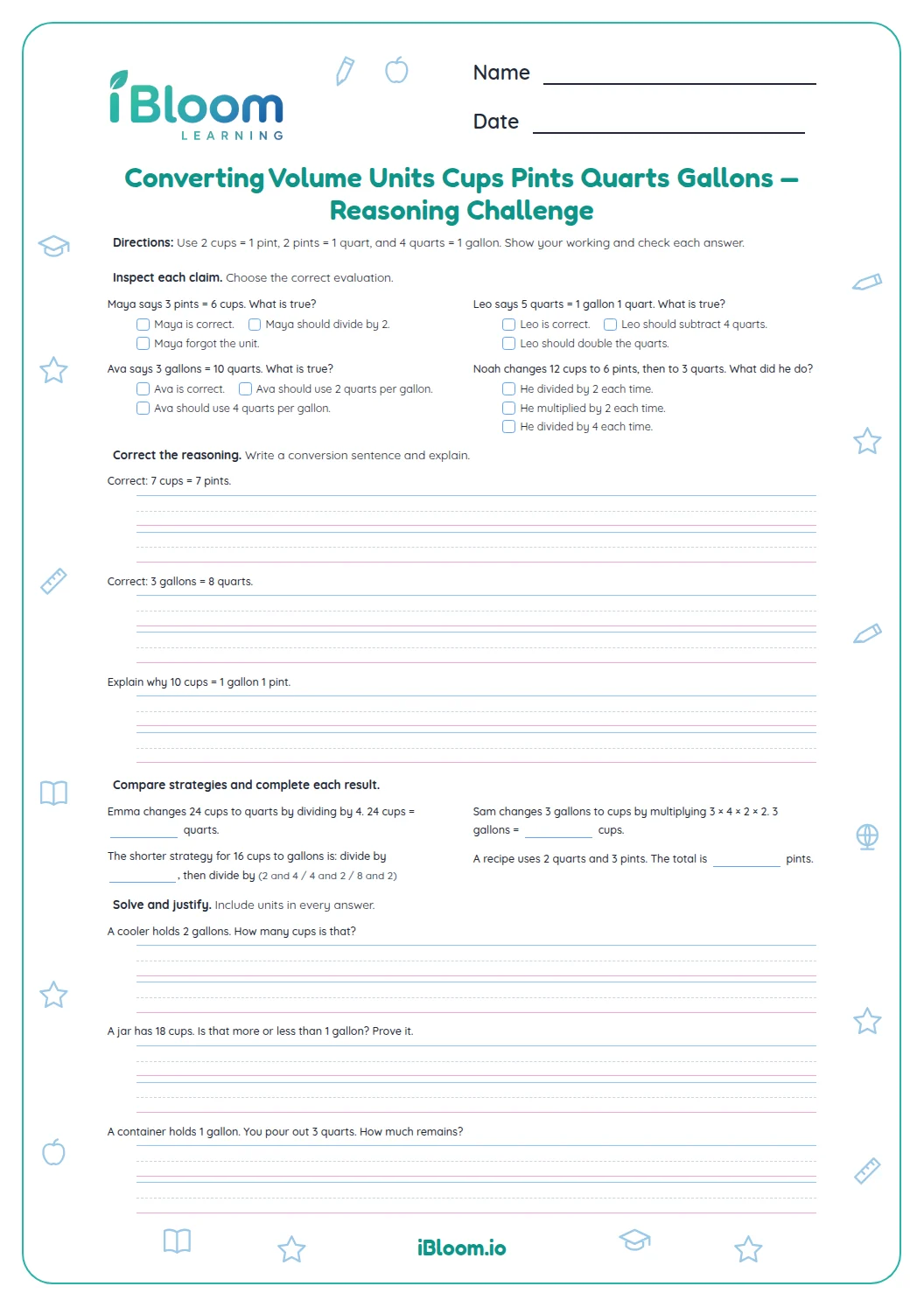
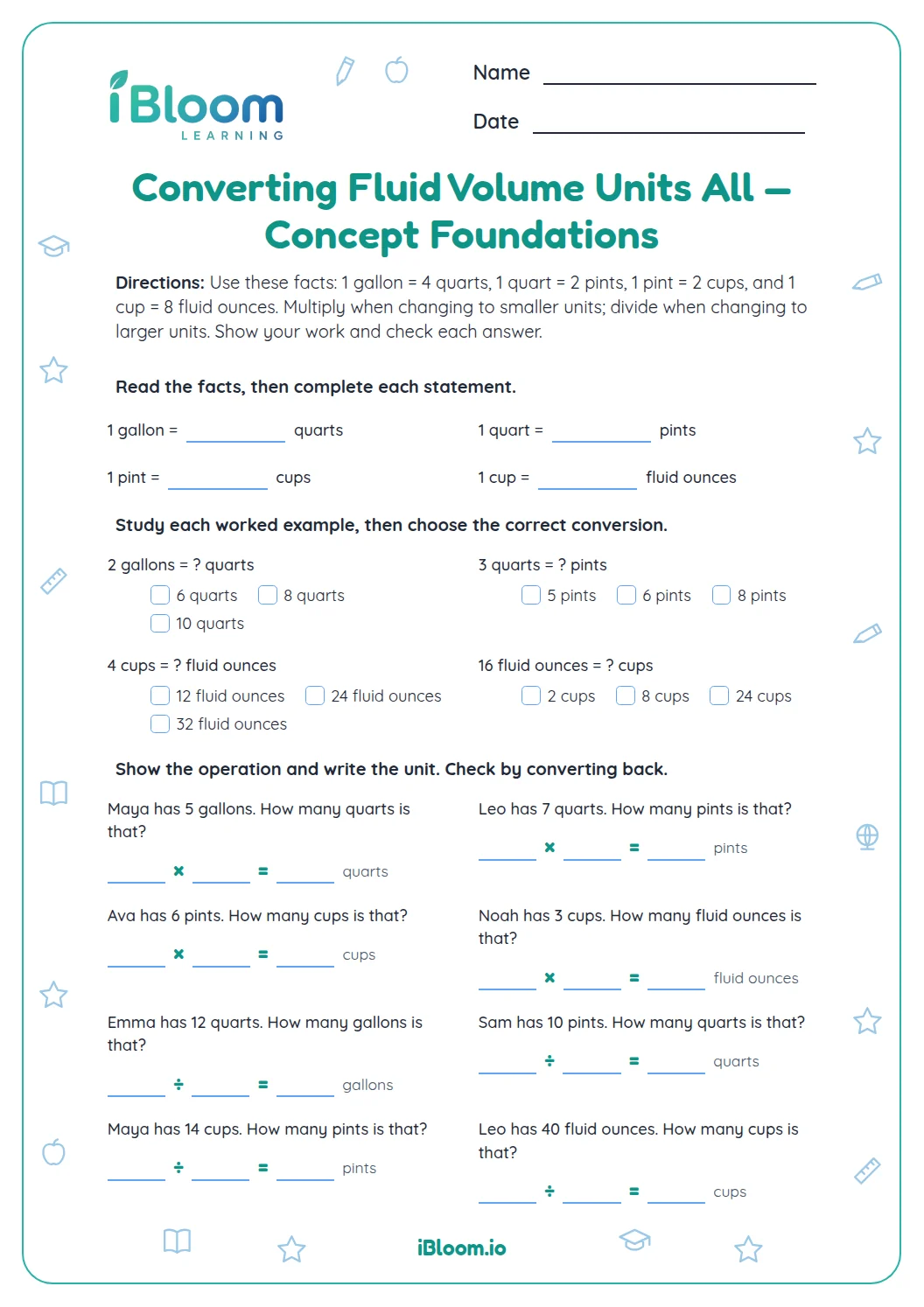
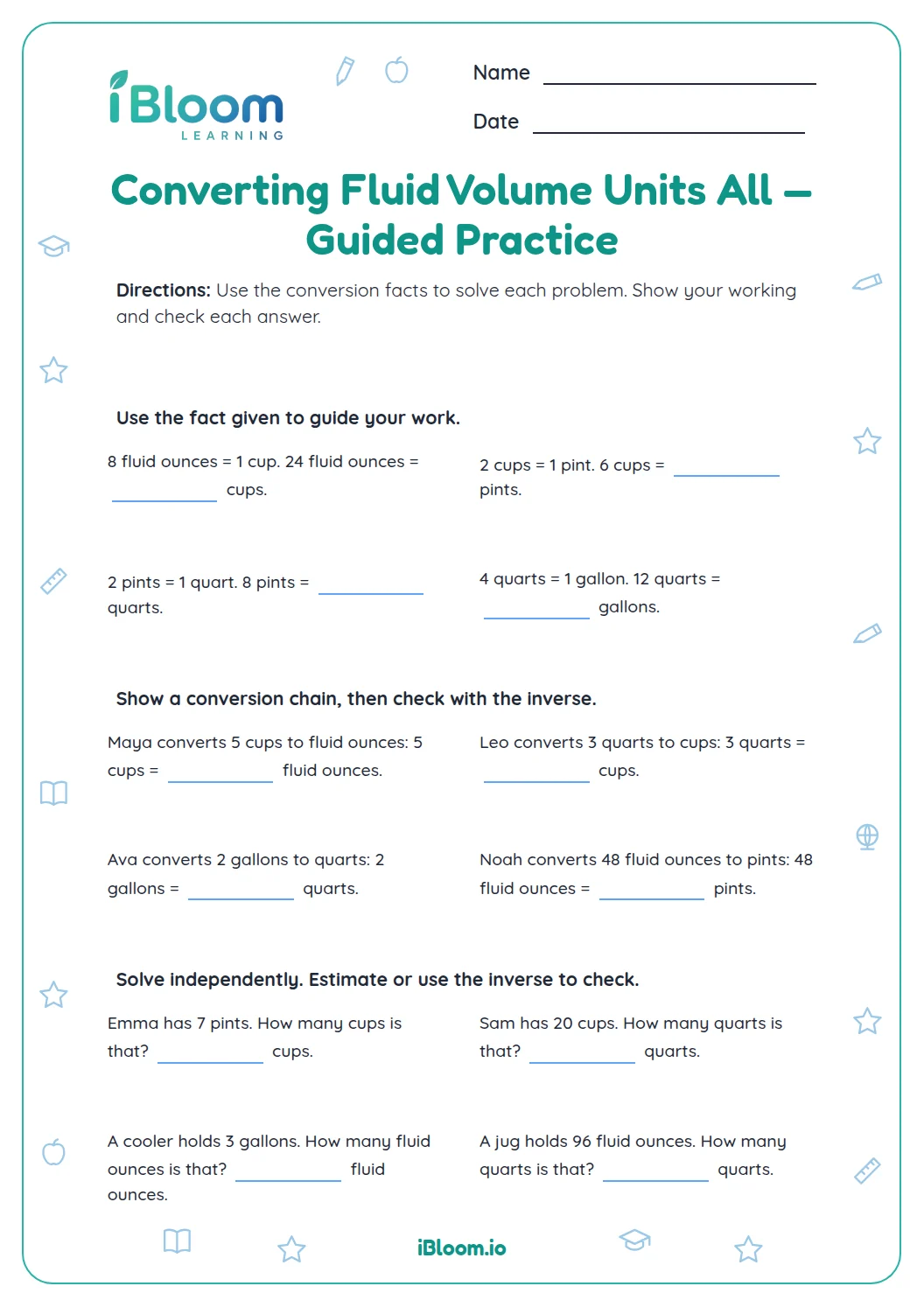
The unit chain on this sheet is 2 cups = 1 pint, 2 pints = 1 quart, and 4 quarts = 1 gallon. That also means 4 cups = 1 quart and 16 cups = 1 gallon.
For question 1, 6 cups ÷ 2 = 3 pints. For question 6, 2 gallons × 16 = 32 cups.
- 16 cups ÷ 2 cups per pint = 3 pints
- 2Check: 3 pints × 2 = 6 cups
How do students choose a unit for a story?
Use the unit named in the question as the final unit. Question 8 asks for the amount left in quarts: 2 gallons becomes 8 quarts, and 8 − 5 = 3 quarts.
For equal sharing or repeated amounts, convert first so that the arithmetic uses a single unit.
What kinds of situations are included?
The stories involve recipes, a drink dispenser, bottles, a cooler, and sharing juice. They ask for totals, amounts remaining, and equal groups. The final answer key gives a value and the requested unit for every item.
How to work through the sheet
- 1Write the unit relationship that connects the two units.
- 2Multiply when expressing a larger unit in smaller units.
- 3Divide when expressing a smaller unit in larger units.
- 4For totals or leftovers, convert every amount to the same unit first.
- 5Check that the final unit matches the question.
Common mistakes and quick fixes
The mistake
Skipping a step in the unit chain.
The fix
Move through one relationship at a time, such as pints to quarts to gallons.
The mistake
Adding cups and quarts as if they match.
The fix
Rewrite both amounts in cups or both in quarts.
The mistake
Reporting the right number with the wrong unit.
The fix
Circle the requested unit in the question before writing the answer.
Common Core alignment
This worksheet gives children practice applying the measurement and number skills described below.
Use customary volume conversions to solve grade-level problems.
On this sheet: The questions ask students to customary volume conversions in several contexts.
Show the official wordingHide the official wording
Convert among different-sized standard measurement units within a given measurement system (e.g., convert 5 cm to 0.05 m), and use these conversions in solving multi-step, real world problems.
What to practice next
Make more practice
Further reading
Questions parents and teachers ask
What volume facts are provided?
The worksheet gives 2 cups = 1 pint, 2 pints = 1 quart, and 4 quarts = 1 gallon. From these, students can find that 4 cups equal 1 quart and 16 cups equal 1 gallon. The conversion relationships are printed in the directions for quick reference.
How do I convert gallons to cups?
Use the chain from gallons to quarts and then quarts to cups, or use the equivalent fact that 1 gallon = 16 cups. For example, 2 gallons equals 32 cups because 2 × 16 = 32. This conversion can be checked by grouping the cups into sets of sixteen.
How should the dispenser problem be worked?
Convert 2 gallons to 8 quarts because one gallon equals 4 quarts. Then subtract the 5 quarts served: 8 − 5 = 3 quarts remain. Working in quarts throughout keeps the subtraction clear. The subtraction is easier to track when both values use quarts.
Why does question 5 have a decimal answer?
Four cups make one quart, so 14 cups is 3 full quarts and 2 more cups. The remaining 2 cups are half of a quart, giving 3.5 quarts. This connects a familiar fraction of a quart to decimal notation.
Is there a separate key?
Yes. The practice section is followed by an answer key. The key includes units, so students can check both the numerical conversion and whether they reported the requested measurement. Students can check the calculation and the unit together.