

About this worksheet
This Grade 5 worksheet gives students practice with build four-digit by two-digit multiplication with place value. It has 16 printed questions on two worksheet pages, followed by a two-page answer key. Students work through 2 sections, using the printed numbers and equations on the student pages. The answer key provides the results for checking each item. The problems practice CCSS 5.NBT.B.5, as described in the curriculum alignment below.
Aligned to CCSS.MATH.CONTENT.5.NBT.B.5
How does the standard algorithm organize multiplication?
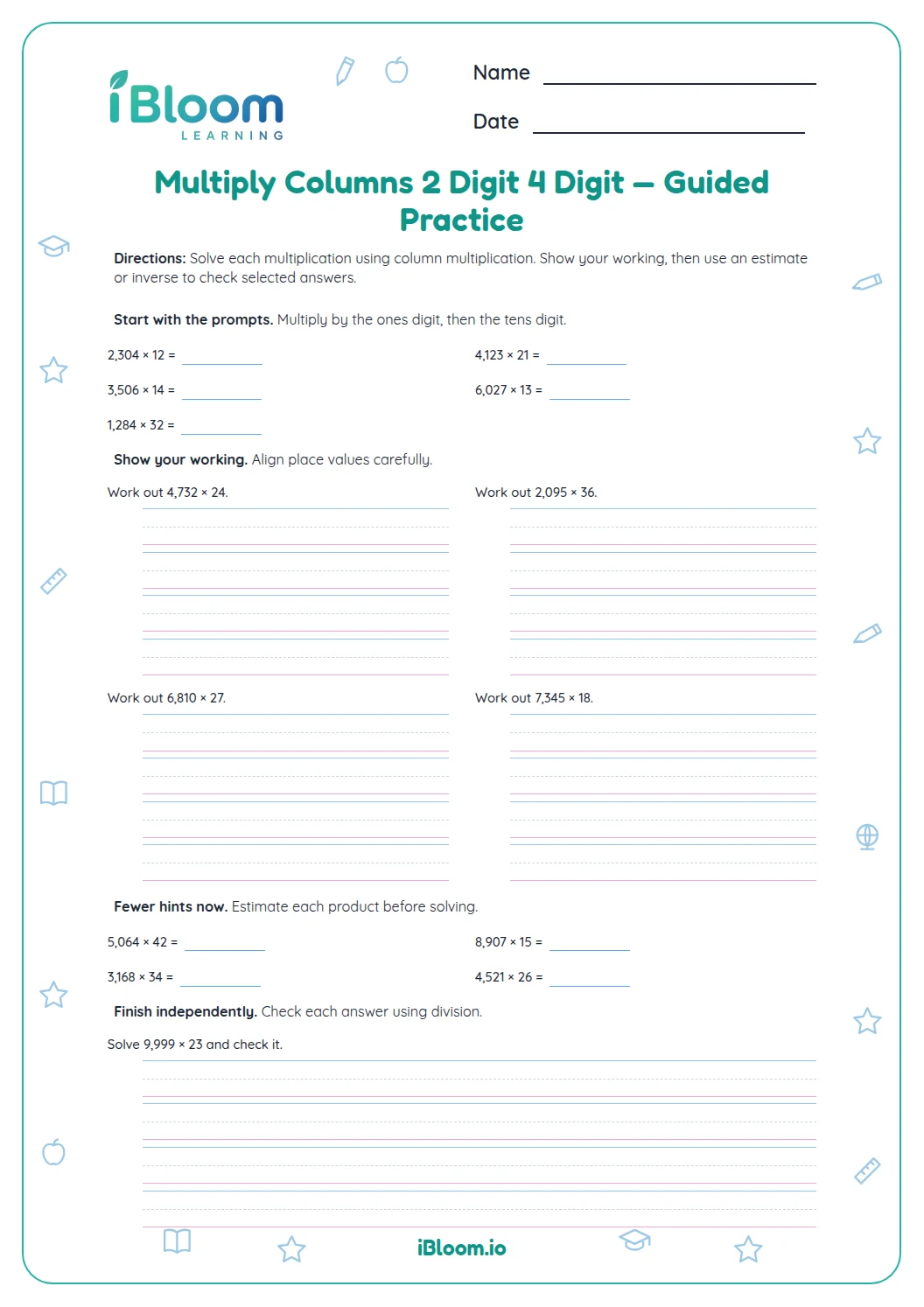
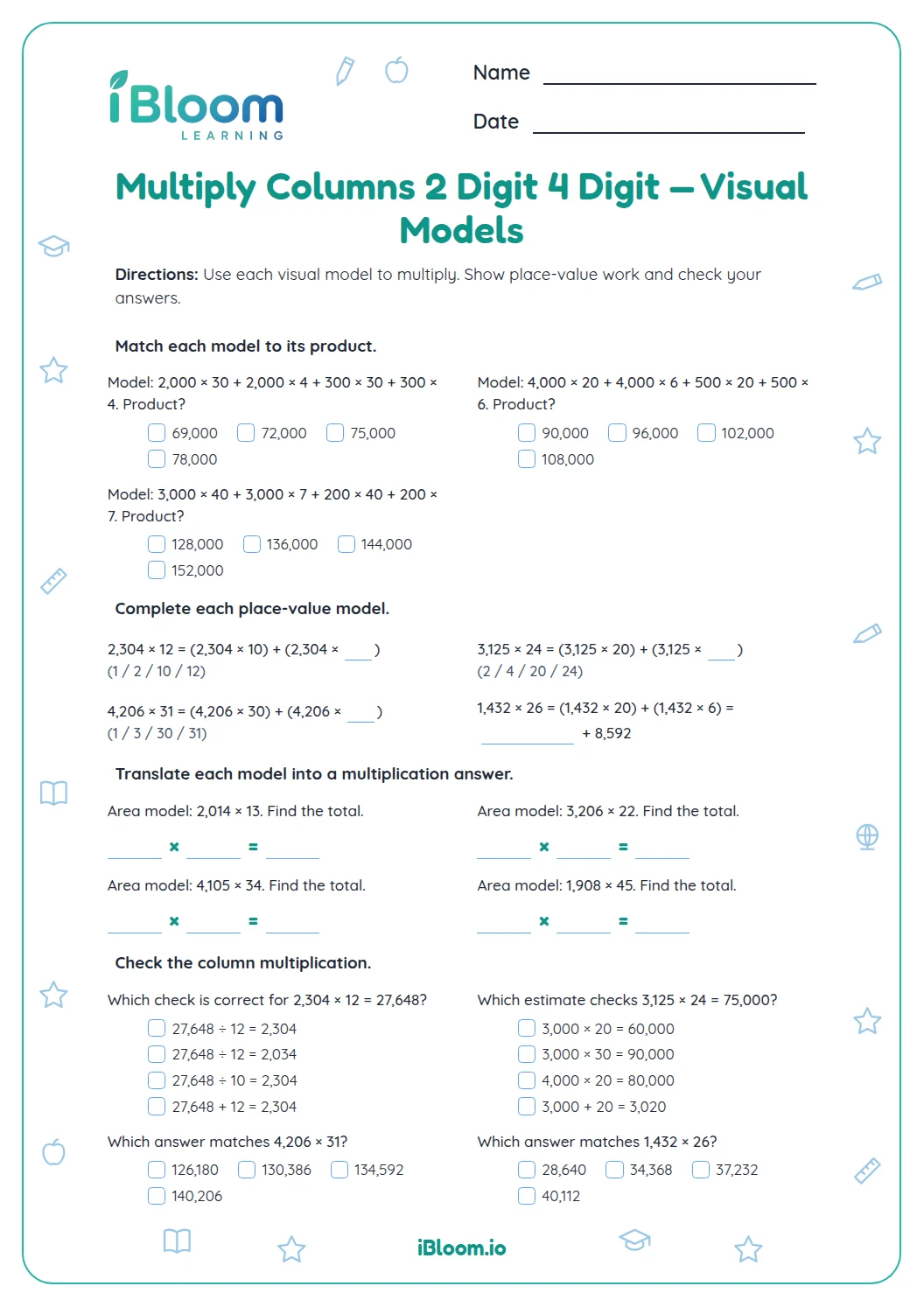
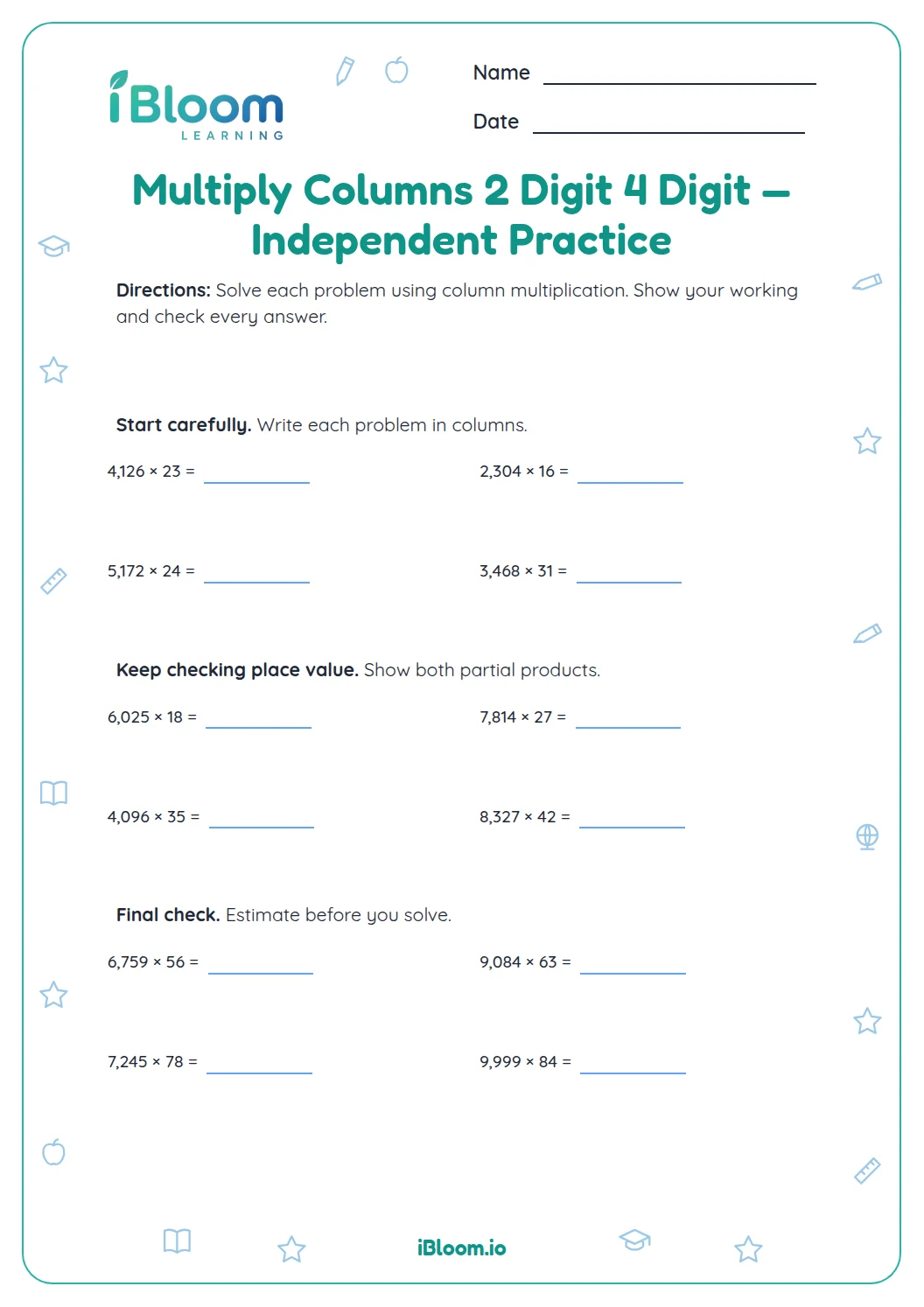
Multiply each digit in the two-digit factor by the four-digit factor, keeping place values aligned. The first eight items provide products to calculate; the next four ask students to use the distributive property.
Where does multiplication appear in the story problems?
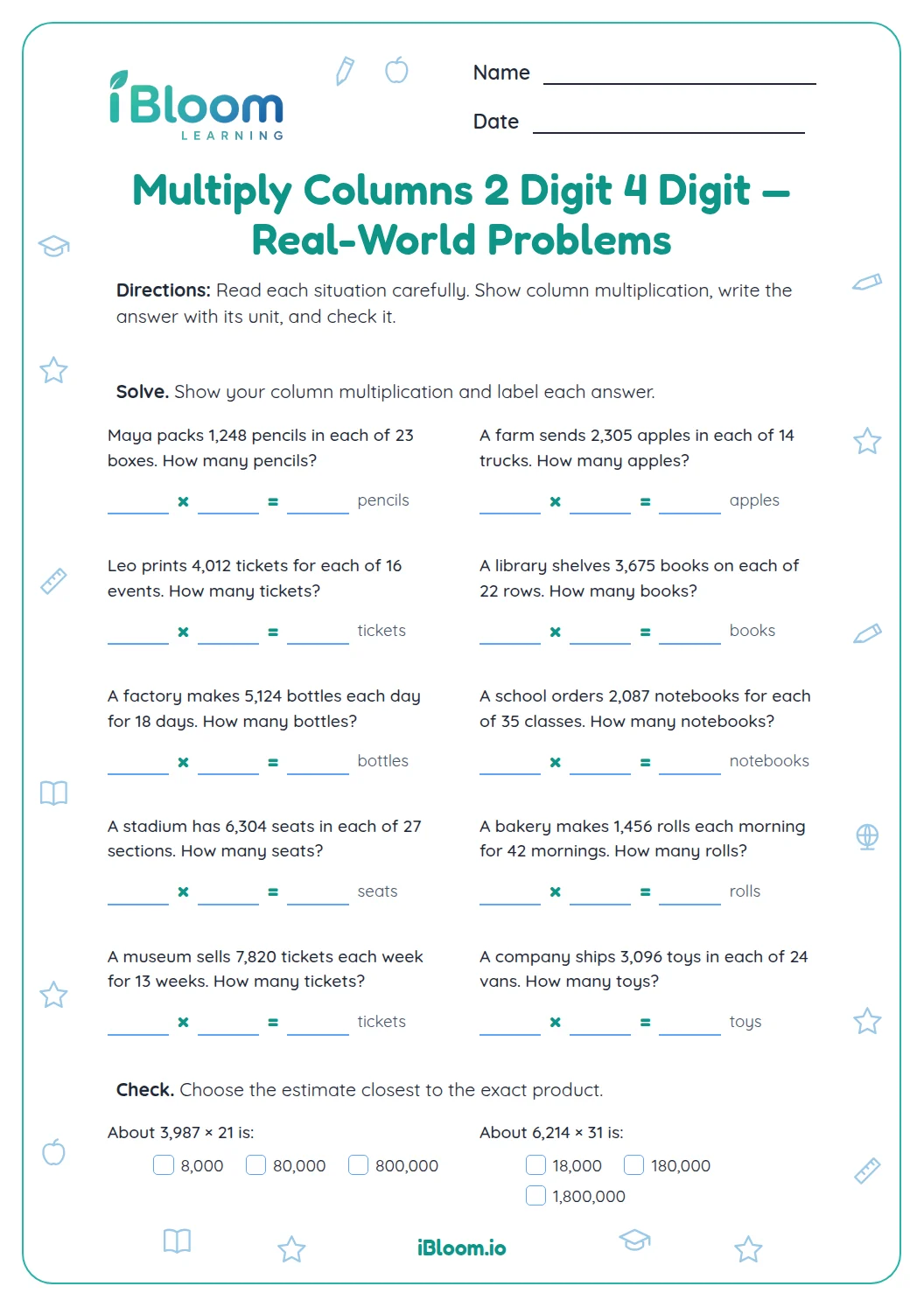
The printer and stadium questions describe equal groups. Multiply the amount in one group by the number of groups to find the total.
How can students check a large product?
Estimate by rounding one or both factors, then compare the estimate with the exact product. Students can also add the partial products to check the total.
How to work through the sheet
- 1Read the section direction before beginning its problems.
- 2Copy or use the numbers printed in each question.
- 3Show calculation steps in the working space when provided.
- 4Check the result against the answer key after solving.
Check your work
The mistake
Forgetting place value or sign rules while calculating.
The fix
Write each step clearly, then estimate or use the inverse operation to check.
Curriculum alignment
This worksheet practices the named grade-level skill.
Fluently multiply multi-digit whole numbers using the standard algorithm.
On this sheet:
Show the official wordingHide the official wording
Fluently multiply multi-digit whole numbers using the standard algorithm.
What to practice next
Questions parents and teachers ask
What is a partial product?
A partial product is the product of one place-value part of a factor. For 1,243 × 12, students can find 1,243 × 10 and 1,243 × 2, then add those two results to get the full product. Use the printed factors and directions to guide each step, then compare the result with the answer key.
Why does the tens row shift in column multiplication?
The tens digit represents groups of ten, so its partial product is ten times the digit product. Align that row one place to the left, or use a zero placeholder, before adding the partial products. Use the printed factors and directions to guide each step, then compare the result with the answer key.
How can a student check a large product?
Estimate using nearby easy numbers and see whether the exact product is reasonable. For example, 1,248 × 12 is close to 1,200 × 12, or 14,400. The student can also recompute with partial products. Use the printed factors and directions to guide each step, then compare the result with the answer key.
What standard does this worksheet practice?
It practices CCSS 5.NBT.B.5: fluently multiplying multi-digit whole numbers with the standard algorithm. The printed questions use four-digit and two-digit whole-number factors and include column and distributive-property work. Use the printed factors and directions to guide each step, then compare the result with the answer key.
What is in the answer key?
The key lists the answer to each of the 16 printed questions, including the products in the story problems and the missing-factor expansion. Students can compare their calculations after completing the two worksheet pages. Use the printed factors and directions to guide each step, then compare the result with the answer key.