




About this worksheet
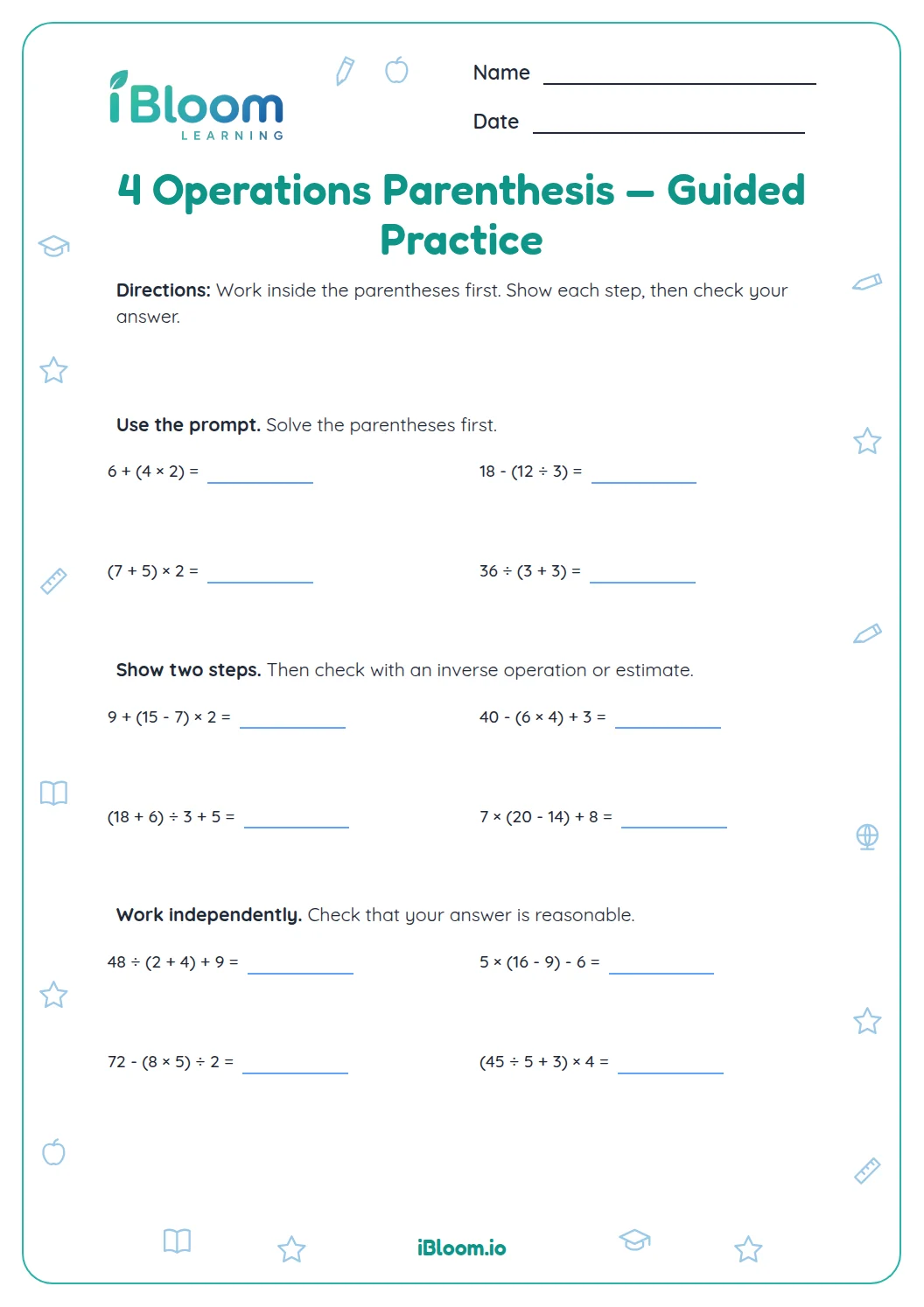
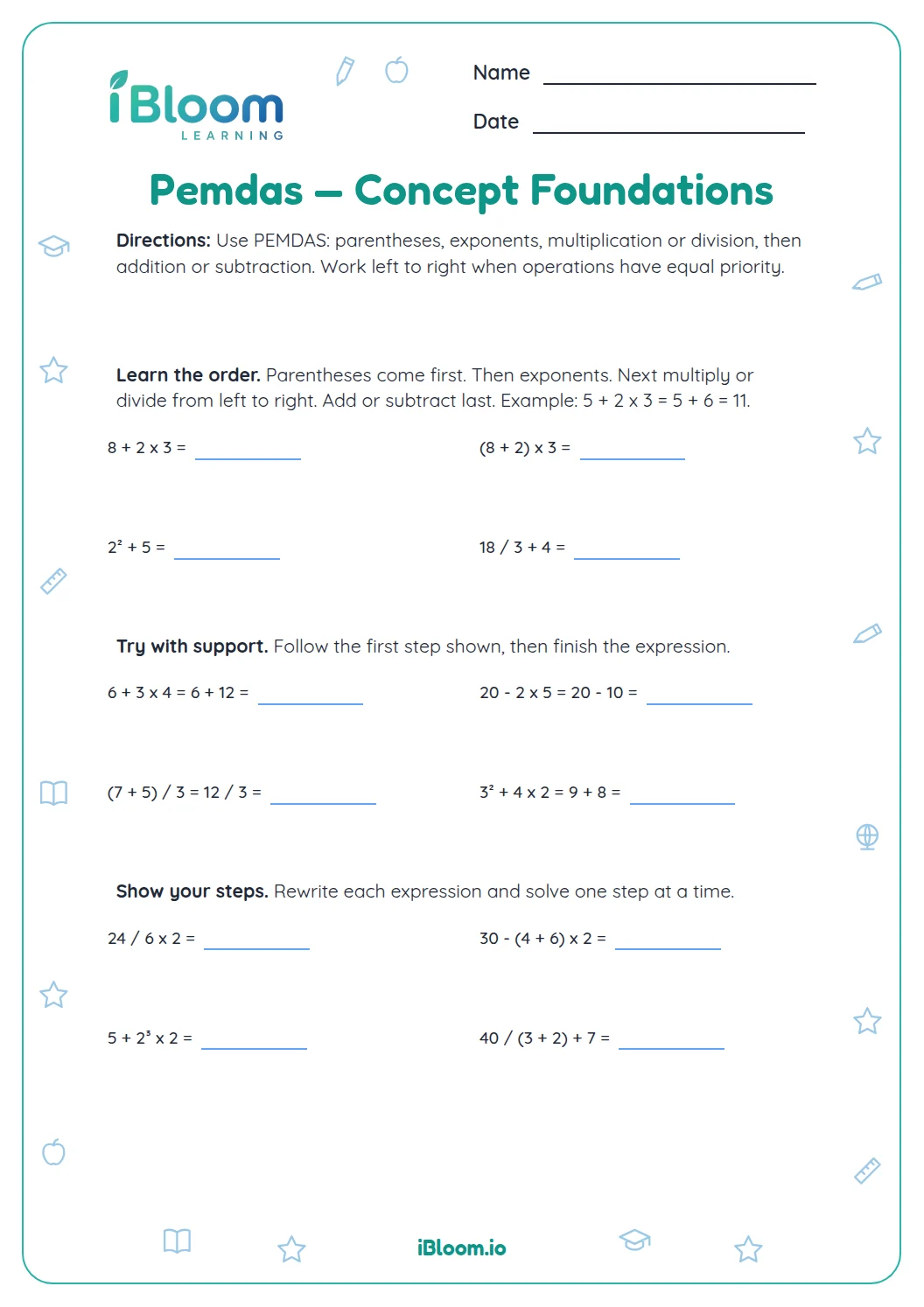
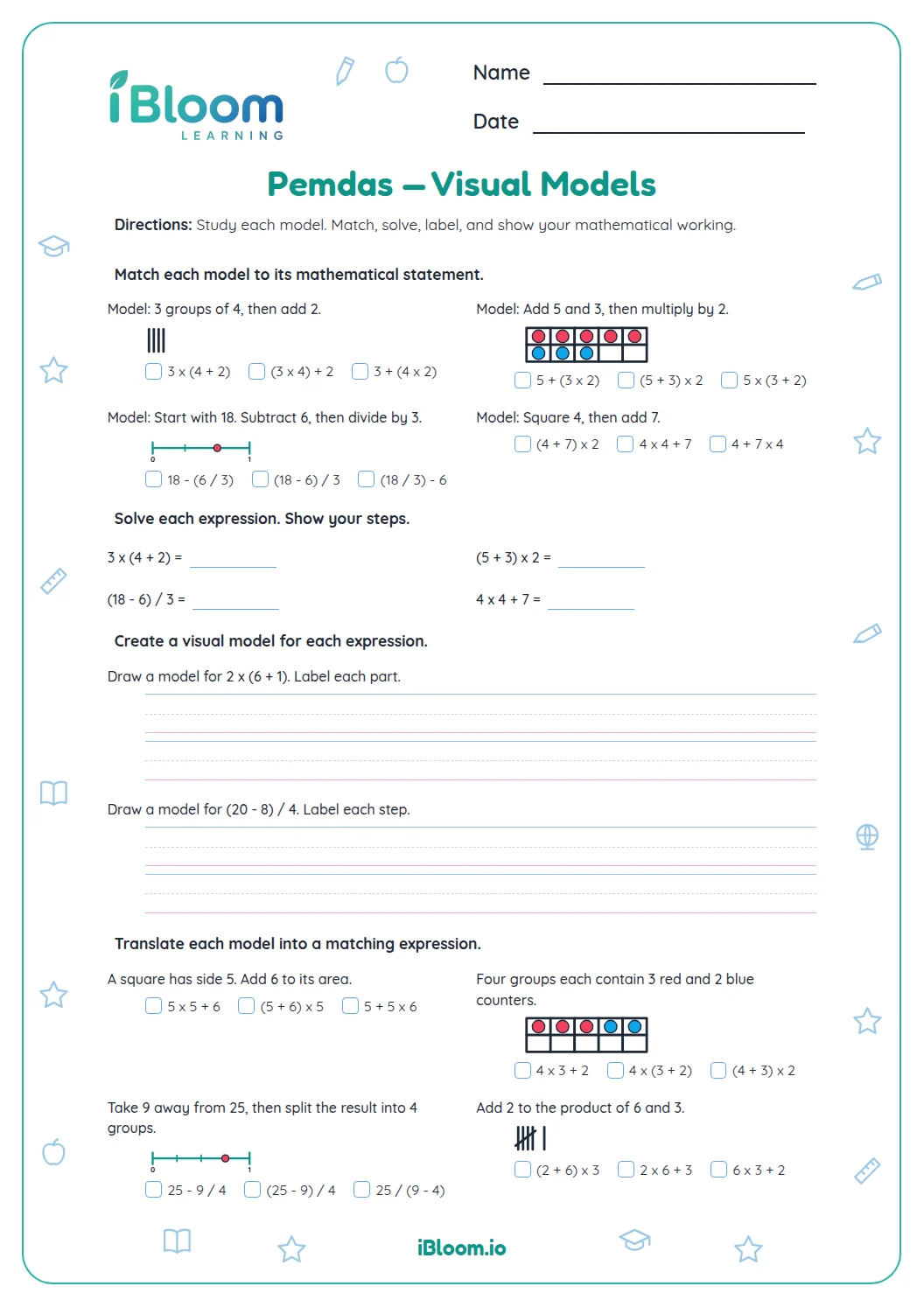
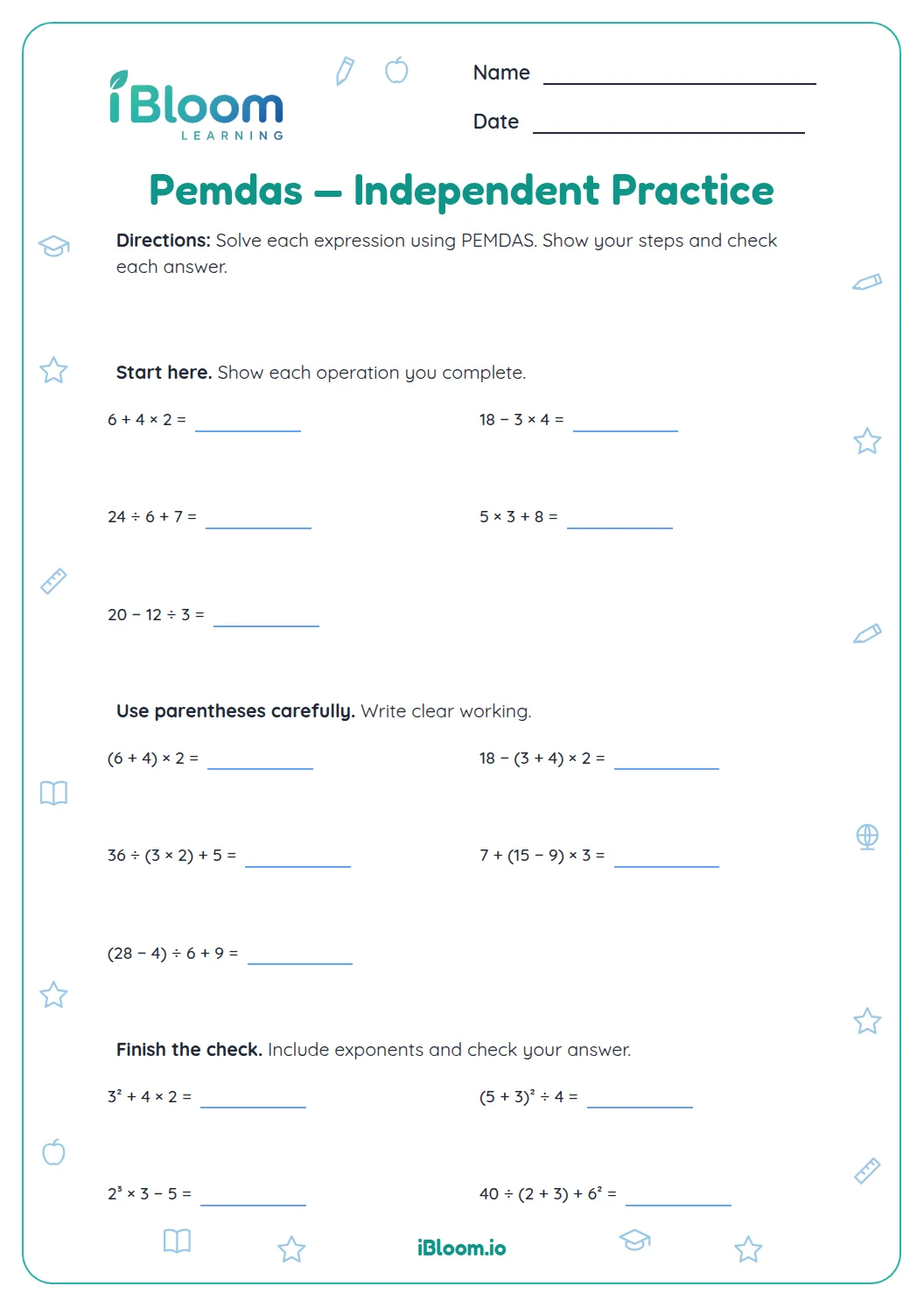
This Grade 5 worksheet connects order of operations to short situations about supplies, games, food, and groups. Students evaluate expressions with all four operations, then work with parentheses to show which quantities belong together. The 16 questions provide space for calculations and a separate answer key. It practices CCSS 5.OA.A.1 through numerical expressions using parentheses.
Aligned to 5.OA.A.1
What is the order of operations?
Work inside parentheses first when they appear. Then multiply and divide from left to right, and finally add and subtract from left to right. Multiplication does not automatically come before division, and addition does not automatically come before subtraction.
Question 1 is 4 × 6 + 5. Multiply first: 4 × 6 = 24; then add 5 to get 29.
- 14 × 6 + 5
- 24 × 6 = 24
- 324 + 5 = 29
What do parentheses change?
Parentheses tell students to treat a group as one part of the expression. In question 13, 3 × (7 + 2) means add 7 and 2 first, then multiply the result by 3.
Without parentheses, 3 × 7 + 2 would be evaluated differently. The expression’s grouping controls the calculation.
How do stories connect to expressions?
A story describes actions such as making equal groups, adding more, or taking items away. Students use the expression printed in each question and apply the order rules to evaluate it. The answer key gives the numerical result for all 16 problems.
How to work through the sheet
- 1Read the whole expression before calculating.
- 2Complete the parentheses first.
- 3Multiply and divide from left to right.
- 4Add and subtract from left to right.
- 5Compare the expression with the story to check that the grouping makes sense.
Common mistakes and quick fixes
The mistake
Calculating strictly left to right.
The fix
Pause at multiplication and division before doing addition or subtraction.
The mistake
Doing addition before multiplication.
The fix
Evaluate multiplication and division first unless parentheses change the grouping.
The mistake
Ignoring parentheses.
The fix
Circle the grouped operation and evaluate it before the rest of the expression.
Common Core alignment
This worksheet gives children practice applying the measurement and number skills described below.
Evaluate numerical expressions with parentheses and the four operations.
On this sheet: Students evaluate numerical expressions, including expressions with parentheses.
Show the official wordingHide the official wording
Use parentheses, brackets, or braces in numerical expressions, and evaluate expressions with these symbols.
What to practice next
Make more practice
Further reading
Questions parents and teachers ask
What does PEMDAS mean for these questions?
It is a reminder to evaluate parentheses first, then multiplication and division from left to right, and then addition and subtraction from left to right. The left-to-right rule matters: multiplication and division share a level, as do addition and subtraction.
How is question 1 evaluated?
The expression is 4 × 6 + 5. Multiply 4 by 6 to get 24, then add 5. The result is 29 markers. This order follows multiplication before addition. The units in the story provide a quick check on the result.
Why are parentheses used in some expressions?
Parentheses group a quantity that should be evaluated together. In 3 × (7 + 2), students add the 7 snacks and 2 drinks first, then multiply the 9 items by 3 bags. The expression’s grouping controls the calculation.
Do students need to write their own expressions?
Each question already provides the numerical expression so students can focus on evaluating it accurately. They should still connect the expression to the story and show their work in the available answer space. The focus is accurate evaluation and showing a clear calculation.
Does the sheet include division and subtraction?
Yes. The set uses addition, subtraction, multiplication, and division in multi-step expressions, including examples with and without parentheses. Students can use the same operation order across the entire worksheet. Both operations appear in multi-step problems throughout the set.