

About this worksheet
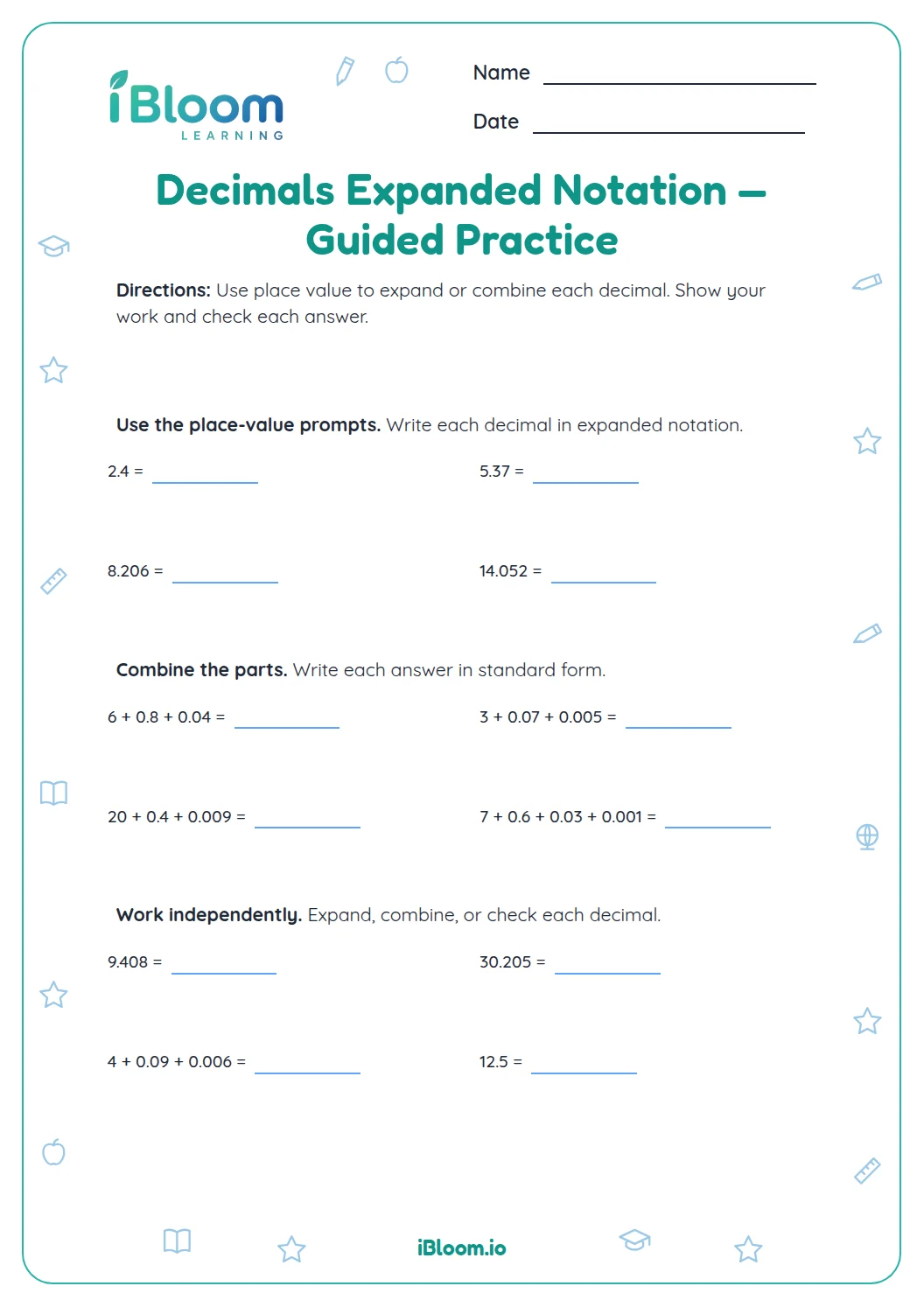
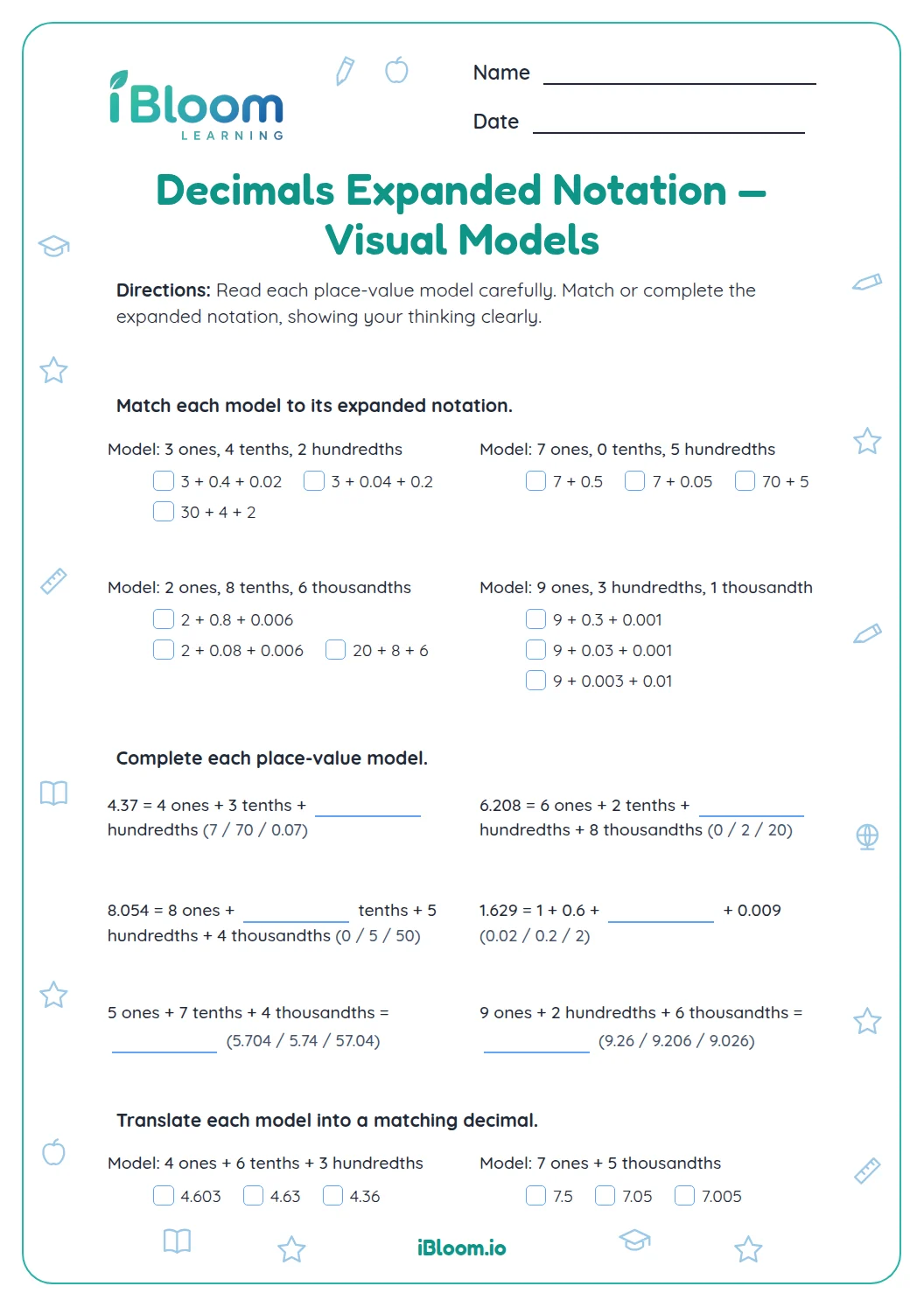
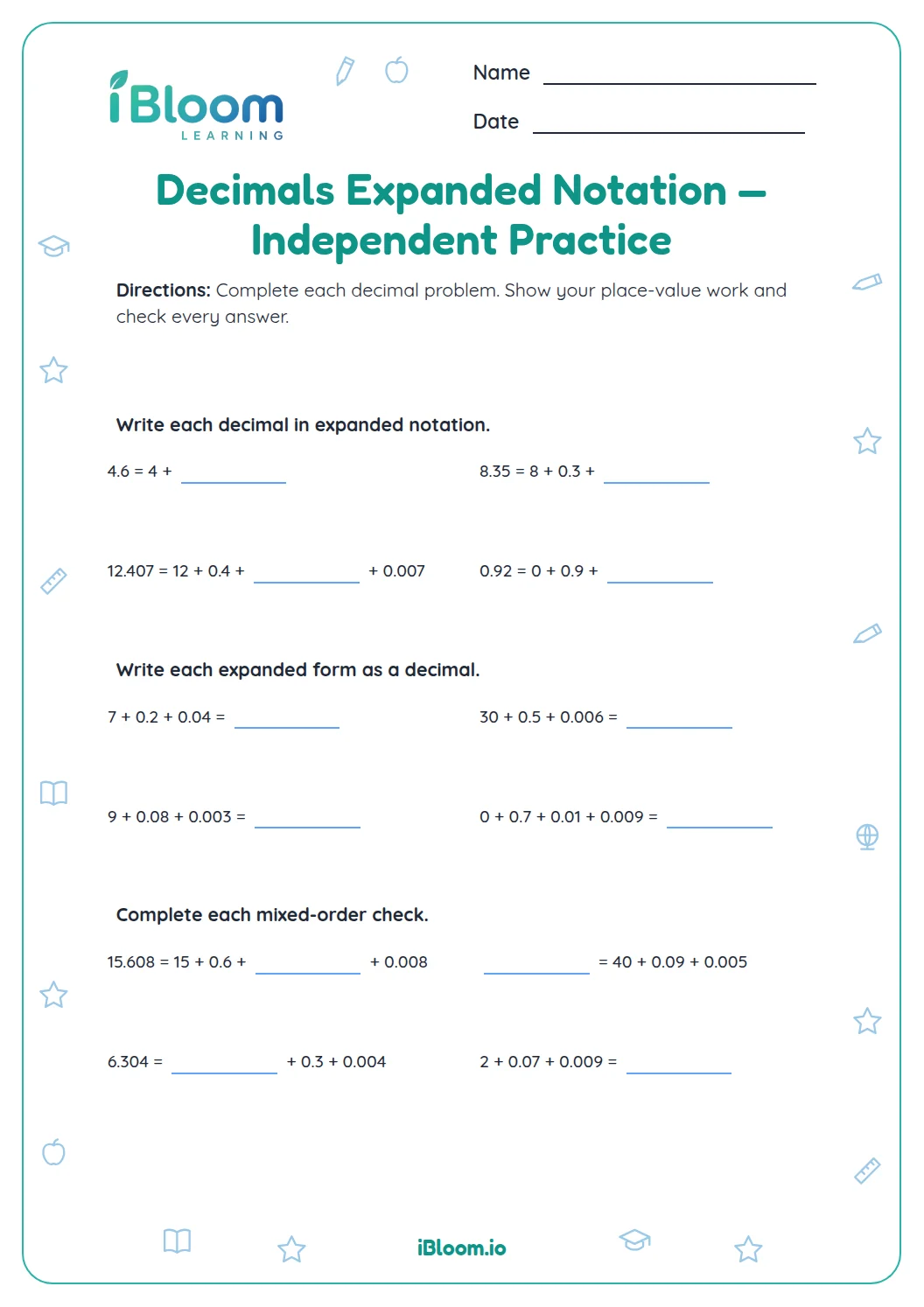
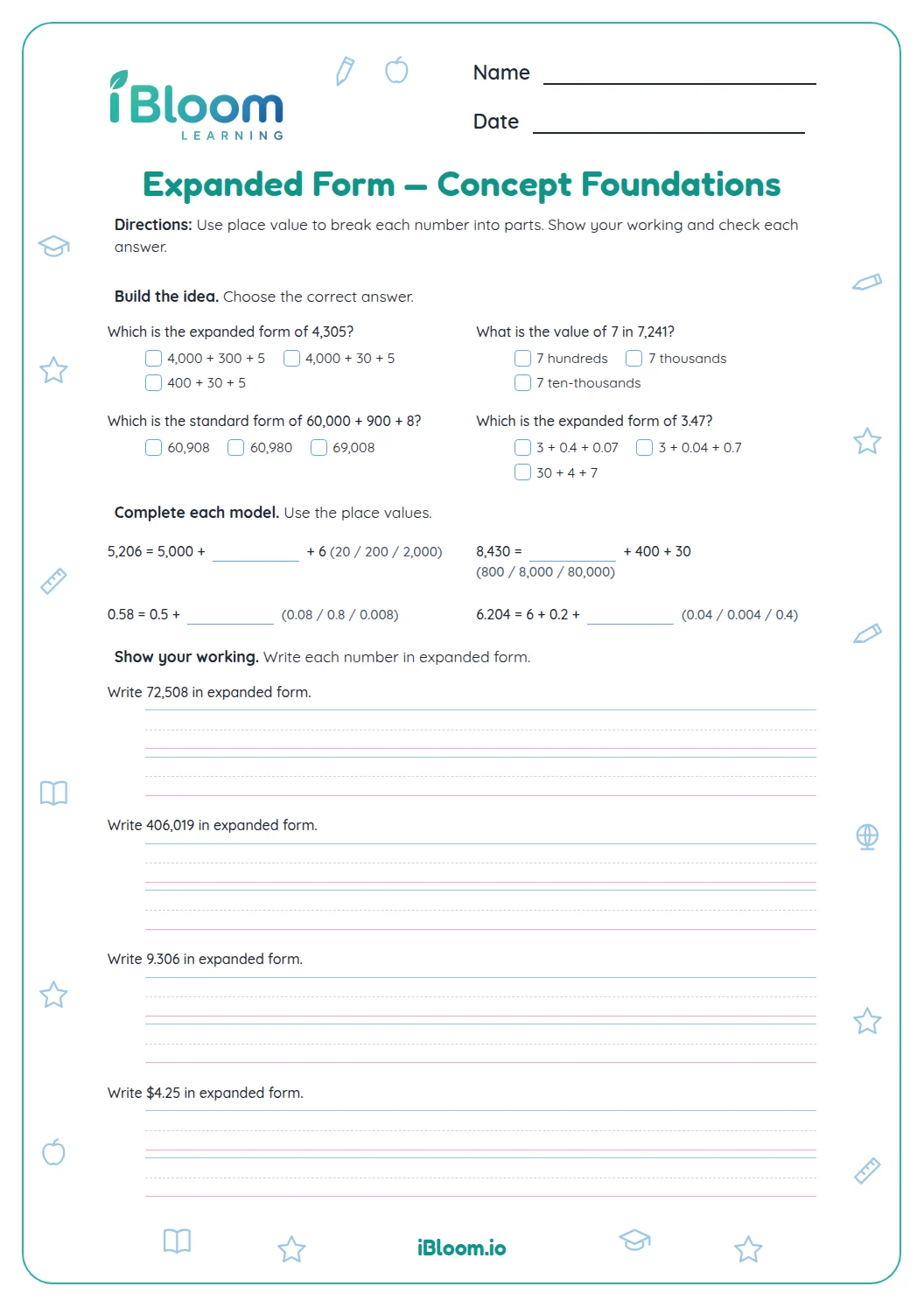
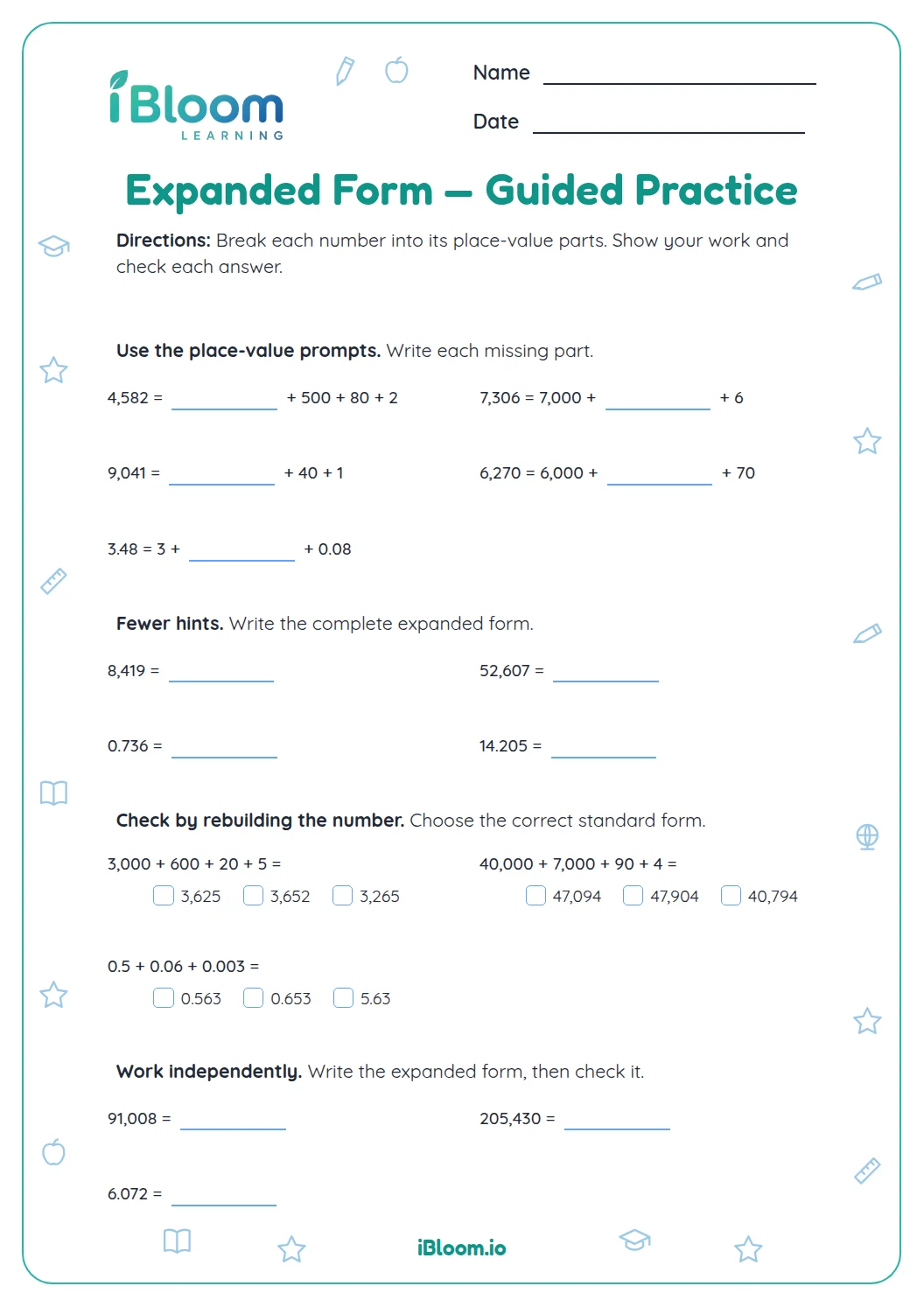
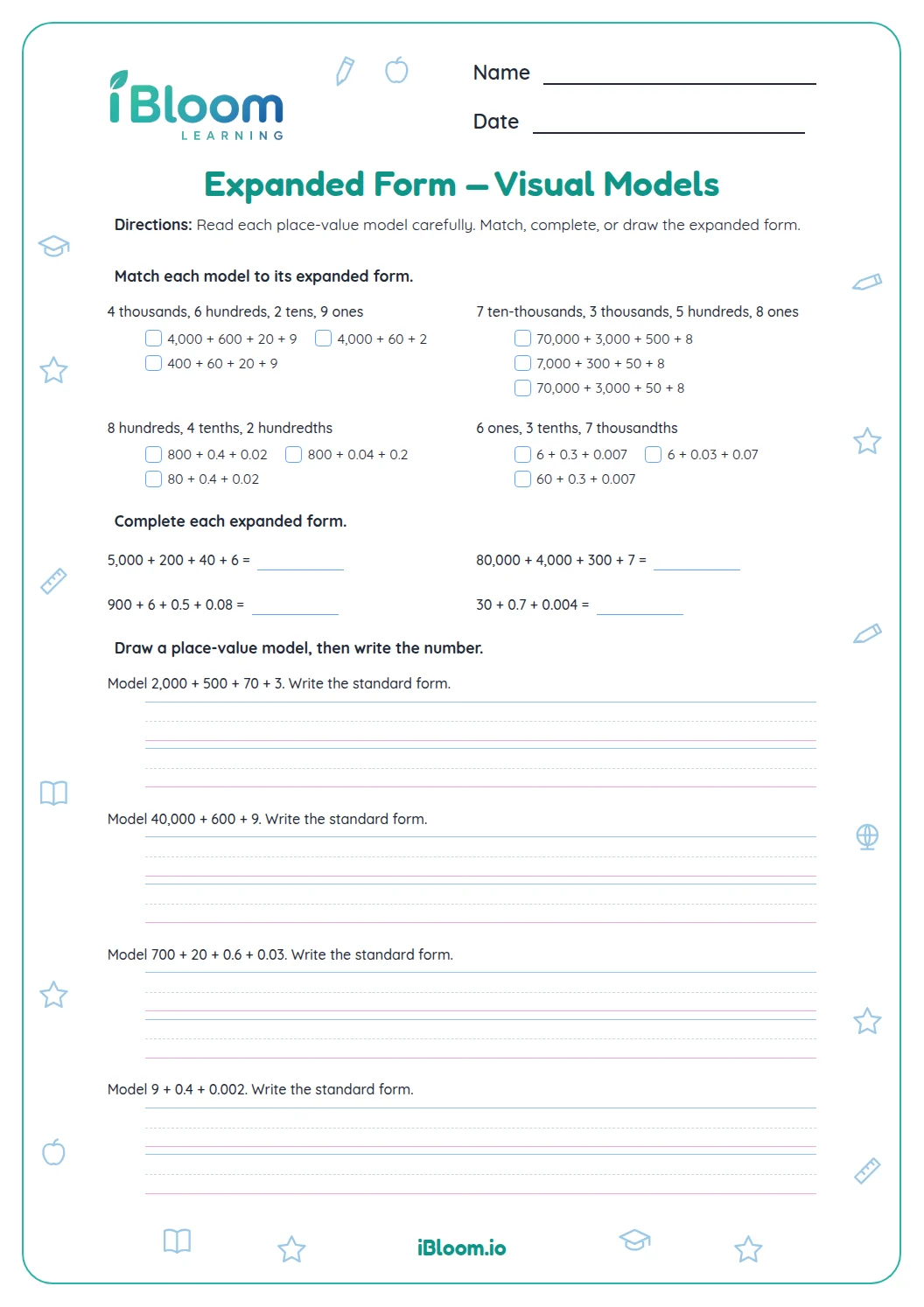
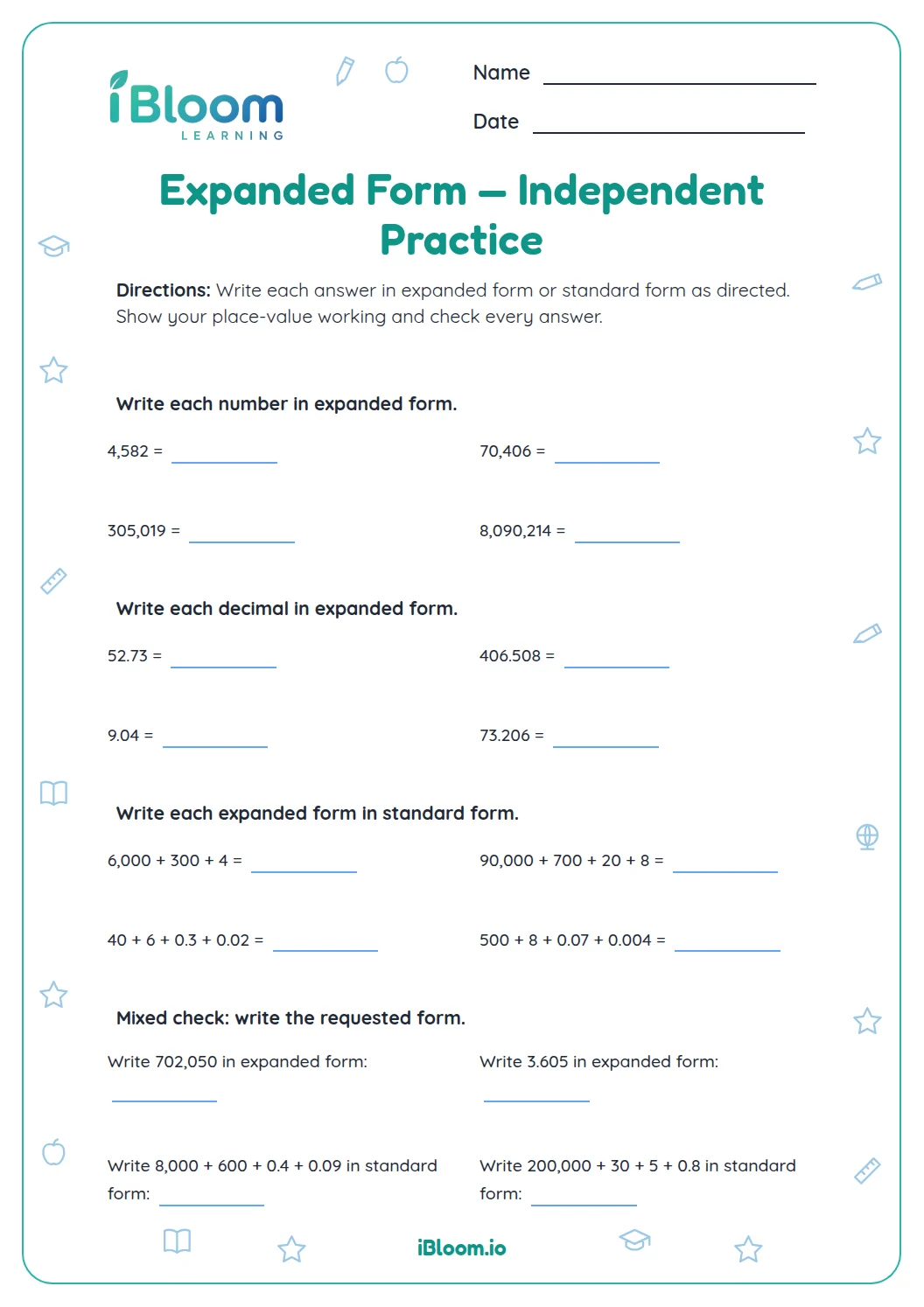
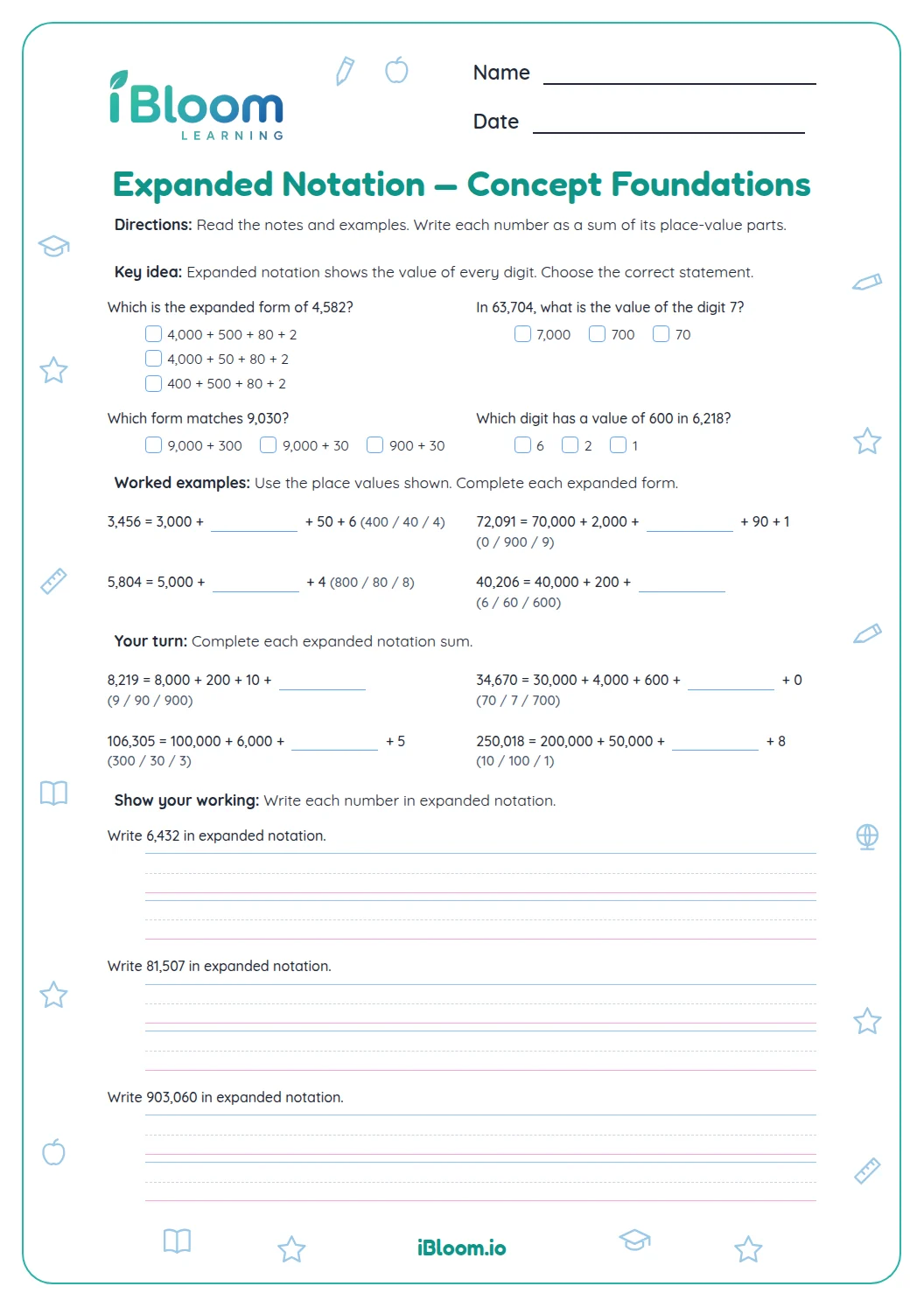
This Grade 5 worksheet builds decimal place-value understanding through expanded form. Students name tenths, hundredths, and thousandths, write each nonzero digit as an addend, and convert between expanded and standard form. For example, 7.35 = 7 + 0.3 + 0.05.
How do decimal places determine each addend?
The first digit to the right of the decimal is tenths, the second is hundredths, and the third is thousandths. In 7.35, 3 tenths is 0.3 and 5 hundredths is 0.05.
The addends must keep their place values; 0.3 + 0.05 is not the same as 0.03 + 0.5.
- 17.35 = 7 + 0.3 + 0.05
- 23 is in the tenths place
- 35 is in the hundredths place
Why can a zero appear in the middle of a decimal?
A zero holds a place even when that place contributes no addend. In 8.406, there are 4 tenths, 0 hundredths, and 6 thousandths, so the expanded form is 8 + 0.4 + 0.006.
What will students practice?
Sixteen questions move from building expanded forms to naming digit values and converting in both directions.
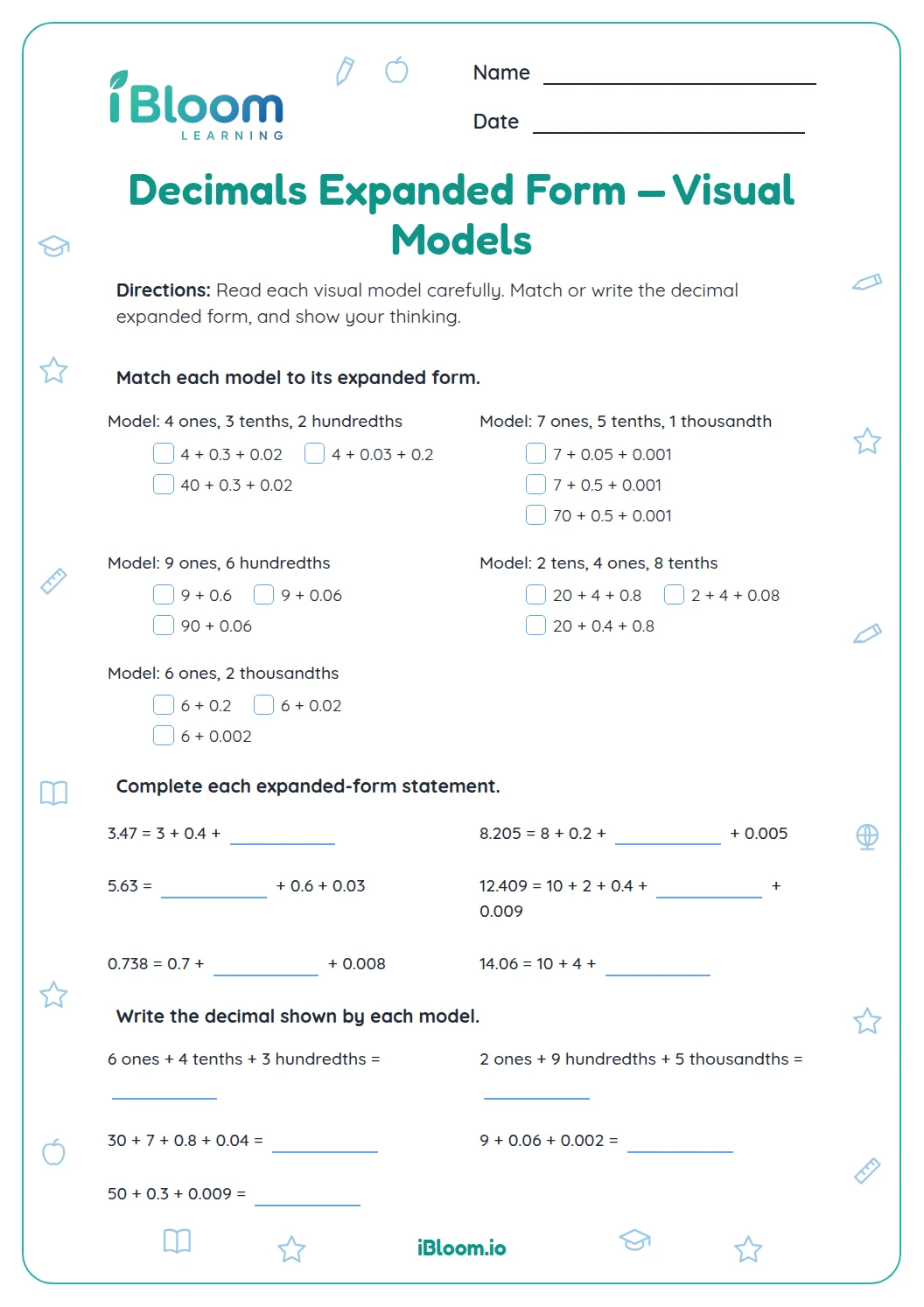
- Part A: six equations with separate missing addends
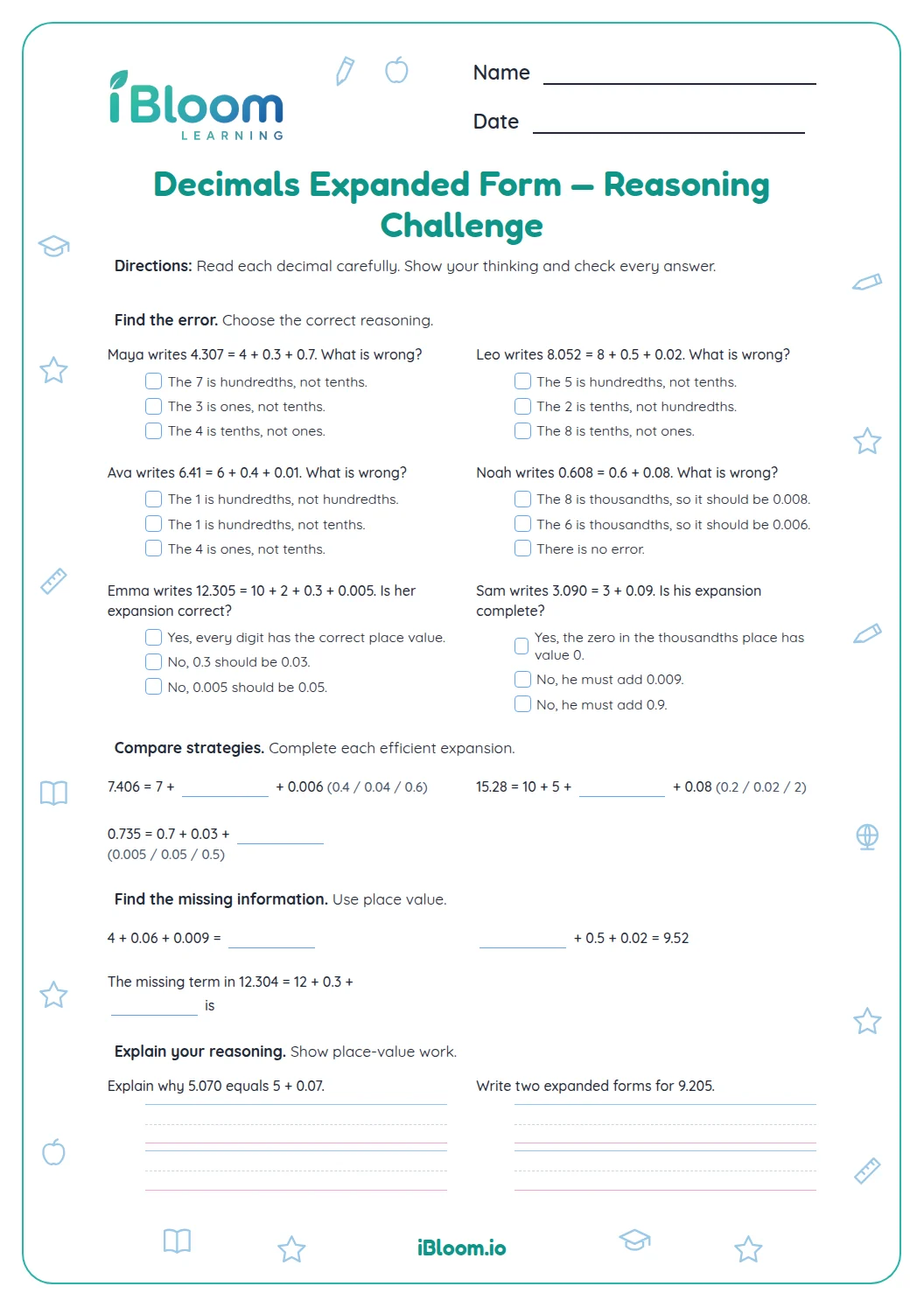
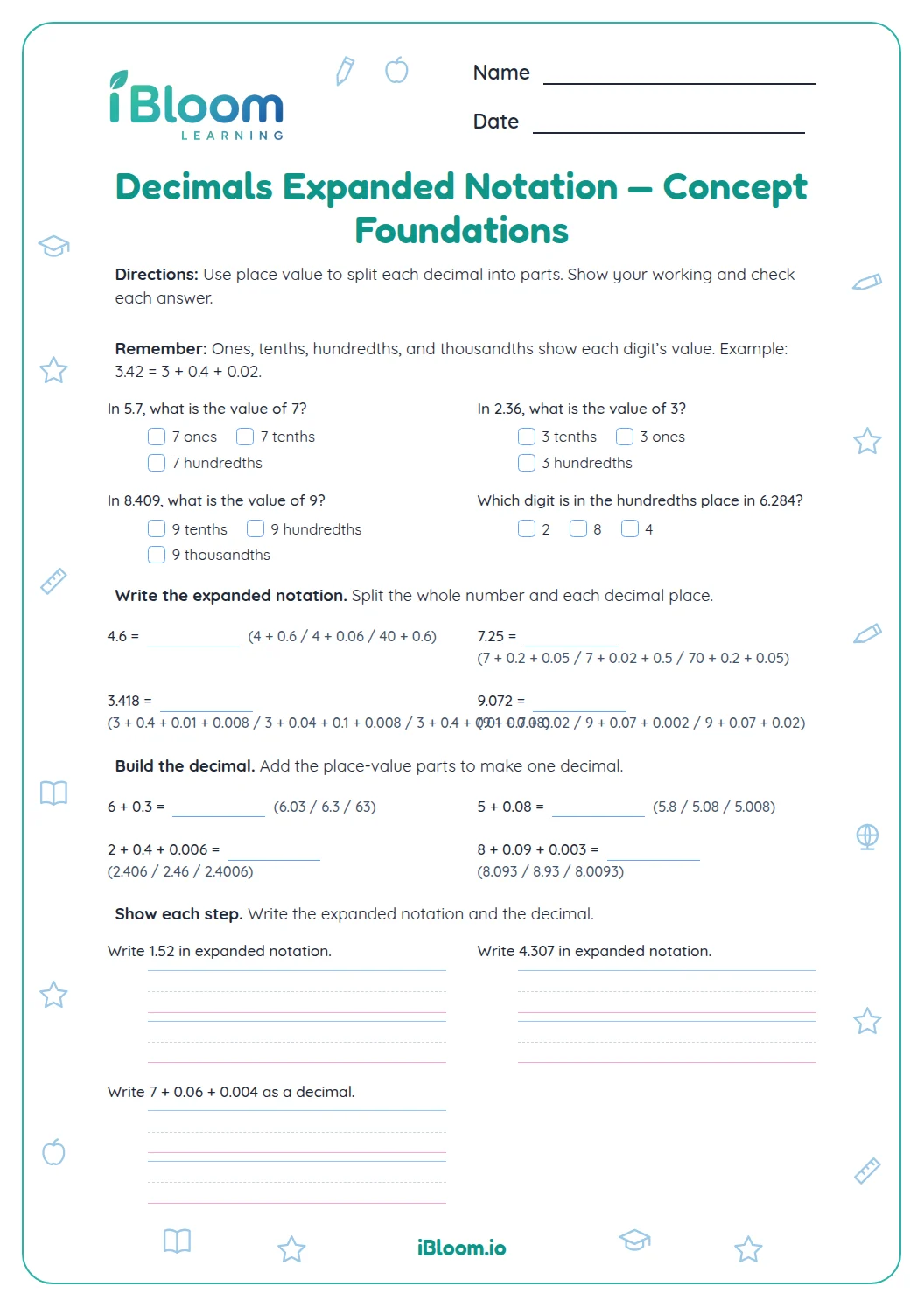
- Part B: five place-value multiple-choice questions
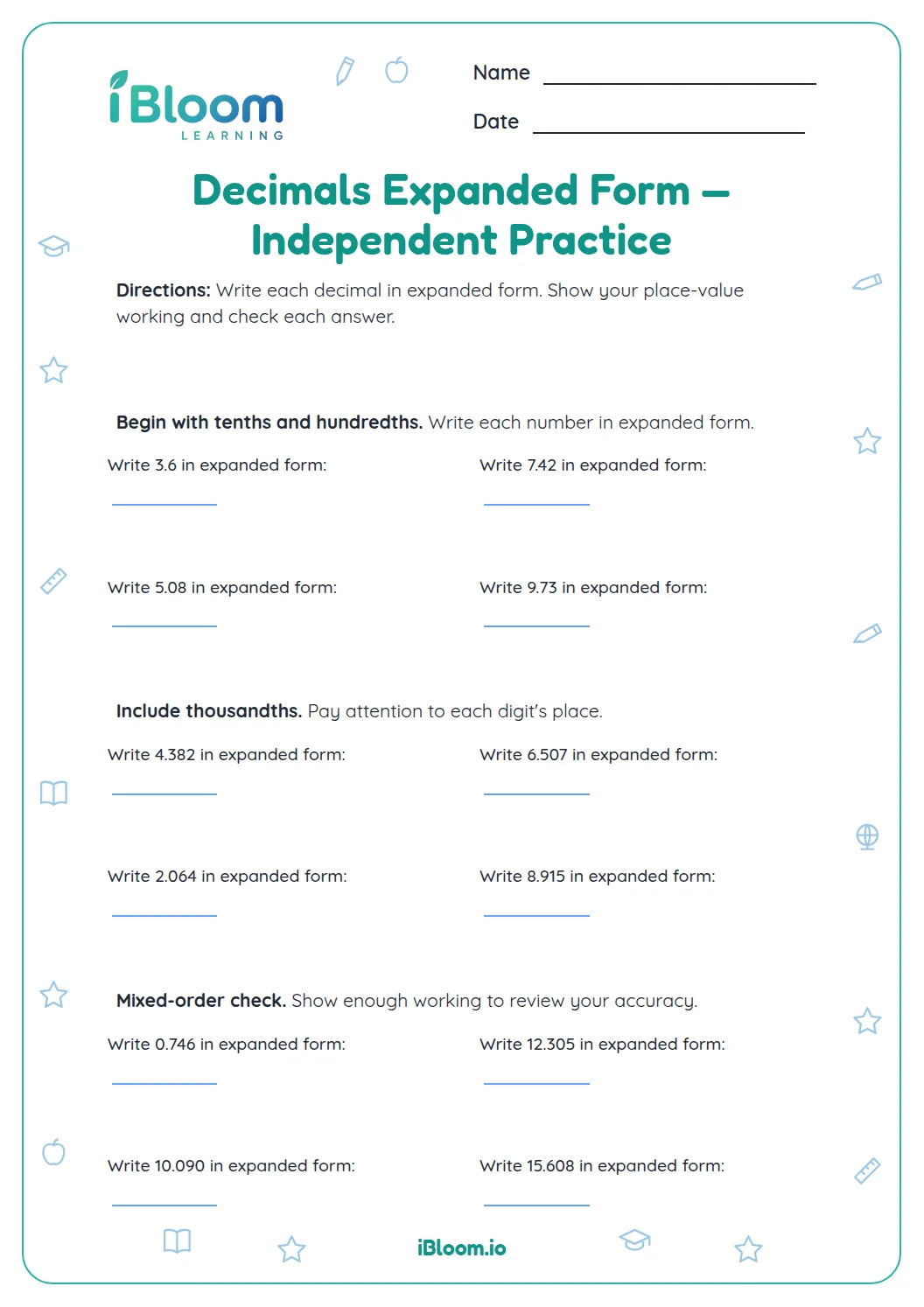
- Part C: five written conversions and a correction
How can students check an expanded form?
Add the parts and compare the sum with the original decimal. Also check that each digit’s value matches its place before adding.
How to use this worksheet at home or in class
- 1Review the places to the right of the decimal: tenths, hundredths, thousandths.
- 2Read each digit’s place before writing its value.
- 3Fill each blank with only the addend belonging in that place.
- 4For multiple choice, identify the place first, then choose the digit or value.
- 5Add the expanded parts to check the original decimal.
Common mistakes and quick fixes
The mistake
Writing the digit rather than its place value.
The fix
In 7.35, the 3 represents 0.3, not 3.
The mistake
Switching tenths and hundredths.
The fix
Tenths are one place right of the decimal; hundredths are two places right.
The mistake
Dropping a zero that holds a place.
The fix
Keep the zero in standard form, as in 8.406, even though its place adds no amount.
What to practice next
Make more practice
Questions parents and teachers ask
How do you write a decimal in expanded form?
Write each nonzero digit as an addend that names its place value. For 7.35, the 3 represents 0.3 and the 5 represents 0.05, so the expanded form is 7 + 0.3 + 0.05. Add the parts to check the result.
What is the difference between 0.3 and 0.03?
0.3 is three tenths, while 0.03 is three hundredths. A digit one place farther to the right has one tenth the value. Part B asks students to identify decimal digit values so the position of each digit stays clear. In 8.219, the final digit 9 is in the thousandths place, while 2 is tenths and 1 is hundredths.
Why does 8.406 have a zero in the middle?
The zero holds the hundredths place, so the 6 remains in the thousandths place. The number is eight and four hundred six thousandths, or 8 + 0.4 + 0.006 in expanded form. The number keeps that zero in standard form; its expanded form can omit a zero addend because zero contributes no value.
How many questions are included?
There are 16 questions in three parts: six expanded-form equations, five place-value choices, and five conversions or corrections. Students use both standard and expanded notation with tenths, hundredths, and thousandths. The sequence moves from filling separate addend blanks to identifying place values and writing equivalent decimal forms.
How can students check an expanded form?
Add the parts and compare the sum with the original decimal. Then confirm that each digit’s value matches its place. For example, 0.3 + 0.05 equals 0.35, the decimal part of 7.35. This checks both arithmetic and place value. This final check can catch a misplaced digit before the answer is finished. This check works for each item.