



About this worksheet
This Grade 5 worksheet uses visual models to represent whole-number division. Students count equal jumps on number lines and solve equal-group situations involving teams, boxes, lengths, and collections. For example, a line from 0 to 36 in jumps of 4 has 9 jumps.
How does a number line model division?
Count equal jumps until the line reaches the total. If each jump is 4 and the line ends at 36, nine jumps are needed because 9 × 4 = 36.
The prompt names both the total and jump size, so the quotient is the number of jumps.
- 1Total: 36
- 2Jump size: 4
- 336 ÷ 4 = 9 jumps
What does an array show?
Rows of equal size represent groups. Six rows of 7 make 42, so 42 ÷ 7 = 6. Multiplication checks the result: 6 × 7 = 42.
What is on the worksheet?
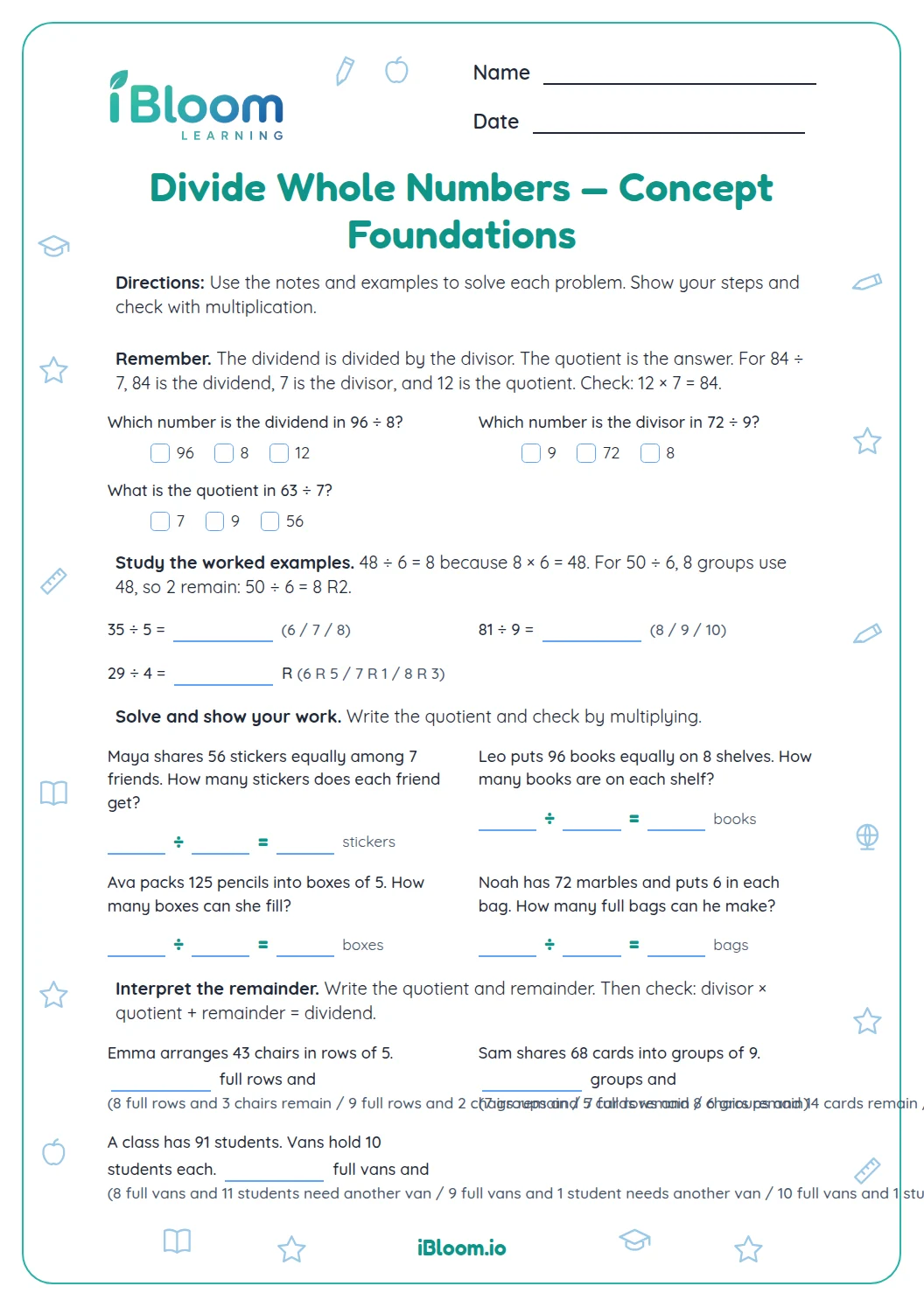
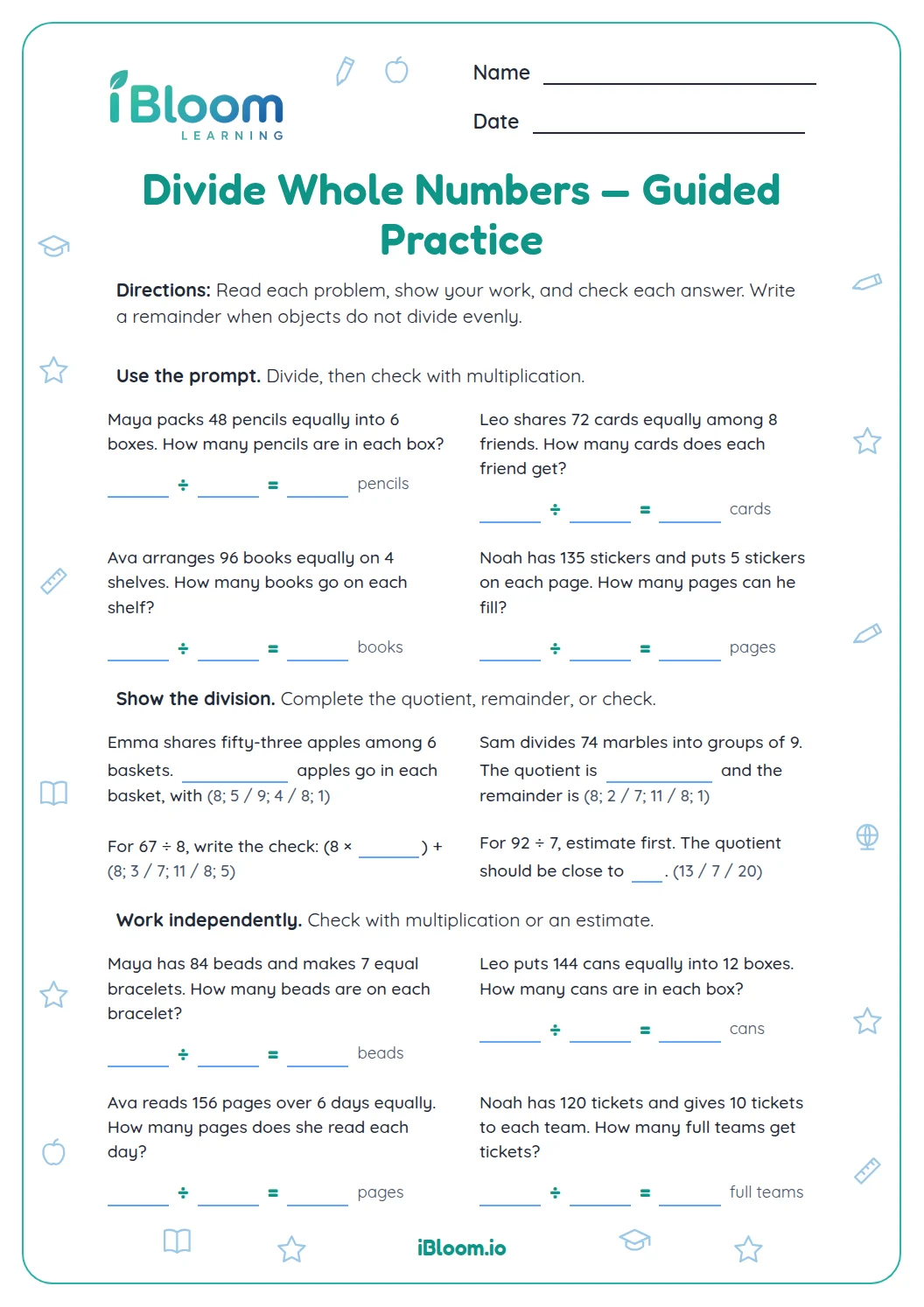
The 16 questions appear in three parts. Six include a drawn number line or array, six use short division contexts, and four return to a drawn model.
- Part A: six number-line and array questions
- Part B: six equal-group word problems
- Part C: four additional model-reading problems
How can multiplication check a division answer?
Multiply the number of groups by the size of each group. The product should match the total. If it does not, recount the jumps or rows and revise the quotient.
How to use this worksheet at home or in class
- 1Read the total and group size aloud before counting.
- 2On number lines, count each interval once and stop at the endpoint.
- 3For arrays, use the number of rows as groups and dots per row as group size.
- 4Write a division equation for the story problems.
- 5Check each quotient by multiplying groups by group size.
Common mistakes and quick fixes
The mistake
Swapping the total and jump size.
The fix
Name the endpoint as the total and each jump as the group size; the quotient counts jumps.
The mistake
Counting tick marks instead of intervals.
The fix
Start at zero and count spaces between ticks, ending at the total.
The mistake
Using the number of dots as the number of groups.
The fix
Count complete rows or columns, then check rows × dots per row.
What to practice next
Make more practice
Questions parents and teachers ask
How does a number line show division?
Each equal jump represents one group of the jump size. On a number line from 0 to 36 with jumps of 4, counting the jumps gives 9, so 36 ÷ 4 = 9. Part A uses number lines to make this relationship between groups and quotient visible.
What does “how many groups?” mean in division?
The total amount is split into groups of a stated size, and the quotient tells how many groups there are. For example, 45 players placed in teams of 5 make 9 teams. Students can check by multiplying 9 teams by 5 players.
What models are on the worksheet?
The worksheet includes number lines with equal jumps and equal-group situations. Students also solve related problems about teams, boxes, books, and cut lengths. The models and contexts show how the total is built from groups of a known size. Several questions pair these group situations with models, so students can connect each quotient to the visible jumps or groups.
How many questions are included?
There are 16 questions in three parts: number-line models, equal-row models, and equal-group word problems. The answer key lists the quotient for each question so students can review the number of jumps or groups. Across the page, students read the model, write the related division fact, and compare it with equal-group situations in words.
How can a student check a division answer?
Multiply the number of groups by the size of each group. For example, 9 jumps of 4 reach 36 because 9 × 4 = 36. This check connects the division equation to the equal jumps shown on the number line.