





About this worksheet
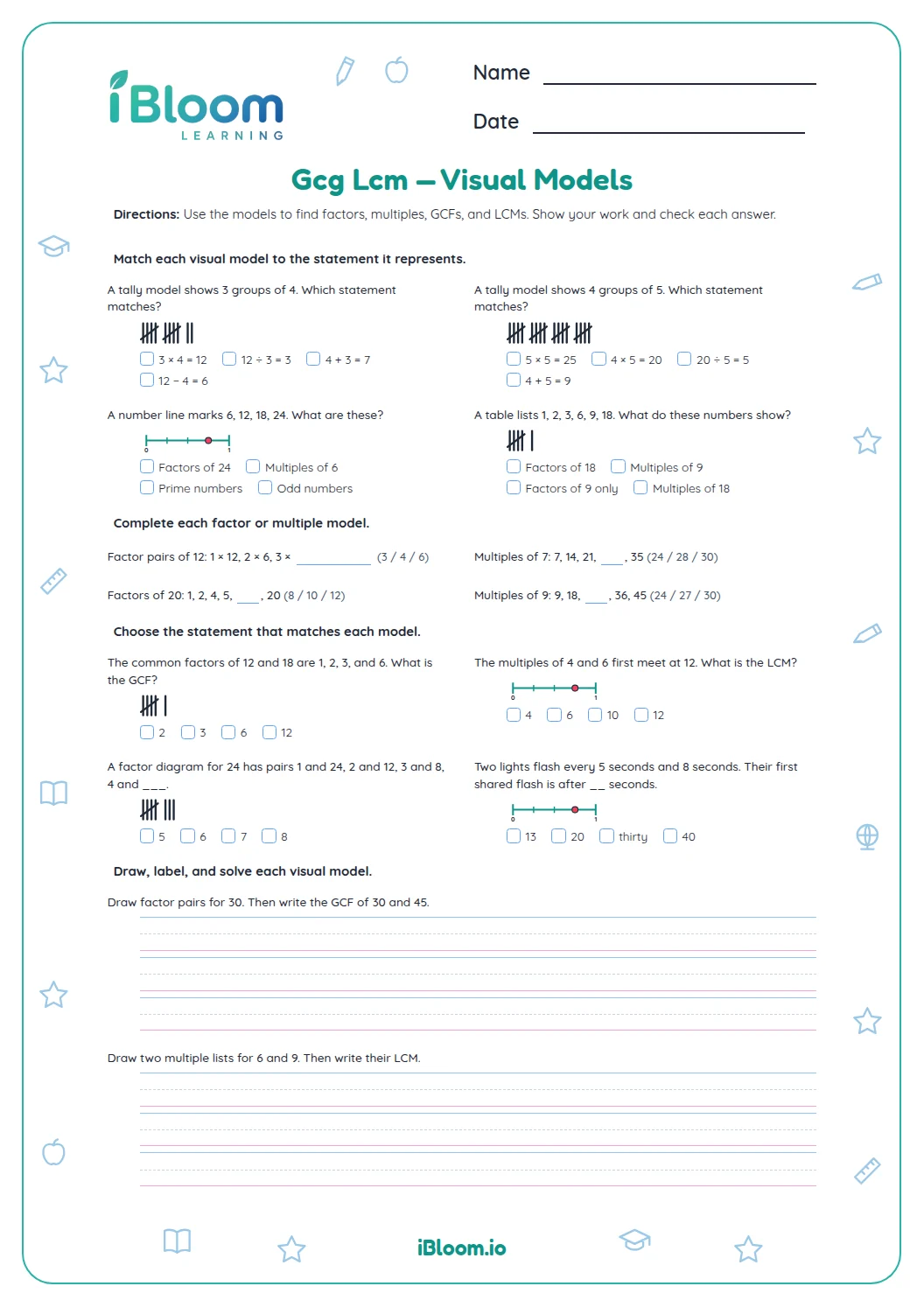
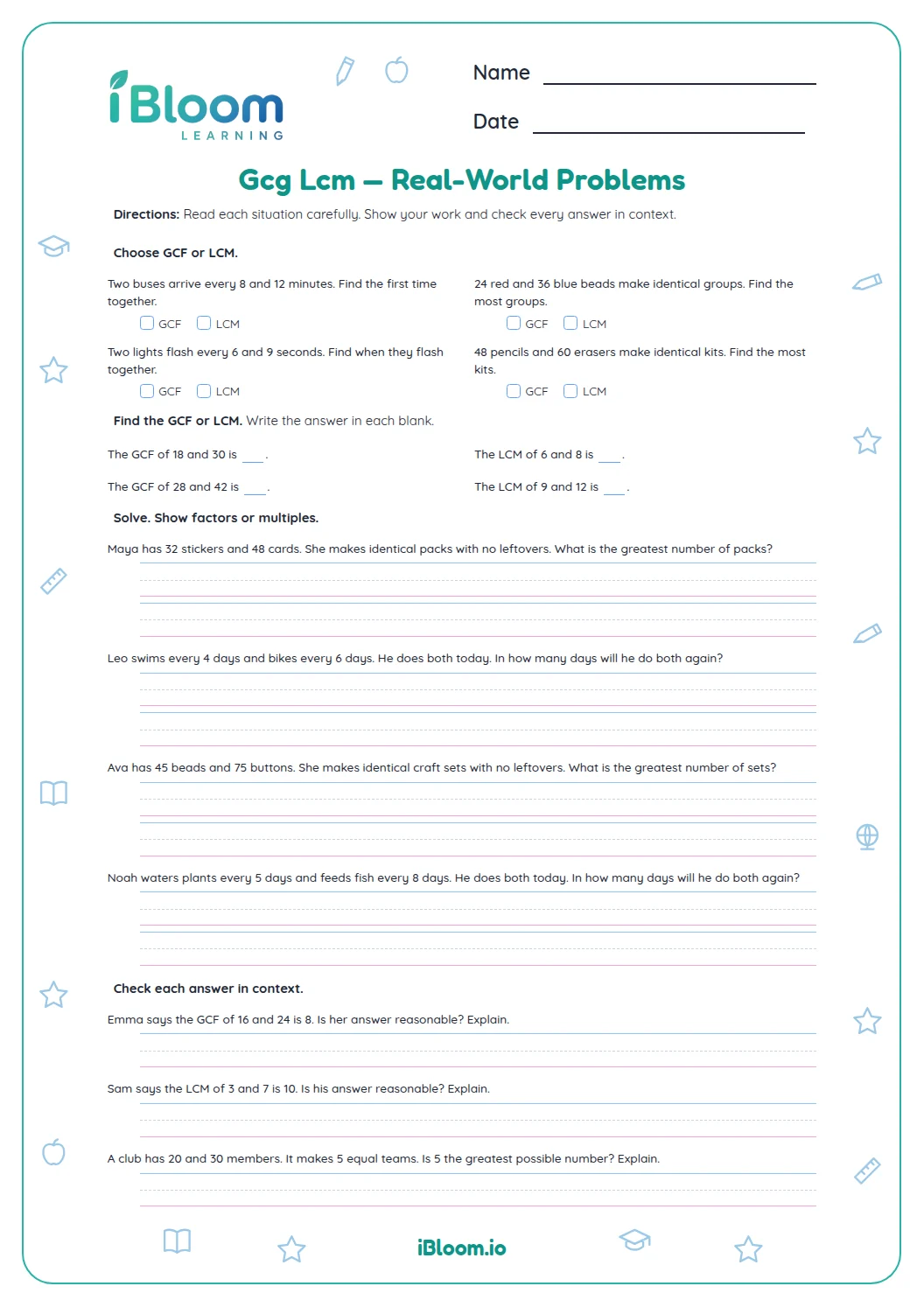
This Grade 5 printable practices GCF and LCM in situations about making equal groups and finding when repeating events meet. The 14 questions move from identifying the needed relationship to solving short word problems, with a separate answer key. Students use common factors for equal groups and common multiples for schedules, practicing the content named in CCSS 6.NS.B.4.
Aligned to 6.NS.B.4
How can students solve greatest common factor and least common multiple word problems?
For equal groups, the greatest common factor gives the largest number of groups that divide both collections evenly. For repeating events, the least common multiple gives the first time both schedules meet.
Question 1 asks for equal groups from 12 and 18 items. Their common factors are 1, 2, 3, and 6, so 6 is the greatest possible number of groups.
- 112 and 18
- 2Common factors: 1, 2, 3, 6
- 3Answer: 6 groups
What practice is on the sheet?
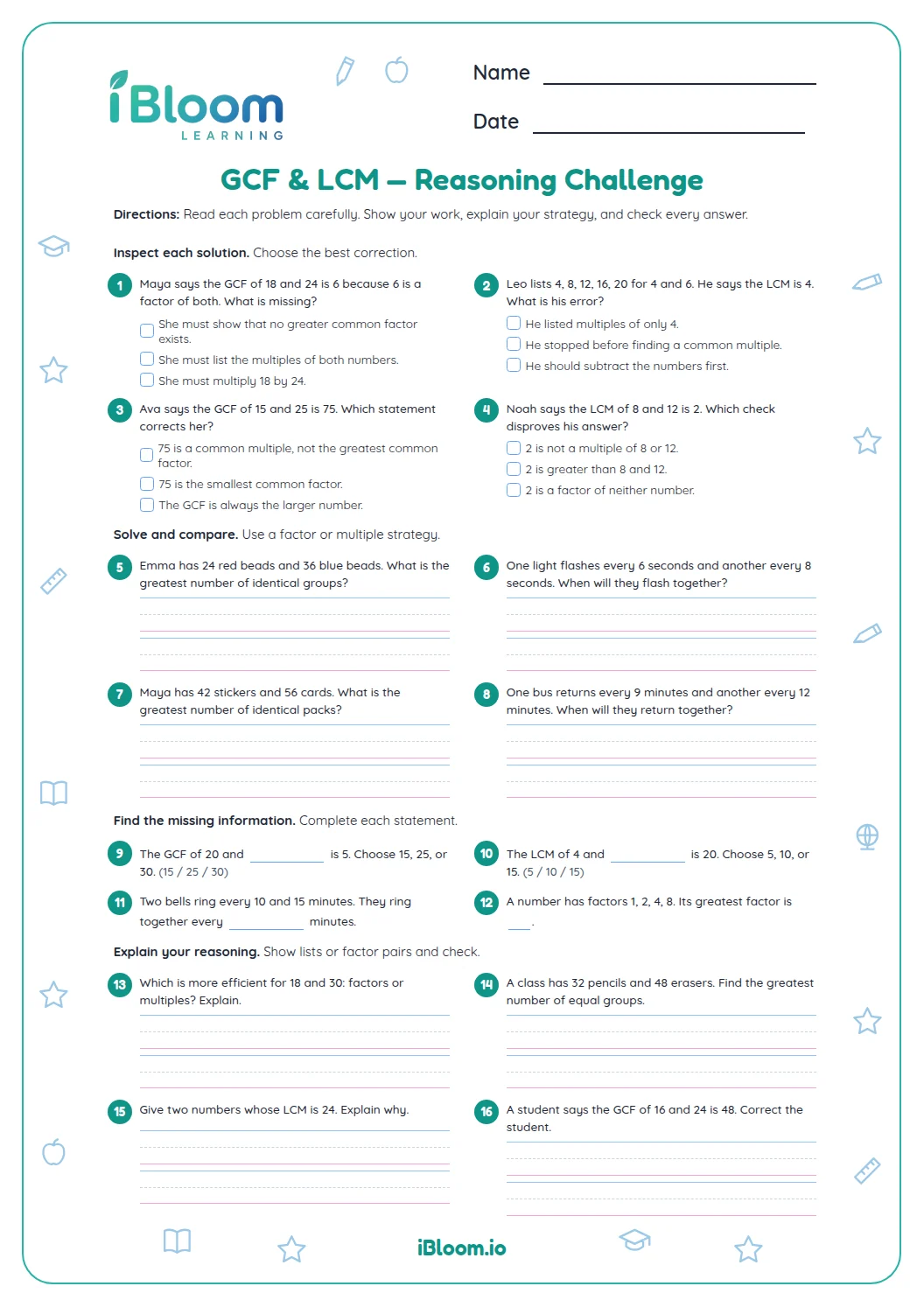
The worksheet has 14 questions in 3 short parts. Each part changes the way students practice, while keeping the same central skill.
How can students check an answer?
Estimate or reason about the size of the result before comparing it with the exact answer. For a model, first read the represented amount, then check that the equation matches it.
How to use the worksheet
- 1Circle words that indicate equal groups or repeating schedules.
- 2List factors for grouping problems or multiples for schedule problems.
- 3Choose the greatest shared factor or first shared multiple.
- 4Write only the requested result and unit.
Mistakes to watch for
The mistake
Choosing a common factor that is not the greatest.
The fix
List shared factors, then select the largest one.
The mistake
Stopping at a shared multiple that is not the first one.
The fix
Find the smallest positive multiple shared by both intervals.
The mistake
Mixing up group count and items in each group.
The fix
Check by dividing both collections by the number of groups.
Common Core alignment
Find greatest common factors and least common multiples.
On this sheet: The questions use factor pairs and multiples to find a greatest common factor or least common multiple.
Show the official wordingHide the official wording
Find the greatest common factor of two whole numbers less than or equal to 100 and the least common multiple of two whole numbers less than or equal to 12. Use the distributive property to express a sum of two whole numbers 1–100 with a common factor as a multiple of a sum of two whole numbers with no common factor.
What to practice next
Make more practice
Further reading
Questions parents and teachers ask
How do I know whether to use GCF or LCM?
Use the GCF when the story asks for the largest equal groups or sets with nothing left over. Use the LCM when two repeating schedules begin together and you need their next shared time. The wording of each question points to one of these relationships.
Why does the greatest common factor give the group count?
A common factor divides both collections evenly, so every group receives the same whole-number amount of each item. The greatest such factor creates the largest possible number of groups. For 12 and 18 items, that number is 6 because both quantities divide evenly by 6.
How can I find when two events happen together?
List multiples of both time intervals until the lists share a value. The least common multiple is the first positive shared time, so it tells when the events next coincide. For example, intervals of 8 and 12 minutes meet again after 24 minutes.
What units belong in an LCM answer?
Use the unit named by the repeating intervals. A question stated in minutes needs an answer in minutes, while intervals stated in seconds need seconds. The answer key includes the matching unit so students can check both the number and what it measures.
How can I check an equal-groups answer?
Divide each collection by the proposed number of groups. Both quotients should be whole numbers, and multiplying each quotient by the group count should recover the original quantities. This confirms that the groups are equal and that no items are left over.