

About this worksheet
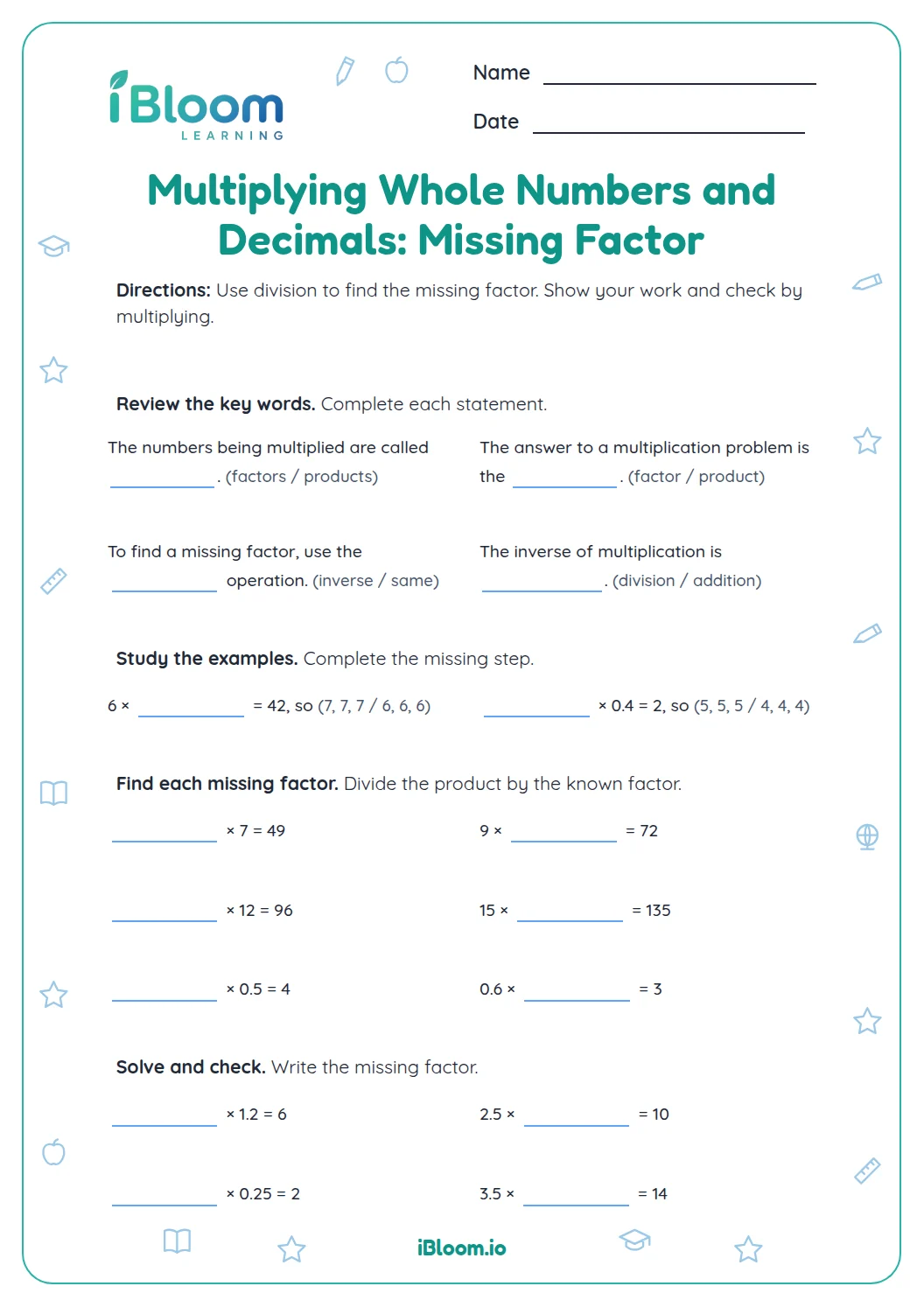
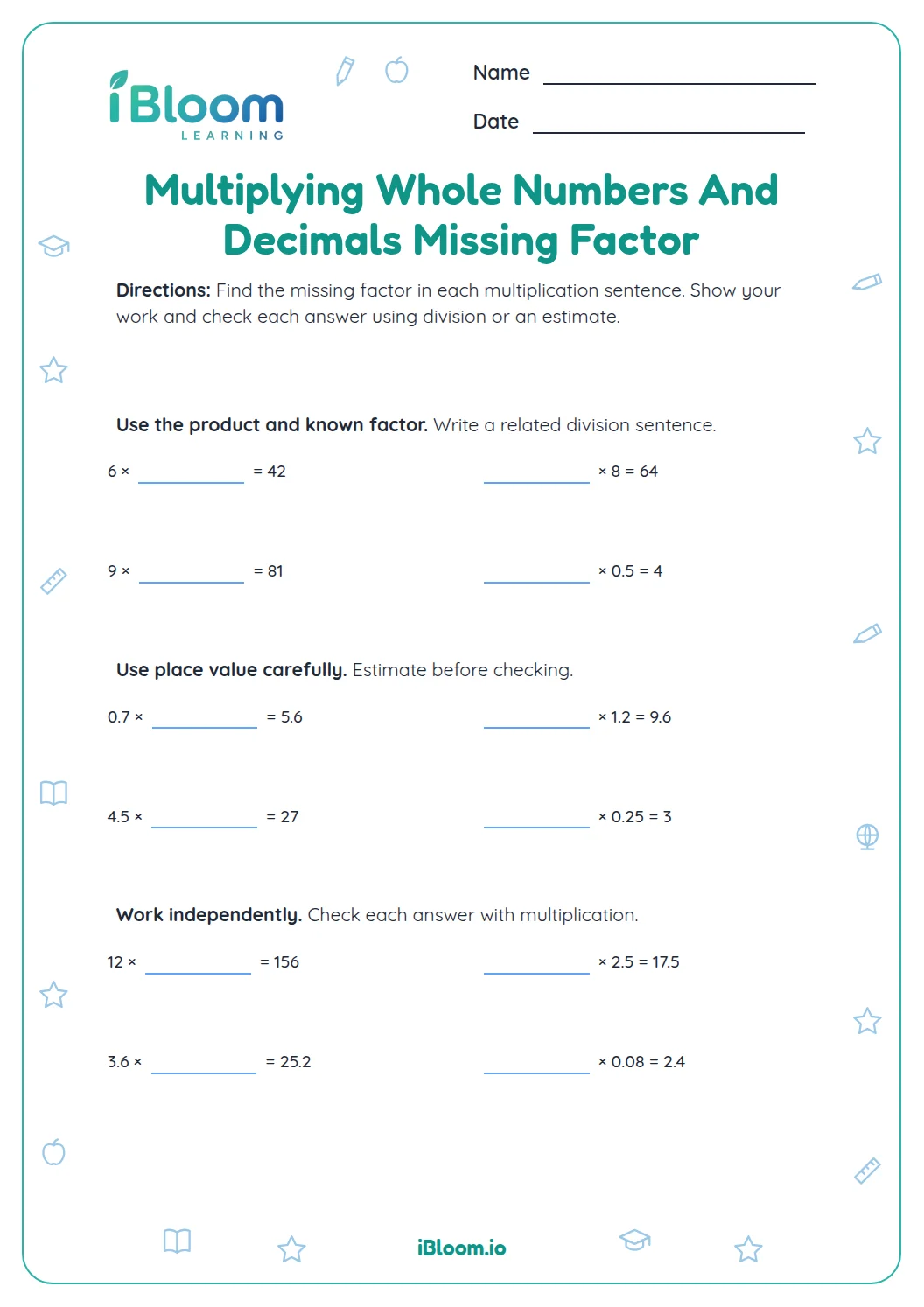
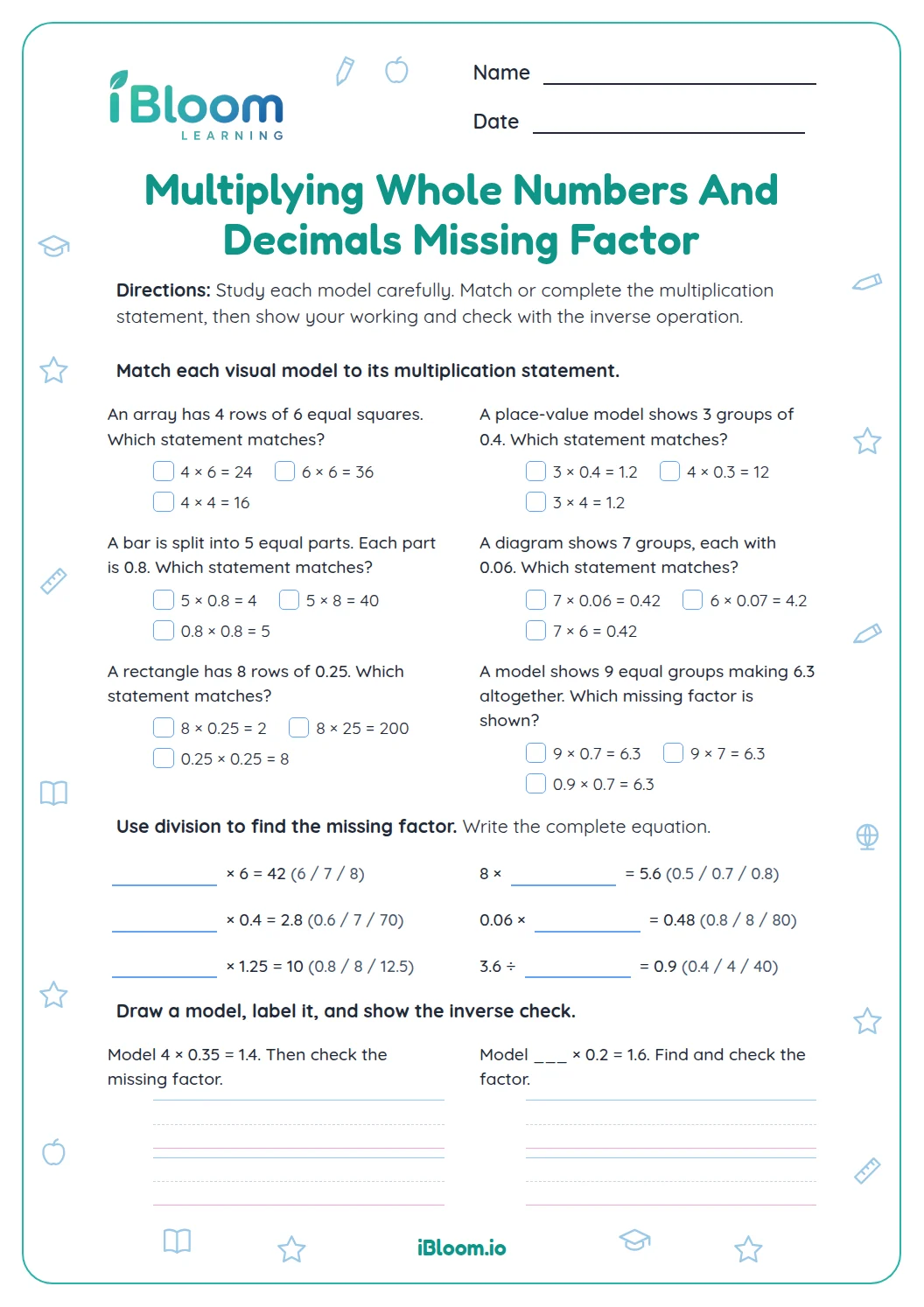
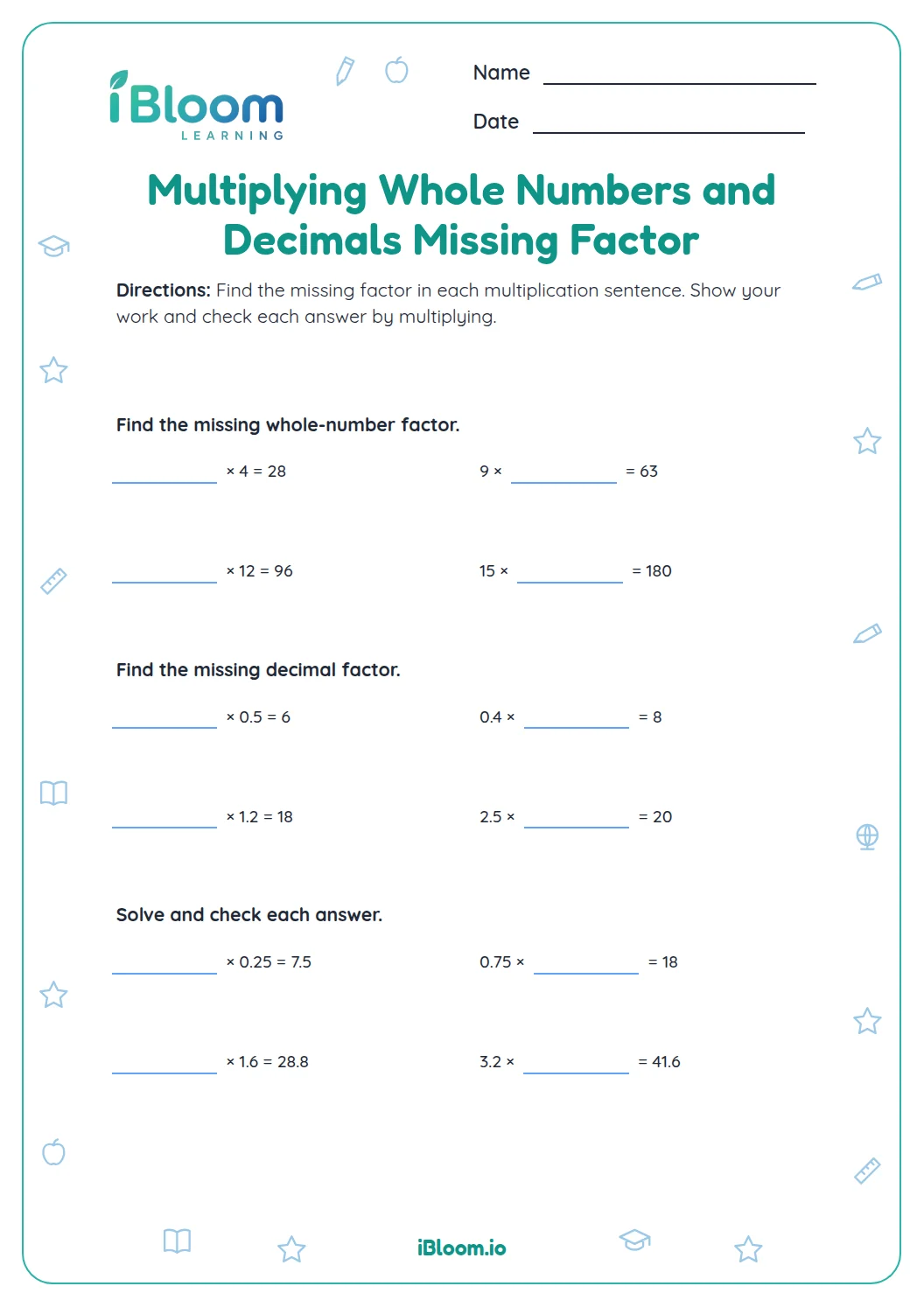
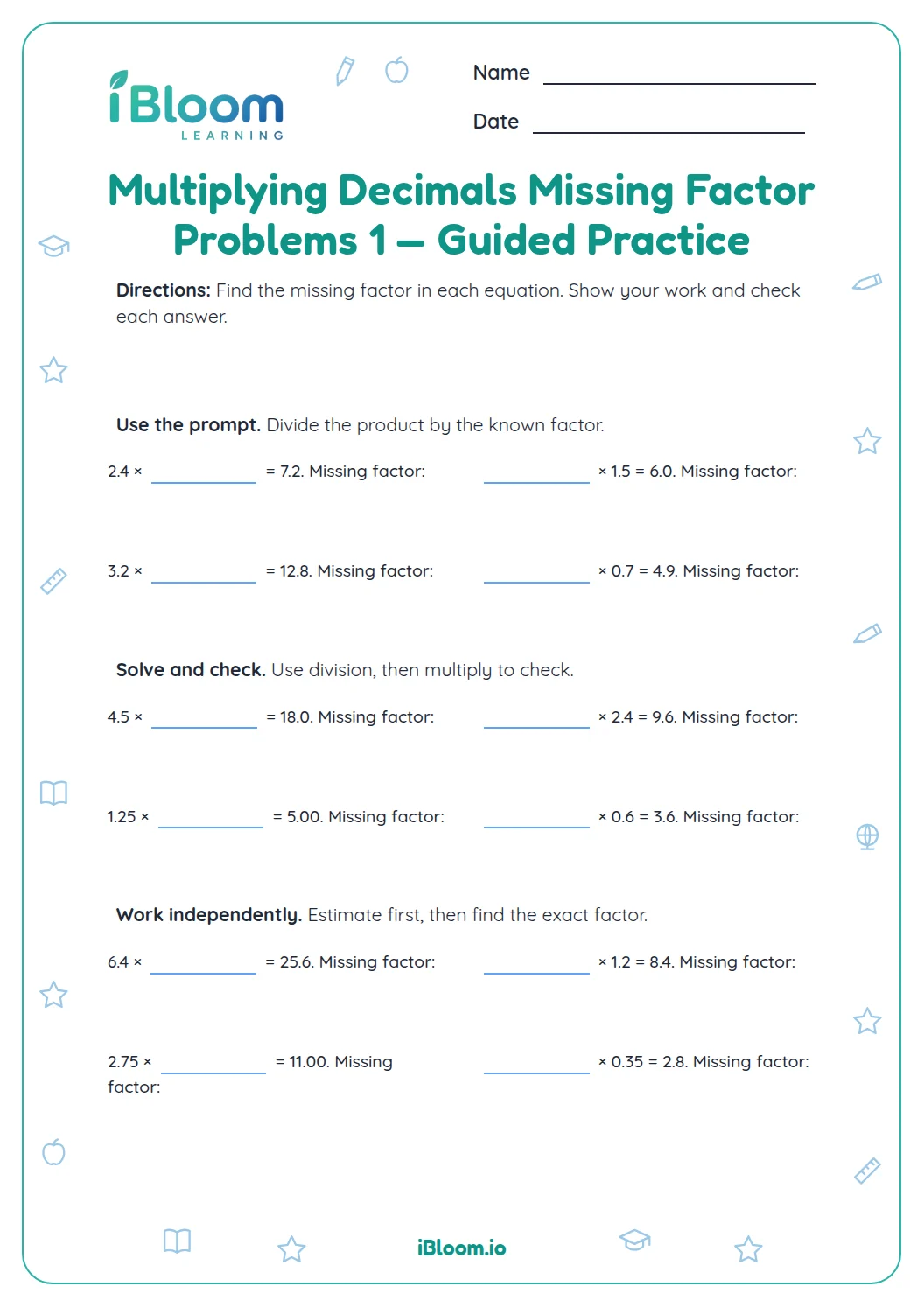
This free printable Grade 6 worksheet gives students 16 questions to practice solving real-world missing-factor problems with whole numbers and decimals. Use division to find an unknown equal-group amount, then multiply to check it. The answer key is printed separately for checking work.
Aligned to 6.NS.B.3
How do you solving real-world missing-factor problems with whole numbers and decimals?
Use division to find an unknown equal-group amount, then multiply to check it.
Six equal boxes hold 144 pencils, so 144 ÷ 6 = 24 pencils per box.
- 1Six equal boxes hold 144 pencils.
- 2144 ÷ 6 = 24 pencils in each box.
- 3Check: 24 × 6 = 144.
What will students practice?
The 16 stories use money, distance, length, capacity, mass, and discrete objects. Discrete counts have whole-number answers.
How can students check their answers?
Multiply the quotient by the known factor. The result should equal the total in the story.
How to use this worksheet
- 1Underline the total and the known number of equal groups.
- 2Write a division equation for the missing factor.
- 3Solve and label the answer with the requested unit.
- 4Check by multiplying the quotient by the known factor.
- 5Decide whether the quotient makes sense for the quantity being counted.
Common mistakes and quick fixes
The mistake
Dividing by the total instead of the number of groups.
The fix
Use total ÷ known number of equal groups.
The mistake
Giving a fractional number of discrete items.
The fix
Check whether the story counts indivisible objects or a measurable amount.
The mistake
Leaving off the unit.
The fix
Use the unit named in the question.
Common Core alignment
This worksheet practices use division to find an unknown equal-group amount, then multiply to check it. through the problems on the sheet.
Solve real-world problems by dividing to find an unknown factor and checking with multiplication.
On this sheet: Solve real-world problems by dividing to find an unknown factor and checking with multiplication.
Show the official wordingHide the official wording
Fluently add, subtract, multiply, and divide multi-digit decimals using the standard algorithm for each operation.
What to practice next
Make more practice
Further reading
Questions parents and teachers ask
What does this worksheet practice?
It practices solving real-world missing-factor problems with whole numbers and decimals using the questions printed on the sheet. Students work through 16 items in 4 parts, then use the separate key to check the answers. The first items build the method, and later questions ask students to use it independently.
How many questions are included?
The worksheet has 16 numbered questions across 4 parts. Each part focuses on a step in the skill, so students can pause between sections and review their approach before moving on. The sections are labeled so students can see how the practice progresses.
Does it include an answer key?
Yes. A separate answer key is included with a response for every question. Students can try the full worksheet first, then compare their work with the key and revisit any item where the answer differs. It follows the same numbering as the student page, making it easy to find each response.
How can I support a student who is stuck?
Ask the student to name the quantities or symbols in the question and explain how they connect. Then use the worked example about solving real-world missing-factor problems with whole numbers and decimals as a model, solve one step at a time, and check whether the result fits the question.
How long does the worksheet take?
Plan for about 20 minutes for the 16 questions. Students who write out each step may need more time, especially on the later problems. The answer key can be used after the practice to review any difficult item.