



About this worksheet
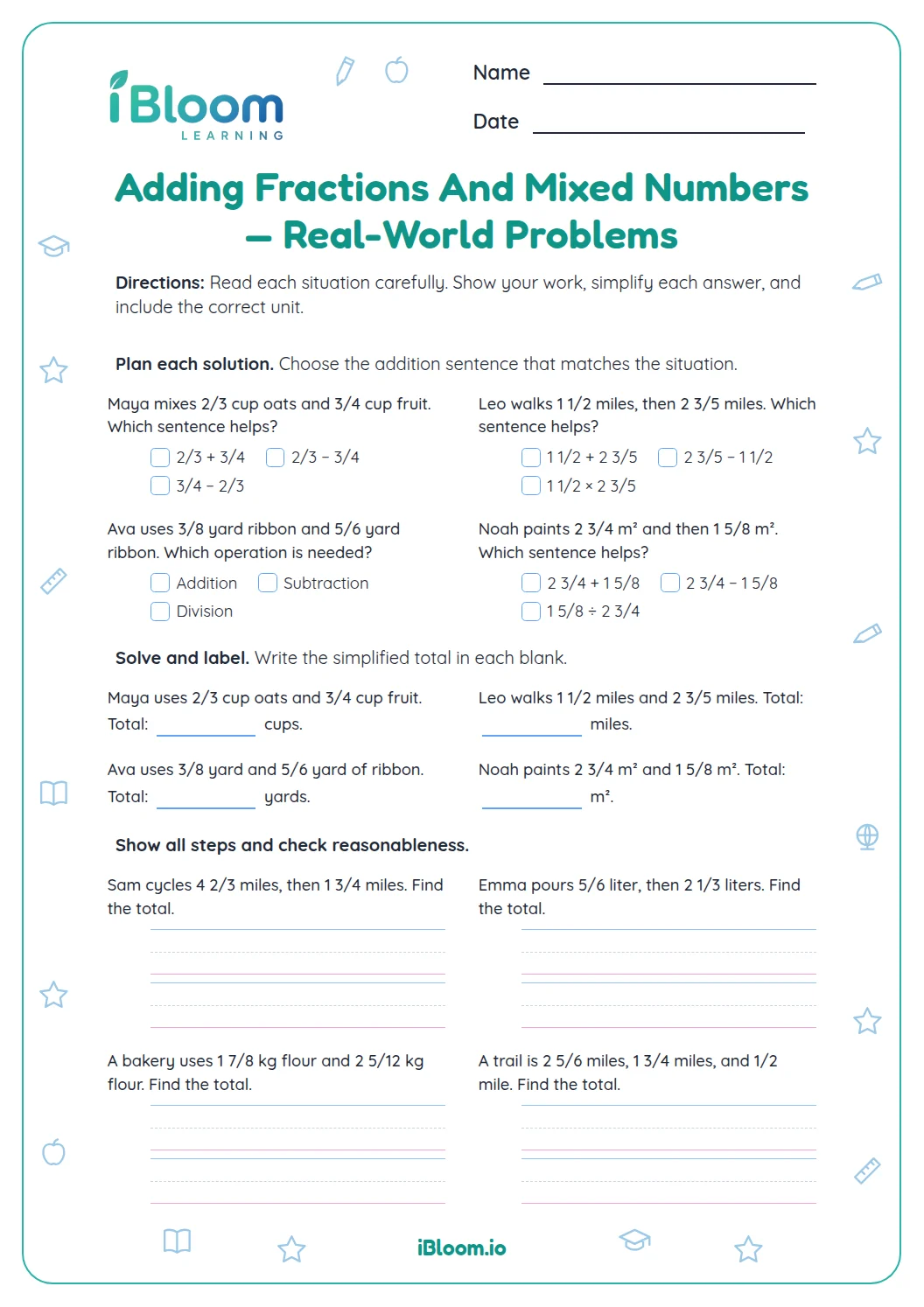
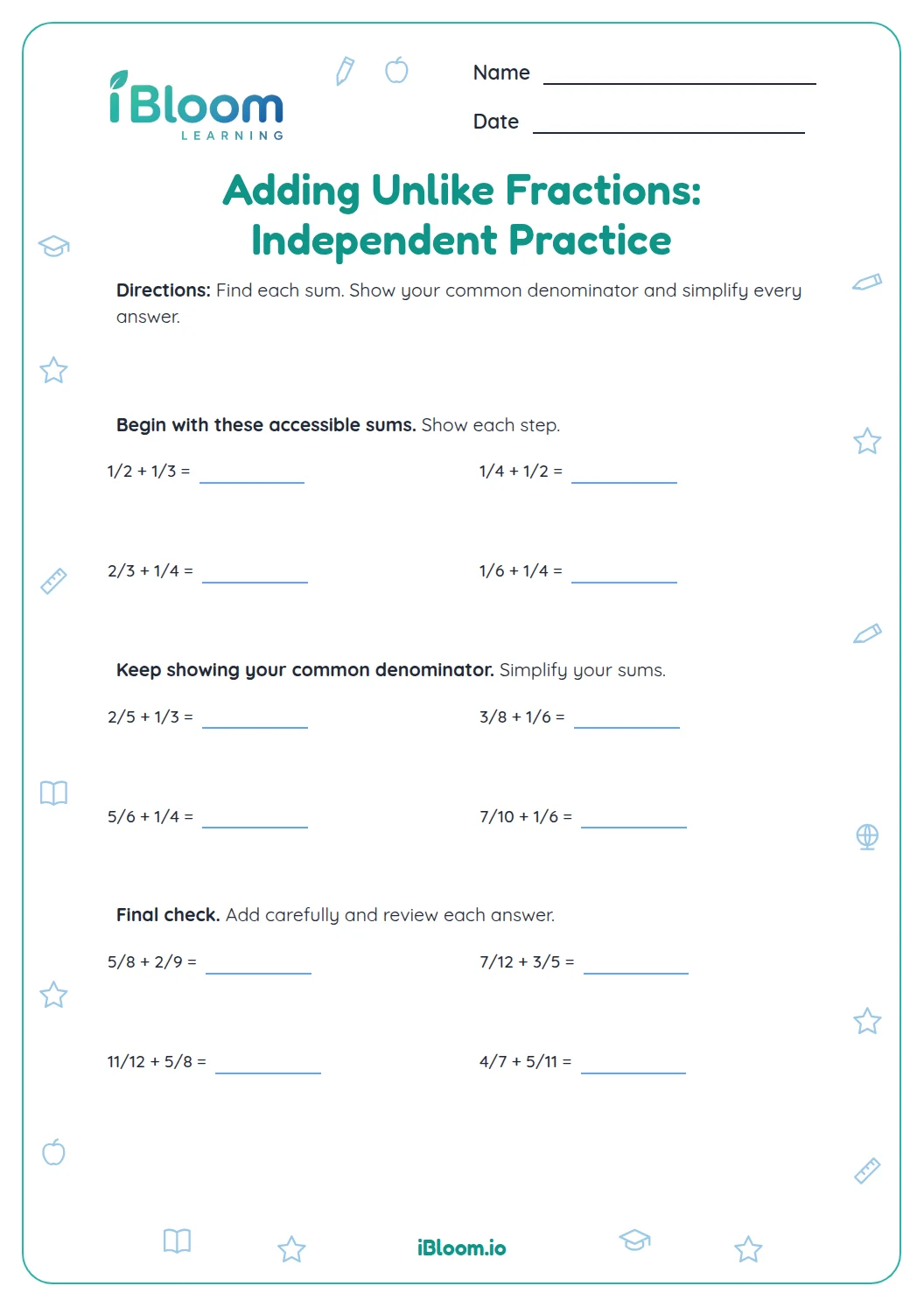
This Grade 6 worksheet starts with shaded fraction models whose values are stated clearly, then moves to fraction and mixed-number addition, and ends with measured amounts in word problems. Every positive addend has an explicit plus sign. The key includes units for the real-world answers.
Aligned to 5.NF.A.1
How do you add fractions with unlike denominators?
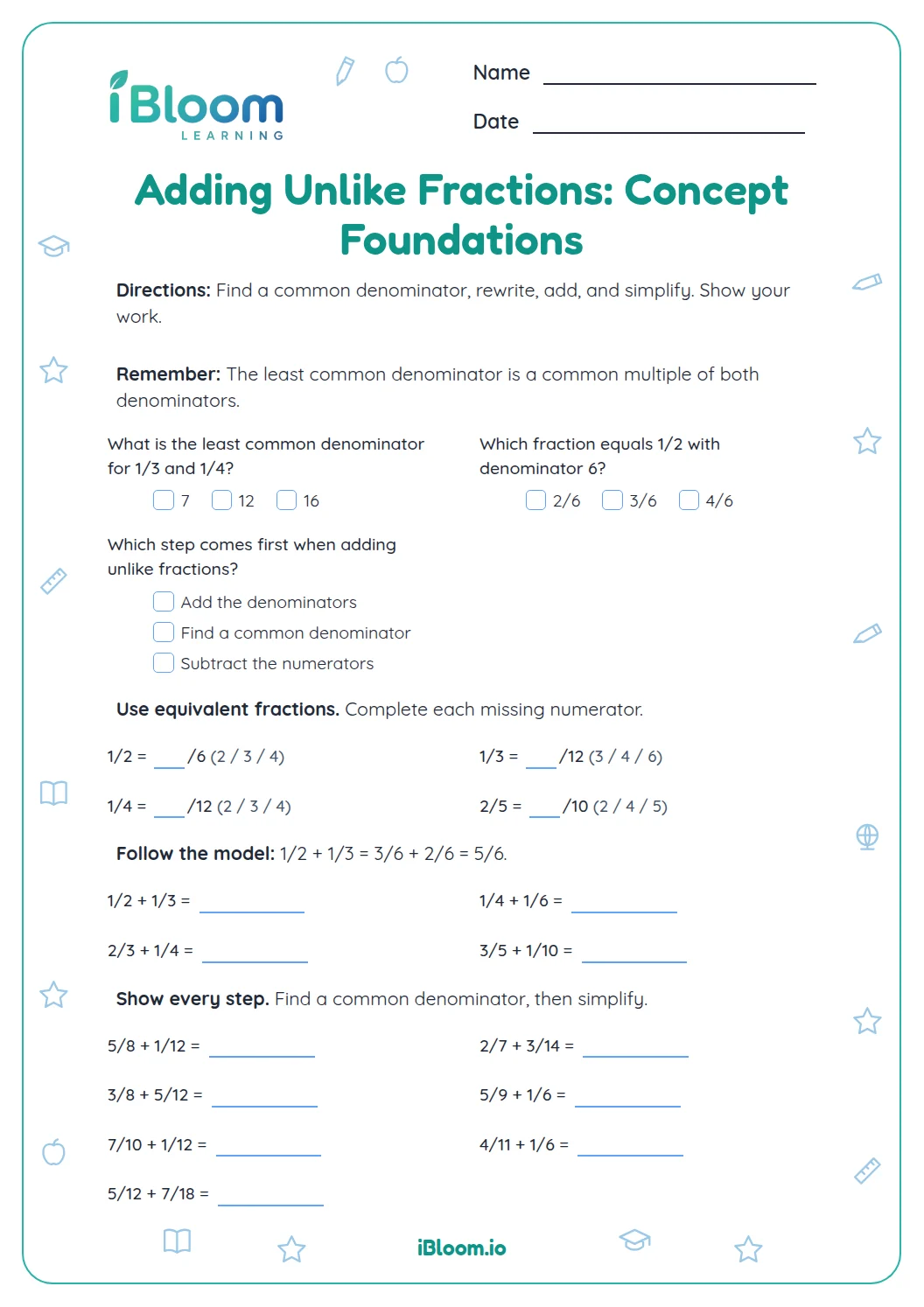
Rename the fractions so their parts have the same size. Then add the numerators and keep the shared denominator. For question 2, two sixths plus three sixths equals five sixths.
- 15/12 + 1/3
- 25/12 + 4/12
- 39/12 = 3/4
How do you add mixed numbers?
Add whole-number parts and fractional parts, regrouping when the fractional sum is at least one whole. In question 6, the fractional parts total 3/4 and the whole-number parts total 3.
How to use this worksheet
- 1Read the positive addends and identify their denominators.
- 2Rename unlike fractions with a common denominator.
- 3Add the numerators and keep the denominator.
- 4Add whole-number parts and regroup a fractional sum of one or more wholes.
- 5For a story problem, include the unit in the answer.
Common mistakes and fixes
The mistake
Adding denominators.
The fix
Use equivalent fractions to make equal-sized parts, then add numerators only.
The mistake
Forgetting to regroup.
The fix
Trade a fractional total of one whole or more for a whole number.
The mistake
Leaving off a measurement unit.
The fix
Copy the unit from the question into the final answer.
Common Core alignment
This worksheet gives students practice with the fraction skills described below.
Add fractions by renaming them with a common denominator.
On this sheet: Students rename unlike fractions as equivalent fractions with like denominators before adding.
Show the official wordingHide the official wording
Add and subtract fractions with unlike denominators (including mixed numbers) by replacing given fractions with equivalent fractions in such a way as to produce an equivalent sum or difference of fractions with like denominators.
What to practice next
Make more practice
Further reading
Questions parents and teachers ask
Why does every addend have a plus sign?
Each problem asks students to combine positive quantities. The plus sign marks every addend explicitly, including a first term, so the operation is easy to read in the printed worksheet. Students can check that the calculation matches the values and directions printed in this worksheet before using the separate key to review the result.
How do you solve 5/12 + 1/3?
Rename 1/3 as 4/12, then add 5/12 + 4/12 to get 9/12. Simplify 9/12 by dividing both parts by 3 to get 3/4. Students can check that the calculation matches the values and directions printed in this worksheet before using the separate key to review the result.
What does the shaded model represent?
The model shows the total number of shaded equal parts in the sum. The words above it state each addend so students can connect the two amounts to the combined shaded amount. Students can check that the calculation matches the values and directions printed in this worksheet before using the separate key to review the result.
When should a student include units?
Include a unit whenever the story measures cups, miles, or feet. The key gives each story answer with the matching unit. Students can check that the calculation matches the values and directions printed in this worksheet before using the separate key to review the result.
How can students check a mixed-number sum?
Add the whole-number parts and fraction parts separately, then verify any regrouping. For example, 1/4 plus 2/4 is 3/4, which does not need regrouping. Students can check that the calculation matches the values and directions printed in this worksheet before using the separate key to review the result.