Free printable practice
Dividing Mixed Numbers Practice Activities
Grade 6 students practise dividing mixed numbers by converting, multiplying by reciprocals, simplifying, and checking whether each quotient makes sense.
Practice that builds confidence
What students learn
These Grade 6 math worksheets focus on the Fractions Multiplication Division skill of dividing mixed numbers. Students practise changing mixed numbers to improper fractions, using the reciprocal of the divisor, multiplying, simplifying, and writing answers in a clear form.
The printable activities include structured problems that move from careful setup to more independent calculation. Children also build the habit of estimating first, so a quotient like 4 1/2 ÷ 1 1/2 can be checked against real number sense instead of treated as a memorized rule.
Dividing mixed numbers combines several fraction skills in one problem. A student must read each mixed number, convert it accurately to an improper fraction, divide by multiplying by the reciprocal, and then simplify the result. For example, 3 1/3 ÷ 1 2/3 becomes 10/3 ÷ 5/3, then 10/3 × 3/5 = 2. The goal is not just to get an answer, but to understand why the divisor tells how many groups fit into the amount.

Progression of the practice
The worksheets support a steady progression from visible steps to fluent work. Early items encourage students to rewrite each mixed number before dividing. Later problems require them to choose the reciprocal correctly, cross-cancel when helpful, and convert improper fraction answers back to mixed numbers. This sequence fits the Grade 6 fraction multiplication and division path because it connects computation, simplification, and reasonableness.
A simple parent routine
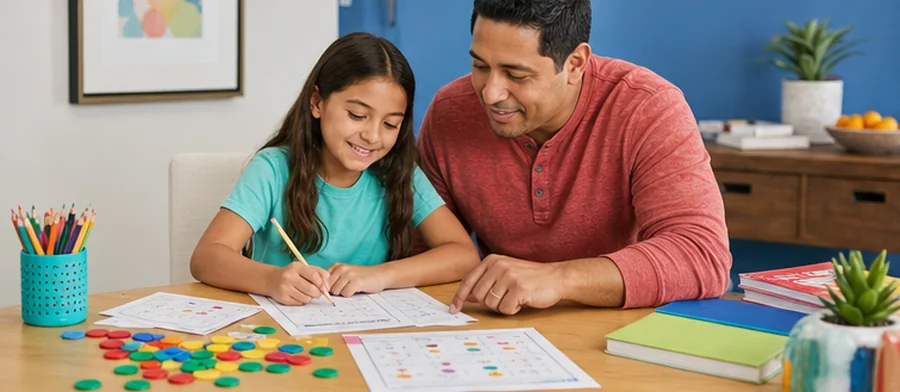
At home, ask your child to solve one problem out loud. Have them say: “convert, keep the first fraction, change division to multiplication, flip the second fraction, multiply, simplify.” Before they calculate, ask whether the answer should be greater or less than the starting number. Afterward, use a quick check such as “Does 6 ÷ 2 1/2 being a little more than 2 make sense?” This short conversation catches many errors.
Classroom uses for teachers
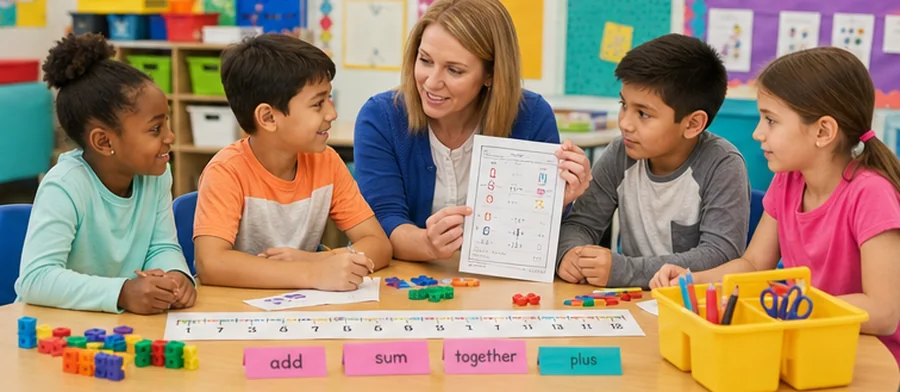
Teachers can use these pages for guided practice, small-group reteaching, math centers, independent review, or exit tickets after a lesson on fraction division. Problems are useful for spotting whether a student’s difficulty is with mixed-number conversion, the reciprocal, multiplication facts, or simplifying. Students can also compare two solution methods: full multiplication first versus cross-canceling before multiplying.
Common errors to watch for
Frequent mistakes include flipping the wrong fraction, forgetting to convert both mixed numbers, adding numerators and denominators instead of multiplying, or leaving an answer like 18/6 unsimplified. Some students also assume division always makes numbers smaller, which is not true when dividing by a fraction less than 1. Estimation helps them notice impossible answers.
Free printable PDF download
Use this dividing mixed numbers worksheets grade 6 page to preview the activity, print it, or download it as a PDF for quick practice. It works well for homework, homeschool lessons, tutoring, morning work, revision, and classroom centers.
Answers and answer key support
After the child completes the worksheet independently, parents and teachers can use the answer support or answer key information to check the work, review mistakes, and choose the next practice step.
Why iBloom worksheets help
iBloom worksheets give focused practice on this exact Grade 6 skill without mixing in unrelated fraction tasks too early. The layout leaves room for the conversion step, the reciprocal step, and the final simplified answer, so students can build a repeatable process. A child-friendly strategy is: “Make them fractions, flip the divider, multiply, then tidy the answer.”
Helpful answers
Frequently asked questions
What steps should Grade 6 students use to divide mixed numbers?
They should convert each mixed number to an improper fraction, keep the first fraction, change division to multiplication, use the reciprocal of the second fraction, multiply, and simplify the answer.
Why do students need to convert mixed numbers before dividing?
Mixed numbers are harder to multiply or divide directly. Converting them to improper fractions gives one numerator and one denominator, making the reciprocal and multiplication steps clear.
How can my child check if a mixed-number division answer is reasonable?
Have your child estimate first. For example, 5 1/2 ÷ 2 is about 2 3/4, so an answer near 3 is reasonable, while an answer like 12 would signal a mistake.
What is the most common mistake in dividing mixed numbers?
A common mistake is flipping the first fraction instead of the divisor. Students should remember that only the number after the division sign becomes its reciprocal.
Are these worksheets good for review after learning fraction multiplication?
Yes. Dividing mixed numbers depends on fraction multiplication, so these worksheets help students apply multiplication facts, simplification, and reciprocal use in one connected skill.
Is this dividing mixed numbers worksheets grade 6 free?
Yes. You can preview it for free and use the printable worksheet for home or classroom practice.
Can I download this dividing mixed numbers worksheets grade 6 as a PDF?
Yes. Use the worksheet download option to save a printable PDF, or print the worksheet directly from the page.
Does this dividing mixed numbers worksheets grade 6 include answers or an answer key?
When the activity has fixed answers, iBloom includes answer support so parents and teachers can check the completed worksheet.