




About this worksheet
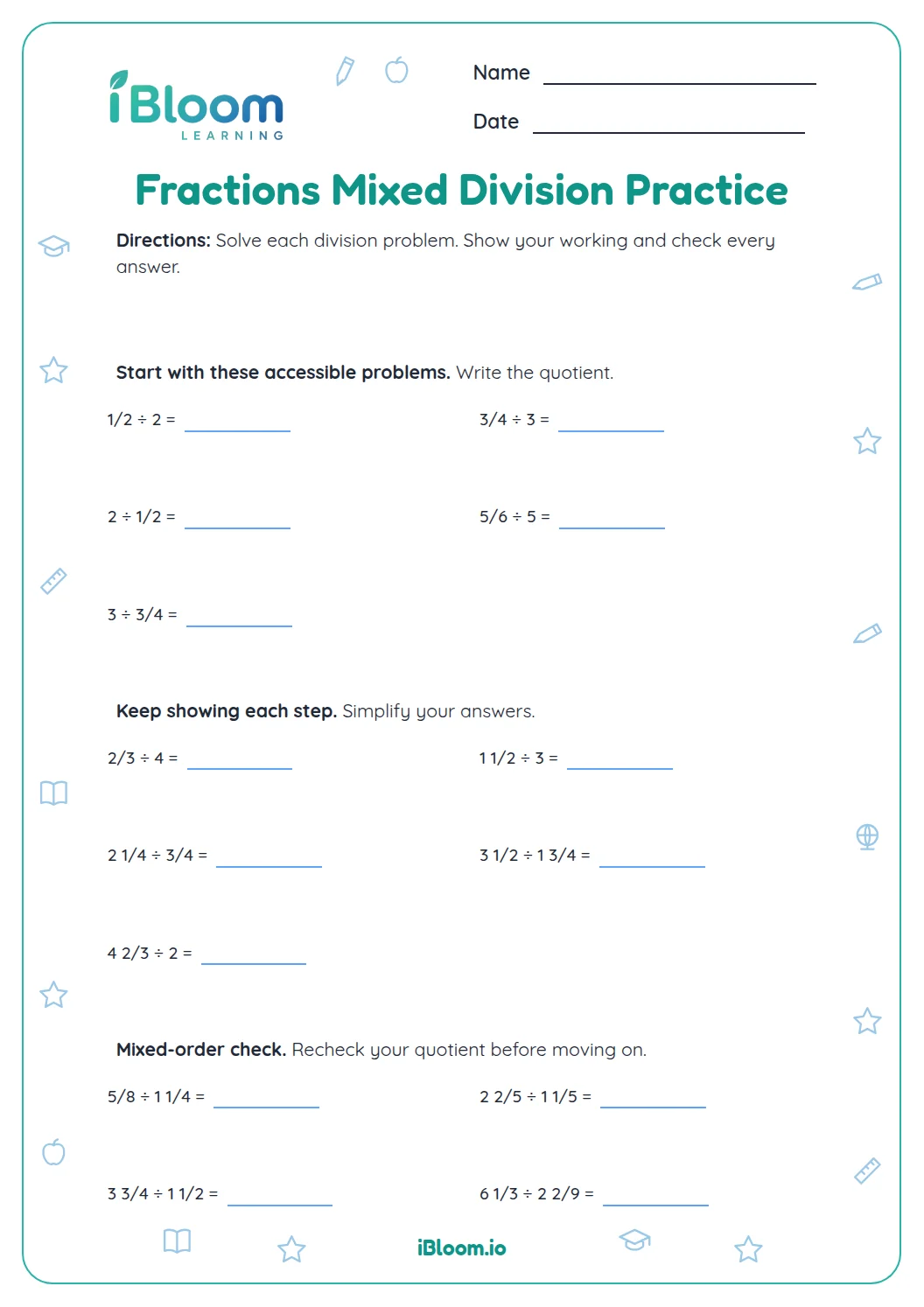
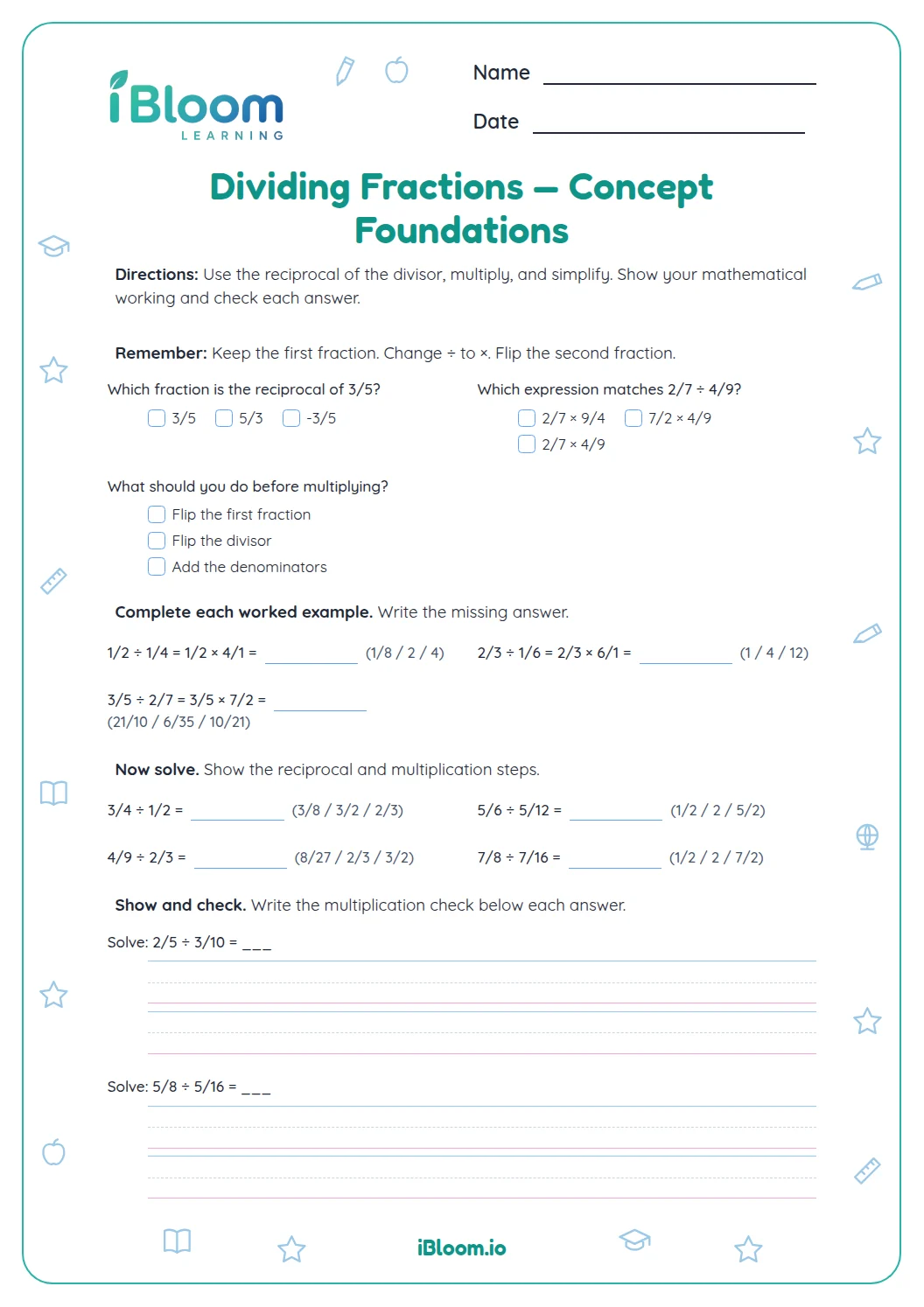
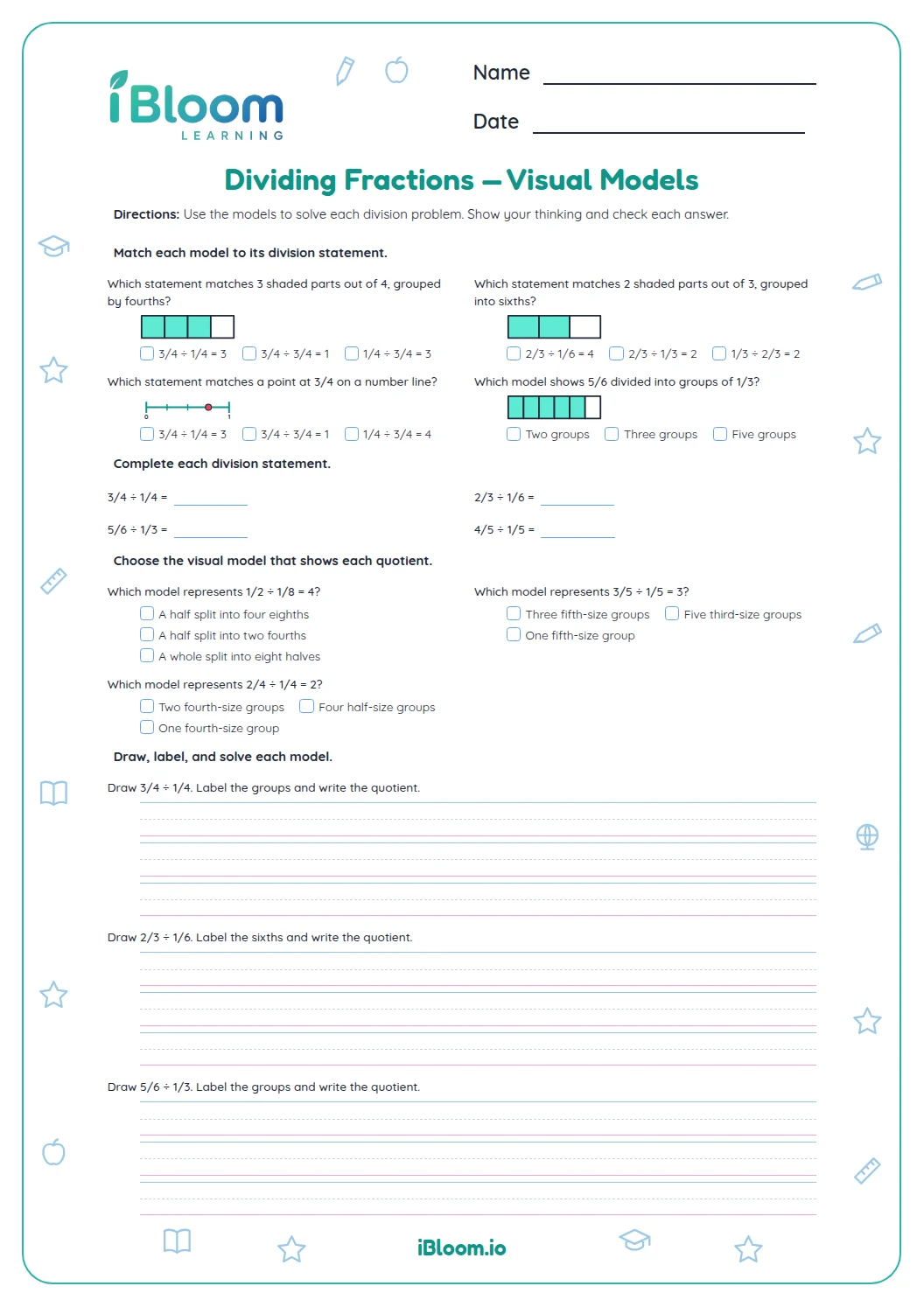
This free printable dividing mixed fractions worksheet gives Grade 6 students 16 focused problems. It practices Interpret fraction division by multiplying by the reciprocal, then simplify. The separate answer key makes it easy to check each calculation after students finish.
How can you solve dividing mixed fractions problems?
To divide by a fraction, multiply by its reciprocal. In the first claim, 10/3 comes from multiplying by 2/3; reversing the divisor gives 15/2, or 7 1/2. Estimate first: dividing 5 by less than 1 should produce a quotient greater than 5.
- 15 ÷ 2/3 = 5 × 3/2 = 15/2 = 7 1/2.
What practice is on the page?
The worksheet moves from direct calculations to choices and short reasoning checks. Each item has one clear answer and the key matches the student page. A quotient can be larger than the dividend when the divisor is less than 1.
How can you check an answer?
Estimate the size of the result before calculating. Then repeat the operation in a different order or use an inverse relationship to catch a sign, factor, or place-value slip.
How to use this worksheet
- 1Read the directions for the current part.
- 2Copy each operation carefully, including every sign.
- 3Work one step at a time and simplify when appropriate.
- 4Estimate whether the result is reasonable.
- 5Use the separate key to find and correct any missed step.
Common mistakes and quick fixes
The mistake
Changing the operation while copying.
The fix
Point to each symbol and number before beginning the calculation.
The mistake
Stopping before simplifying a fraction.
The fix
Find a common factor in the numerator and denominator and reduce.
The mistake
Trusting an answer that is far from a reasonable estimate.
The fix
Estimate first, then recompute the operation to locate the slip.
What to practice next
Make more practice
Questions parents and teachers ask
What does the first quotient claim test?
It checks whether the divisor is reversed before multiplying. For 5 ÷ 2/3, use 3/2 as the second factor, giving 15/2 or 7 1/2. Multiplying by 2/3 instead gives 10/3, the specific error students must identify. This matters because the divisor changes to its reciprocal while the dividend stays the same.
How many questions and pages are included?
The worksheet has 16 questions across three worksheet pages, plus three answer-key pages. The matching answer-key pages list the checked result for every problem in this practice set. The answer key is separate so students can finish the full set before checking their reasoning.
How should students check their work?
Work through each section using its printed direction, and simplify fraction answers where needed. For calculations, estimate or use a reverse check. Then compare with the key and redo any item whose result differs from the checked answer. A reverse check helps locate whether the operation, reciprocal, or simplification caused a mismatch.
How long does this worksheet take?
Plan for about 20 minutes, with extra time if students write out every calculation step. The questions move from direct practice into application or reasoning, so students can pause between sections and check their work carefully. Short pauses between sections can help students keep the symbols and fractions organized.
How does the reciprocal change the quotient?
For 5 ÷ 2/3, multiply by the reciprocal 3/2 to get 15/2, or 7 1/2. The claim 10/3 shows what happens when a student multiplies by 2/3 instead. The answer key identifies the correct choice. Use the relationship between division and multiplication to verify the quotient.