




About this worksheet
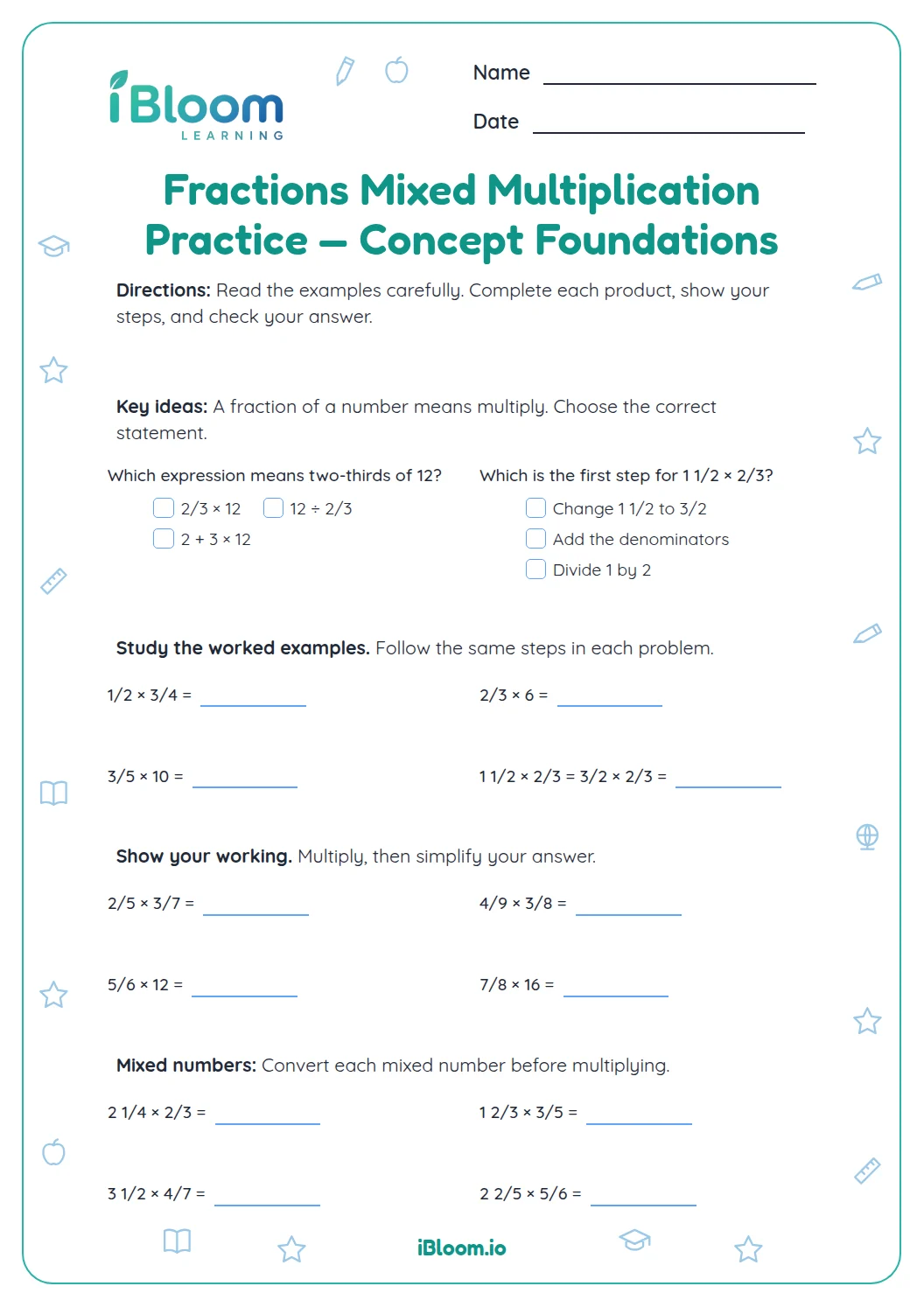
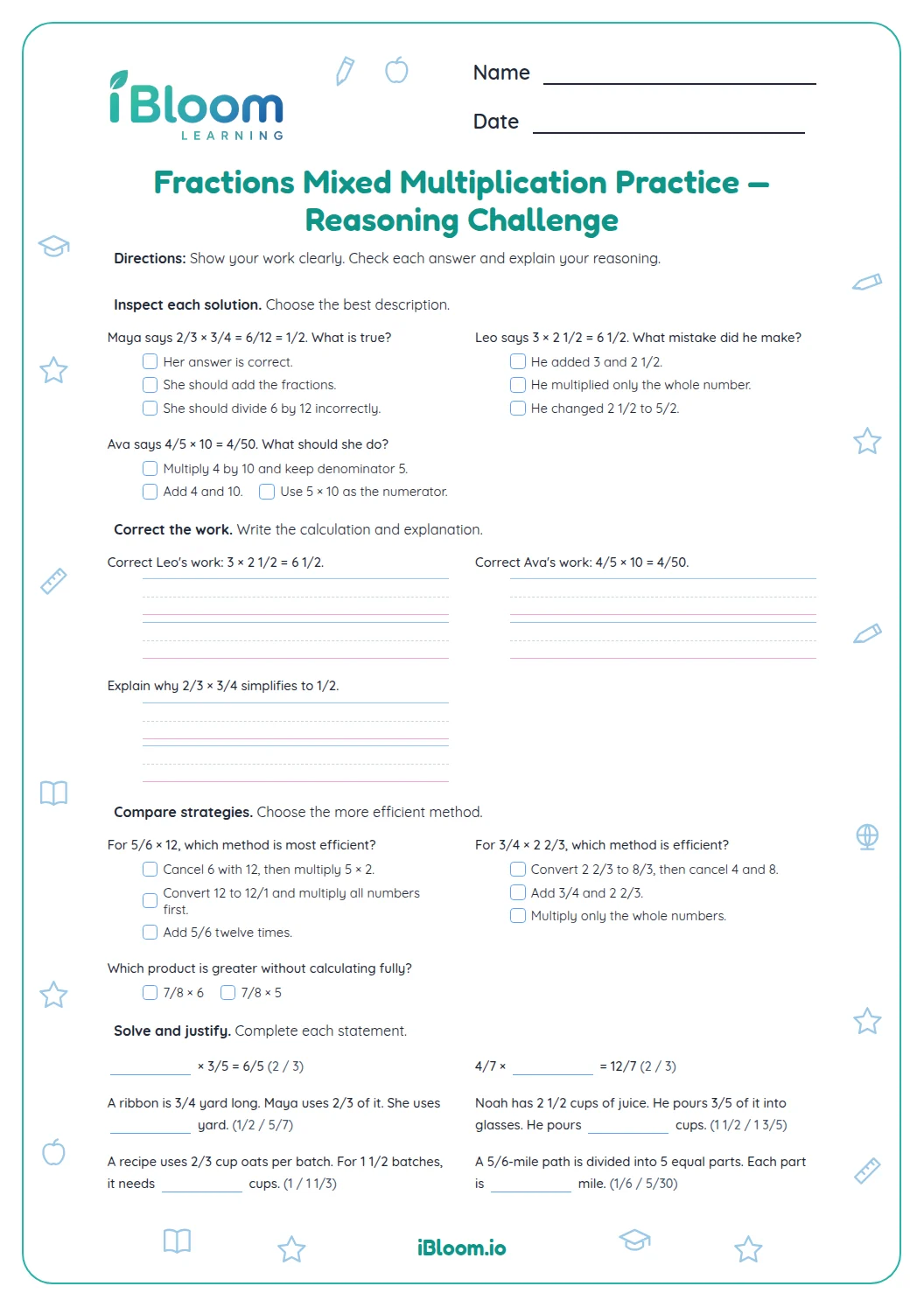
This free printable multiplying fractions and mixed numbers worksheet gives Grade 6 students 16 focused problems. It practices Multiply fractions and mixed numbers by converting, multiplying, and simplifying. The separate answer key makes it easy to check each calculation after students finish.
How can you solve multiplying fractions and mixed numbers problems?
Change each mixed number to an improper fraction, multiply numerators and denominators, then simplify. For example, 4 2/5 becomes 22/5 and 1 1/7 becomes 8/7. The product 176/35 is 5 1/35, just above 5.
- 14 2/5 × 1 1/7 = 22/5 × 8/7 = 176/35 = 5 1/35.
What practice is on the page?
The worksheet moves from direct calculations to choices and short reasoning checks. Each item has one clear answer and the key matches the student page. If a factor is greater than 1, the product grows; if it is less than 1, the product shrinks.
How can you check an answer?
Estimate the size of the result before calculating. Then repeat the operation in a different order or use an inverse relationship to catch a sign, factor, or place-value slip.
How to use this worksheet
- 1Read the directions for the current part.
- 2Copy each operation carefully, including every sign.
- 3Work one step at a time and simplify when appropriate.
- 4Estimate whether the result is reasonable.
- 5Use the separate key to find and correct any missed step.
Common mistakes and quick fixes
The mistake
Changing the operation while copying.
The fix
Point to each symbol and number before beginning the calculation.
The mistake
Stopping before simplifying a fraction.
The fix
Find a common factor in the numerator and denominator and reduce.
The mistake
Trusting an answer that is far from a reasonable estimate.
The fix
Estimate first, then recompute the operation to locate the slip.
What to practice next
Make more practice
Questions parents and teachers ask
Why convert mixed numbers before multiplying?
A mixed number combines a whole number and a fraction, so rewrite it as one improper fraction first. Then multiply numerators and denominators and reduce. The key shows simplified answers, including mixed-number form when a product is greater than one. This keeps each factor represented by one fraction and makes the multiplication steps easier to track.
How many questions and pages are included?
The worksheet has 16 questions across three worksheet pages, plus three answer-key pages. The matching answer-key pages list the checked result for every problem in this practice set. The key is separate so students can complete the practice independently before checking their work.
How should students check their work?
Work through each section using its printed direction, and simplify fraction answers where needed. For calculations, estimate or use a reverse check. Then compare with the key and redo any item whose result differs from the checked answer. A quick estimate helps students notice if a product should be above or below either factor.
How long does this worksheet take?
Plan for about 20 minutes, with extra time if students write out every calculation step. The questions move from direct practice into application or reasoning, so students can pause between sections and check their work carefully. Students may take extra time to write conversion steps beside the larger mixed-number products.
What does a simplified product look like?
Convert each mixed number, multiply the fractions, and simplify. For example, 4 2/5 × 1 1/7 becomes 22/5 × 8/7 = 176/35 = 5 1/35. The key uses this simplified mixed-number form. Reducing before or after multiplication gives the same simplified value.