





About this worksheet
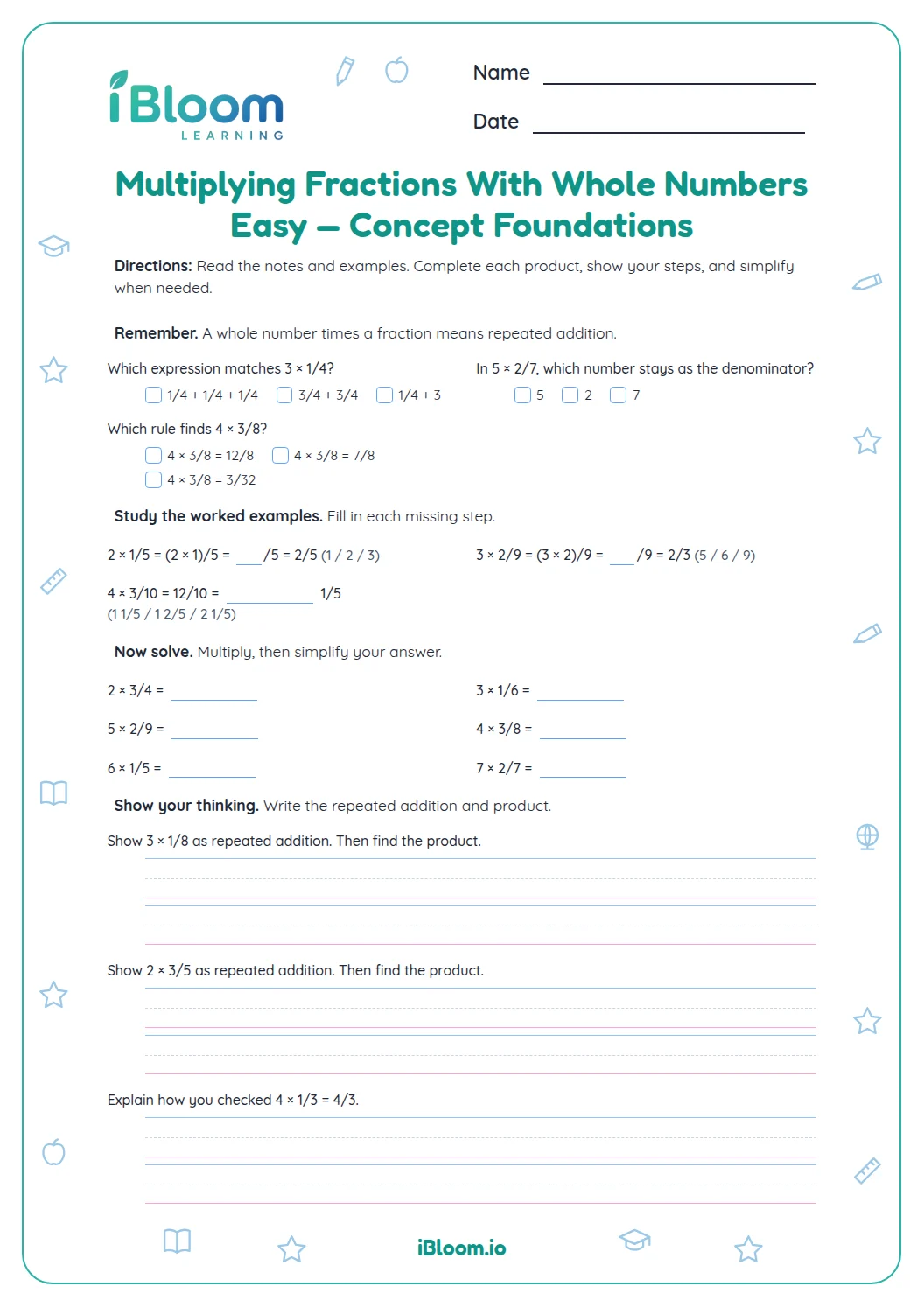
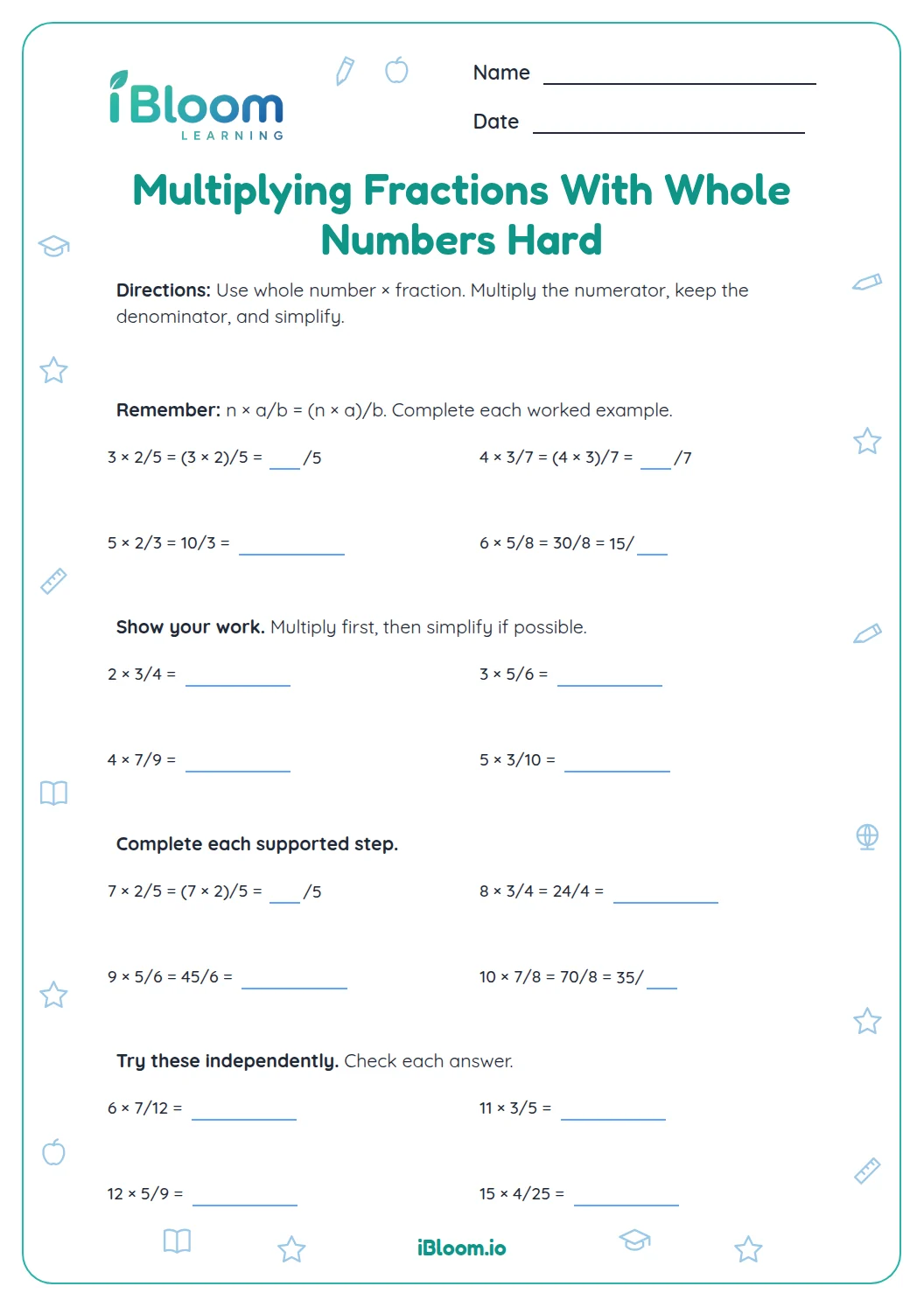
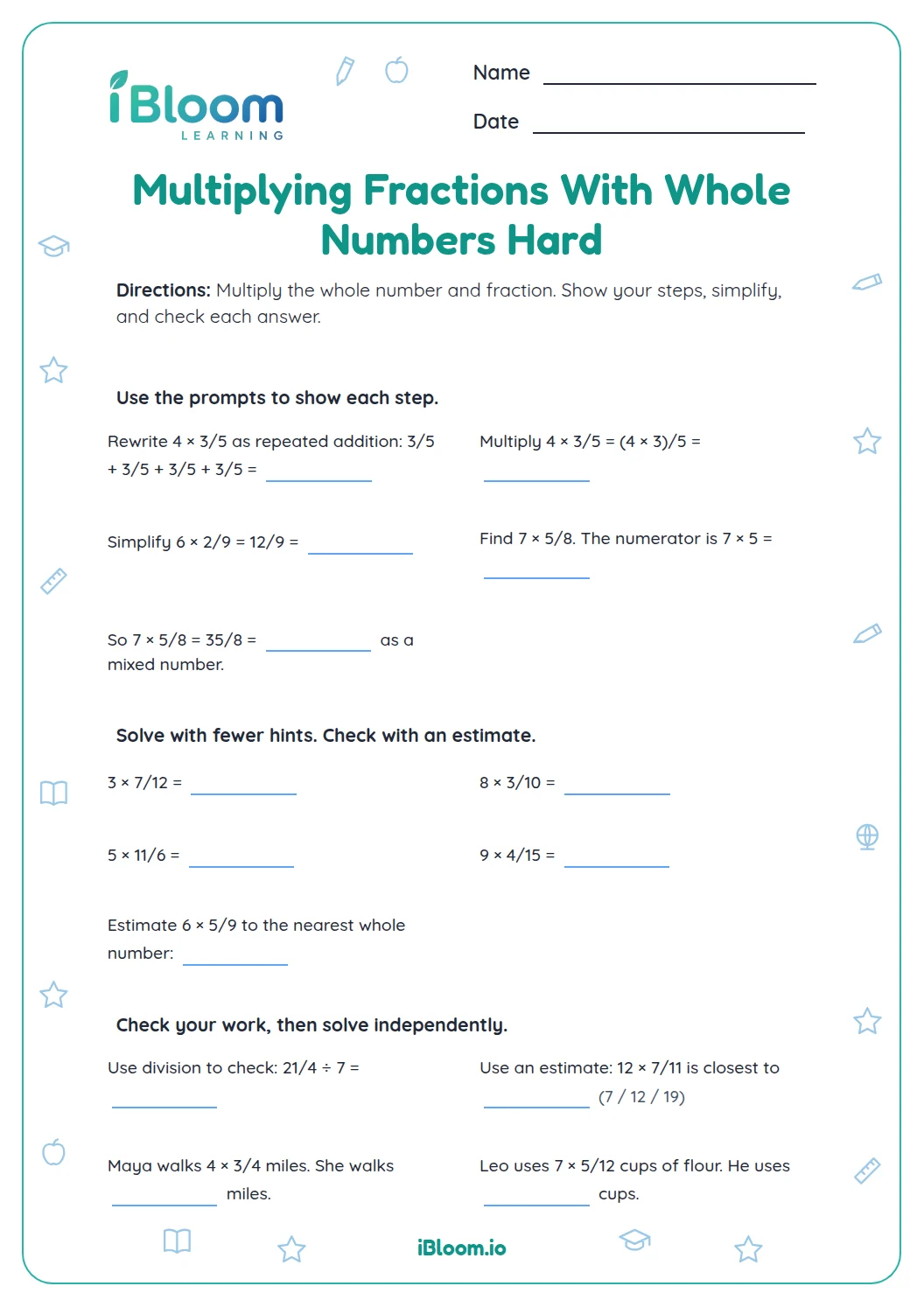
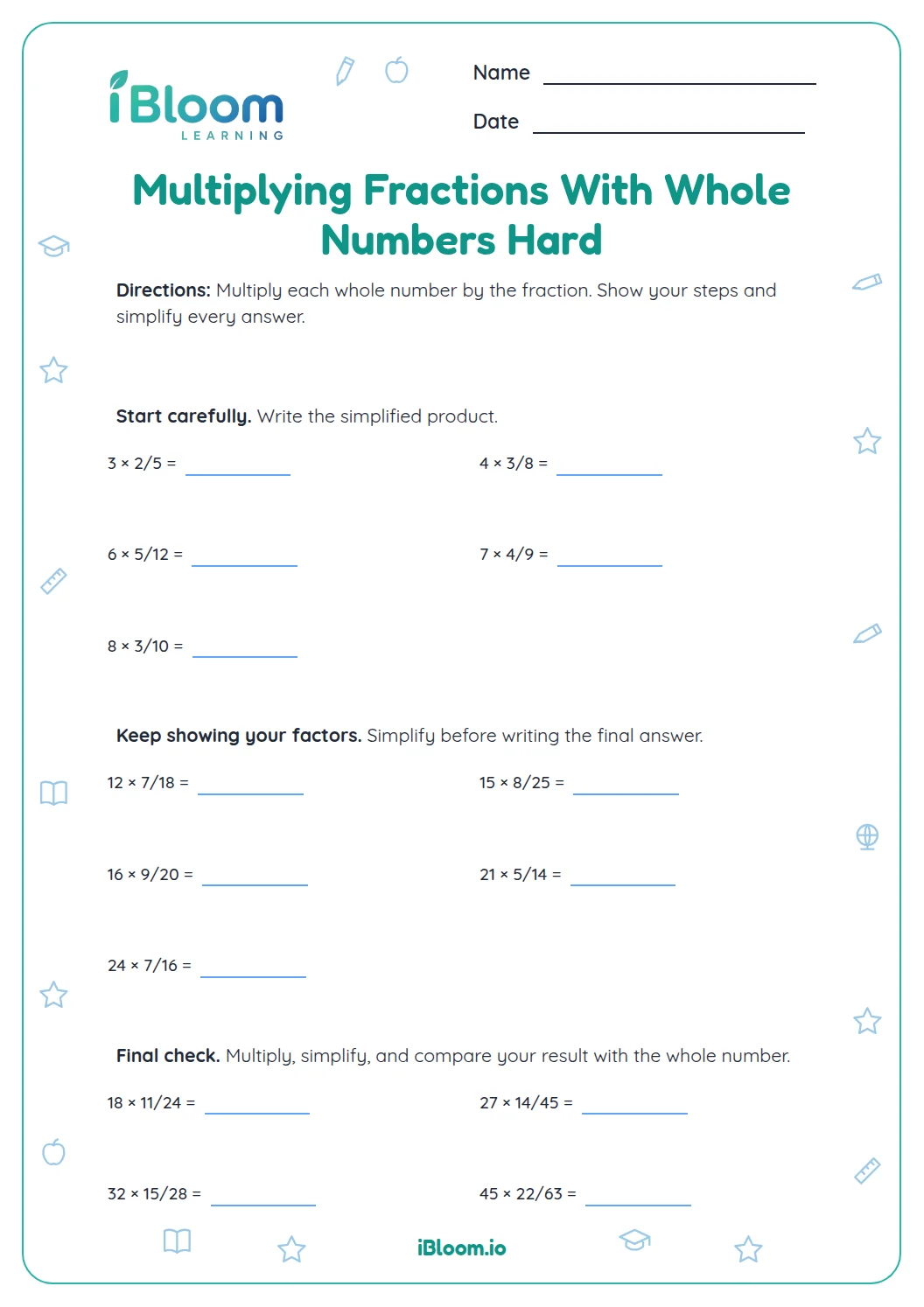
This printable guided practice sheet helps students multiply fractions by whole numbers. The first section isolates the numerator step that was missing from the previous key; later questions ask for products in simplest form and use the operation in short contexts. There are 16 questions across four parts and a separate answer key. The work follows the Common Core understanding of fraction products as equal parts of a whole-number amount.
Aligned to 5.NF.B.4.a
What changes when a whole number multiplies a fraction?
A whole number times a fraction means taking that fraction repeatedly. For 2 × 1/5, there are two one-fifths, which makes 2/5. The first part of the sheet gives one numerator blank per question so the intermediate step is visible and keyed.
- 12 × 1/5 = 2/5
- 2The numerator is 2 × 1 = 2; the denominator stays 5.
When should students simplify a product?
After multiplying the numerator, keep the denominator and check whether the result can be reduced. For instance, 4 × 3/8 gives 12/8, which is 1 1/2. The later practice asks for simplified products.
How does the same multiplication model repeated amounts?
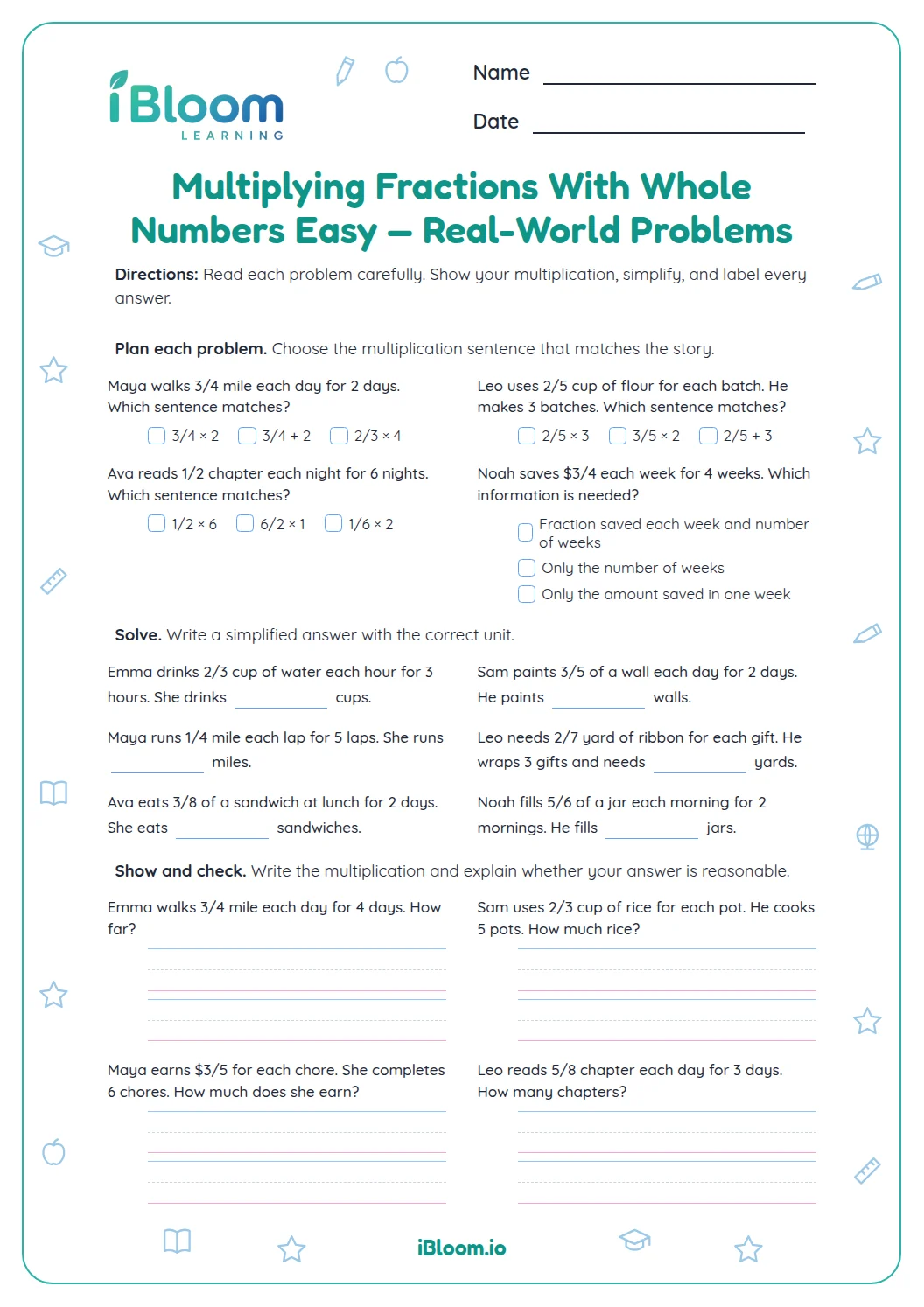
The final questions use loops, recipe batches, garden rows and hiking loops. Each context names an amount for one group and asks for the total across a whole number of equal groups.
What is on the worksheet and key?
There are 16 questions in four parts: numerator steps, products with several numerators, simplified products, and applications. The answer key includes every intermediate numerator and each final result.
How to use the guided practice
- 1Read the whole number as the number of equal fraction groups.
- 2Multiply it by the numerator in the first two parts.
- 3Keep the denominator unchanged while finding the product.
- 4Reduce the fraction or change an improper fraction to a mixed number.
- 5For a story, write whole number × fraction and include the requested unit.
Common fraction multiplication mistakes
The mistake
Multiplying the denominator by the whole number.
The fix
Only the numerator counts repeated copies; the unit fraction size, set by the denominator, stays the same.
The mistake
Leaving an improper fraction unsimplified when the prompt asks for the product.
The fix
Check whether the numerator is at least the denominator, then write a mixed number if useful.
The mistake
Dropping the unit in a distance or recipe answer.
The fix
Use the unit named in the story after calculating the total.
Common Core alignment
The worksheet represents multiplication by a whole number as repeated fraction parts.
Interpret a whole-number-by-fraction product as equal parts.
On this sheet: The products and story items apply the equal-parts interpretation.
Show the official wordingHide the official wording
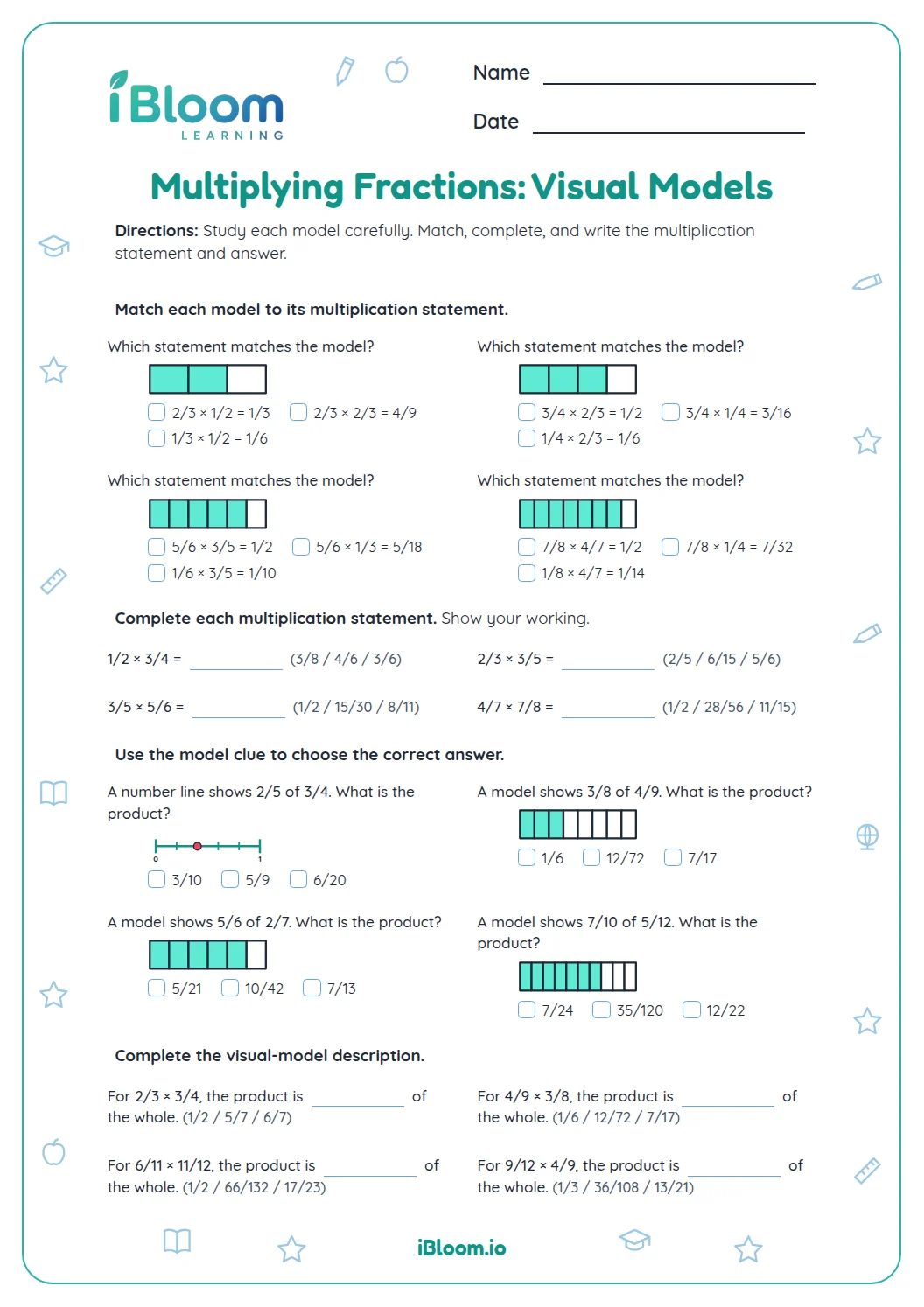
Interpret the product (a/b) × q as a parts of a partition of q into b equal parts; equivalently, as the result of a sequence of operations a × q ÷ b. For example, use a visual fraction model to show (2/3) × 4 = 8/3, and create a story context for this equation. Do the same with (2/3) × (4/5) = 8/15. (In general, (a/b) × (c/d) = (ac)/(bd).
What to practice next
Make more practice
Further reading
Questions parents and teachers ask
What is the first step in 3 × 1/6?
Multiply 3 by the numerator 1, then keep the denominator 6. The intermediate numerator is 3, so the product is 3/6, which simplifies to 1/2. The early questions show that numerator step directly before students move to simplified products. This shows how the repeated groups accumulate in the numerator.
Why does the denominator stay the same?
The denominator names the size of each equal part. Taking several copies of one-sixth gives more sixths, not a different-sized part. The numerator counts how many sixths there are, so only that count changes during the multiplication step. The denominator continues to name the size of each equal part.
How do students simplify an improper fraction product?
First multiply the whole number by the numerator. Then keep the denominator, reduce if possible, and rewrite an improper fraction as a mixed number when that makes the amount clear. For example, 4 × 3/8 is 12/8, or 1 1/2.
What kinds of situations appear on the sheet?
The last part uses repeated distances and amounts: laps, recipe batches, garden rows and hiking loops. Each question gives the fraction for one group and a whole number of groups. Students multiply and report the total with the stated unit.
Does the answer key include the intermediate steps?
Yes. Each early numerator blank has its own keyed value, including 2 × 1, 3 × 1 and 4 × 1. The answer key also gives simplified products and the results with units for the four application questions. The key lists each numerator step separately before showing later products.