


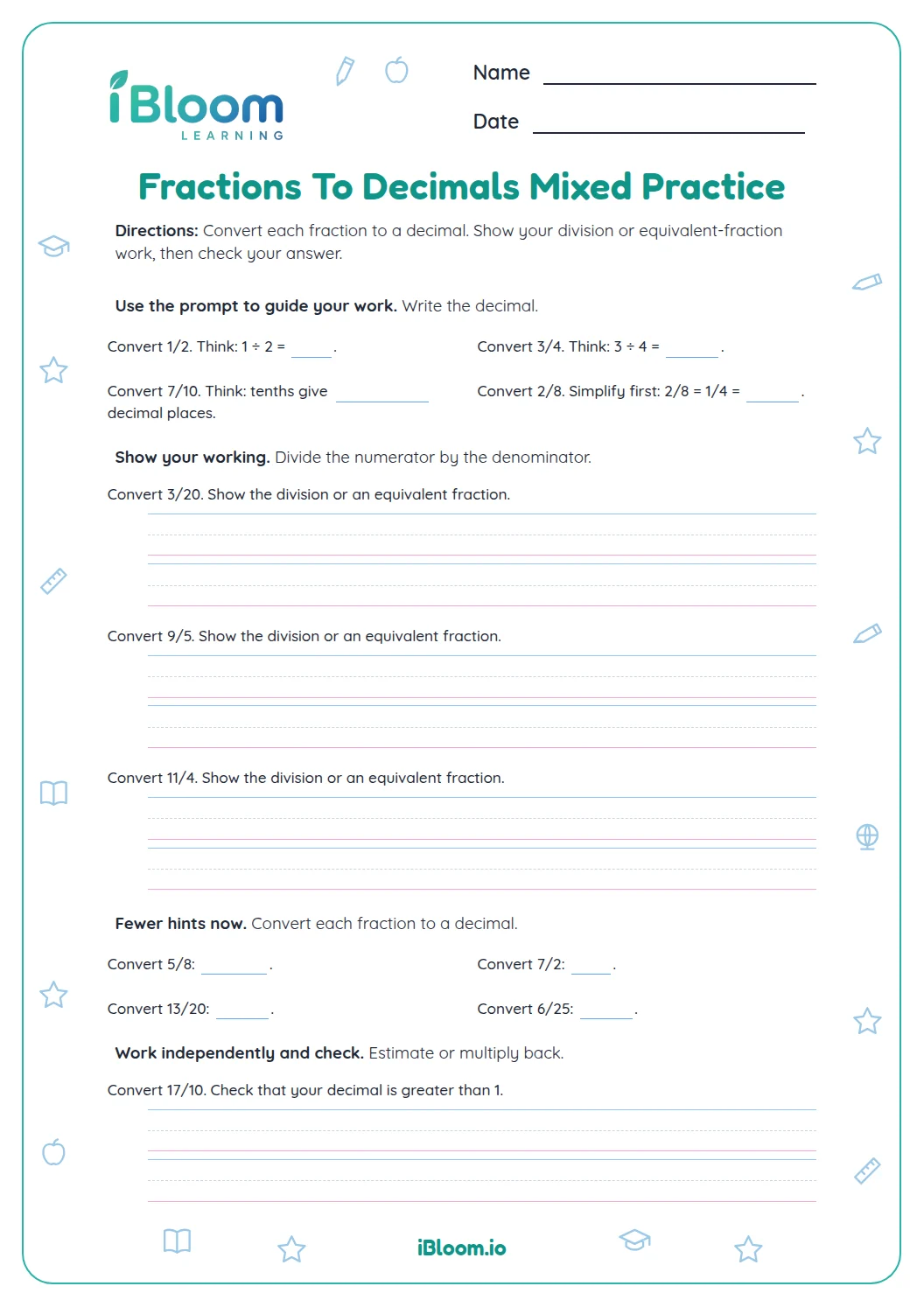
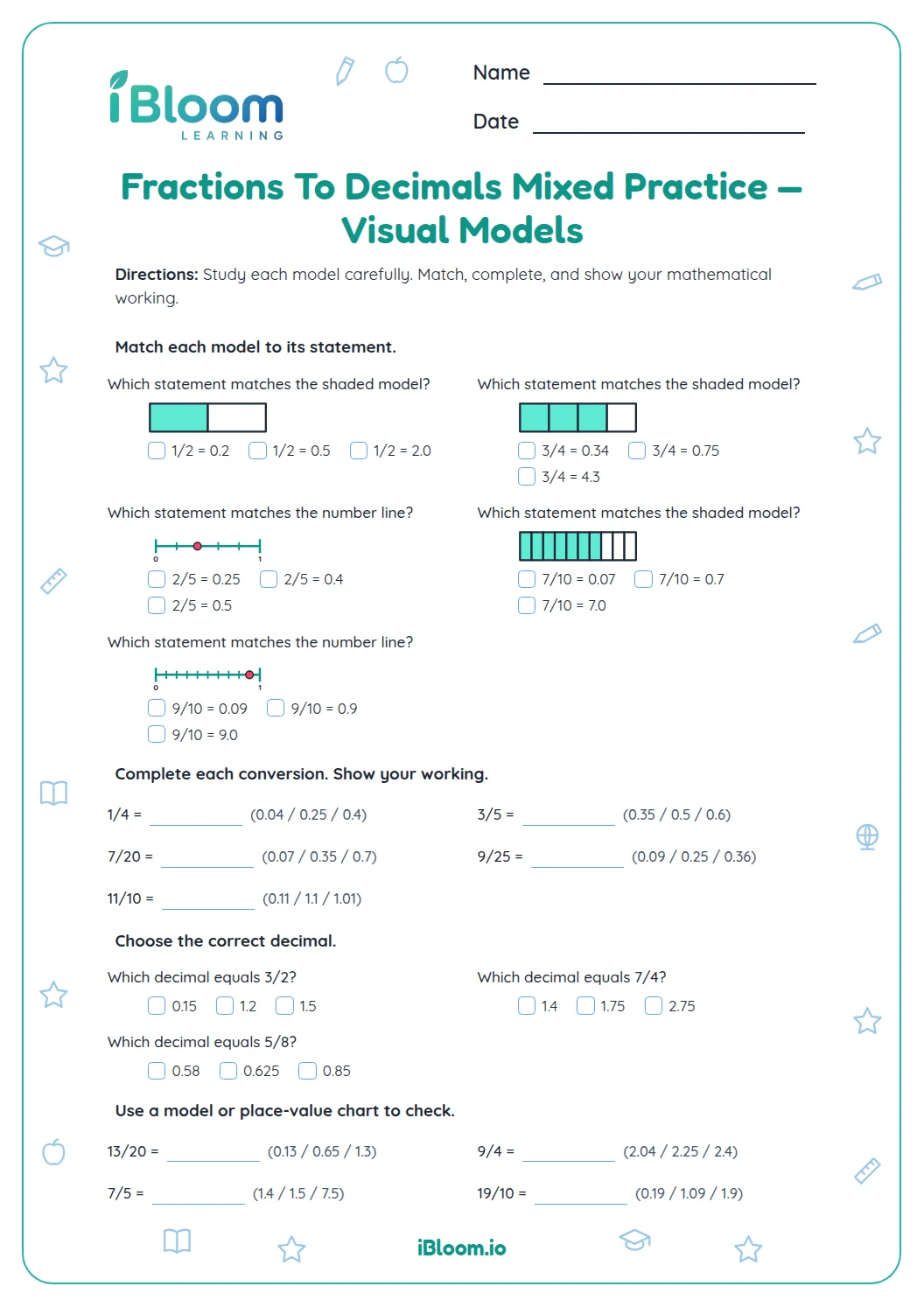
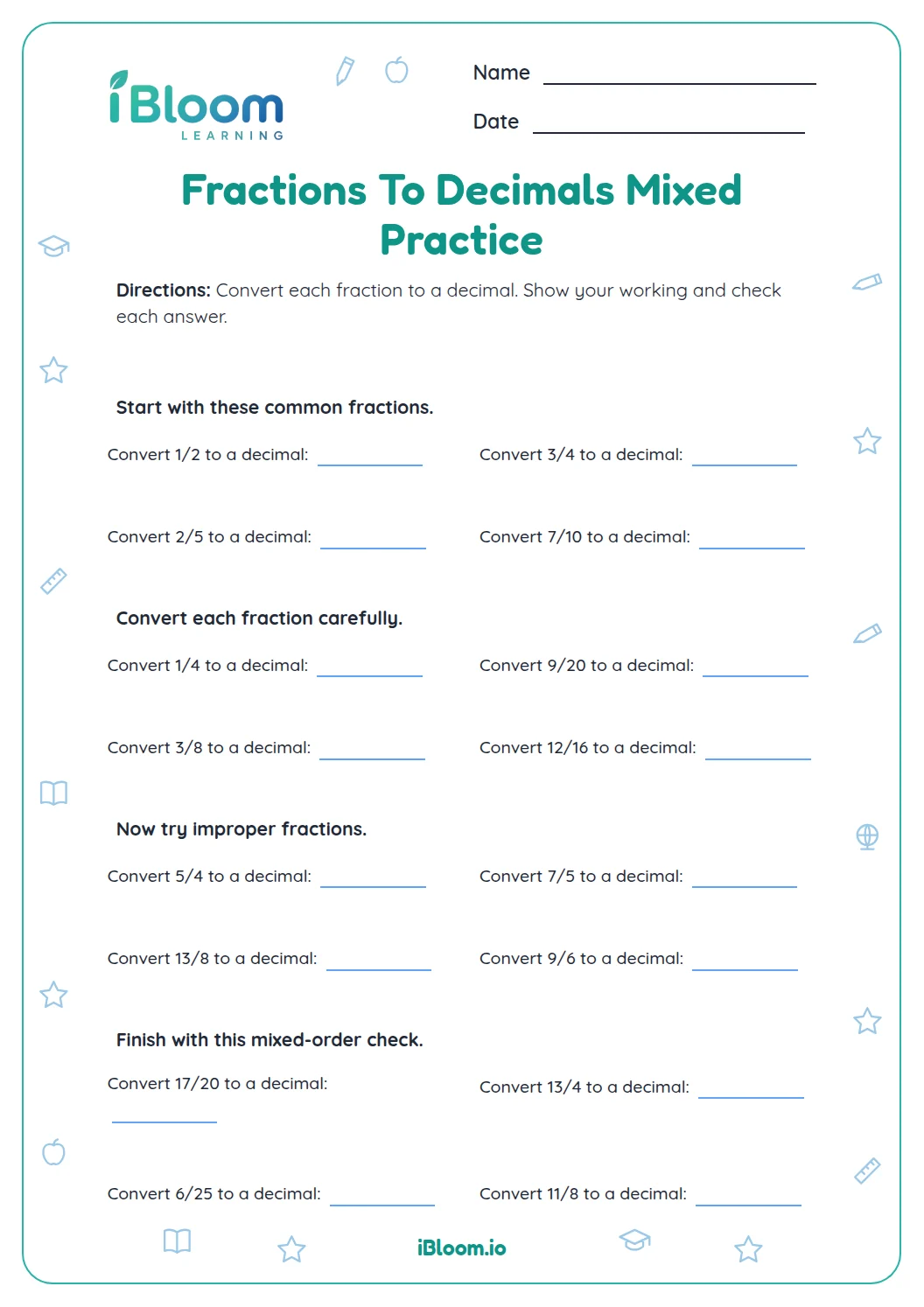
About this worksheet
This Grade 6 reasoning challenge practices writing mixed numbers as decimals. Students convert tenths and hundredths, identify a place-value error, move between decimal and mixed-number forms, and record measurements in decimal notation. The 16 questions appear in four parts with a separate answer key. The first question keeps the whole number and decimal fraction answers in distinct questions and blanks.
Aligned to 4.NF.C.6
How do tenths become decimal digits?
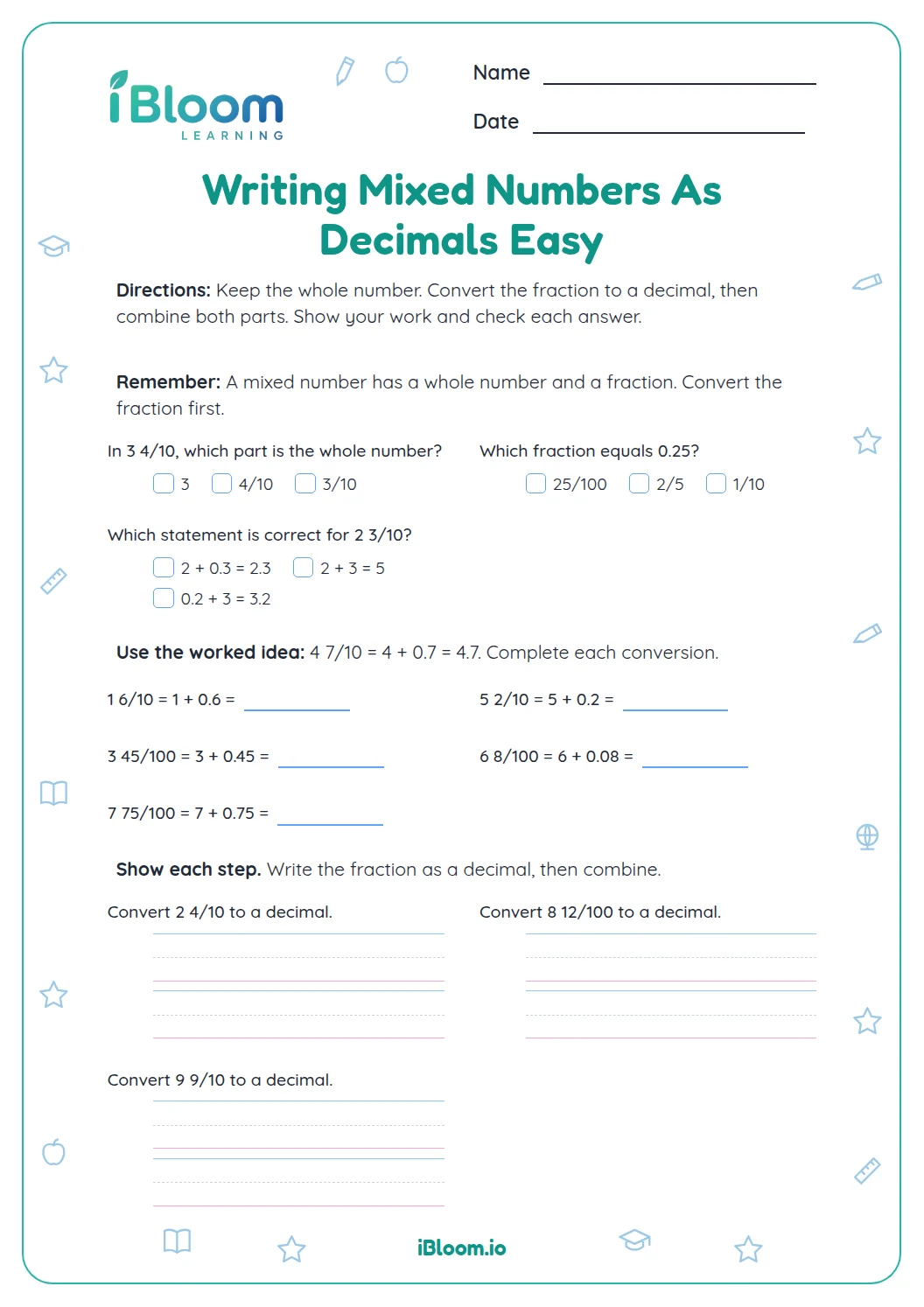
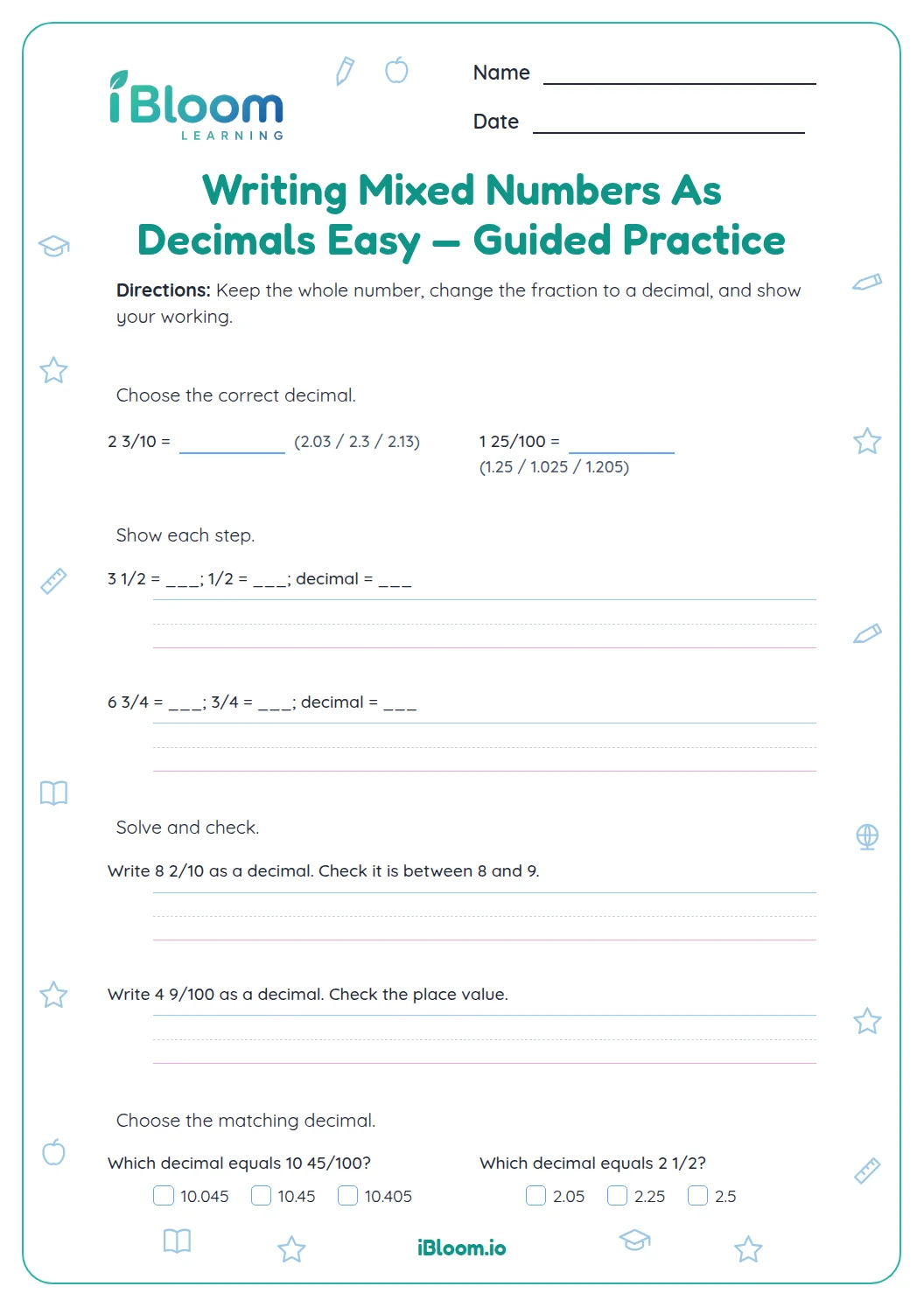
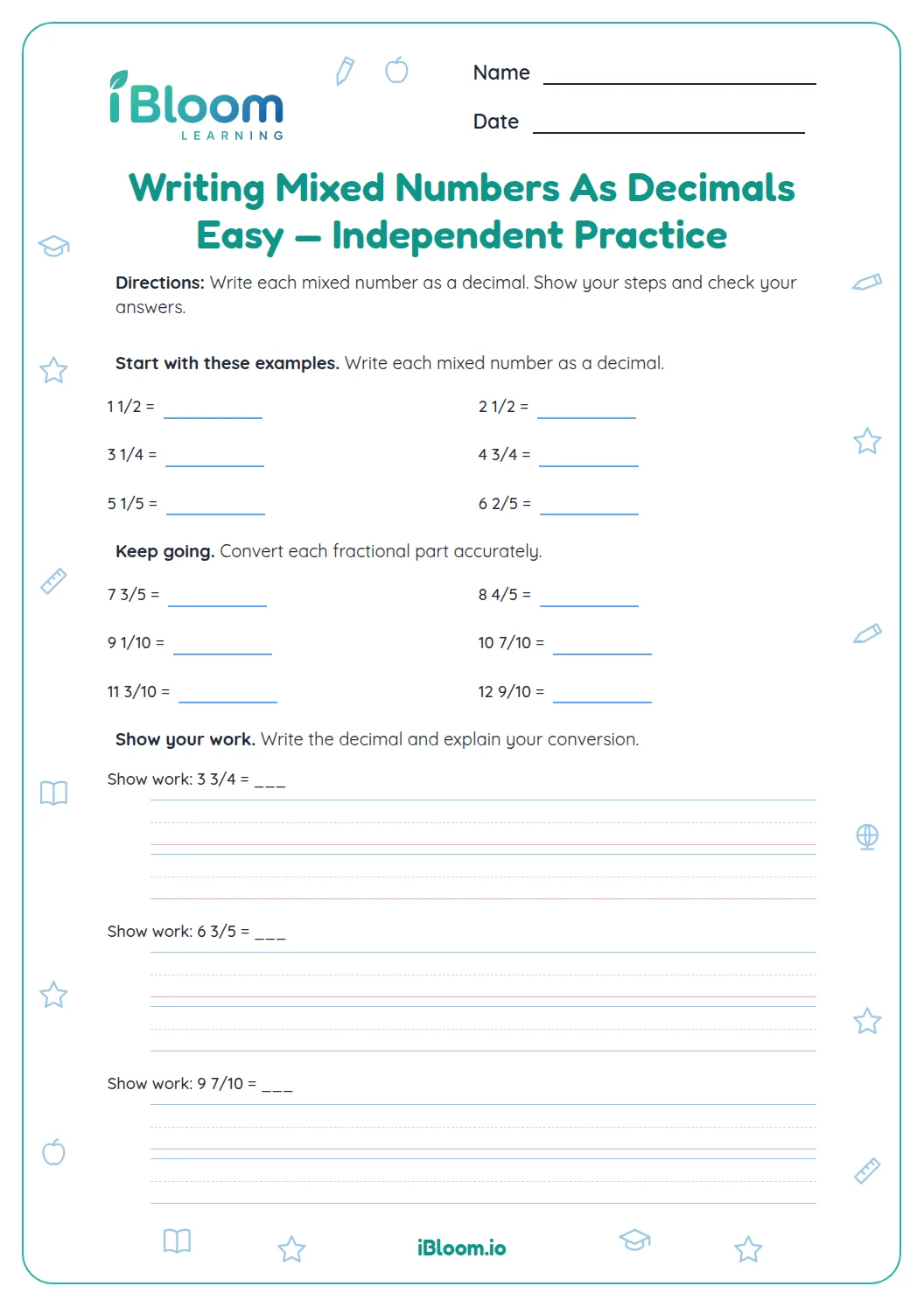
A mixed number combines a whole number with a fractional part. To write 4 5/10 as a decimal, keep 4 and write 5/10 as 0.5, giving 4.5. The first question asks for the decimal and separately asks which whole number stays the same.
- 14 5/10 = 4.5
- 2The whole number stays 4.
How do hundredths appear in decimal notation?
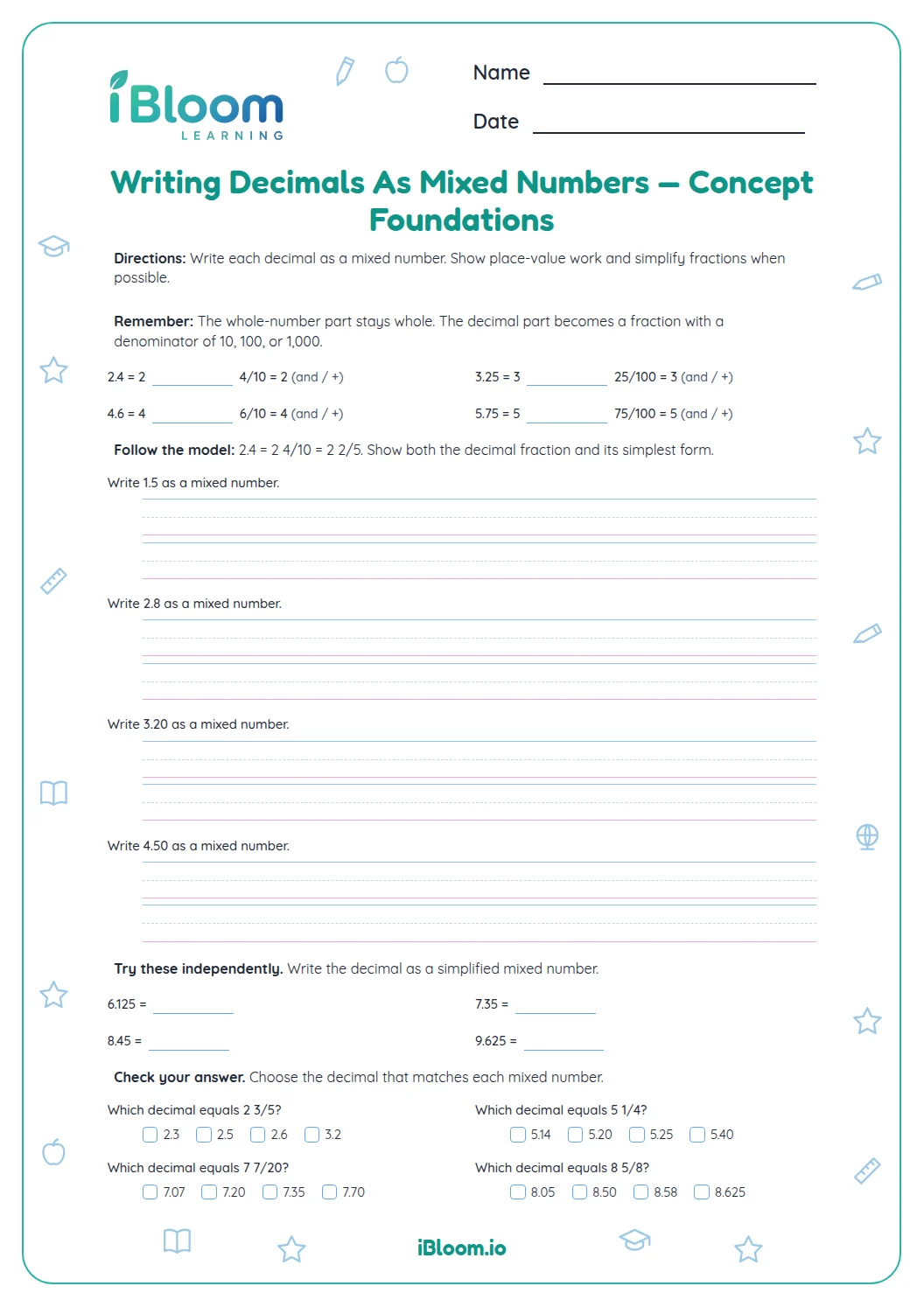
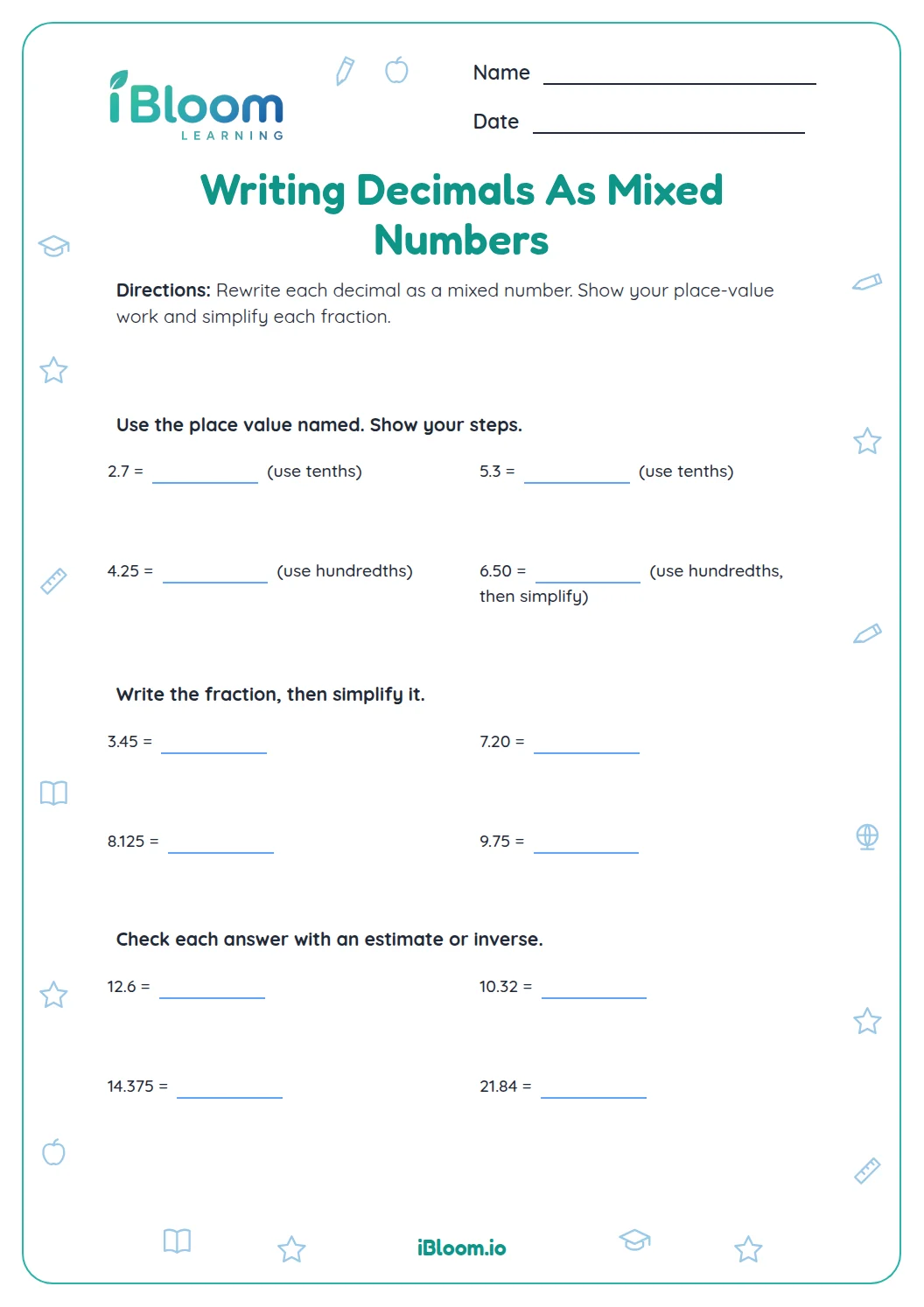
Tenths occupy the first decimal place and hundredths the second. For example, 3 25/100 is 3.25. The prompts name the fractional denominator so students can place each digit correctly.
How can students catch a place-value error?
Compare the fraction name with the decimal places. Four tenths is 0.4, not 0.04; the latter represents four hundredths. Question 10 uses that common mix-up and asks students to choose the corrected decimal.
What will the reasoning challenge include?
The 16 questions move from tenths to hundredths, then check an error, change decimals back to mixed numbers and write measurement amounts in decimal form. The worksheet and answer key are provided separately.
How to convert each mixed number
- 1Copy the whole number to the left of the decimal point.
- 2Name the fractional denominator: tenths use one decimal place; hundredths use two.
- 3Put the numerator in the corresponding place, adding a zero when a place is empty.
- 4Check that the decimal represents the same fraction amount.
- 5For a measurement, include the unit given in the question.
Common decimal conversion mistakes
The mistake
Writing tenths in the hundredths place, such as 5 4/10 = 5.04.
The fix
Say “four tenths” and place 4 immediately after the decimal point.
The mistake
Dropping a needed zero in a hundredths value such as 8/100.
The fix
Write 0 in the tenths place so the 8 remains in the hundredths place.
The mistake
Changing the whole-number part while converting the fraction.
The fix
Copy the whole number first, then convert only the fractional part.
Common Core alignment
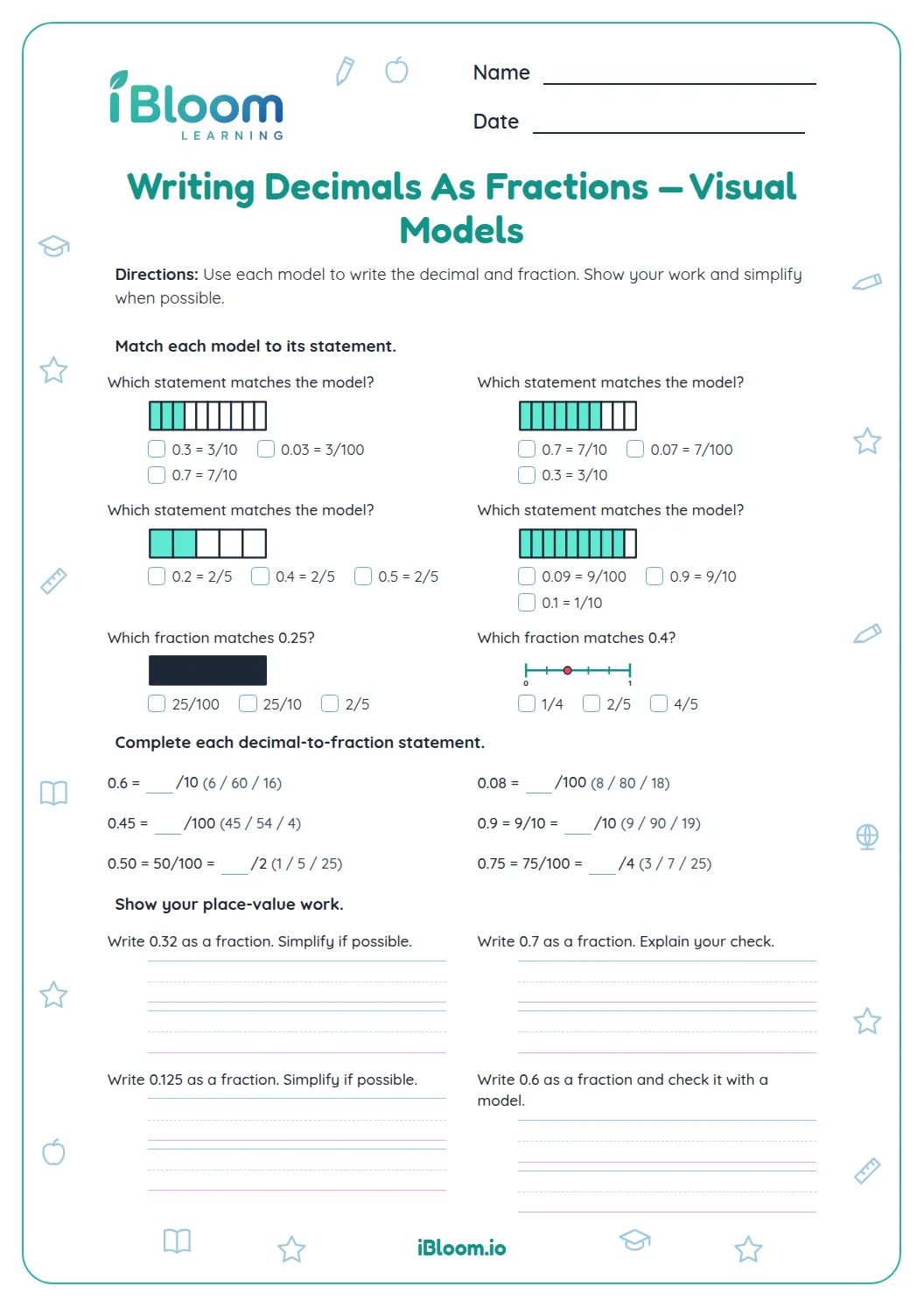
The sheet practices decimal notation as a way to write fractions with denominators 10 and 100.
Use decimal notation for fractions with denominators 10 or 100.
On this sheet: The conversion items write tenths and hundredths as decimals and use decimal measurements.
Show the official wordingHide the official wording
Use decimal notation for fractions with denominators 10 or 100. For example, rewrite 0.62 as 62/100; describe a length as 0.62 meters; locate 0.62 on a number line diagram.
What to practice next
Make more practice
Further reading
Questions parents and teachers ask
What is 4 5/10 as a decimal?
It is 4.5. The whole number 4 stays to the left of the decimal point, and five tenths is written as 5 in the tenths place. The first question asks for this decimal and keeps the whole-number reasoning visible in the explanation below.
Why does 5 8/100 become 5.08?
The fraction is eight hundredths, so its 8 belongs in the second decimal place. A zero in the tenths place holds the position open. Without it, 5.8 would mean five and eight tenths, a larger amount. That zero acts as a placeholder and protects the value of the 8.
What is the difference between 5.4 and 5.04?
In 5.4, the 4 is in the tenths place, so it represents four tenths. In 5.04, the 4 is in the hundredths place, so it represents four hundredths. Question 10 asks students to correct this exact kind of place-value slip.
Does the worksheet include conversions in both directions?
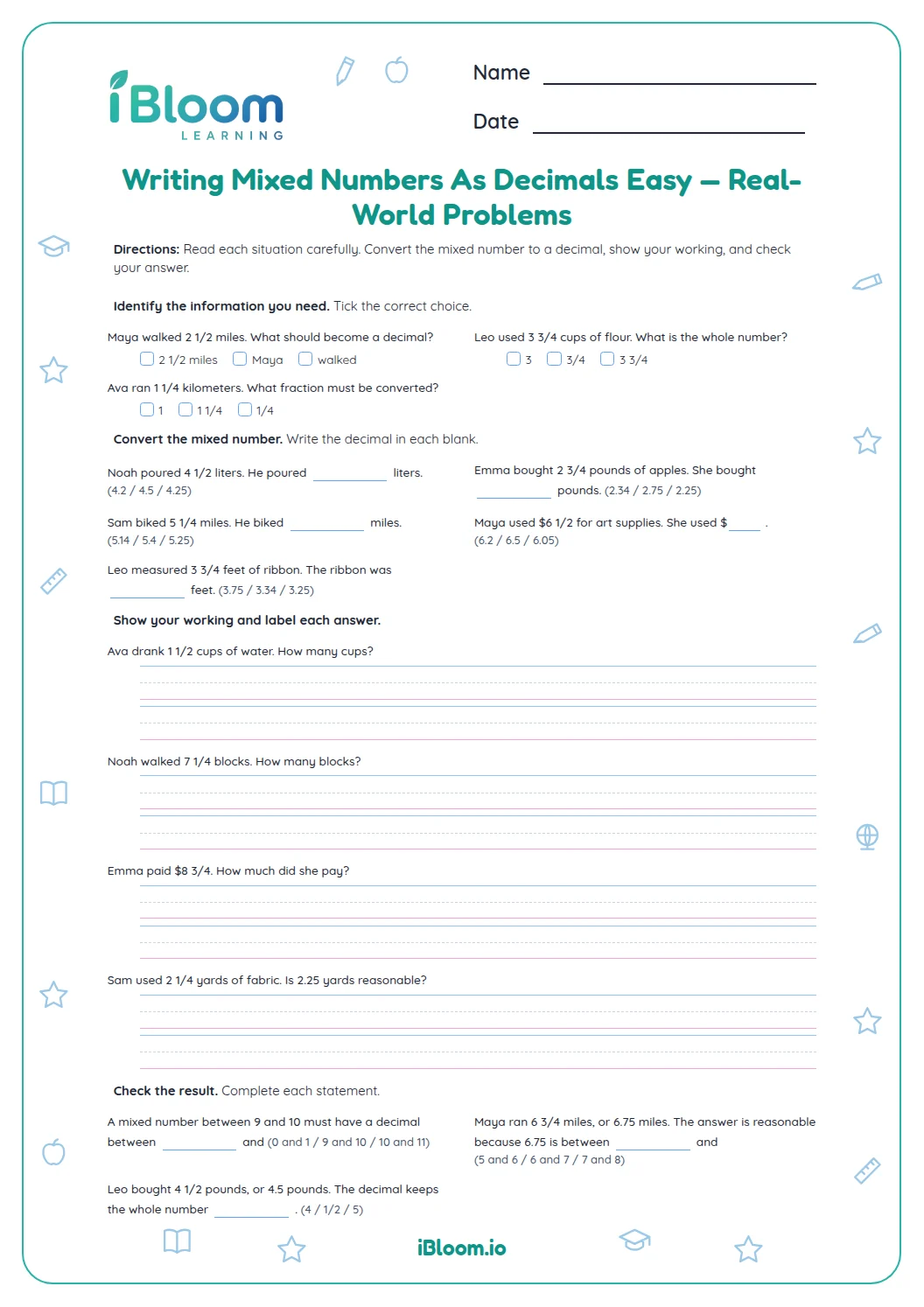
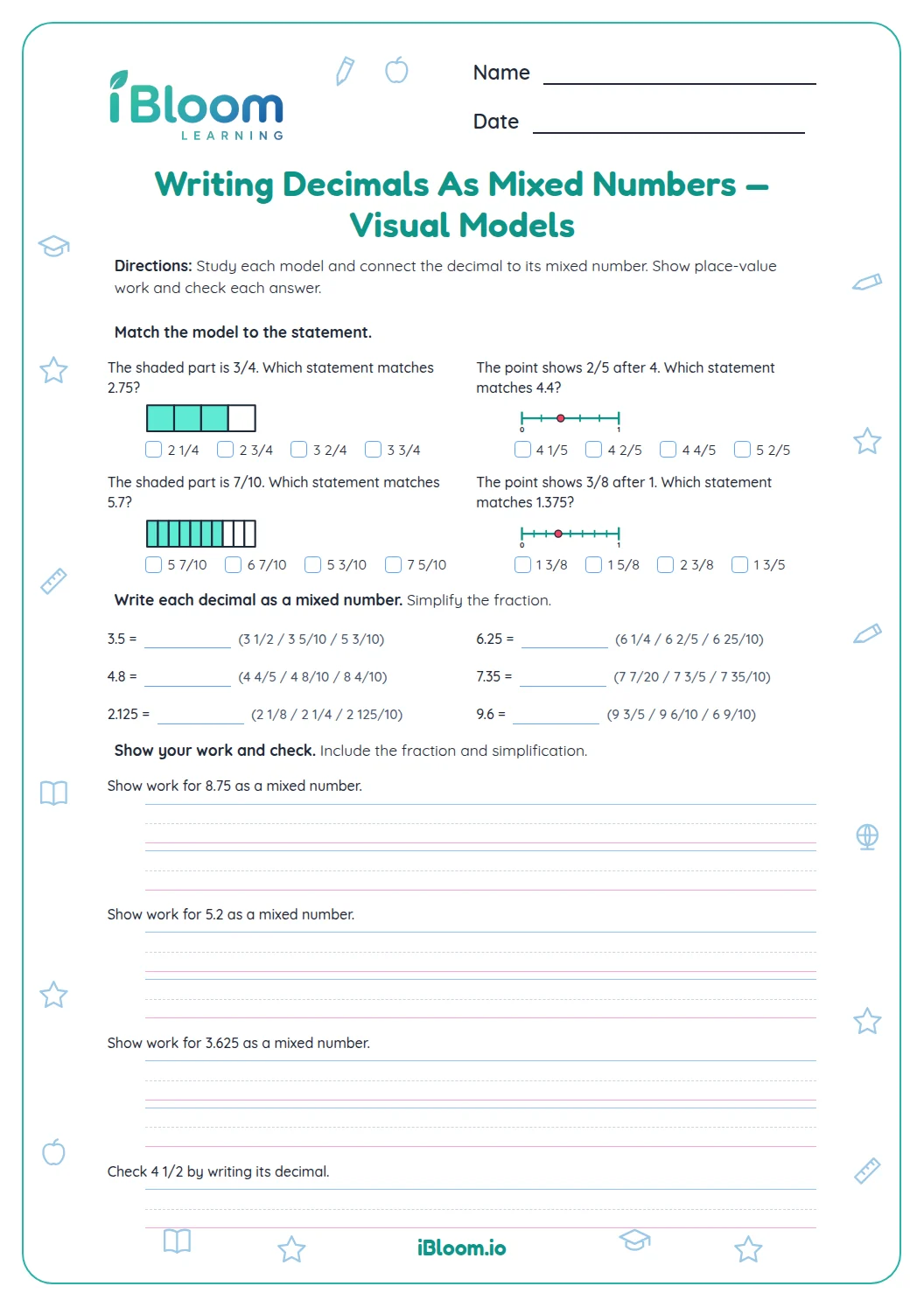
Yes. Most questions convert mixed numbers to decimals, while two ask students to write decimals as mixed numbers with tenths or hundredths. The final items apply decimal notation to measurements in liters, miles and feet. The reverse questions check that students can read decimal places both ways.
What is included in the answer key?
A separate answer key gives all 16 responses, including the decimal conversions, the corrected choice, mixed-number forms and measurement amounts. A unit is included where the question asks students to report a measured quantity. The answer key follows the same unit labels used in the measurement prompts.