





About this worksheet
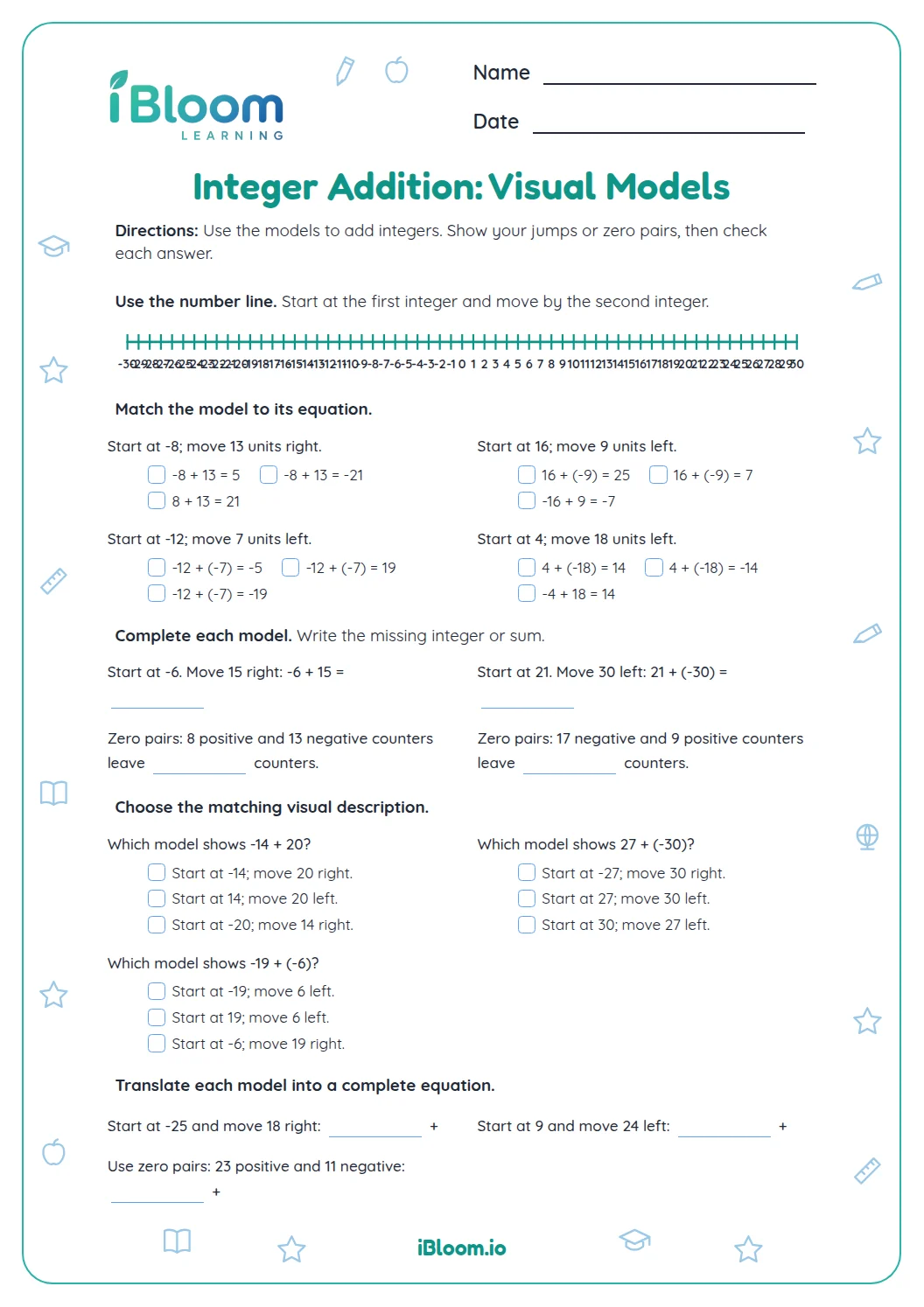
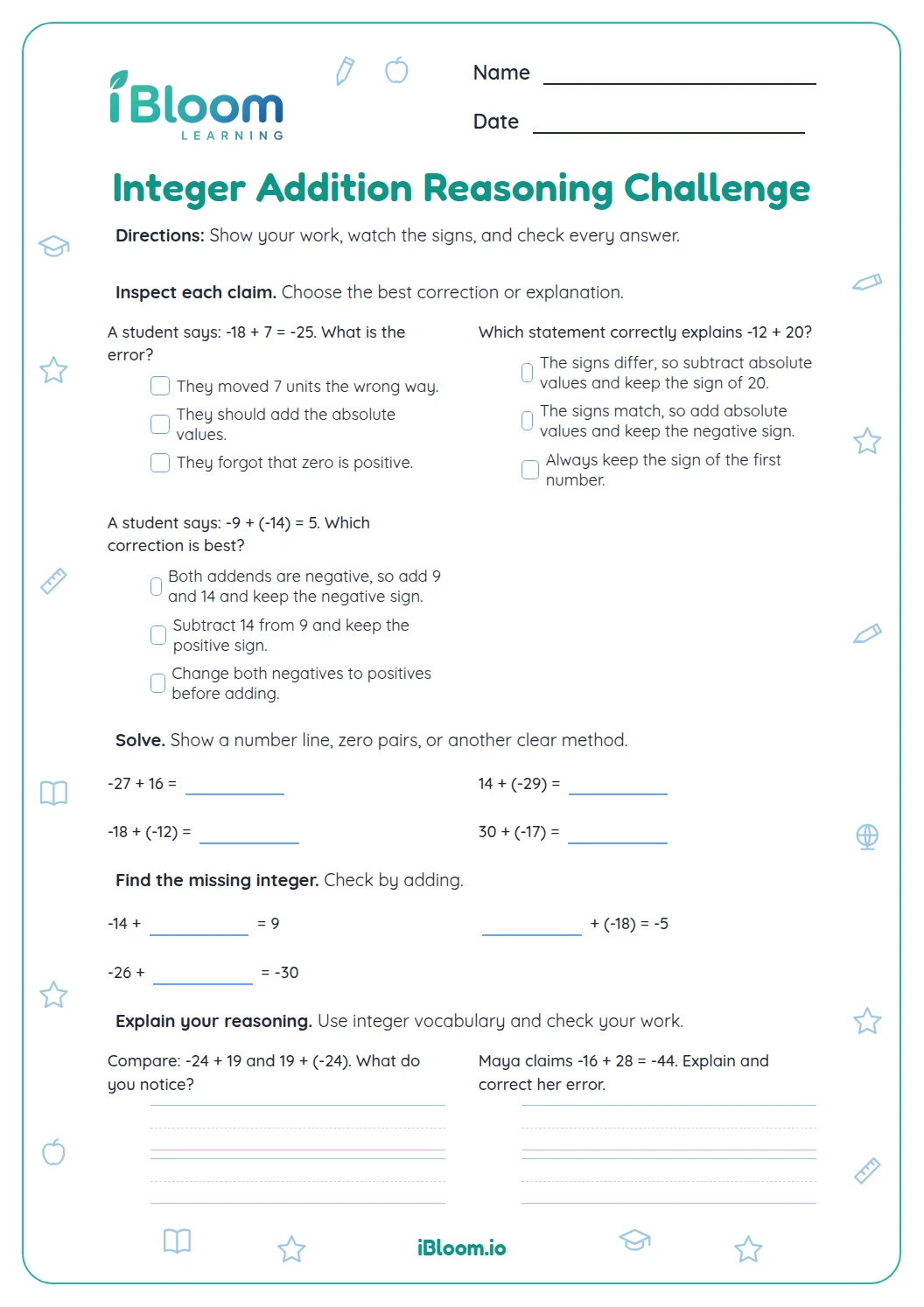
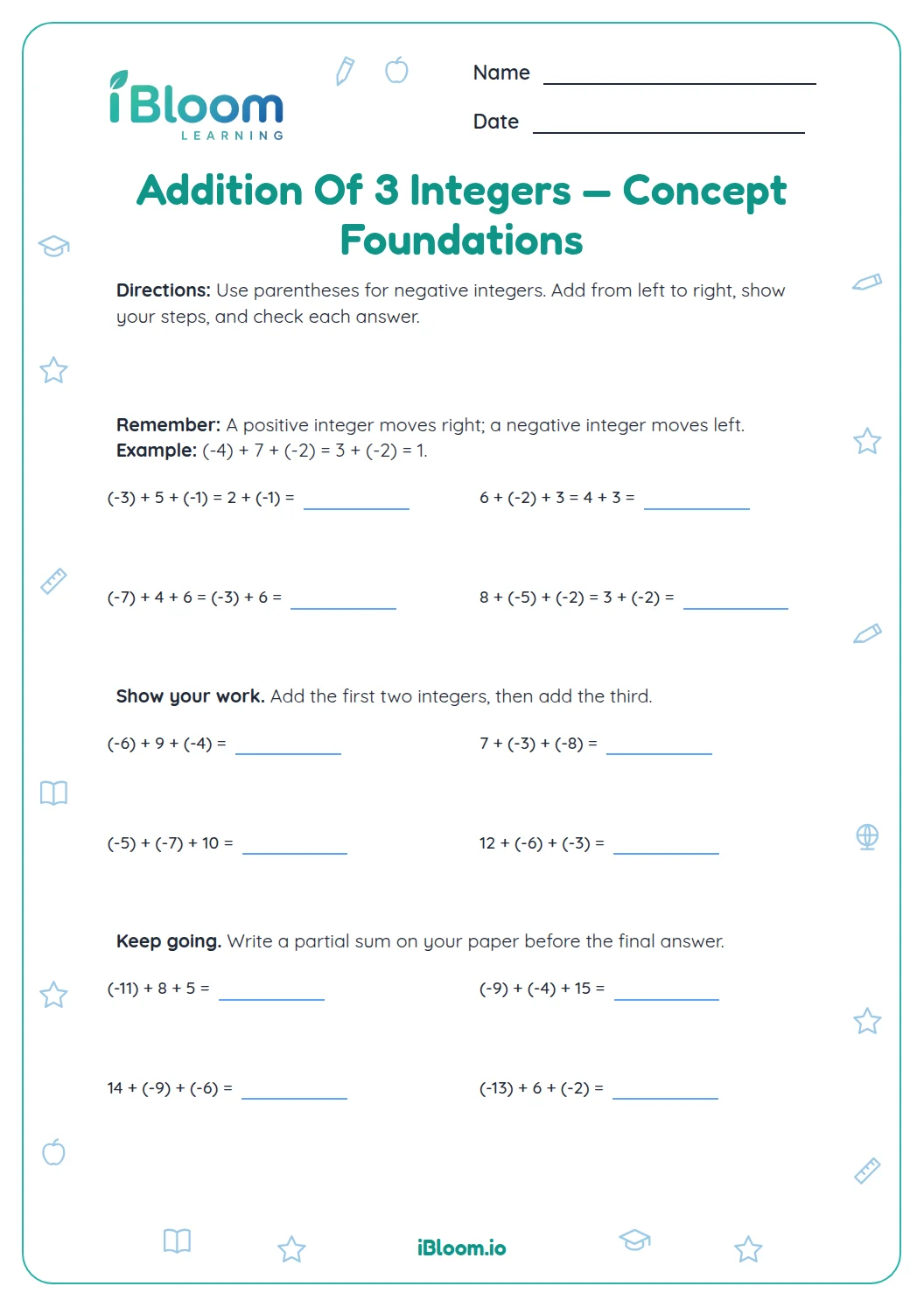
This guided practice worksheet covers integer addition from −30 to +30. Students first add opposites to make zero, then combine integers with matching and different signs, and finally interpret signed changes in elevation and game scores. There are 16 questions across four parts with a separate answer key. The zero-pair idea is asked in a standalone question so each blank has one answer.
Why do opposites add to zero?
An integer and its opposite are the same distance from zero but lie in opposite directions. Their total is zero. Question 1 asks for the sum; question 2 separately asks how many zero pairs form.
- 1(−18) + (+18) = 0
- 2The two addends are opposites, so their sum is zero.
How do you add integers with the same sign?
Add their magnitudes and keep the shared sign. For example, (−12) + (−8) is −20 because the magnitudes total 20 and both addends are negative.
How do you add integers with different signs?
Subtract the smaller magnitude from the larger magnitude. The result takes the sign of the addend with the larger magnitude. In (+24) + (−9), 24 is larger than 9, so the result is positive 15.
How can a signed sum describe a change?
A positive change moves upward or adds points; a negative change moves downward or removes points. The last part represents starting values and changes as addition, then interprets the resulting elevation or score.
How to add the integers
- 1Keep the sign attached to each addend.
- 2For opposites, recognize that the sum is zero.
- 3For matching signs, add magnitudes and keep the common sign.
- 4For different signs, subtract magnitudes and use the sign of the larger magnitude.
- 5In a context, identify the starting value and write each change with its sign.
Common integer addition mistakes
The mistake
Dropping a plus or minus sign before calculating.
The fix
Copy each addend with parentheses so its sign stays attached.
The mistake
Adding magnitudes for different-sign addends.
The fix
Subtract the magnitudes and use the sign of the number farther from zero.
The mistake
Writing a nonzero sum for opposite integers.
The fix
Match each positive unit with one negative unit; all units cancel.
What to practice next
Make more practice
Further reading
Questions parents and teachers ask
What is the sum of −18 and +18?
The sum is zero because −18 and +18 are opposites. Each positive unit cancels one negative unit. Question 1 asks for the sum in one blank, while question 2 separately asks how many zero pairs form. This keeps the numerical result separate from the count of matched pairs.
How do you add two negative integers?
Add their magnitudes and keep the negative sign. For example, (−12) + (−8) is −20. On a number line, both moves go in the negative direction, so the total is farther below zero. A number line move can help students see why both addends combine negatively.
How do you add integers with different signs?
Subtract the smaller magnitude from the larger one, then use the sign of the addend with the larger magnitude. In (+24) + (−9), the result is positive 15 because 24 has the larger magnitude. Magnitude comparison identifies which sign remains in the answer.
What does a negative elevation or score change mean?
A negative change means the value decreases; a positive change means it increases. The final questions combine each starting value with a signed change, so students can find the new elevation or score using integer addition. Each context turns its change into a signed addend.
What range of integers appears on this sheet?
The addends and sums stay within the stated range of −30 to +30. The worksheet has 16 items in four parts: opposites, same-sign sums, different-sign sums and short applications. A separate answer key lists each result. The key reports every total with the value expected for that item.