
About this worksheet
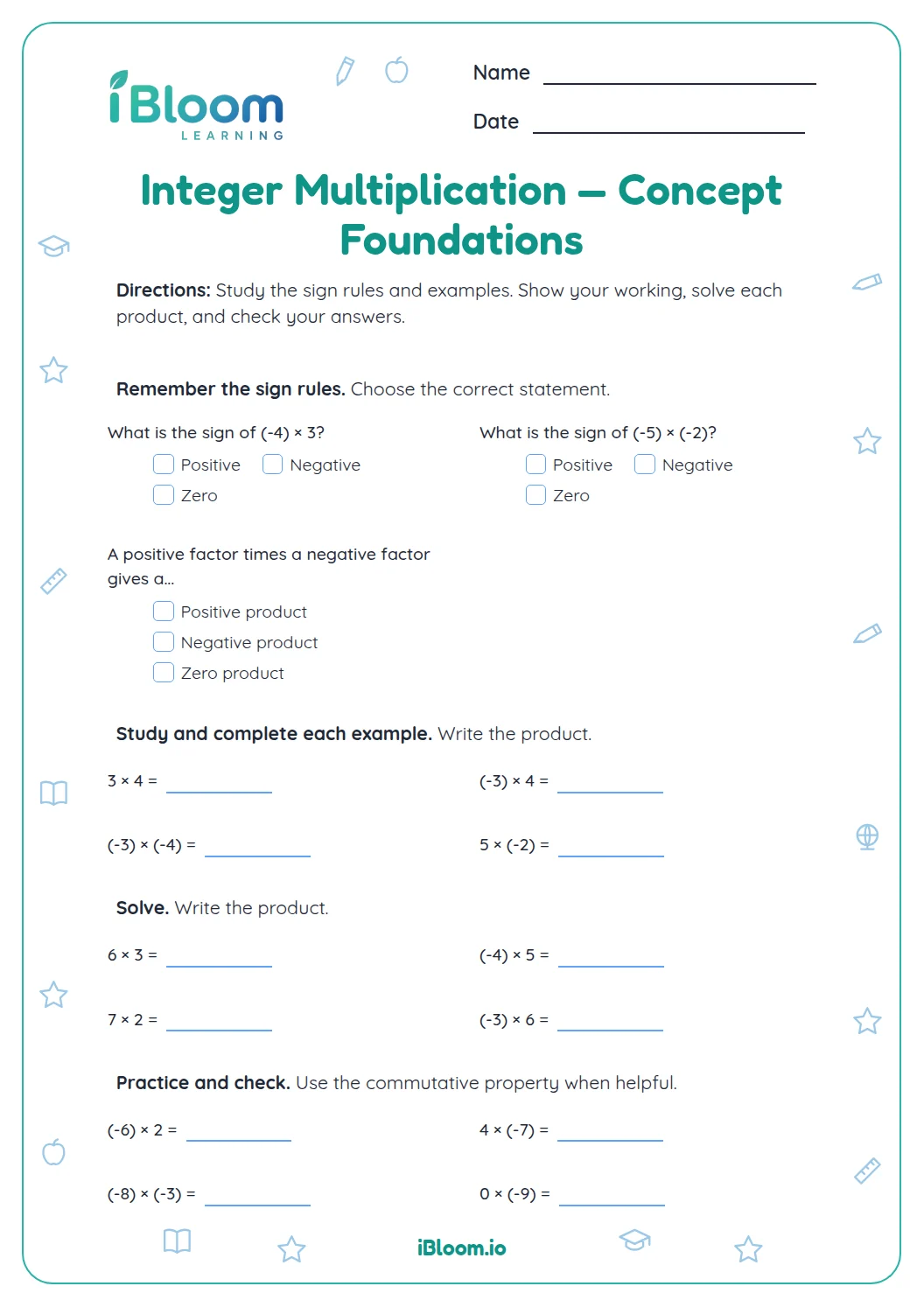
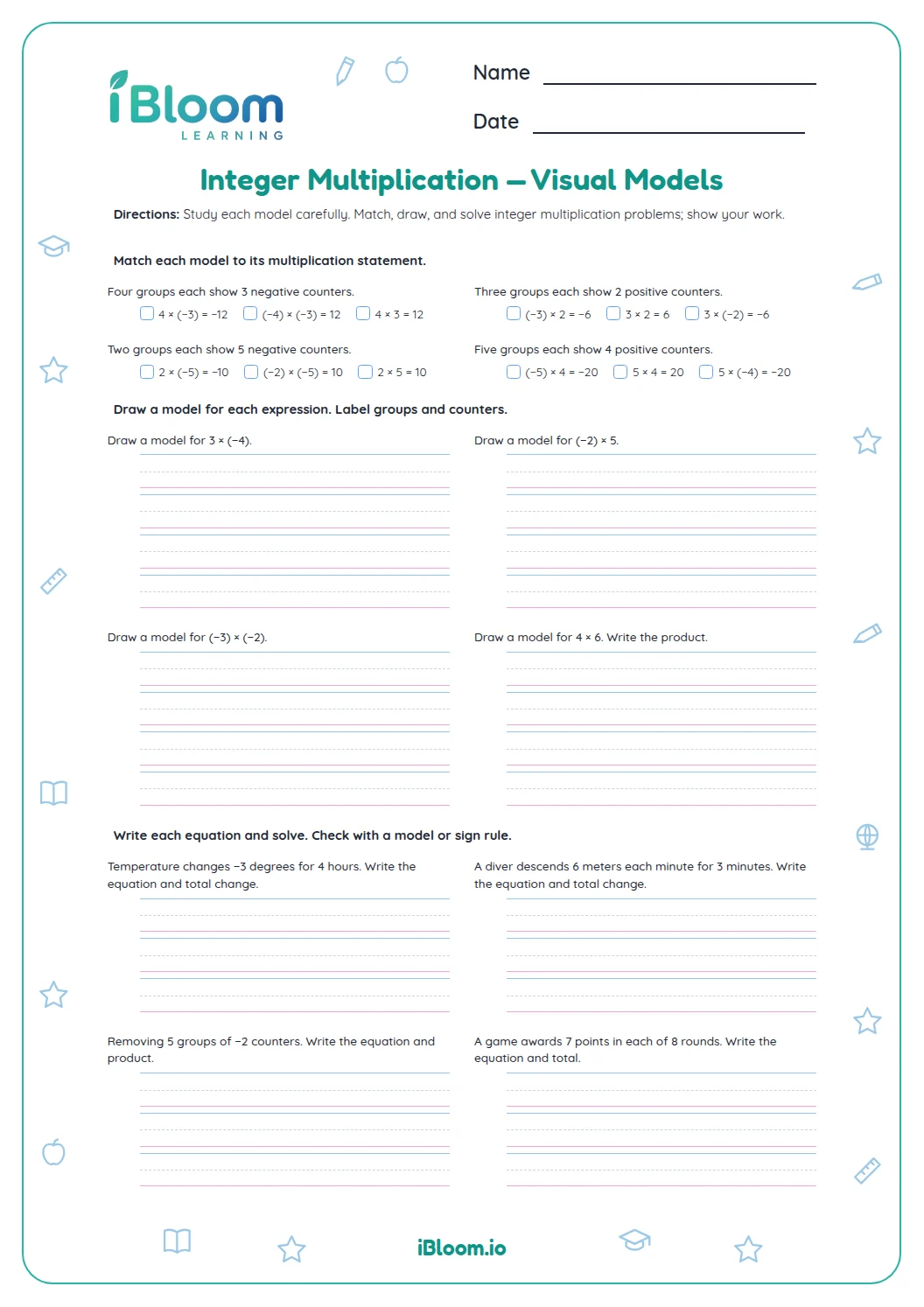
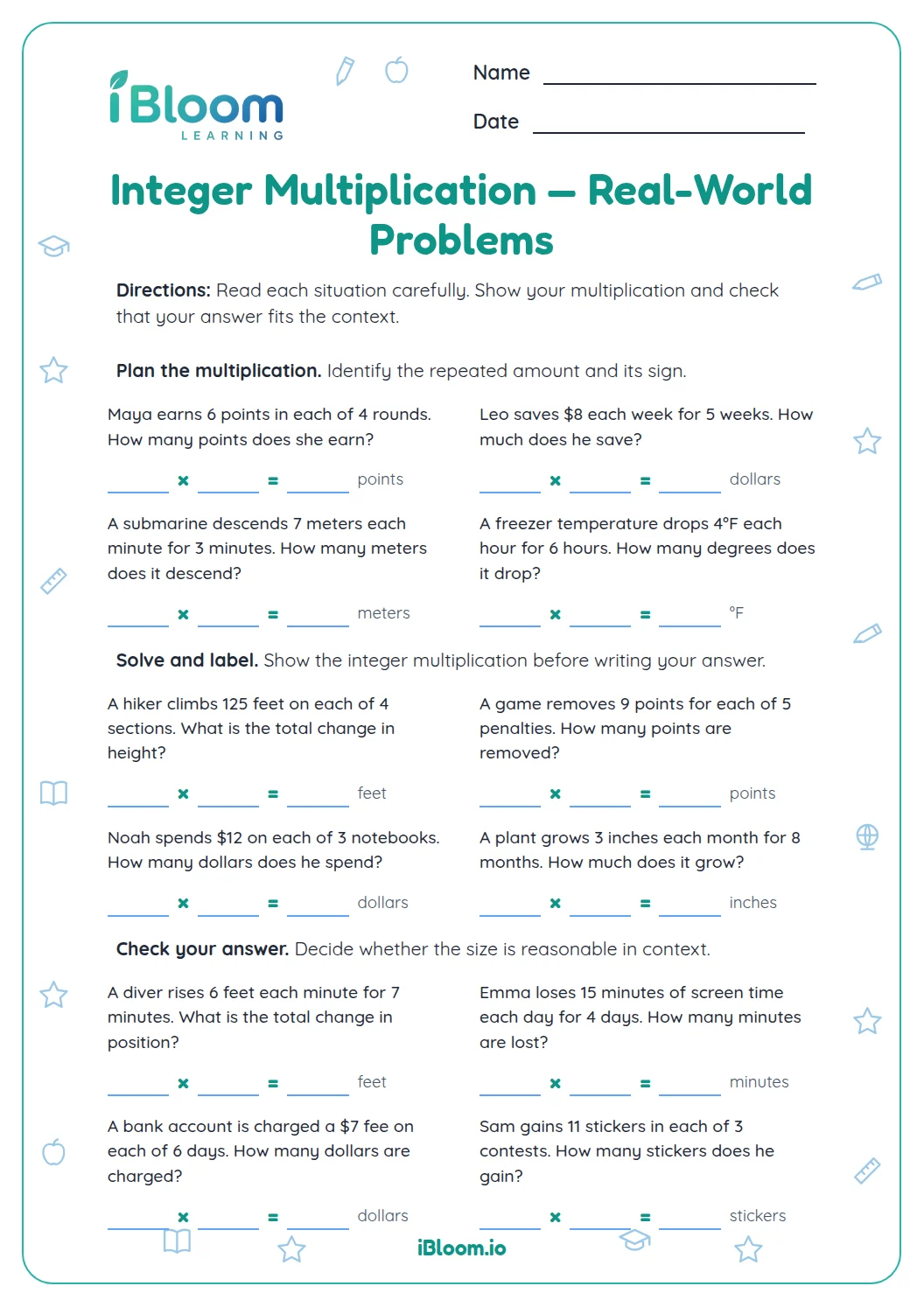
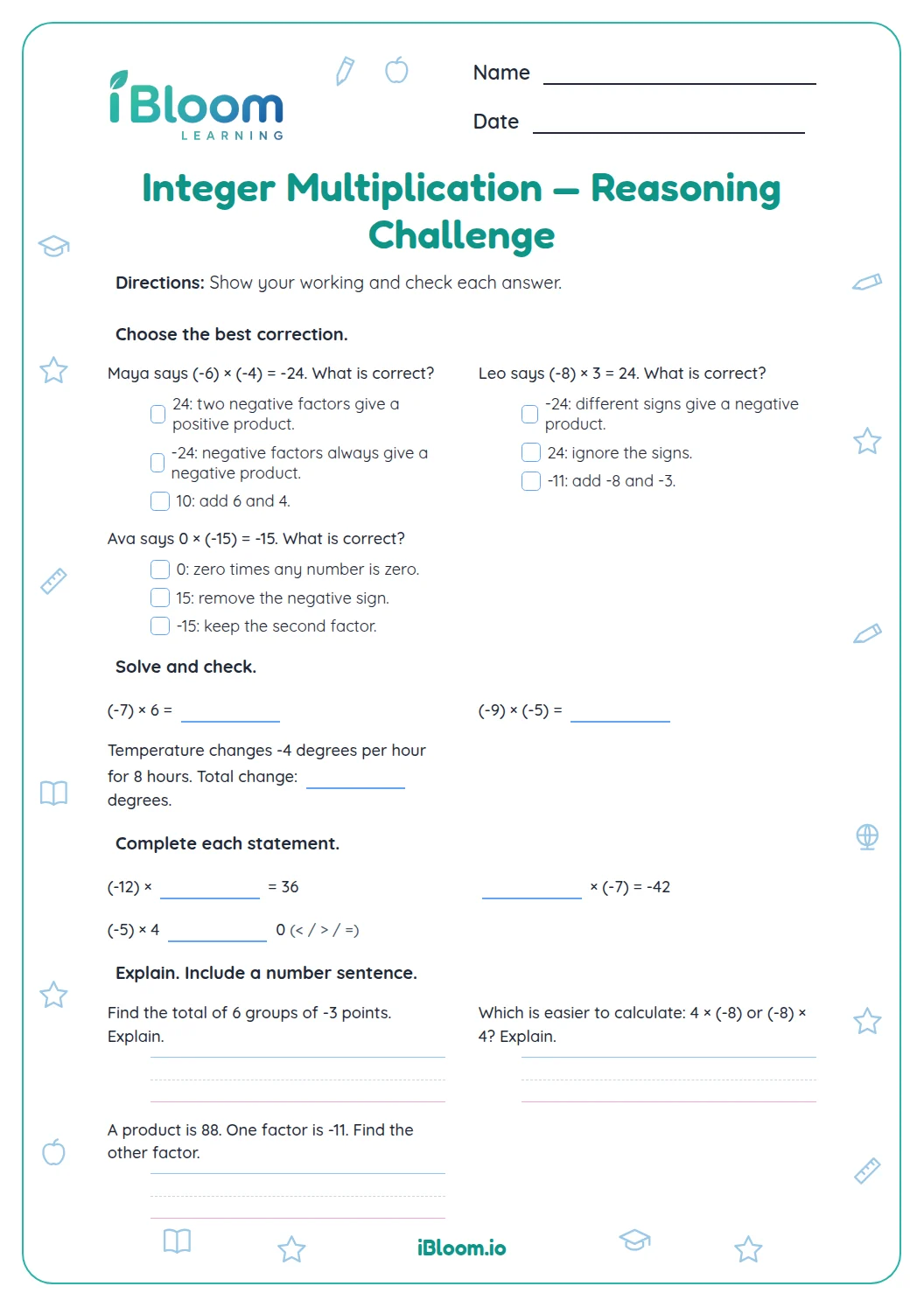
This Grade 6 worksheet gives students practice with practice signs and products with positive and negative integers. It has 16 printed questions on two worksheet pages, followed by a two-page answer key. Students work through 4 sections, using the printed numbers and equations on the student pages. The answer key provides the results for checking each item. The problems practice CCSS 7.NS.A.2.a, as described in the curriculum alignment below.
Aligned to CCSS.MATH.CONTENT.7.NS.A.2.a
How do factor signs determine a product?
Factors with the same sign have a positive product; factors with different signs have a negative product. Any factor multiplied by zero gives a product of zero.
How can a product represent a change?
A repeated decrease can be modeled by multiplying a negative rate by a positive number of time units. For example, a drop of 4 degrees each hour for 6 hours is (−4) × 6 = −24 degrees.
What does the answer key help students check?
Use the key to check both the numerical product and its sign. For a missing-factor question, multiply the proposed factor by the given integer to see whether it gives the stated product.
How to work through the sheet
- 1Read the section direction before beginning its problems.
- 2Copy or use the numbers printed in each question.
- 3Show calculation steps in the working space when provided.
- 4Check the result against the answer key after solving.
Check your work
The mistake
Forgetting place value or sign rules while calculating.
The fix
Write each step clearly, then estimate or use the inverse operation to check.
Curriculum alignment
This worksheet practices the named grade-level skill.
Apply multiplication rules to signed rational numbers.
On this sheet:
Show the official wordingHide the official wording
Understand that multiplication is extended from fractions to rational numbers by requiring that operations continue to satisfy the properties of operations, particularly the distributive property, leading to products such as (−1)(−1)=1 and the rules for multiplying signed numbers.
What to practice next
Questions parents and teachers ask
When is an integer product negative?
A product is negative when one factor is positive and the other is negative. The magnitude comes from multiplying the absolute values; the unlike signs determine that the result is below zero. Use the printed factors and directions to guide each step, then compare the result with the answer key.
What happens when both factors are negative?
The product of two negative integers is positive. Multiply their absolute values, then use a positive sign. For example, (−6) × (−5) = 30. Use the printed factors and directions to guide each step, then compare the result with the answer key.
What is the product of an integer and zero?
Any integer multiplied by zero has a product of zero. In this worksheet, (−9) × 0 equals 0, regardless of the negative sign on the other factor. Use the printed factors and directions to guide each step, then compare the result with the answer key.
How can a negative rate describe change?
A negative rate can represent a decrease in each time period. A drop of 4 degrees per hour for 6 hours is (−4) × 6 = −24 degrees, so the total change is a decrease of 24 degrees. Use the printed factors and directions to guide each step, then compare the result with the answer key.
Which standard does this skill practice?
The sheet practices CCSS 7.NS.A.2a, applying multiplication to signed rational numbers and the rules for signed products. Its integer factors are whole numbers with positive or negative signs. Use the printed factors and directions to guide each step, then compare the result with the answer key.