







About this worksheet
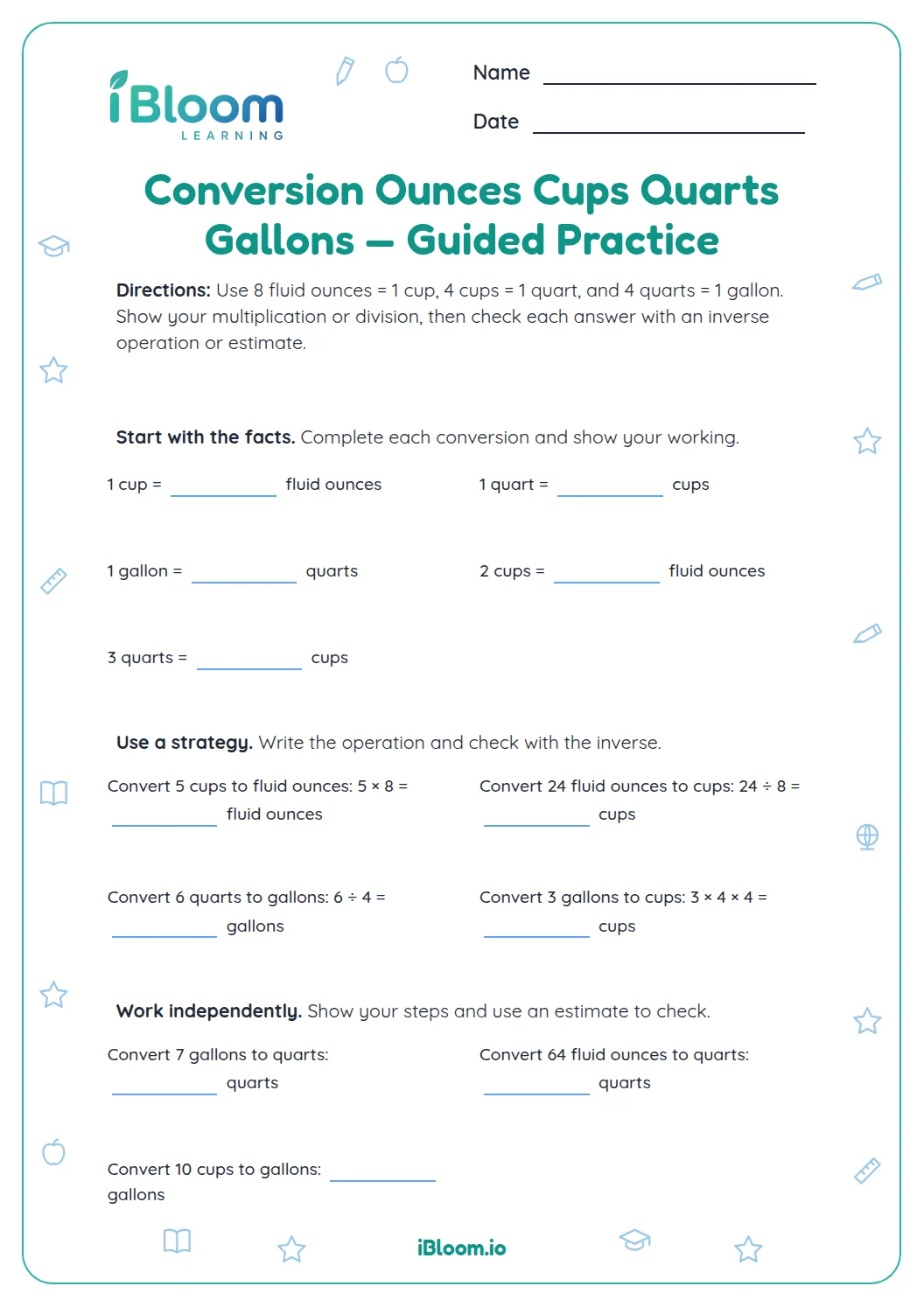
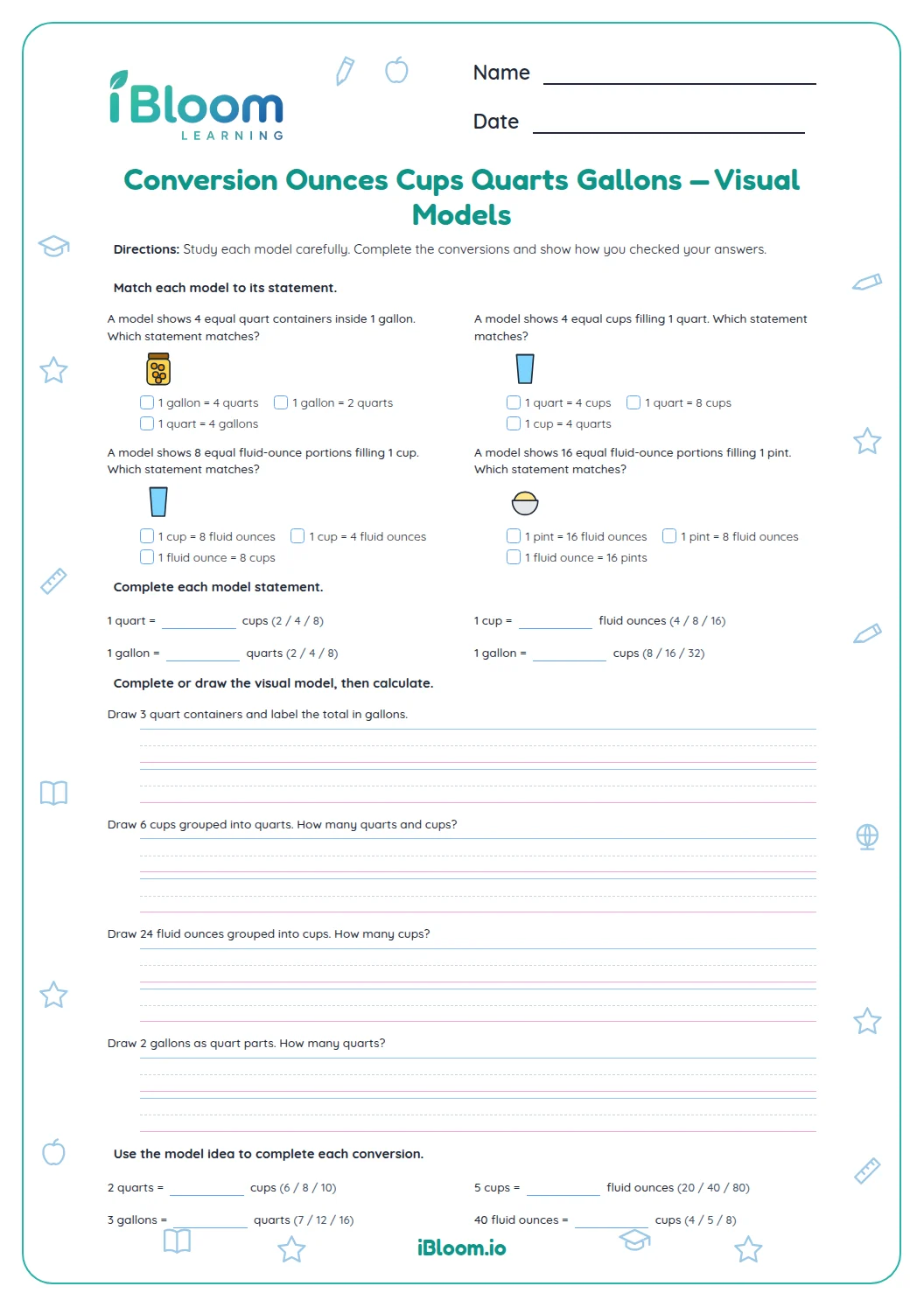
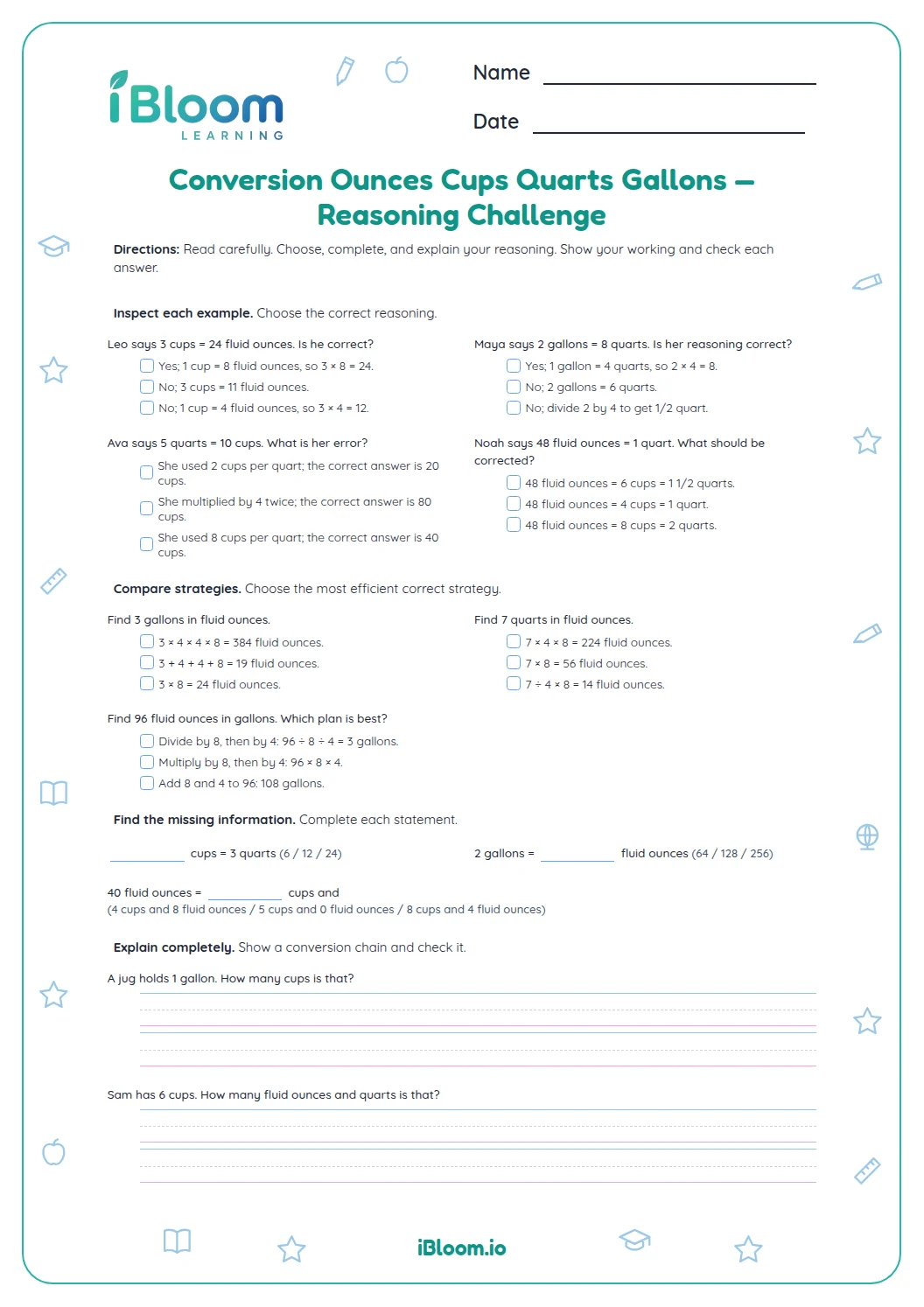
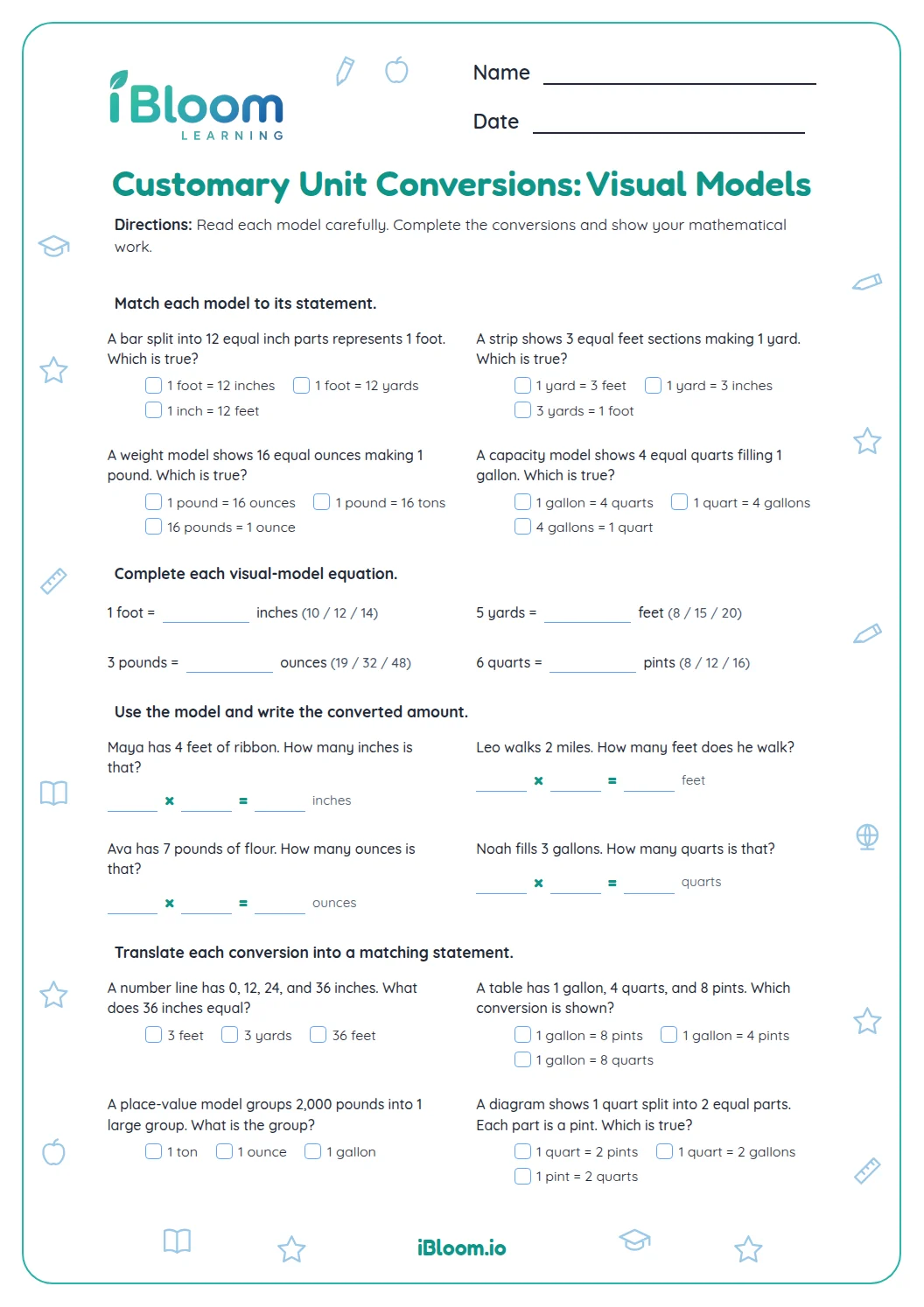
This free printable Grade 6 worksheet gives students 16 varied questions about converting customary volume using ounces, cups, quarts, and gallons. The practice moves from foundational choices to independent calculations and short real-world situations. It aligns with Common Core 5.MD.A.1. A separate answer key supports checking each calculation and unit.
Aligned to 5.MD.A.1
How do ounces, cups, quarts, and gallons connect?
A cup contains 8 fluid ounces, a quart contains 4 cups, and a gallon contains 4 quarts. Multiplying along the chain gives 16 cups in one gallon.
For q9, 4 quarts × 4 cups per quart = 16 cups. Since cups are smaller units than quarts, the count grows.
How can you check a volume conversion?
Check whether you are moving up or down the unit chain. Converting gallons into cups should increase the number; converting cups into gallons should decrease it.
For q10, 48 cups ÷ 16 cups per gallon = 3 gallons. Multiply back to confirm: 3 gallons equals 48 cups.
Common mistakes and quick fixes
The mistake
Confusing cups and fluid ounces
The fix
There are 8 fluid ounces in 1 cup.
The mistake
Using 4 cups per gallon
The fix
There are 4 cups per quart and 4 quarts per gallon.
The mistake
Repeating the unit in the answer key
The fix
Include the target unit once in the answer.
This sheet applies fraction and measurement reasoning in familiar problem settings.
Convert customary volume using ounces, cups, quarts, and gallons. in each item.
On this sheet:
Show the official wordingHide the official wording
Convert among different-sized standard measurement units within a given measurement system (e.g., convert 5 cm to 0.05 m), and use these conversions in solving multi-step, real world problems.
What to practice next
Make more practice
Further reading
Questions parents and teachers ask
How many questions are included?
The worksheet contains 16 questions arranged in three parts. Students begin with focused practice, find missing values next, and finish with short situations that ask them to apply the same skill. Show the factor, calculate, and check that the final unit and size make sense.
Does the printable include an answer key?
Yes. The printable includes a separate answer key. Students can complete one part at a time, then compare their work and revisit any step where the units or operation need attention. Show the factor, calculate, and check that the final unit and size make sense.
How should students decide which operation to use?
First compare the size of the units. Moving to a smaller unit makes the numerical measure larger, while moving to a larger unit makes it smaller. The equal-measure relationship shows whether to multiply or divide. Show the factor, calculate, and check that the final unit and size make sense.
What if the units in a problem are different?
Convert one measure so both quantities use a common unit before adding, subtracting, or comparing. Keeping the unit written beside each step helps students see whether the conversion is moving in the correct direction. Show the factor, calculate, and check that the final unit and size make sense.
What grade is this worksheet for?
This worksheet is written for Grade 6 math. It uses customary-unit conversions and related number reasoning with a range of direct and applied questions, followed by a key for checking answers. Show the factor, calculate, and check that the final unit and size make sense.
What volume relationships should students know?
There are 8 fluid ounces in a cup, 4 cups in a quart, and 4 quarts in a gallon. These can be chained together: a gallon holds 16 cups or 128 fluid ounces. Show the factor, calculate, and check that the final unit and size make sense.