


About this worksheet
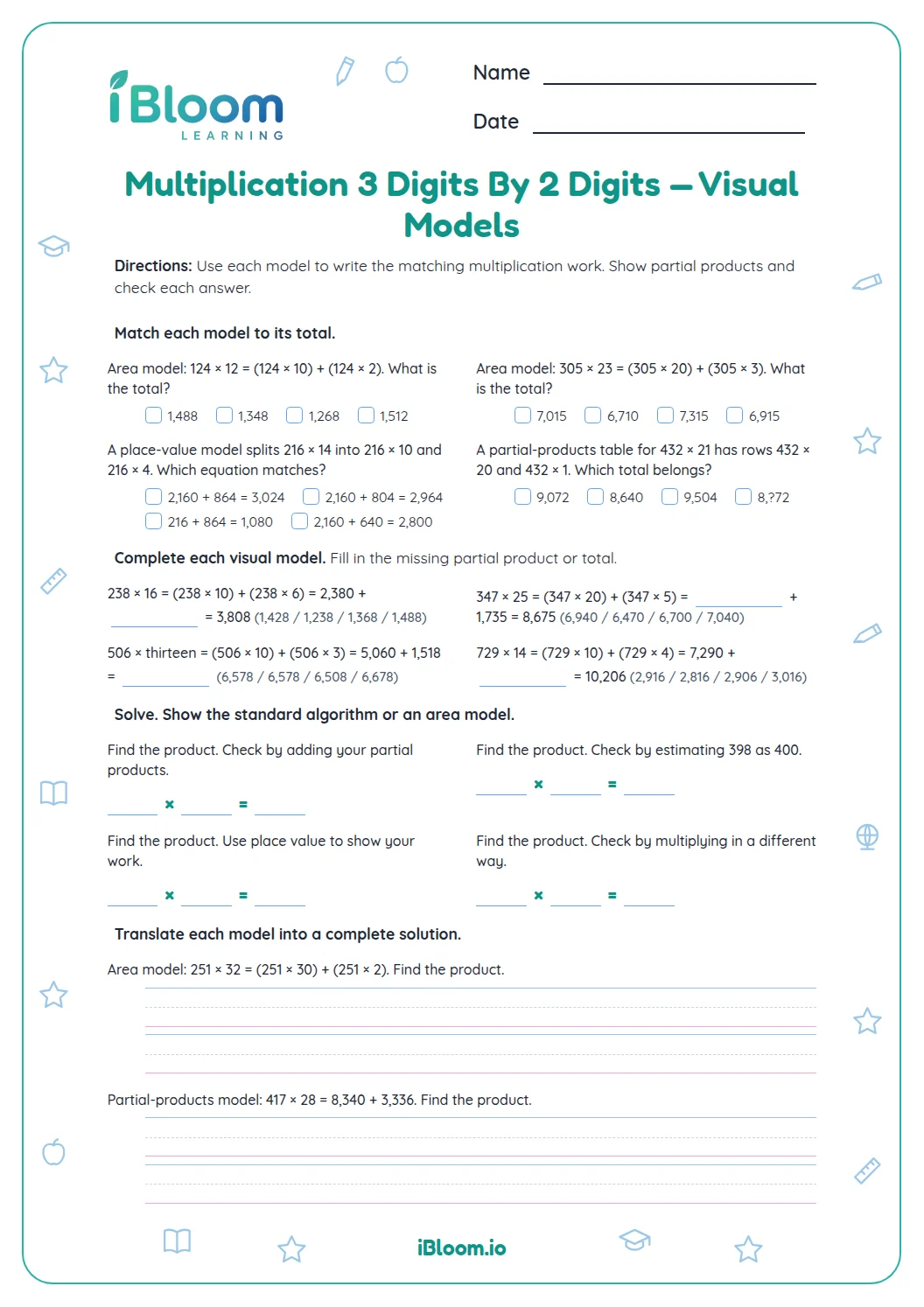
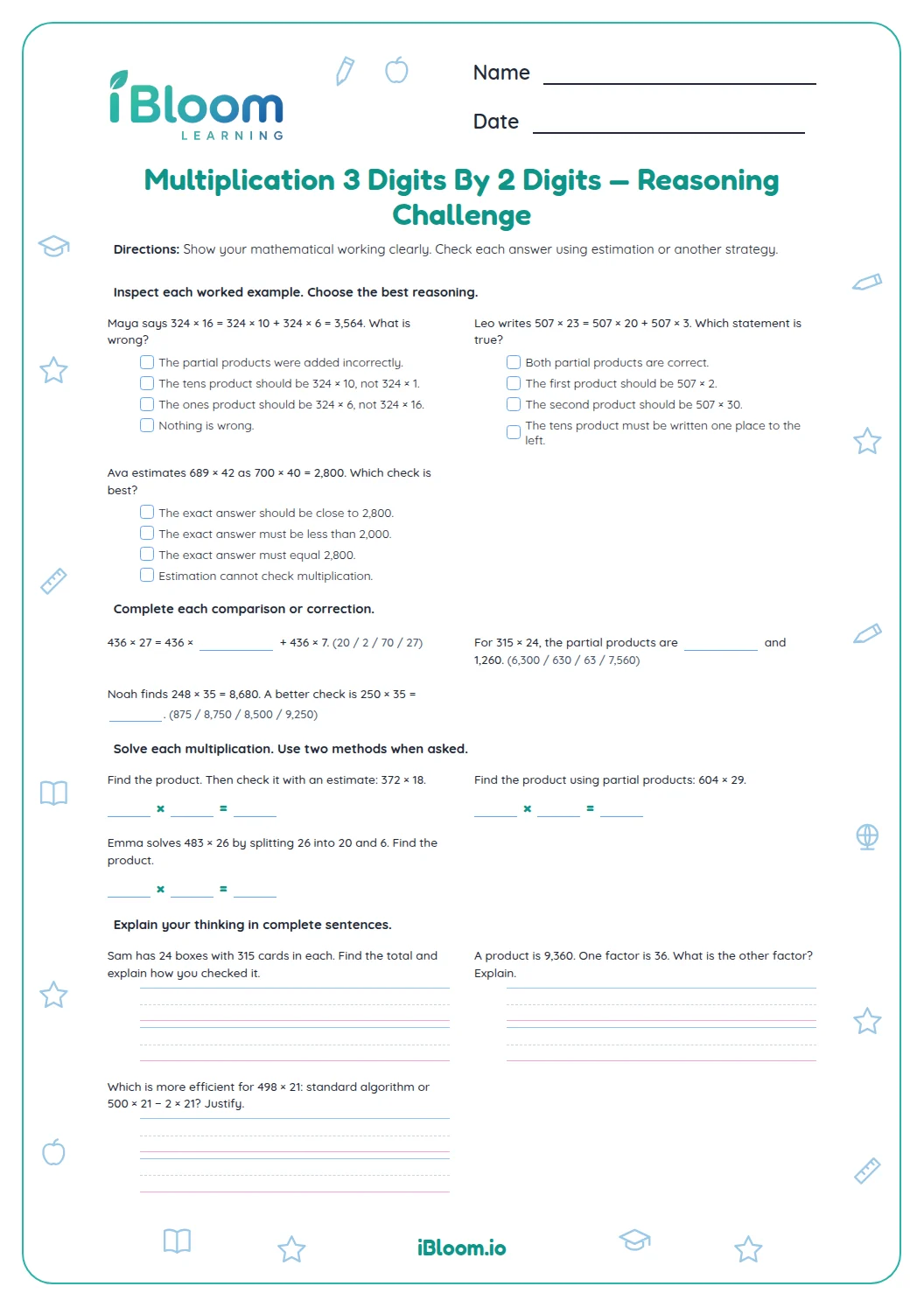
This Grade 6 worksheet gives students practice with multiply a three-digit number by a two-digit number. It has 16 printed questions on two worksheet pages, followed by a two-page answer key. Students work through 2 sections, using the printed numbers and equations on the student pages. The answer key provides the results for checking each item. The problems practice CCSS 5.NBT.B.5, as described in the curriculum alignment below.
Aligned to CCSS.MATH.CONTENT.5.NBT.B.5
How do you multiply a three-digit number by a two-digit number?
Multiply by the ones digit, then by the tens digit, keeping the place values aligned. Add the two partial products. For example, 146 × 23 = 146 × 20 + 146 × 3 = 2,920 + 438 = 3,358.
How does multiplication solve the story problems?
Each story describes equal groups. Multiply the number in one group by the number of groups to find the total number of notebooks or seats.
How can an answer be checked?
Estimate the factors first, then compare the estimate with the exact product. A second check is to add the partial products and verify that the tens row represents groups of ten.
How to work through the sheet
- 1Read the section direction before beginning its problems.
- 2Copy or use the numbers printed in each question.
- 3Show calculation steps in the working space when provided.
- 4Check the result against the answer key after solving.
Check your work
The mistake
Forgetting place value or sign rules while calculating.
The fix
Write each step clearly, then estimate or use the inverse operation to check.
Curriculum alignment
This worksheet practices the named grade-level skill.
Fluently multiply multi-digit whole numbers using the standard algorithm.
On this sheet:
Show the official wordingHide the official wording
Fluently multiply multi-digit whole numbers using the standard algorithm.
What to practice next
Questions parents and teachers ask
How do you multiply a three-digit number by a two-digit number?
Split the two-digit factor into tens and ones. Multiply the three-digit number by each part, then add the partial products. For 146 × 23, calculate 146 × 20 and 146 × 3, then add 2,920 and 438 to get 3,358.
Why split the two-digit factor?
Splitting makes the place value visible: 23 means 20 plus 3. The tens product represents groups of ten, so its digits must be aligned in the tens place when using the column algorithm. Use the printed factors and directions to guide each step, then compare the result with the answer key.
How can estimation check the answer?
Round the factors to nearby friendly numbers and multiply those to get an approximate product. For 146 × 23, 150 × 20 is about 3,000, so an exact result near that amount is reasonable. Use the printed factors and directions to guide each step, then compare the result with the answer key.
What does the answer key provide?
The two-page answer key lists the product for each of the 16 questions, including the partial-product items, story problems, and expansion questions. Students can use it to check after completing the worksheet. Use the printed factors and directions to guide each step, then compare the result with the answer key.
Which standard does this multiplication practice?
The worksheet practices CCSS 5.NBT.B.5, fluently multiplying multi-digit whole numbers with the standard algorithm. The factors on this sheet are three-digit numbers multiplied by two-digit numbers. Use the printed factors and directions to guide each step, then compare the result with the answer key.