





About this worksheet
This Grade 6 printable builds the connection between decimals and percents with shaded tenths and hundredths grids. Students read four models, convert values in both directions, select equivalent statements, and explain two conversions and interpret two models in both forms. The sixteen questions use decimals from hundredths through values greater than one, with a separate answer key. It practices ratio reasoning by expressing quantities as rates per 100.
Aligned to 6.RP.A.3
How does a shaded grid show a decimal and percent?
A hundredths grid has 100 equal squares, so each shaded square is one hundredth. A tenths strip has 10 equal parts, each worth one tenth. In question 1, 37 squares are shaded; students name the percent, and the related decimal is 0.37.
The two forms name the same amount using different place-value units. Count the shaded parts, then write the decimal and percent relationship.
- 137 of 100 squares are shaded.
- 2The requested percent is 37%.
- 3The equivalent decimal is 0.37.
Which way should the decimal point move?
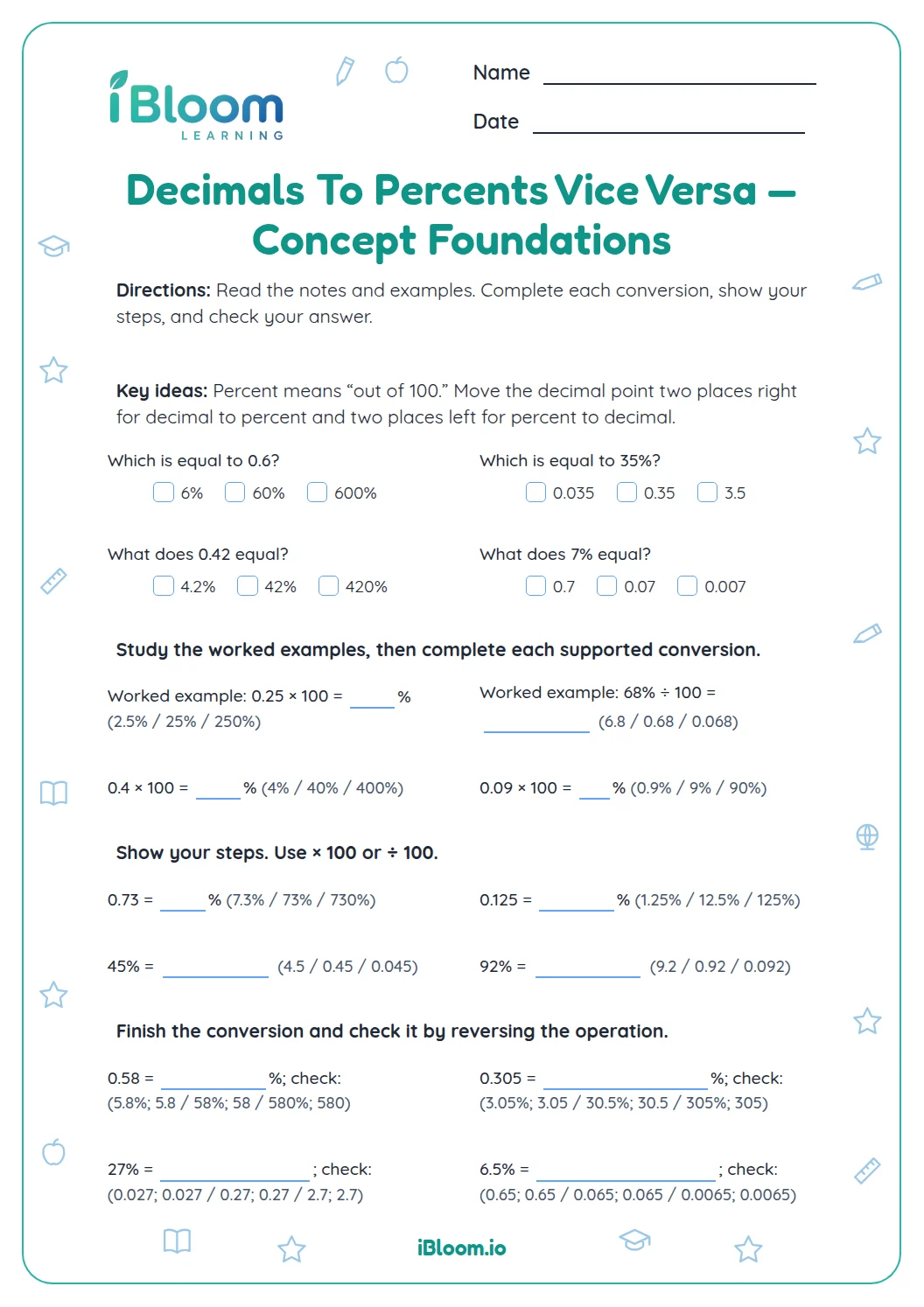
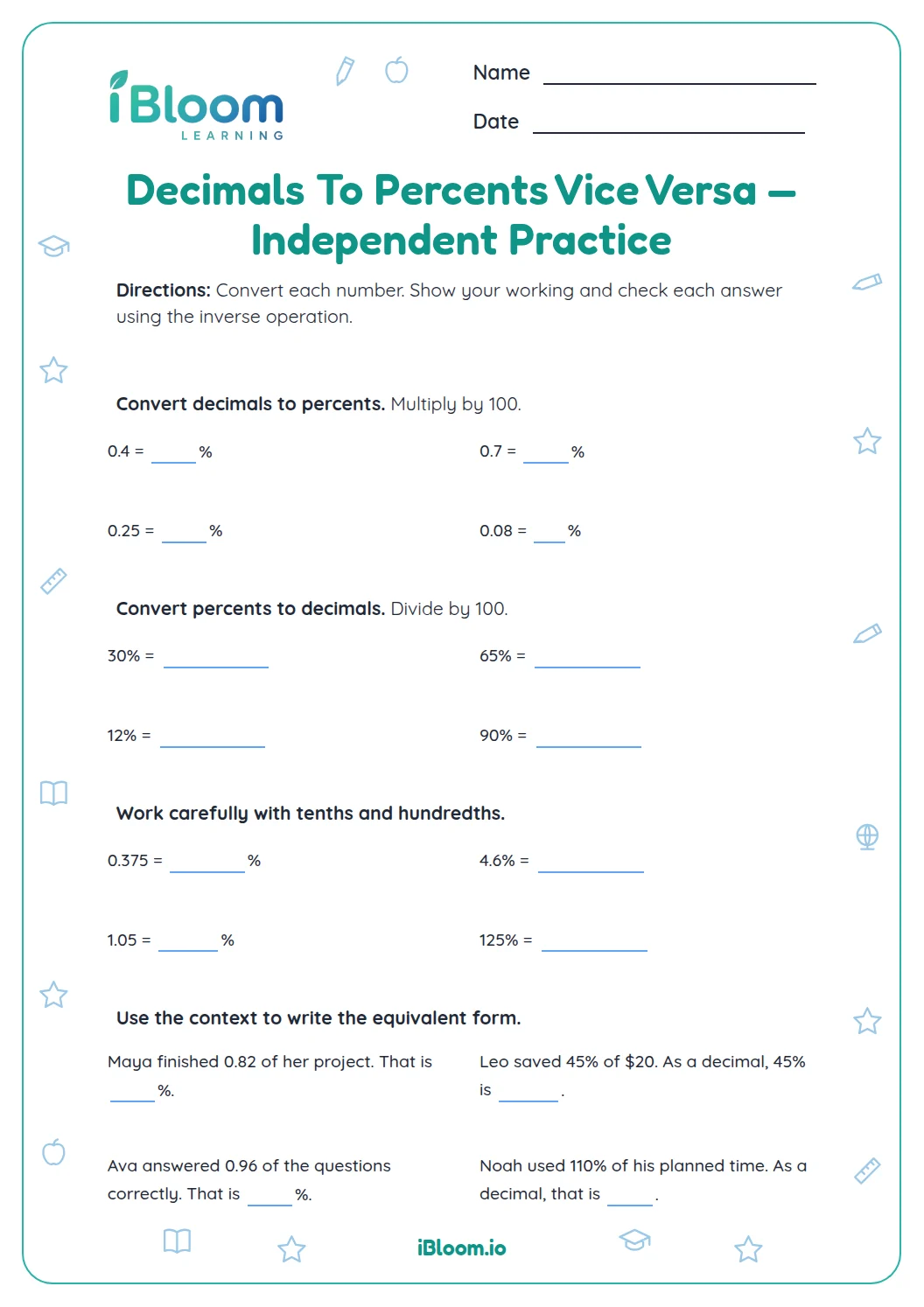
For a decimal-to-percent conversion, multiply by 100: 0.42 becomes 42%. For percent-to-decimal, divide by 100: 7% becomes 0.07. The decimal point moves two places, and zeros keep place value clear.
What practice is on the worksheet sheet?
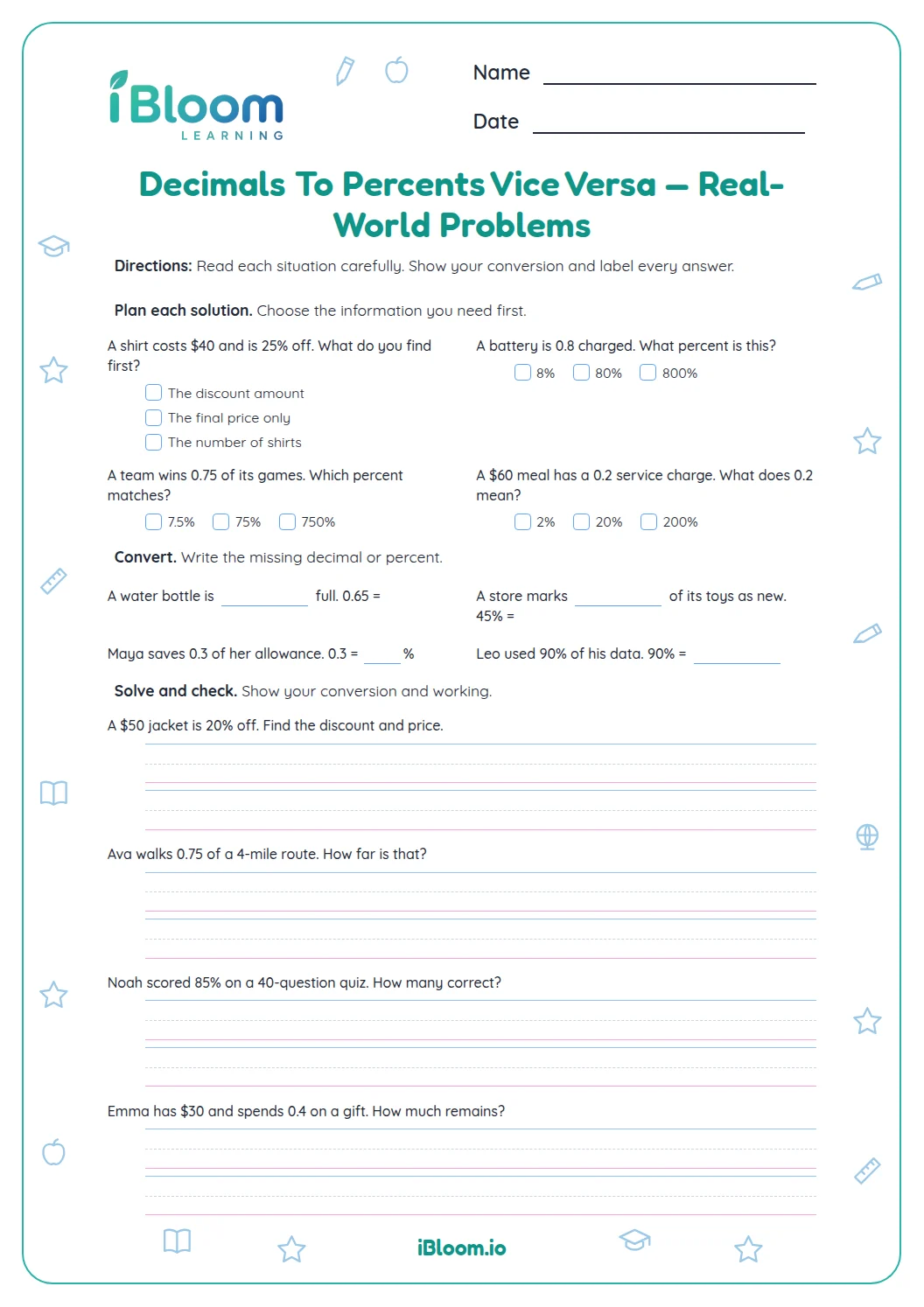
The first part reads four drawings and asks for either a decimal or a percent. The next parts convert, select equivalent statements, and explain conversions using actual values and models. The answer key gives a concise answer for every question.
How can I use this worksheet?
- 1Count shaded hundredths or tenths before naming the value.
- 2Write the decimal with the correct place value.
- 3Use “percent means per 100” to connect the decimal to a percent.
- 4For decimal to percent, move the point two places right.
- 5For percent to decimal, move it two places left.
Common mistakes and quick fixes
The mistake
Writing 0.7 as 7%.
The fix
Remember that 0.7 is seven tenths, or 70 hundredths, so it is 70%.
The mistake
Dropping a zero in 4%.
The fix
Write 4% as 4/100 = 0.04.
The mistake
Moving the decimal only one place.
The fix
Use the factor 100, which means two places.
Common Core alignment
This worksheet gives students focused practice with the standard below.
Use ratio reasoning to convert a fraction to a decimal and percent.
On this sheet: Use ratio reasoning to convert a fraction to a decimal and percent.
Show the official wordingHide the official wording
Use ratio and rate reasoning to solve real-world and mathematical problems.
What to practice next
Further reading
Questions parents and teachers ask
What does percent mean?
Percent means “per hundred.” The shaded hundredths grid in question 1 has 37 of 100 squares shaded, so it represents 37%. Writing 37% as a decimal gives 0.37. The phrase per hundred helps students see why the decimal point moves two places.
How do I change a decimal into a percent?
Multiply the decimal by 100, or move its decimal point two places right. For example, 0.42 becomes 42%. Questions 5 and 13 practice this conversion, while the shaded models help explain why the decimal and percent name the same amount.
How do I change a percent into a decimal?
Divide the percent by 100, or move the decimal point two places left. For example, 7% is 0.07. Keep a zero in the hundredths place when needed; question 12 uses 4%, which is 0.04. This gives students a second way to confirm the place value and operation.
Can a percent be greater than 100%?
Yes. One hundred percent is one whole, so 125% is 1.25, or one and one quarter. Question 11 asks students to choose this equivalent decimal. A value above 100% describes more than one whole. This gives students a second way to confirm the place value and operation.
What does the answer key include?
The answer key gives the value for each shaded model, every conversion, the correct multiple-choice statement, and sample explanations for the final questions. Students can compare each response and revisit any model where the tenths or hundredths were miscounted. This gives students a second way to confirm the place value and operation.