

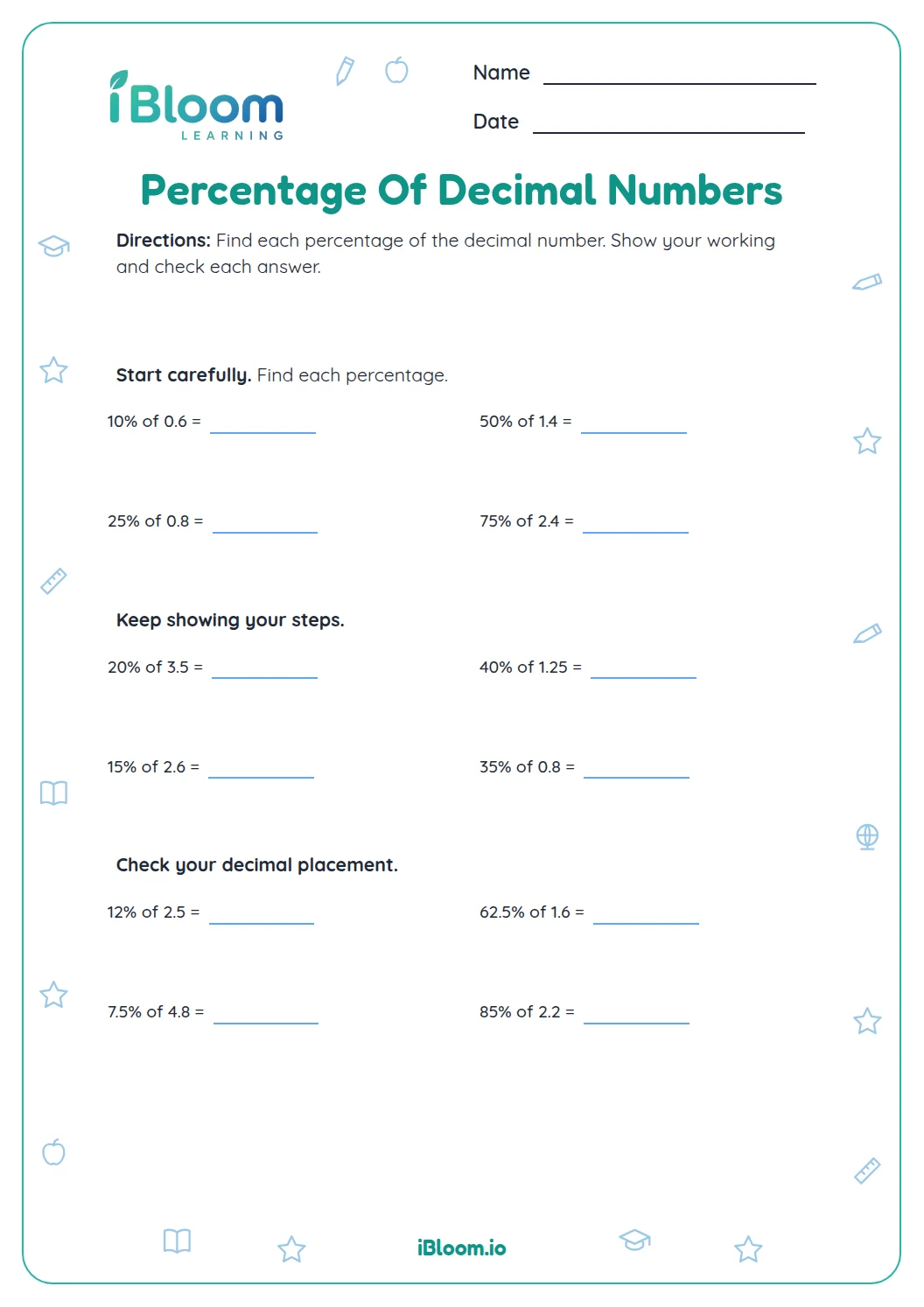
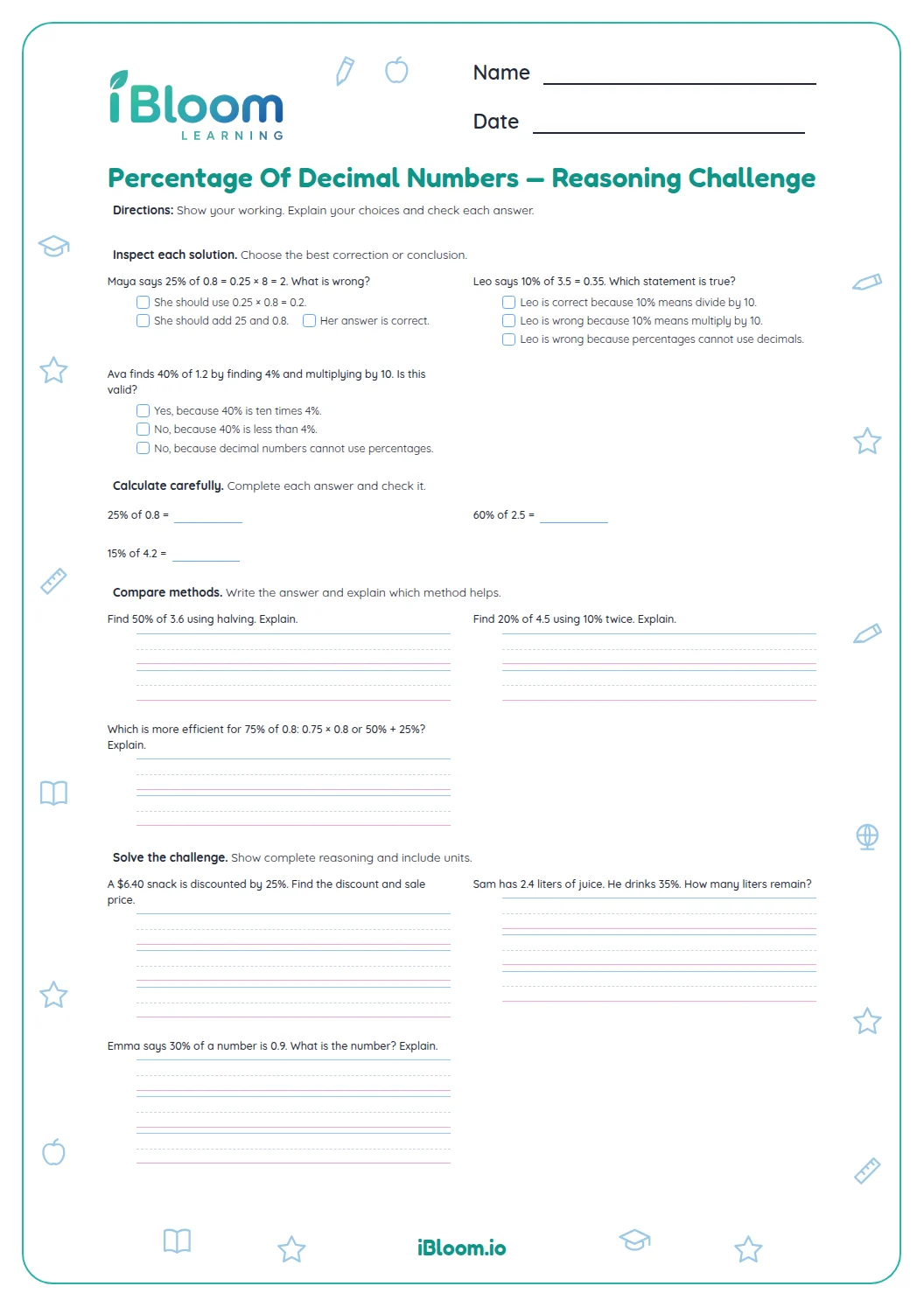
About this worksheet
This free printable worksheet gives students focused practice with percentage of decimal numbers — real-world problems. It is designed for Grade 6 math and includes 15 questions that move from guided examples to independent application. Students work through clearly stated situations, use the printed information, and check answers with the separate key. The page practices Common Core 6.RP.A.3 through the exact skills shown in the questions.
Aligned to 6.RP.A.3
How should students approach each question?
Read the whole prompt first and identify exactly what is being asked. Keep units or sentence meaning in view as you work.
Use the answer key to check both the result and the reasoning; a correct number or revision should match the full situation.
- 1A 1.8-liter bottle is 35% full. How many liters are inside?
- 2Write 35% as 0.35, then multiply: 1.8 × 0.35 = 0.63.
- 3So the bottle contains 0.63 liter.
What practice is included?
The 15 problems use percent rates with whole-number or decimal quantities. Students calculate the requested part, discount, amount used, or elapsed portion, then report it in the stated unit.
How can students check their work?
Estimate first: a percent below 100% gives an amount below the whole, while a percent above 100% gives an amount above it. Then check the decimal multiplication and unit.
How to use this worksheet
- 1Mark the whole amount and the percent in the story.
- 2Write the percent as a decimal by dividing by 100.
- 3Multiply the whole amount by the decimal rate.
- 4Check whether the result is reasonable compared with the whole.
- 5Write the result with the unit requested.
Common mistakes and quick fixes
The mistake
Using the whole as the answer instead of the requested percent amount.
The fix
Multiply the whole by the percent written as a decimal.
The mistake
Moving the decimal the wrong number of places when changing a percent to a decimal.
The fix
Divide the percent by 100 before multiplying.
The mistake
Reporting a value without its context.
The fix
Name the dollars, liters, distance, or other unit asked for.
Common Core alignment
This worksheet practices the stated Common Core skill through applied questions.
This sheet applies 6.RP.A.3 through its printed practice questions.
On this sheet: The questions directly practice this skill.
Show the official wordingHide the official wording
Use ratio and rate reasoning to solve real-world and mathematical problems.
What to practice next
Make more practice
Further reading
Questions parents and teachers ask
How many questions are included?
The worksheet has 15 real-world percent questions across three parts. Students find percent amounts for money, measurements, and groups, with a separate answer key for checking each result and unit. The examples include discounts, amounts used, and parts of groups, so answers connect directly to familiar quantities.
Is an answer key included?
Yes. The answer key follows the two student pages and gives the calculated amount with its unit where needed. Students can compare each result with the story, then redo an item if the percent conversion or multiplication went wrong. Students can first estimate whether the answer should be smaller or larger than the whole before calculating.
How should students show their work?
Students should write the percent as a decimal, multiply by the whole amount, and label the result. The problems provide work space for the calculation. The key helps check both the value and unit, such as dollars, liters, or miles.
Can this be used for independent practice?
Yes. Each problem provides the quantities and percent needed, and the directions ask students to show their work. A student can solve independently, then use the separate key to review the calculation and correct any missed decimal step.
What should students do after checking?
Have the student compare the result with the original whole. For a percent below 100%, the part should be smaller; for a rate above 100%, it should be larger. Recheck the decimal conversion and multiplication if the result does not fit.