







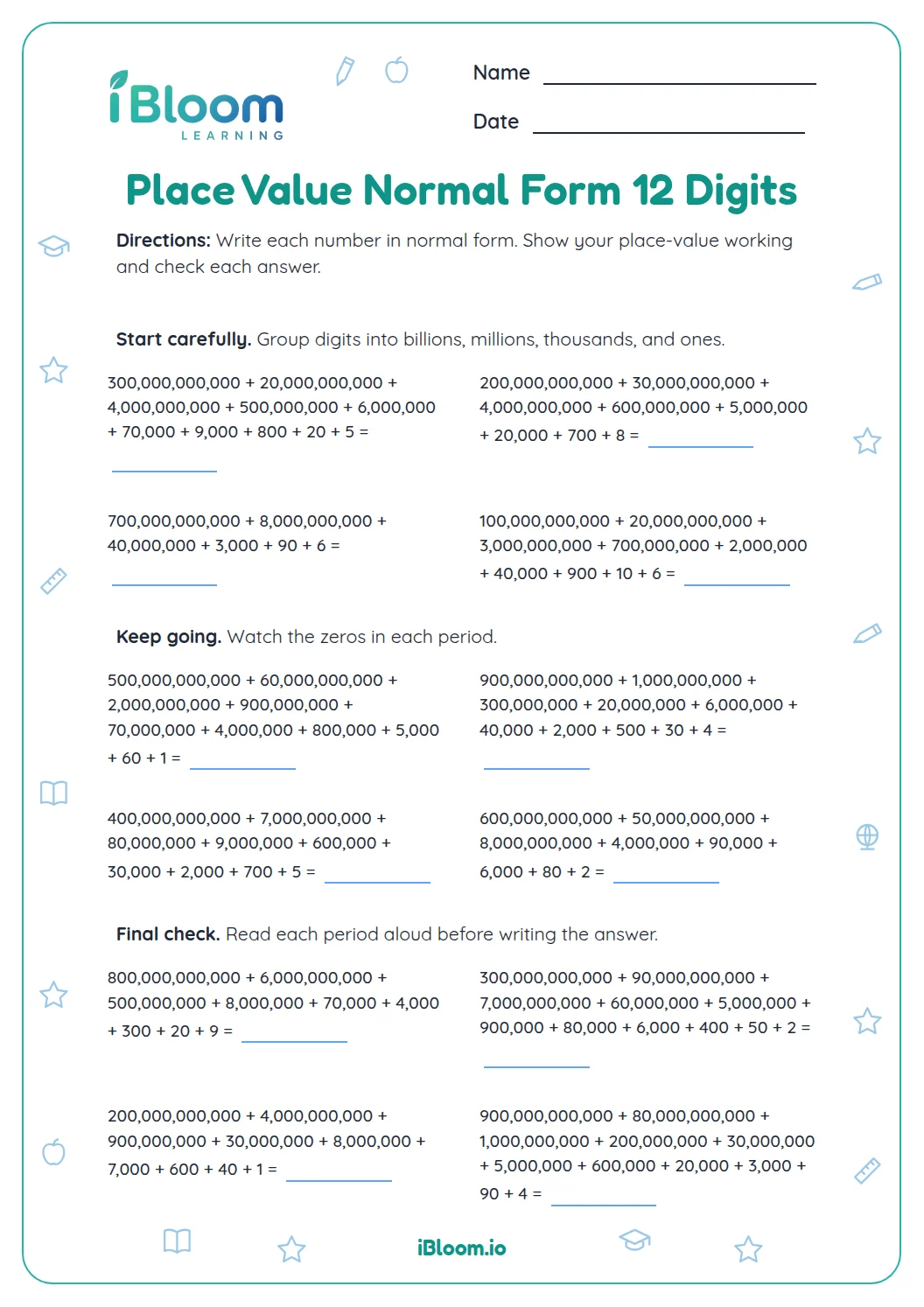
About this worksheet
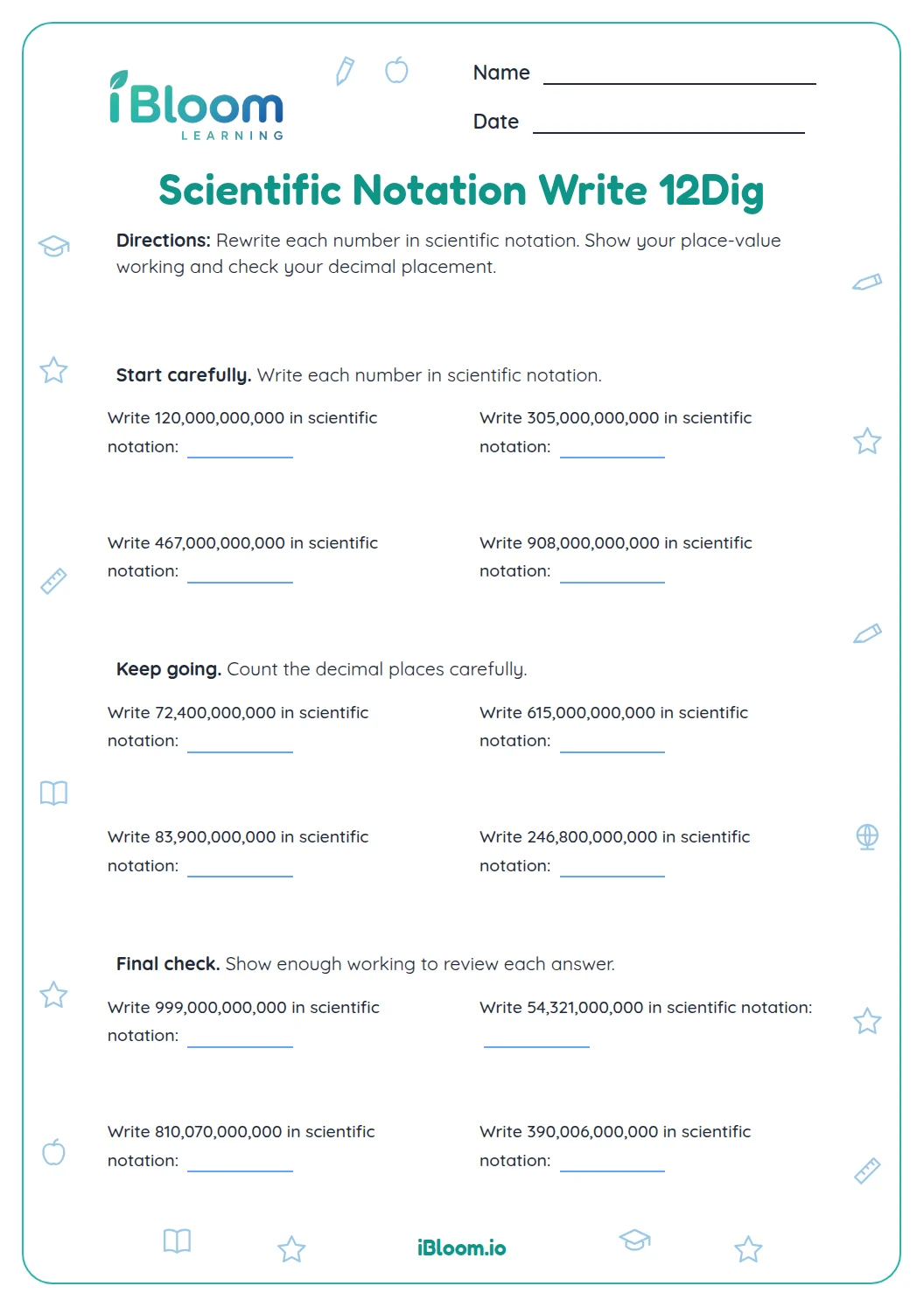
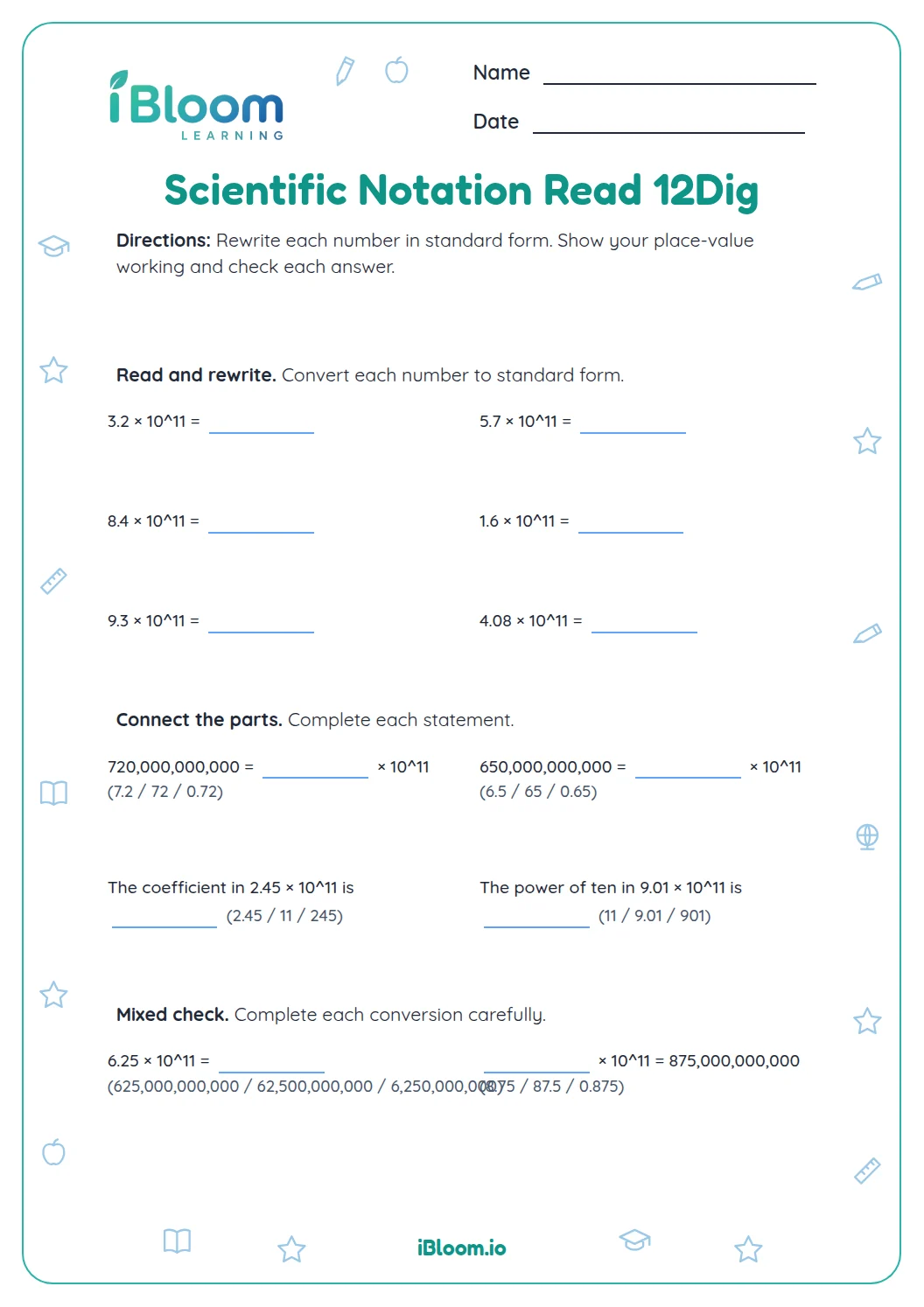
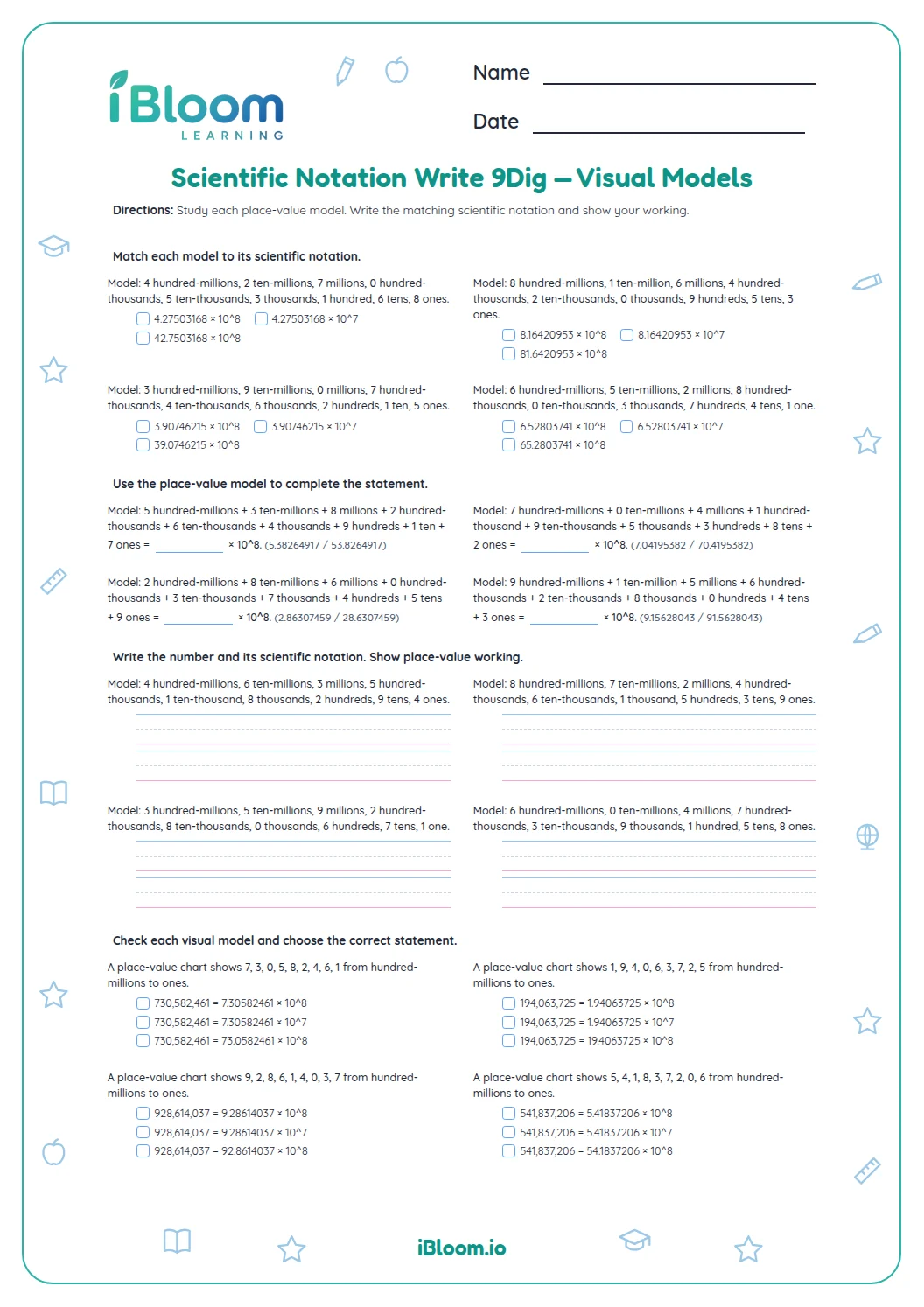
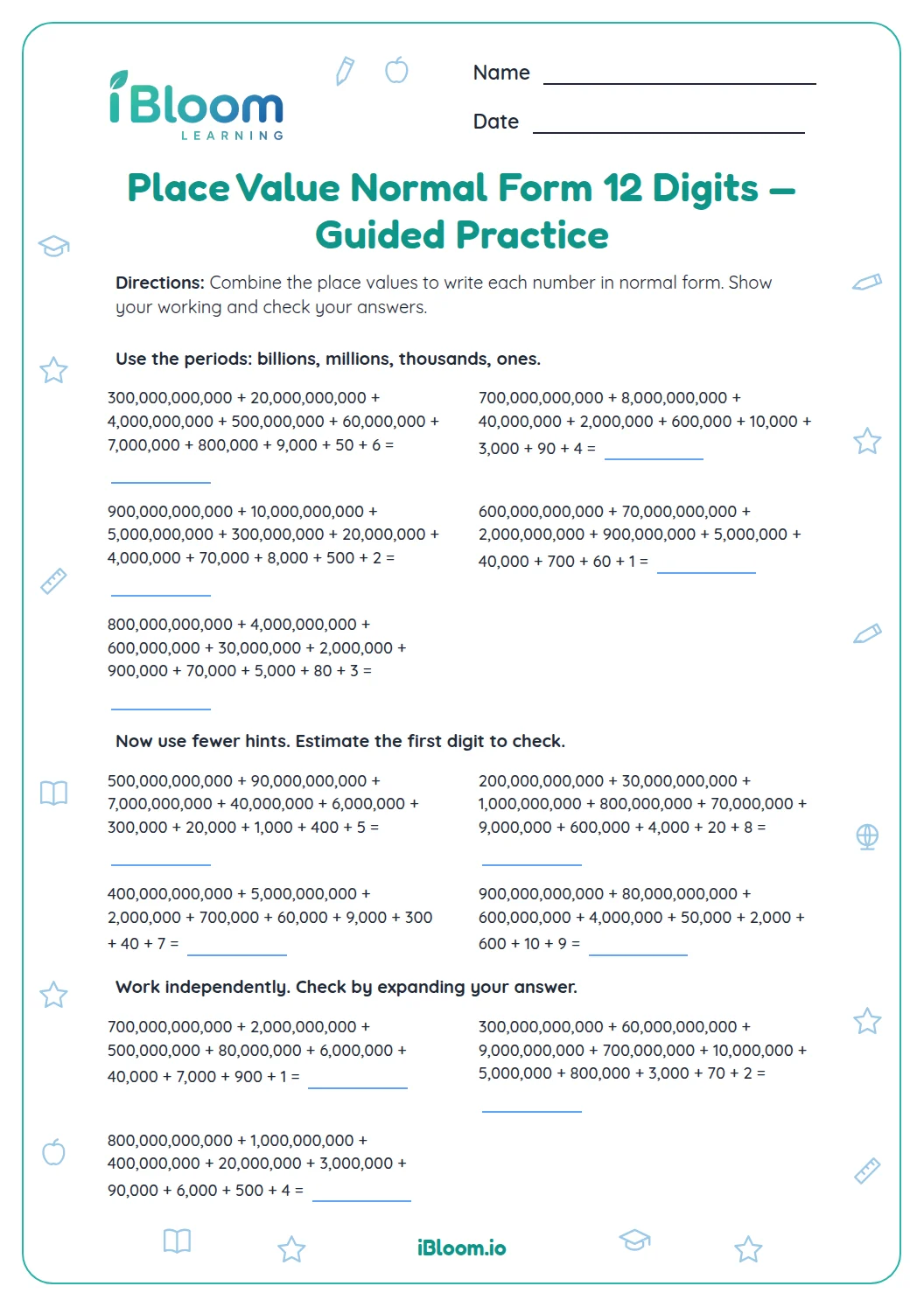
This Grade 6 worksheet practices scientific notation with 12-digit whole numbers. Students write coefficients and exponents, convert values to standard form, choose corrections, and compare powers of ten. Examples and choices use superscript exponents, and the separate key lists each value and comparison. It aligns with CCSS 6.EE.A.1 on numerical expressions with whole-number exponents.
Aligned to 6.EE.A.1
How do you find the coefficient and exponent?
For 308,000,000,000, place the decimal after the first digit to get 3.08. It moves 11 places, so the number is 3.08 × 10¹¹.
How do you compare powers of ten?
When coefficients are between 1 and 10, compare exponents first. If the exponents match, compare coefficients. The worksheet asks students to apply this idea to large values.
What makes notation normalized?
The coefficient must be at least 1 and less than 10. For example, 24.6 × 10¹⁰ is equivalent to 2.46 × 10¹¹, which has a normalized coefficient.
How to use this worksheet
- 1Find the first nonzero digit in the whole number.
- 2Place the decimal after that digit to make the coefficient.
- 3Count the decimal places moved to get the exponent.
- 4For a standard-form conversion, move the decimal right by the exponent.
- 5Check that the coefficient is at least 1 and less than 10.
Common mistakes and how to fix them
The mistake
Making the coefficient 30.8 instead of 3.08.
The fix
Move the decimal until only one nonzero digit is to its left.
The mistake
Counting the first digit as a decimal move.
The fix
Count spaces from the original whole-number decimal point.
The mistake
Changing the coefficient without adjusting the exponent.
The fix
When the decimal shifts left once, increase the exponent by one to keep the value equal.
Common Core alignment
The page uses powers of ten as numerical expressions and asks students to evaluate their values.
Write and evaluate numerical expressions with whole-number exponents.
On this sheet: Students interpret powers of ten and connect each expression to its standard-form value.
Show the official wordingHide the official wording
Write and evaluate numerical expressions involving whole-number exponents.
What to practice next
Make more practice
Further reading
Questions parents and teachers ask
What is the coefficient in scientific notation?
The coefficient is the number before the power of ten. In normalized scientific notation, it is at least 1 and less than 10. For example, the coefficient in 3.08 × 10¹¹ is 3.08. The coefficient carries the significant digits.
What does the exponent tell me?
For a positive power of ten, the exponent tells how many places the decimal moves to the right when converting to standard form. In 3.08 × 10¹¹, moving 11 places gives 308,000,000,000. That check confirms the original value.
How can I compare two scientific-notation values?
Compare exponents first when both coefficients are normalized. A greater exponent means a greater value. If the exponents match, compare the coefficients. The worksheet includes two comparisons at the same scale and uses comparison-symbol choices. Check each value in standard form too.
Why must the coefficient be less than 10?
A coefficient of 10 or more can be rewritten with one fewer nonzero digit before the decimal. Shift its decimal left and raise the exponent by the same amount; the value stays the same and the notation becomes normalized.
What does the answer key include?
The key gives coefficients, exponents, standard-form values, and comparison symbols. For each item, students can confirm the exponent, decimal movement, and value before reviewing how the notation is normalized. It follows the same order as the worksheet. Use it after trying each question.