
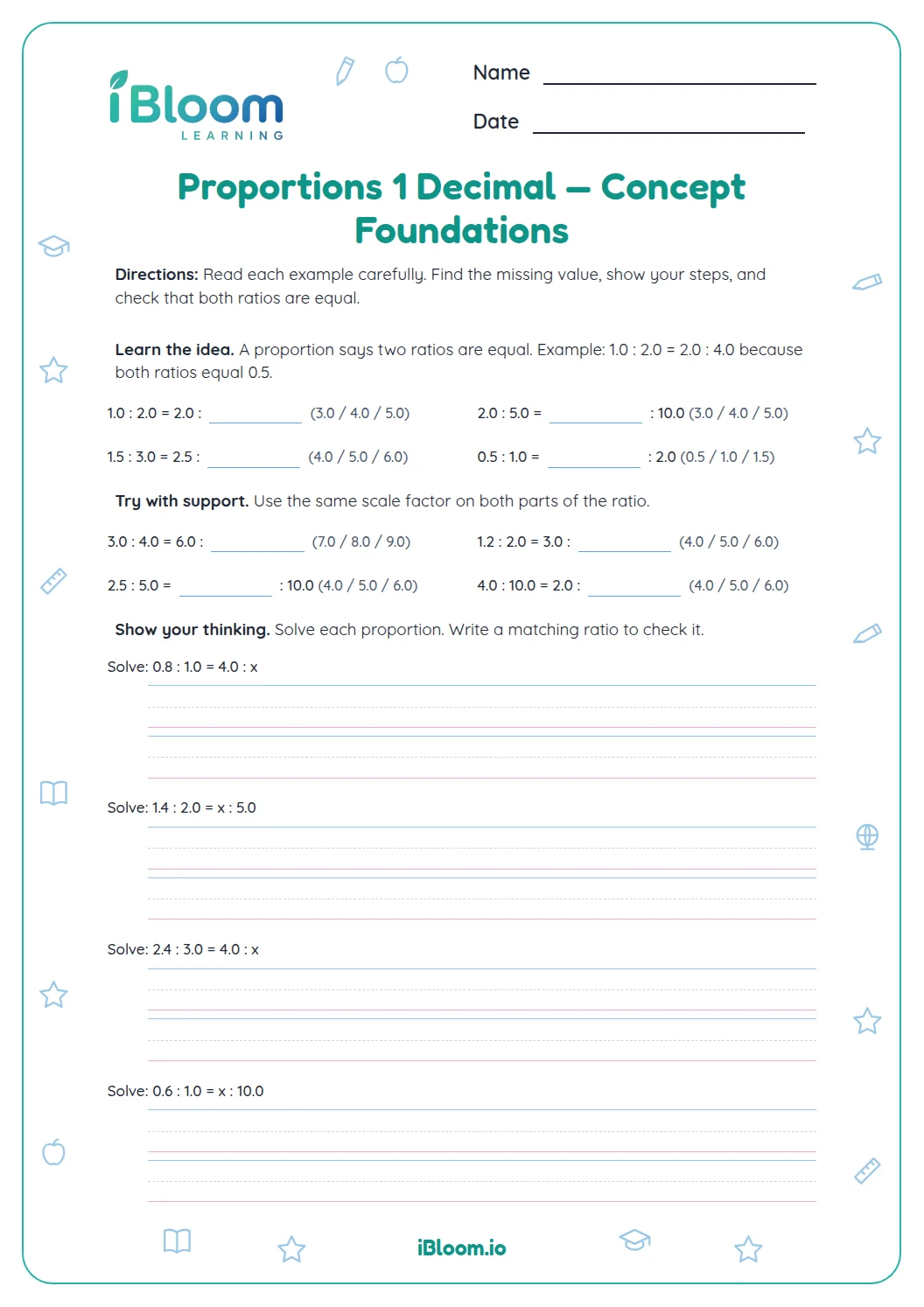
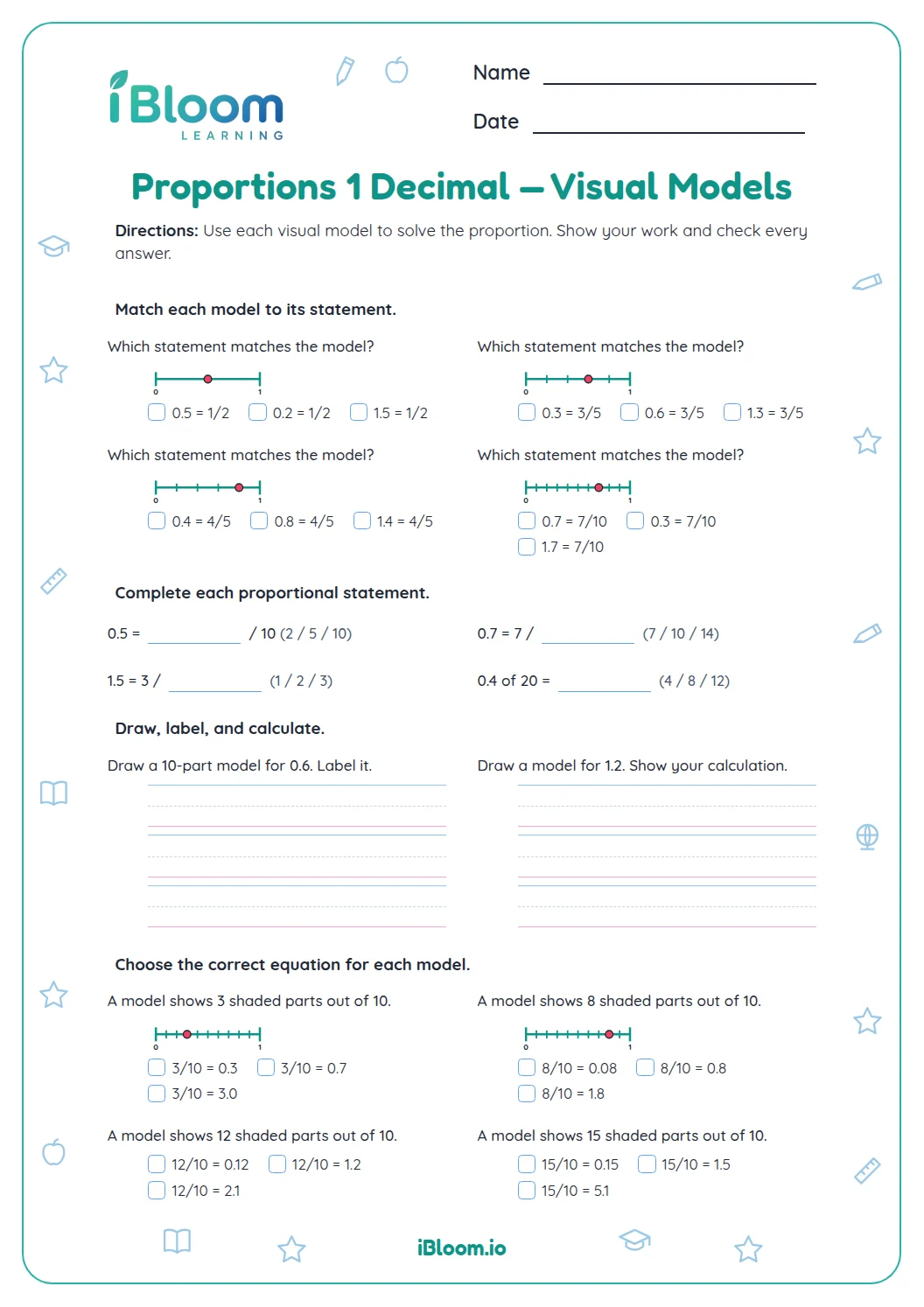
About this worksheet
This free printable worksheet gives students focused practice with proportions 1 decimal — real-world problems. It is designed for Grade 6 math and includes 15 questions that move from guided examples to independent application. Students work through clearly stated situations, use the printed information, and check answers with the separate key. The page practices Common Core 6.RP.A.3 through the exact skills shown in the questions.
Aligned to 6.RP.A.3
How should students approach each question?
Read the whole prompt first and identify exactly what is being asked. Keep units or sentence meaning in view as you work.
Use the answer key to check both the result and the reasoning; a correct number or revision should match the full situation.
- 1A scooter travels 4.8 miles in 0.6 hour. At the same rate, how far does it travel in 1.5 hours?
- 2Find the unit rate: 4.8 ÷ 0.6 = 8 miles per hour.
- 3Then multiply: 8 × 1.5 = 12 miles.
What practice is included?
The 15 problems ask students to use decimal rates for travel, prices, recipes, and measurements. Some ask for a scaled quantity; others ask for a missing number of equal portions or the time needed.
How can students check their work?
Check that the two quantities in the rate stay in the same order. Keep the units attached to each rate, then test whether the answer grows or shrinks as the situation requires.
How to use this worksheet
- 1Identify the two quantities that vary together.
- 2Find the amount for one unit when useful.
- 3Scale both quantities by the same factor.
- 4Use division when the question asks for a number of groups or time.
- 5Check the answer and include its unit.
Common mistakes and quick fixes
The mistake
Dividing the quantities in the wrong order when finding a unit rate.
The fix
Divide the first quantity by its matching amount of time or items.
The mistake
Scaling one quantity but leaving its paired quantity unchanged.
The fix
Use the same scale factor on both sides of a proportion.
The mistake
Dropping a unit in a rate problem.
The fix
Write the requested unit with the calculated value.
Common Core alignment
This worksheet practices the stated Common Core skill through applied questions.
This sheet applies 6.RP.A.3 through its printed practice questions.
On this sheet: The questions directly practice this skill.
Show the official wordingHide the official wording
Use ratio and rate reasoning to solve real-world and mathematical problems.
What to practice next
Make more practice
Further reading
Questions parents and teachers ask
How many questions are included?
There are 15 decimal proportion word problems across three parts. They use rates for distance, cost, recipes, and measurements, with a separate answer key to check each calculated result. Students also practice finding a missing time or number of equal portions from a decimal rate.
Is an answer key included?
Yes. The key follows the two student pages and lists the proportional result for each item. It includes requested units so students can check the number and how it is described in the story context. The answer key shows the final amount with the matching unit for each real-world situation.
How should students show their work?
Students can show a unit rate or a proportion in the provided work space. Keep paired quantities in the same order and include units in the final response. The key provides a concise value for checking each calculation. Encourage the student to explain how the chosen scale factor keeps the relationship equivalent.
Can this be used for independent practice?
Yes. The directions ask students to solve each real-world rate problem and show work. The numbers and units needed for each calculation appear in the question, and the separate key supports independent checking afterward. Students can use a unit rate or equivalent ratios.
What should students do after checking?
Compare the rate with the context. A faster time should not result from more work at the same rate, and a larger quantity should cost or weigh more at a fixed unit rate. Check the proportion setup if the result conflicts.