

About this worksheet
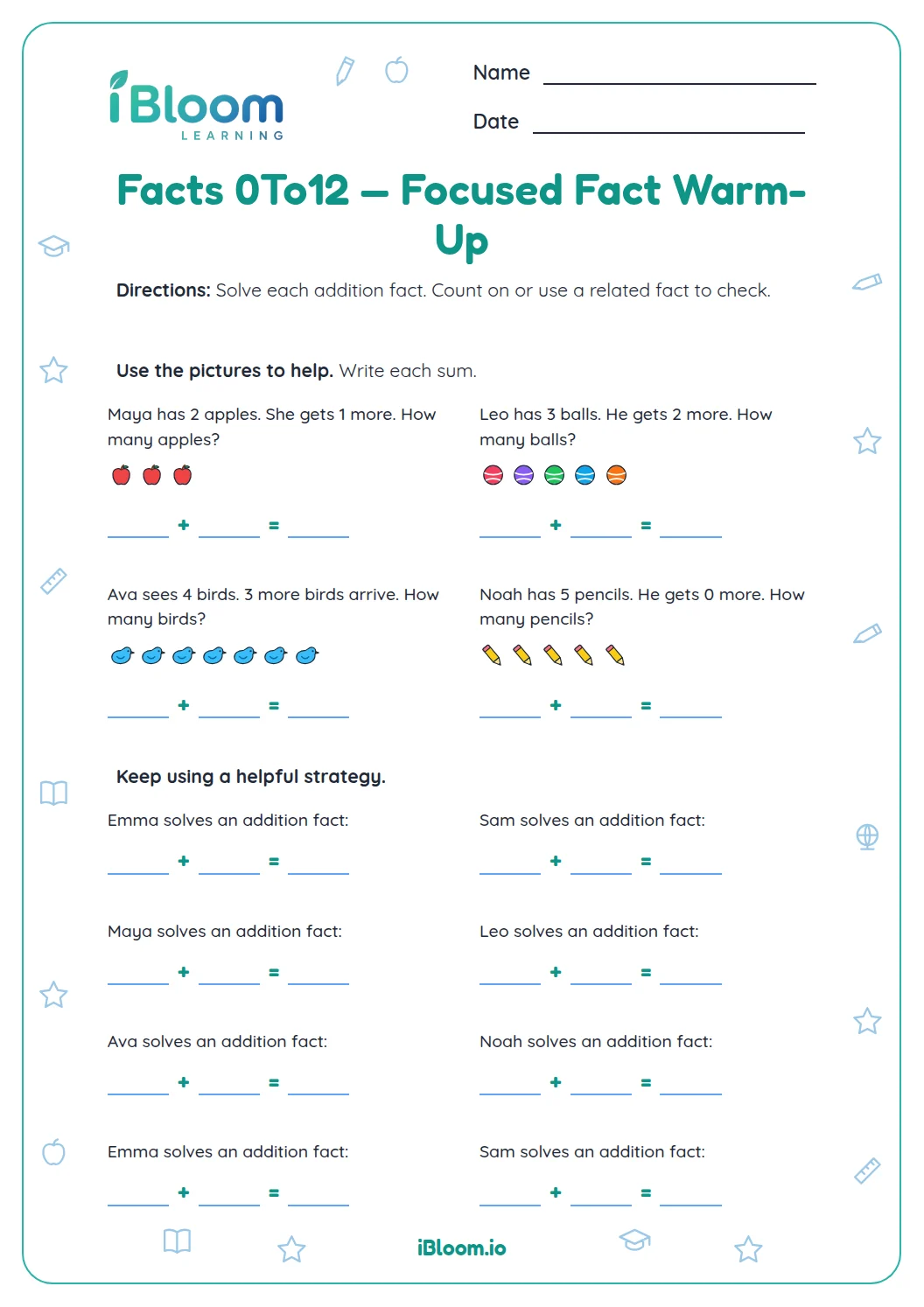
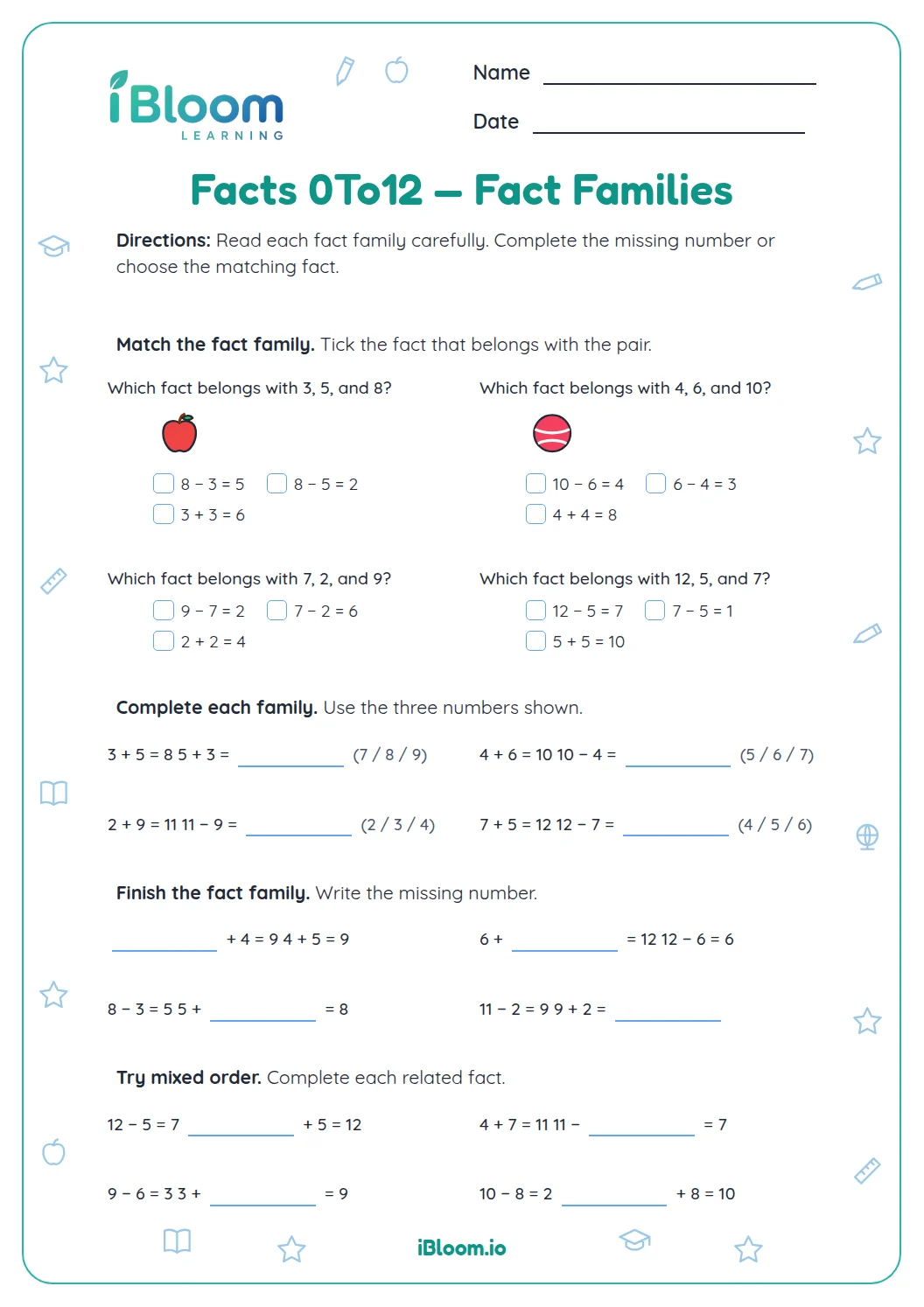
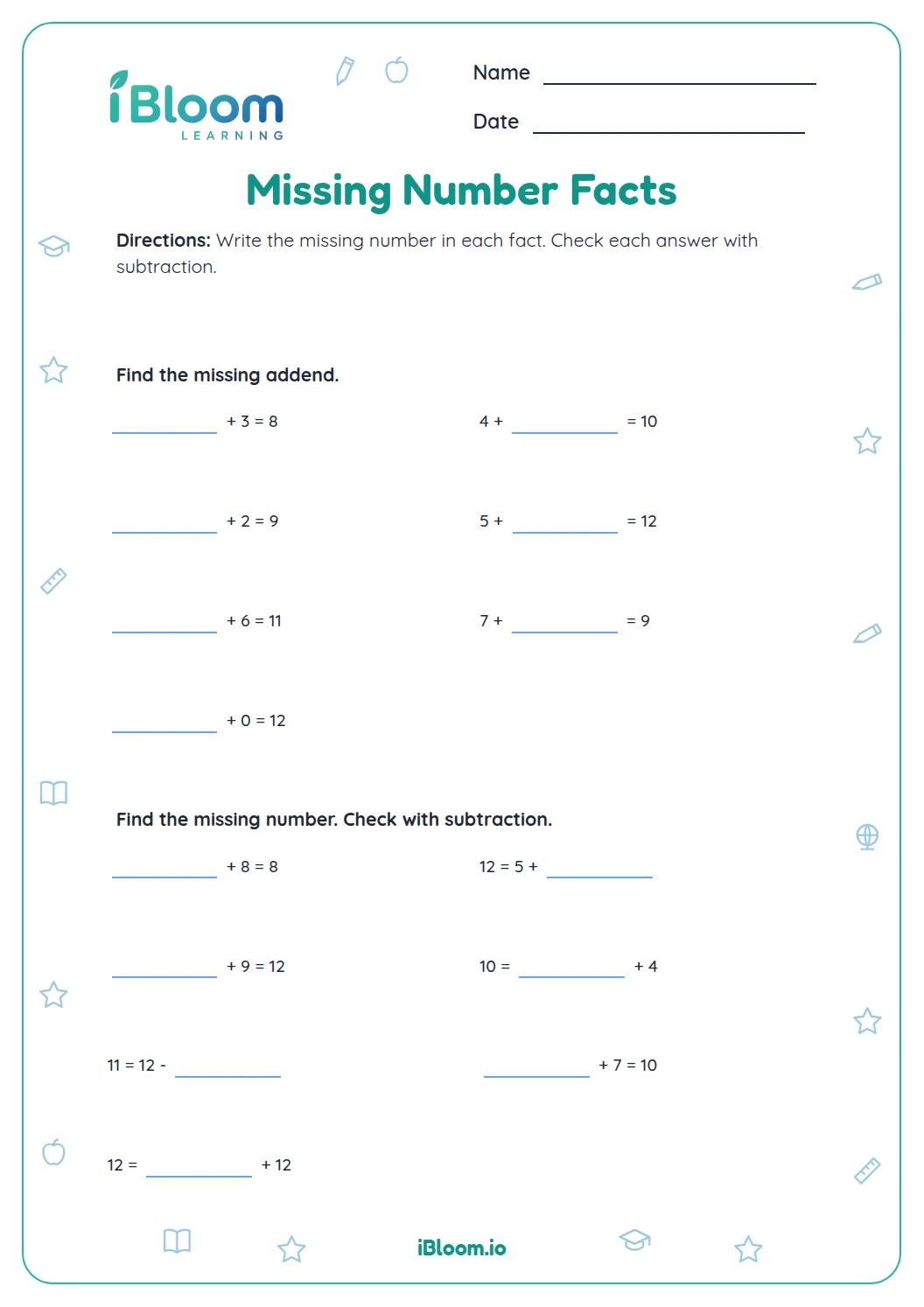
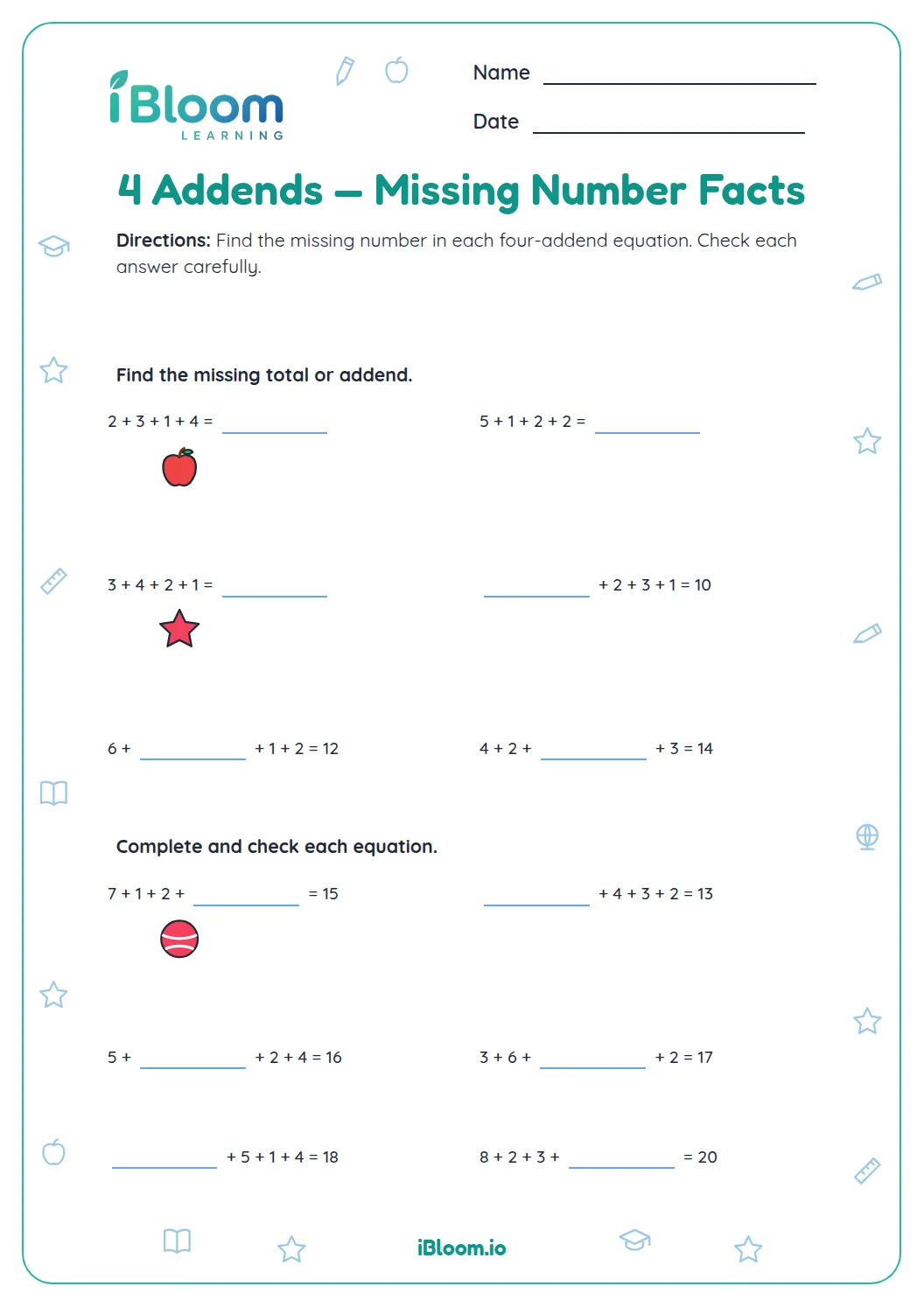
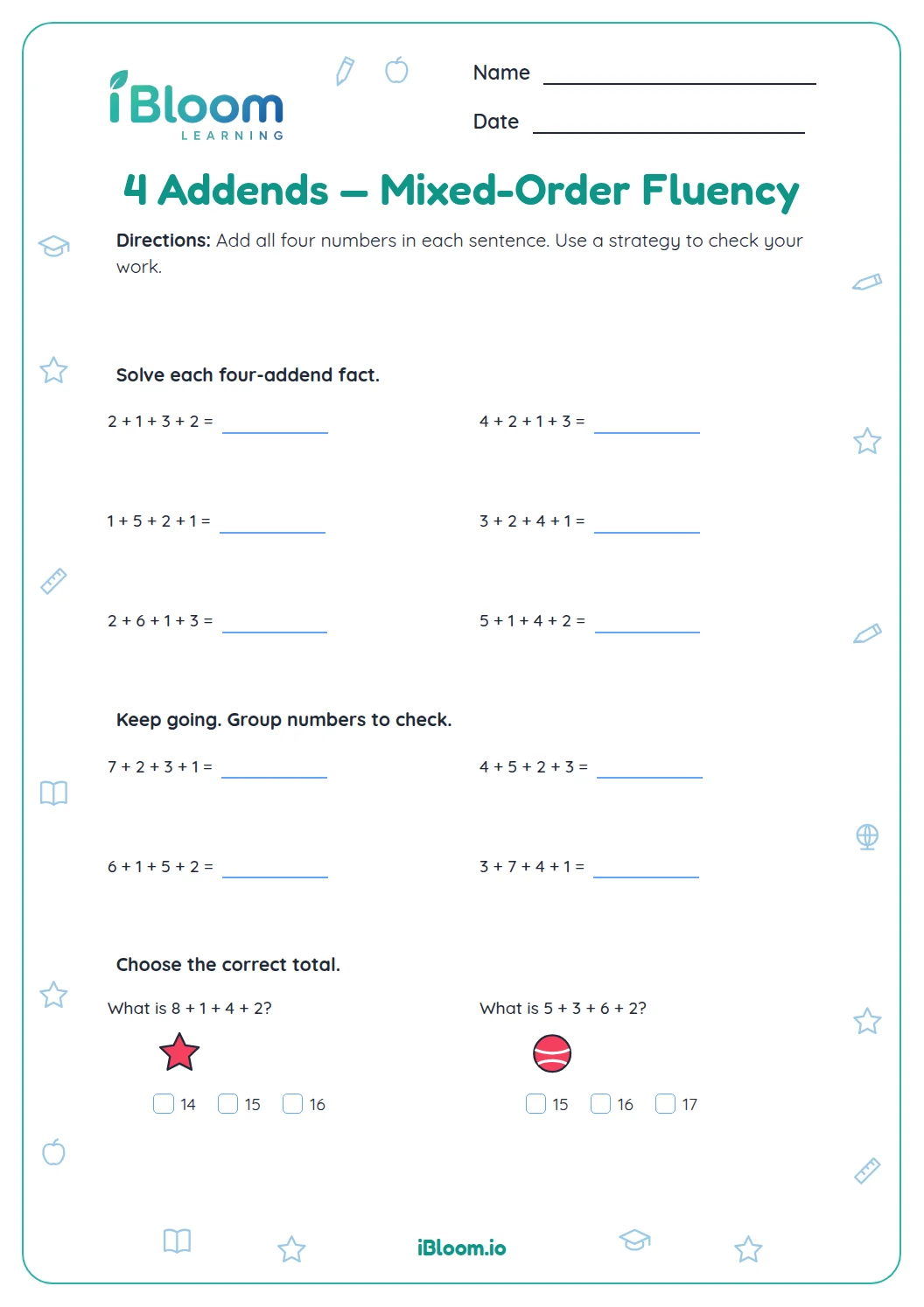
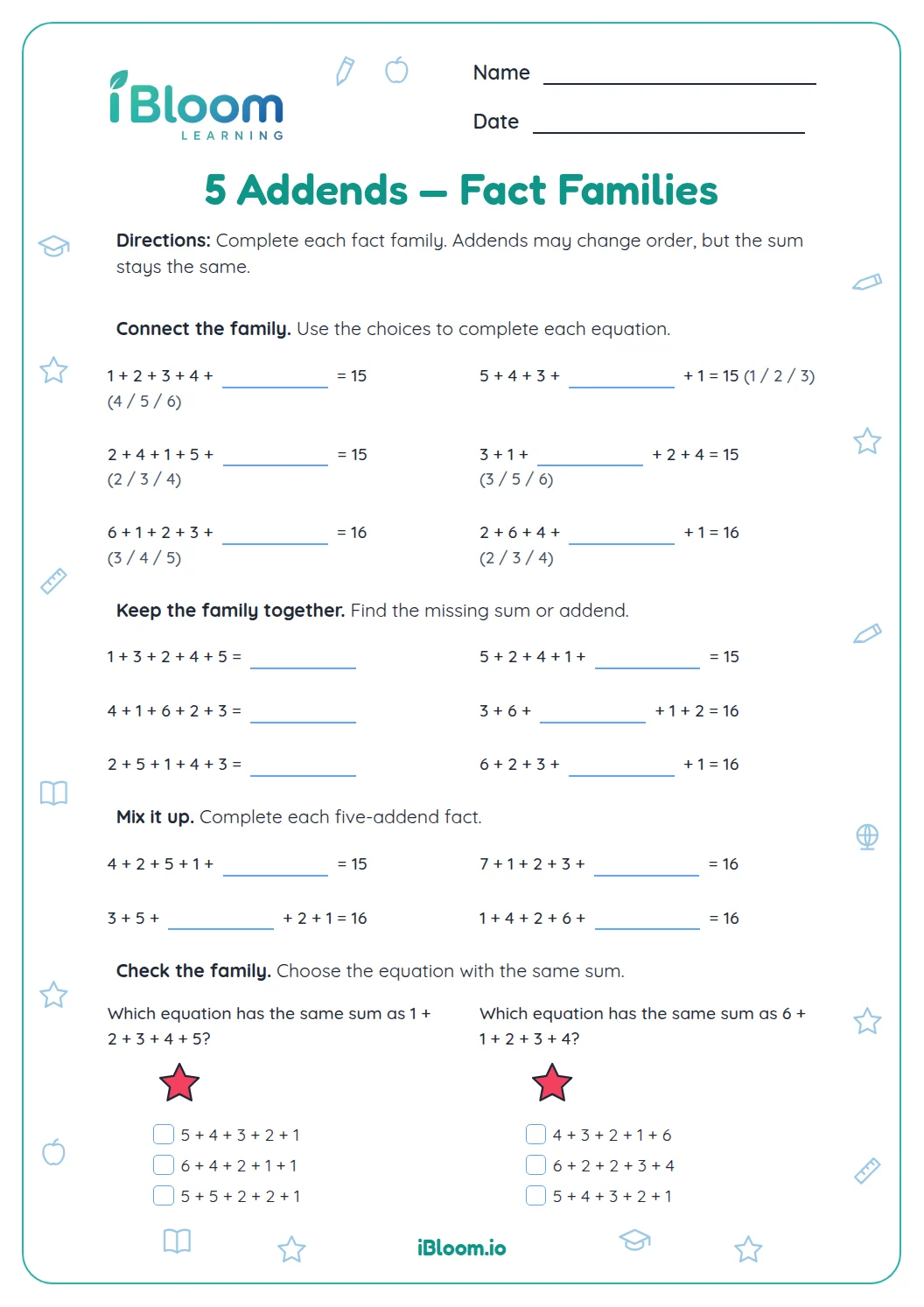
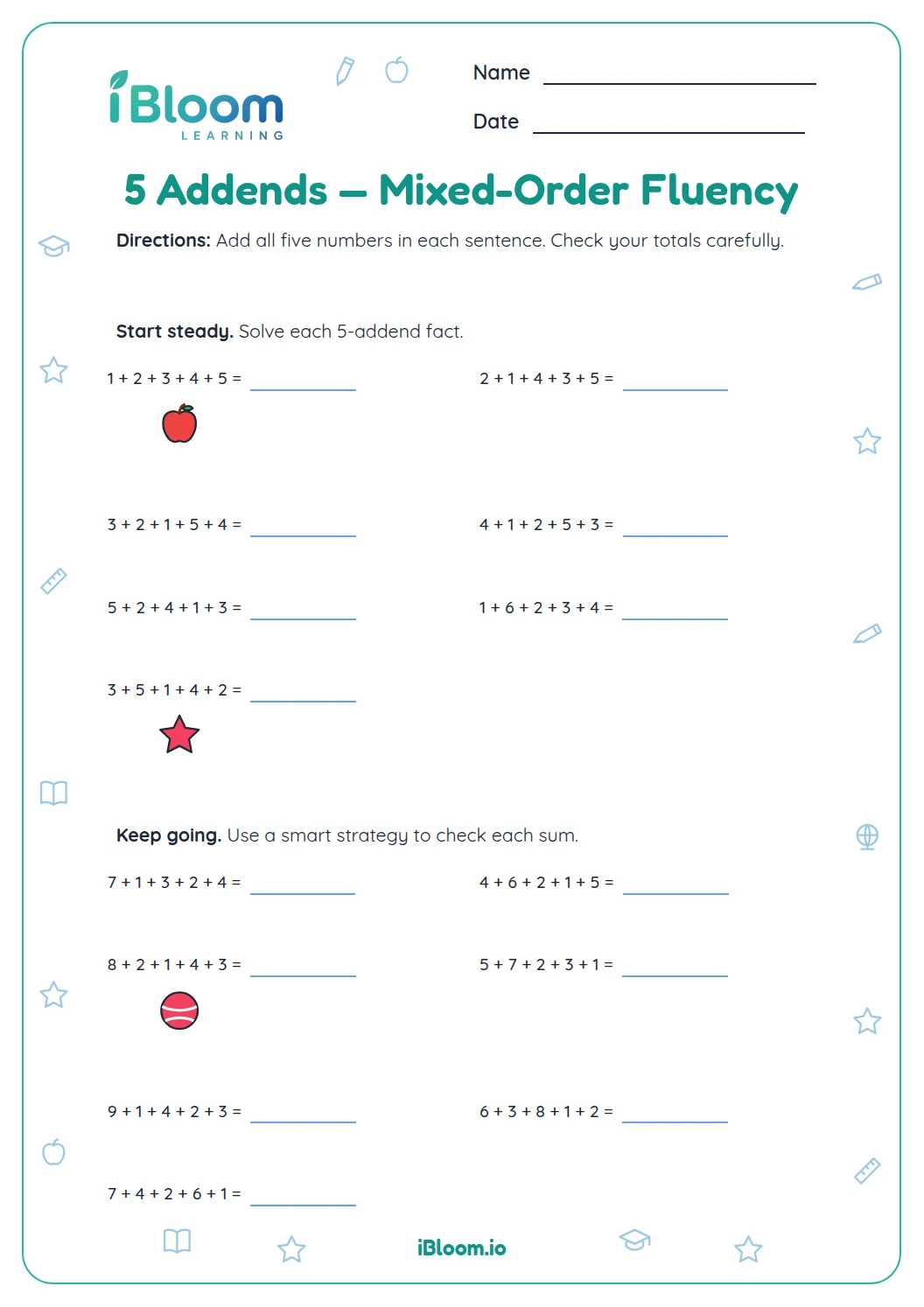
This free printable worksheet gives Grade 2 students 22 addition facts through 12 to solve. Every student prompt shows both addends and the plus sign, with a blank for the sum. The separate answer key lists the matching totals. Students can use counting on, doubles, or make-ten facts to check their thinking.
Aligned to 1.OA.C.6
What does the worksheet ask students to do?
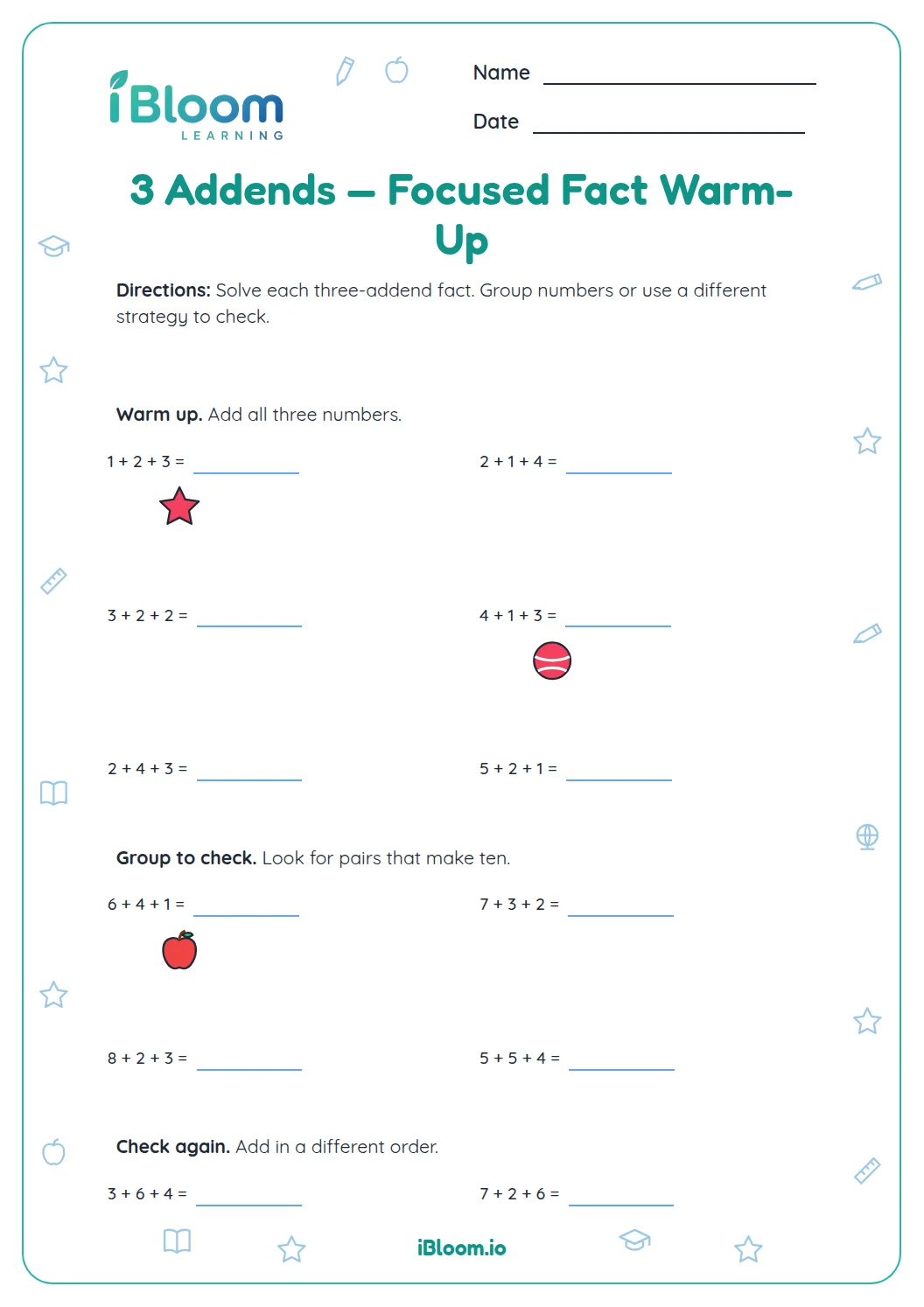
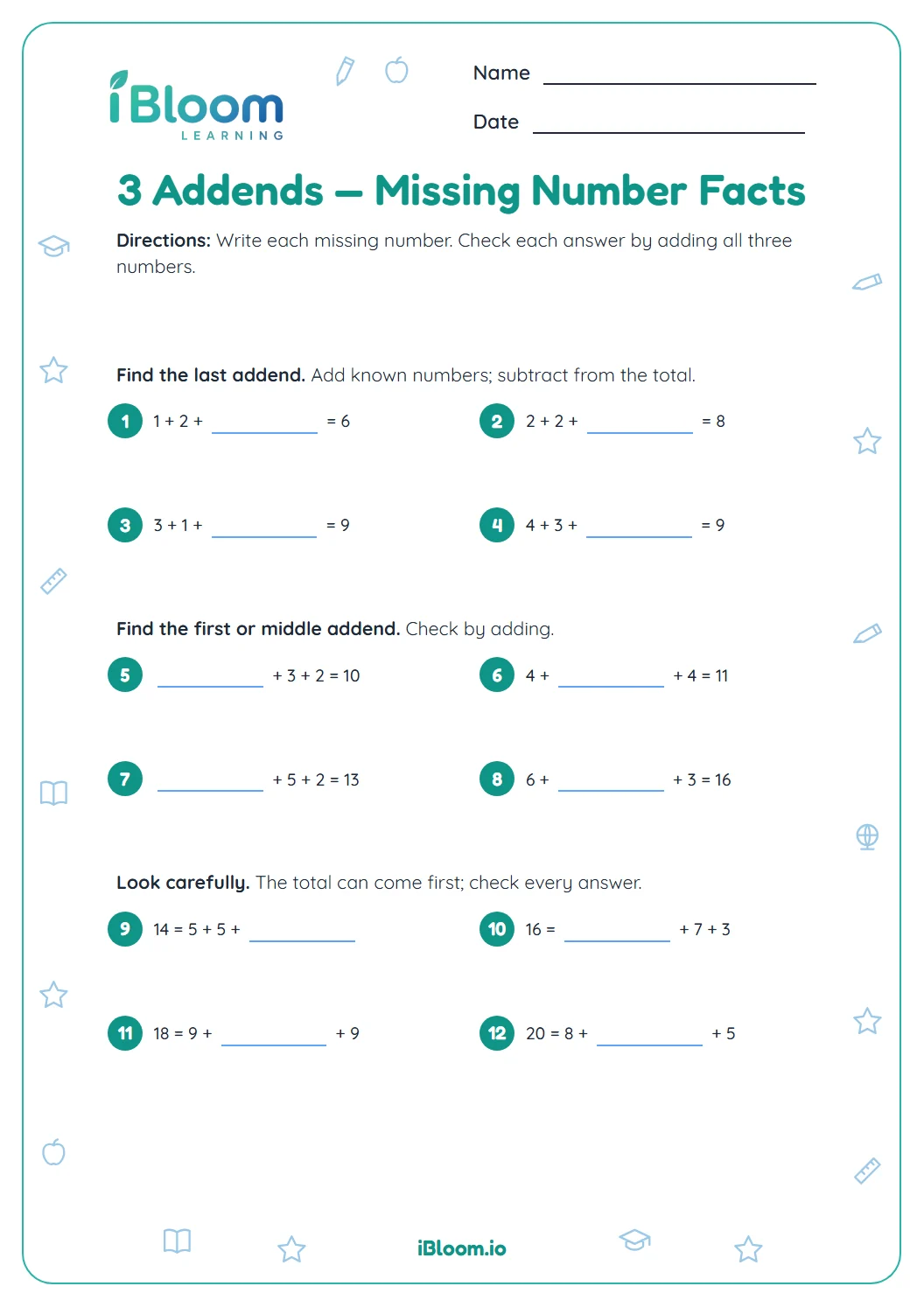
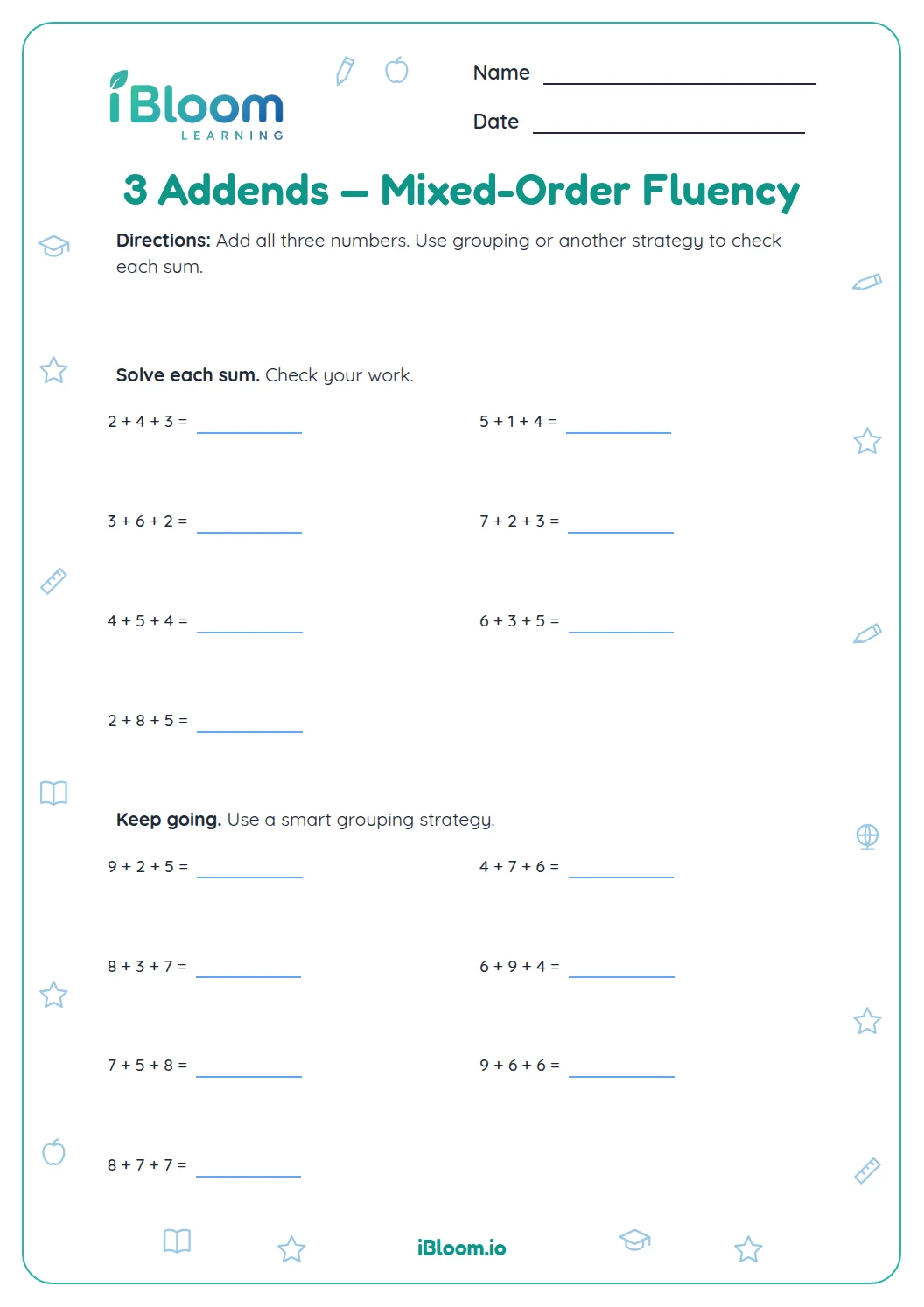
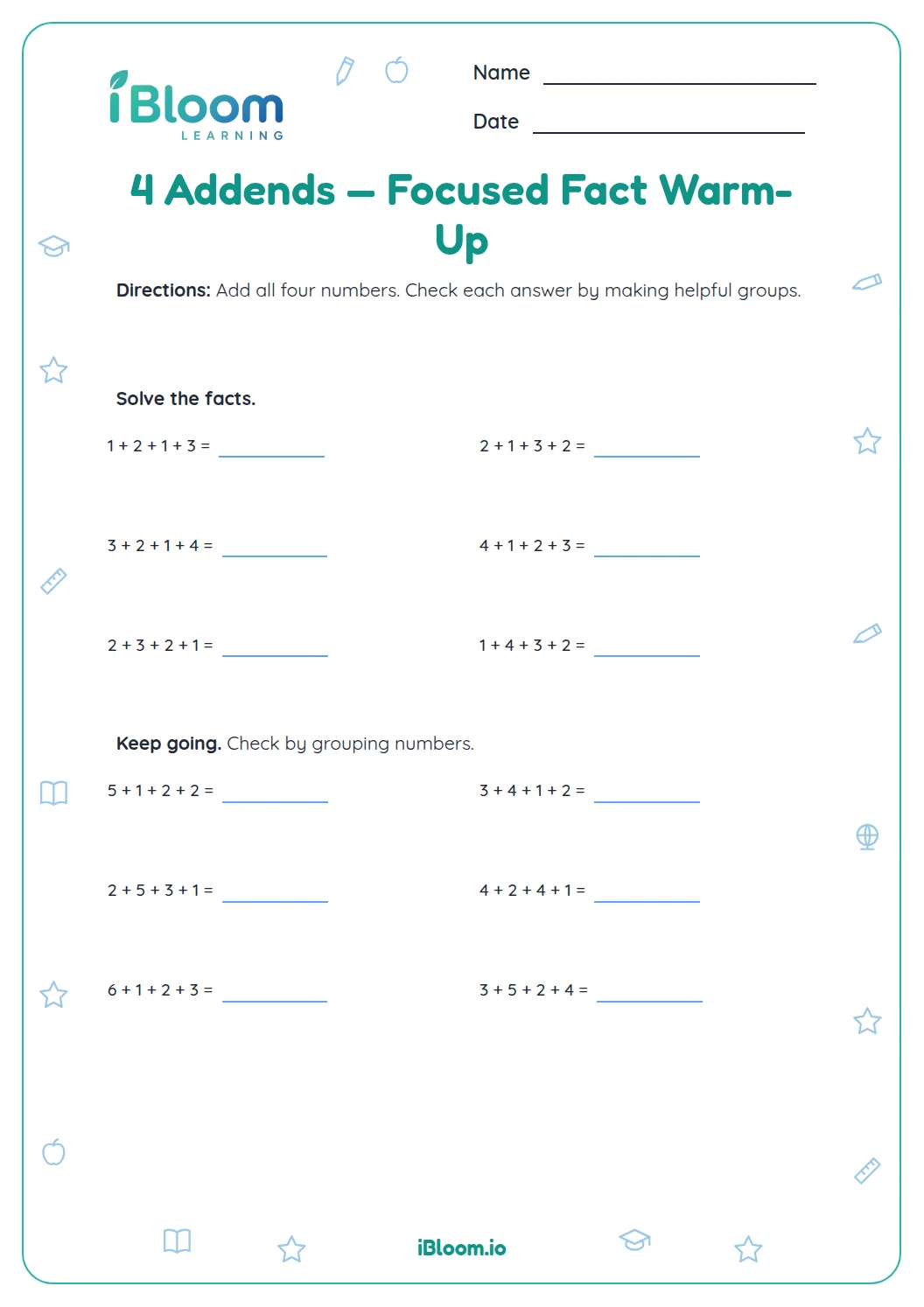
The page has three parts and 22 printed equations. Each fact shows both addends, so students can focus on finding and recording the sum.
The facts vary the addends and their order. In the final section, students can check a sum by counting on, using a double, or making ten.
How can a student solve a fact?
Start with the larger addend and count on by the smaller addend, or use a known fact. For example, in 7 + 3, start at 7 and count 8, 9, 10.
Then check that the answer is the total of both addends. The key is for reviewing work after the student finishes.
- 1Start at 7 in 7 + 3.
- 2Count on three steps: 8, 9, 10.
- 3So 7 + 3 = 10.
How can families use the practice sections?
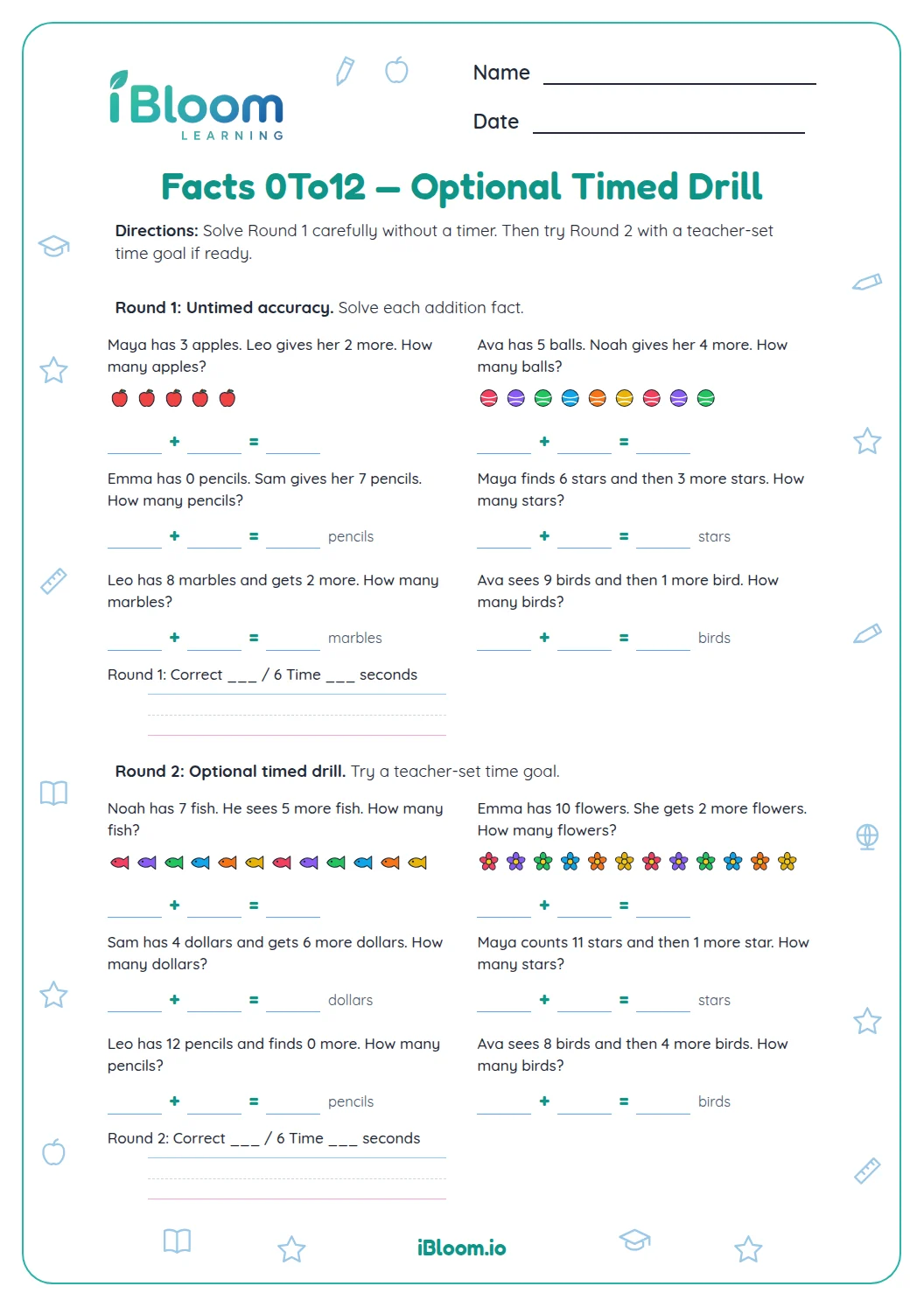
Complete one section at a time and pause to talk through any fact that feels tricky. On the optional timed drill page, timing is a choice; the equations can also be completed at a comfortable pace.
A short practice routine
- 1Read both addends and the plus sign.
- 2Choose a strategy such as counting on, a double, or making ten.
- 3Write one sum in each blank.
- 4Check that the sum is at least as large as either addend.
- 5Use the answer key to review and retry missed facts.
Addition slips to watch for
The mistake
Stopping one count too early.
The fix
Say the starting addend, then make one count for each unit in the other addend.
The mistake
Writing one addend as the sum.
The fix
Check by counting on from that addend; the total must include both numbers.
The mistake
Reading the digits but missing the plus sign.
The fix
Name the operation before solving: this fact asks you to combine the two addends.
Common Core alignment
This practice builds addition fluency using strategies such as counting on and known facts.
Use strategies to add within 20 and build fluency within 10.
On this sheet: Students solve addition equations and may use counting on, doubles, or make-ten facts.
Show the official wordingHide the official wording
Add and subtract within 20, demonstrating fluency for addition and subtraction within 10. Use strategies such as counting on; making ten (e.g., 8 + 6 = 8 + 2 + 4 = 10 + 4 = 14); decomposing a number leading to a ten (e.g., 13 − 4 = 13 − 3 − 1 = 10 − 1 = 9); using the relationship between addition and subtraction (e.g., knowing that 8 + 4 = 12, one knows 12 − 8 = 4); and creating equivalent but easier or known sums (e.g., adding 6 + 7 by creating the known equivalent 6 + 6 + 1 = 12 + 1 = 13).
What to practice next
Make more practice
Further reading
Questions parents and teachers ask
Are the addition problems printed on the student sheet?
Yes. All 22 equations show both addends and a plus sign, followed by a blank for the sum. Students do not need to supply missing prompt numbers. The separate key lists each answer by question number so families can check completed work.
Does the optional timed drill require a timer?
No. The timer is optional. Students can solve the printed facts at a comfortable pace, then use the answer key when finished. If a family chooses to time a round, treat the time as a personal practice record and keep accuracy as the first goal.
What addition strategies can students use?
Students can count on from the larger addend, recall a double, or use a make-ten fact when it fits. For 7 + 3, for example, counting three steps after 7 lands on 10. The answer key supports checking after the student has tried each equation.
How many questions are on the worksheet?
There are 22 addition equations arranged in three sections across two student pages. Both addends appear in every equation, and each item has one sum to write. A separate two-page answer key lists the matching answers for review after practice.
How should a student review a missed fact?
Read the two addends again and name the plus sign. Count on or use a known fact to find the total, then compare it with the key. Re-solving the equation with a strategy helps connect the answer to the numbers instead of simply copying the key.