



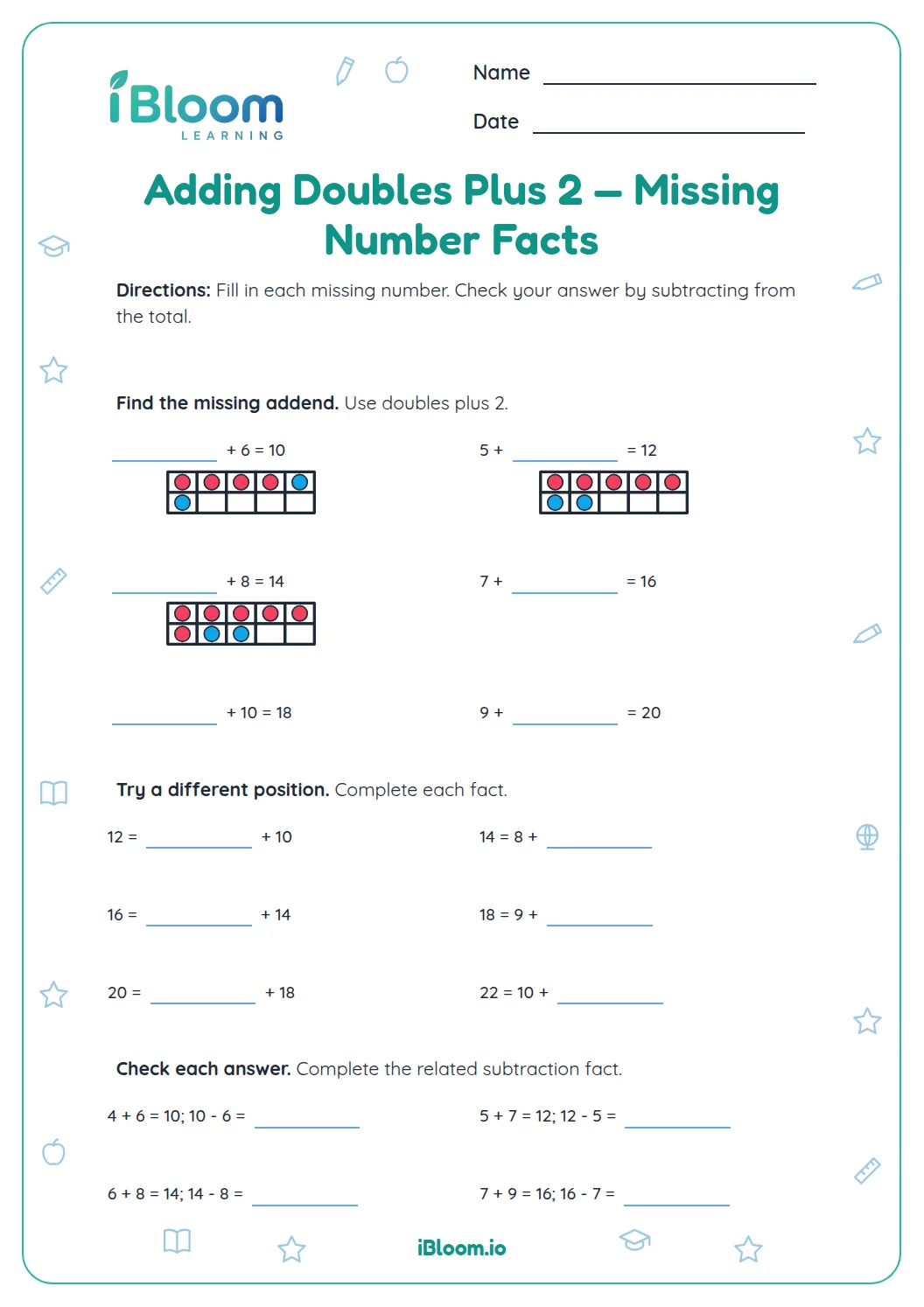
About this worksheet
This printable Grade 1 math sheet gives children 18 fully written addition problems to solve, so every number appears on the student page. It focuses on addition facts that join to make ten, with three parts that move from direct practice to applying the pattern. The questions use addition facts within 20 and connect with Common Core standard 1.OA.C.6. A separate answer key makes it easy to check each response.
Aligned to 1.OA.C.6
What does this make ten sheet include?
Part A gives students direct practice with complete ten.
Part B changes the way students use the pattern, and Part C asks them to bring the skill to mixed problems. Every equation is printed on the student sheet, with a blank only for the answer.
- Part A: 6 complete ten problems
- Part B: 6 ten and more problems
- Part C: 6 mixed ten facts problems
How can a child use make ten?
Look at both addends before solving. In Part A, 1 + ___ = 10 gives a concrete example of the target relationship.
Use a known double or make ten when it helps, then check that the answer is the total of both addends.
- 11 + ___ = 10
- 2The missing addend is 9.
How should students check each addition fact?
To make ten, find the partner that completes the known addend. For 8 + 5, split 5 into 2 and 3: 8 + 2 makes 10, then add 3 to get 13.
How to use this worksheet
- 1Read the directions and solve the printed equation in each row.
- 2Work through Part A, then use the pattern named in Part B.
- 3In Part C, read the whole equation before writing a number.
- 4Check each sum by adding the two addends in the other order.
- 5Use the separate answer key to review answers and revisit any missed fact.
Common addition slips and fixes
The mistake
Adding only one addend to itself when the numbers are close.
The fix
Say both addends aloud and count on from the larger one.
The mistake
Writing one less or one more than the total.
The fix
Check by separating the second addend into a helpful part and the rest.
The mistake
Putting the total into a missing-addend blank.
The fix
Use the known addend and ask what amount completes the total.
Common Core alignment
This sheet practices a Grade 1 addition strategy named in the Common Core State Standards.
Use addition strategies such as making ten and known sums to add within 20.
On this sheet:
Show the official wordingHide the official wording
Add and subtract within 20, demonstrating fluency for addition and subtraction within 10. Use strategies such as counting on; making ten (e.g., 8 + 6 = 8 + 2 + 4 = 10 + 4 = 14); decomposing a number leading to a ten (e.g., 13 - 4 = 13 - 3 - 1 = 10 - 1 = 9); using the relationship between addition and subtraction (e.g., knowing that 8 + 4 = 12, one knows 12 - 8 = 4); and creating equivalent but easier or known sums (e.g., adding 6 + 7 by creating the known equivalent 6 + 6 + 1 = 12 + 1 = 13).
What to practice next
Make more practice
Further reading
Questions parents and teachers ask
How many problems are on the make ten worksheet?
There are 18 printed addition problems in three parts: six missing addends that complete ten, six sums greater than ten, and six mixed facts. Students can write directly beside each equation, then use the separate answer key to check each missing number or sum.
Are the numbers printed on the student worksheet?
Yes. The student sheet prints every addend, total, or missing-number equation beside its answer blank. Students can read each problem from the worksheet itself, complete the page without copying from another source, and use the separate answer key only when they are ready to check their responses.
Does the printable include an answer key?
Yes. A separate answer key gives the correct answer for all 18 questions. It follows the same order as the student page, which makes it simple to find a missed fact, talk through the addition strategy, and revisit just the problems that need another look.
How does making ten help with an addition fact?
Making ten breaks an addend into a part that completes ten and a part left over. For 8 + 5, take 2 from 5 to make 8 + 2 = 10, then add the remaining 3. The total is 13.
Should students use a timer?
No timer is needed for this practice. Students can work at a steady, comfortable pace and focus on accurate sums and the relationship between the addends; the answer key helps families review any fact that needs another look.